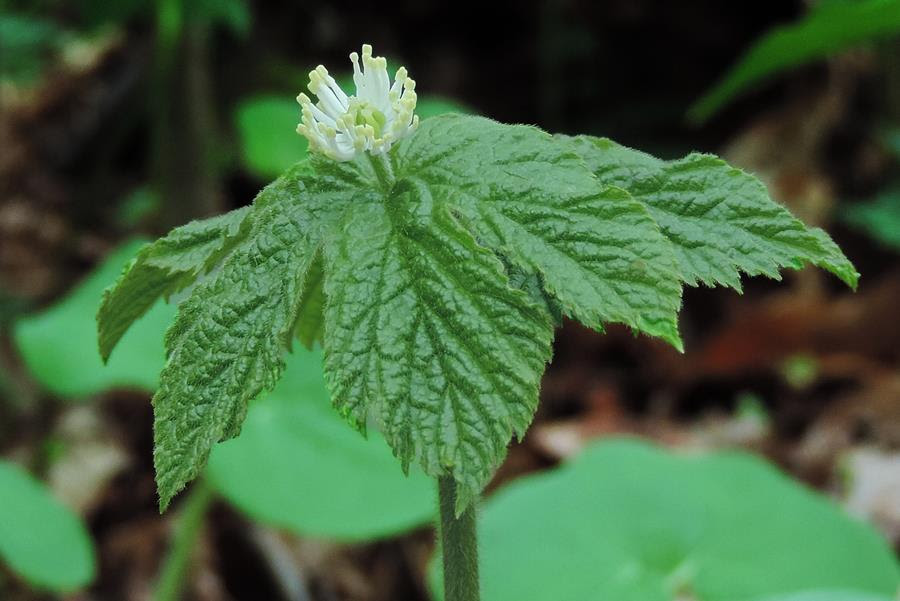
Stalking The Wild Goldenseal

Greetings!

On Thursday, May 24th, I’ll be leading an evening foraging walk in Apollo, Pennsylvania (about 30 miles east of Pittsburgh).  We’ll be exploring a beautiful area known as Roaring Run along the Kiskiminetas River in search of wild edible plants and mushrooms.  If you’re interested in attending this walk, click here for more info!

Moving forward, let’s talk about Goldenseal.

Perhaps you’re familiar with this plant in supplement form.  Several immune-boosting formulas contain Goldenseal as the primary ingredient, and it’s one of the top-selling herbs in the world today.

Goldenseal is not an exotic plant.  This understory species is native to North America and can be found in rich, deciduous woodlands… usually in association with tulip poplar, American beech, white ash, and sugar maple trees.

For centuries, various Native American cultures utilized Goldenseal as a medicinal plant.  Early European settlers also took a liking to this plant and quickly reduced wild populations to perilous numbers.

Today, Goldenseal is listed as endangered, threatened, or vulnerable in at least 10 states.  In some areas, however, it can still be quite abundant.

I recently explored the woods in search of Goldenseal and documented the experience on film.  If you’re interested in learning more about this incredibly special plant, as well as how to receive the benefits of Goldenseal without harvesting Goldenseal (there’s a great alternative!), check out the new video!

Some fungi eat plants, and some fungi eat animals.  Some fungi eat both plants and animals!  The edible Oyster mushroom is just one among the many species of omnivorous fungi that consume non-segmented roundworms called nematodes.  Check out this Instagram post to learn more!

Thanks for reading and watching, and as always, thank you for your support!

-Adam Haritan

Herb Guide: Chamomile

By Crooked Bear Creek Organics

Crooked Bear Creek Organic Herbs's avatarCrooked Bear Creek Organic Herbs

  • German Chamomile – Matricaria chamomilla
  • Roman Chamomile – Anthemis nobilis

The chamomile herb is another well-known plant, used in making effective herbal remedies for the treatment of a variety of illnesses. The herb has a great relaxant action on the nervous system and the digestive system. The herbal remedies made from this plant are considered to be a perfect remedy for the treatment of disorders affecting babies and children. The main action of the chamomile is that it brings about relaxation in all the smooth muscles throughout the body of an individual. The herb acts on the digestive tract and rapidly brings relief from any muscular tension and spasms, it alleviates disorders such as colic, and it can reduce the amount of abdominal pain, and remedy excess production of wind and abdominal distension in patients.

Chamaemelum-German_1

The other major effect of the herb lies in its ability to regulate peristalsis along the…

View original post 2,224 more words

Astrorisamoon Forecaster: Uranus in Taurus for May 2018

IN THE LOFT 
May 15 2018, 3:00  PM
Uranus (Sango’s Planet) 0°00′ entered the sign of Taurus,
the archetype of Osun,  in House 8
We’re now at the beginning stages in the process of re-creating ourselves individually, collectively, and institutionally. Yes, those institutions which we hold so dear are up for some form of renovation and maybe even rejuvenation. As Orisa says “after the fat is fried we will see what remains,” and so that is where we are beginning.

Herb Guide: Echinacea

By Crooked Bear Creek Organics

Crooked Bear Creek Organic Herbs's avatarCrooked Bear Creek Organic Herbs

Echinacea, pronounced ek-i-NAY-see-a, is one herb that has become a “household” name in the 1990’s. Many refer to it as “Purple Cone Flower” because of its large purple daisy petals, which contain a hard and spiny center cone. These spines probably give the plant its name, since sea animals with spines are called “echinoderms”. Echinacea is indigenous to the U.S. and can be found both growing wild in many areas as well as in cultivated gardens. There are actually nine different species of the plant; two are most popular as remedies: Echinacea Angustifolia and Echinacea purpurea.

Echinacea for Immuno-Excellence…

Adapted from The Natural Medicine Chest, by Ellen Kamhi, PhD RN and Eugene Zampieron, ND
______________________________________________________________________________

FACTS:

Echinacea is a North American plant, native to the prairies…

Echinacea is an important plant for treating immune dysfunction…

Echinacea juice can be placed directly on wounds to promote healing…

_______________________________________________________________________________

Echinacea is…

View original post 1,106 more words

Racing’s Efforts to Grapple with Horse Slaughter not Enough, at least for now

by R.T. Fitch

R.T. Fitch's avatarStraight from the Horse's Heart

by Daniel Ross as published on The Guardian

The US racing industry has stepped up its game significantly when it comes to re-homing its retired equine athletes in recent years, but there’s still plenty of work to be done

Ginerous Legacy (Harley) saved from slaughter and adopted by Terry and R.T. Fitch ~ photo by Terry Fitch

Dina Alborano rescues ex-racehorses bound for slaughter. A savvy social media operator, the New Jersey resident drums up donations through platforms like Facebook and Twitter, then purchases and plucks horses from ‘feed lots’ – facilities, also known as ‘kill lots’, where horses are penned before going to slaughter in Mexico or Canada. Through her horse rescue organization, she then endeavors to find these horses new homes.

Alborano’s efforts have recently received support from some of the most respected jockeys, trainers, owners and journalists in the industry. Some say that she has…

View original post 943 more words

Herb Guide: Wild Thyme {Thymus serpyllum}

By Crooked Bear Creek Organics

Crooked Bear Creek Organic Herbs's avatarCrooked Bear Creek Organic Herbs

Also, Known As:

  • Creeping Thyme
  • Mother-of-thyme
  • Wild Thyme

The wild thyme is native to the larger parts of Europe where the land is dry. The wild thyme is rare compared to the common thyme’s and is farmed extensively. Normally, wild thyme is found growing up to a certain altitude on the Alps, on high plateaus, in valleys, alongside trenches, roads, on rocks and also in infertile and dry soil. Wild thyme may also be found growing in moisture-laden clay soil that is improvised of chalk. Wild thyme’s can also be found in old rocky, deserted grounds, dried-up grass turfs and also on open lands. Particularly in England, wild thyme’s grow normally on moorlands and rocky terrains. Wild thyme is frequently cultivated as garden borders, in rock gardens or on the sunlit banks of rivulets and streams.

Wild thyme is a perennial herb. The herb’s sulky wooded stems grow up to a…

View original post 1,531 more words

Astrorisamoon Forecaster: Mars / Ogun transit Aquarius / Sango for May 2018

Mars in Aquarius from May 16 – August 12, 2018
Wednesday, May 16 2018, 12:25 AM EDT
Mars 0°00′ Aquarius, in House 1
Ogun’s planet enters Aquarius the archetype of Sango, and we will experience these effects.
In addition to feeling inspired and self-righteous, our planet will respond with powerful eruptions to release pressure and to re-calibrate itself. Mars 26°Capricorn May 6, 2018,  when the 1st Hawaiian volcanic eruption occurred, this marked the 1st phase of fire, earth, and  air manifesting in an element ruled by Uranus  (the end of Capricorn/ and Aquarius).

Herb Guide: Oregano

By Crooked Bear Creek Organics

Crooked Bear Creek Organic Herbs's avatarCrooked Bear Creek Organic Herbs

Origanum vulgare

Also, Known As:

  • Common Marjoram
  • Oregano
  • True Oregano
  • Turkish Oregano
  • Wild Marjoram
  • Winter Marjoram

The famous European herb called the oregano or the pot marjoram is a very familiar spice, botanical name Origanum vulgare. It is a common herb, and the European oregano is known to be a very hardy and perennial herb characterized by the presence of an erect, and somewhat hairy and well-branched stem, the leaves of the herb are also hairy. When fully grown, the plant can cross two feet in height, and is characterized by a very acrid and pungent odor, the fragrance of the plant is very strong, and has a sage-like an aroma, it also smells somewhat like another spice, the thyme – also used in a lot of European cuisines.

The oregano also refers to the pleasant and mint smelling European herb, the marjoram, or the wild marjoram as it is…

View original post 2,012 more words

Crystals and Breast Health

By Sonia Acone

When I was first asked to write this article, I had balked at the idea. After all, it is a subject that hit a little too close to home for me. I had been through what I like to call the “BCS” or “Breast Cancer Scare” when I was just 38. Although I was spared the “Big C” this time around, I did need to have a lumpectomy done on my right breast (I’m now missing a third of that breast). So, yes, I remember finding the lump, getting the mammogram, going in for surgery, etc. Looking back on that time now, I also remember, prior to that “nightmare,” that I had been under a lot of stress at the time, which may have played a part in the lump forming in the first place. And we all know by now that stress is often a precursor to illness.

But this is not going to be an article about breast cancer per se. See the links at the end of this article for more information concerning crystals that deal with that specifically. This article is going to address the crystals that may help to keep our breasts healthy in the first place, so that you or someone you love may not have to deal with the “BCS.”  We’re going to look at crystals that can help with most every aspect of breast health; from pain and inflammation (that often occurs during the monthly cycles, during pre-and-post-menopause), breastfeeding and lactation, and healthy breasts in general.

Now for some biology (stay with me, you’ll thank me at the end!). Our breasts are composed of fatty tissue, glandular tissue that is divided into lobes, and connective tissue that ties it all together. The glandular tissue is comprised of lymph glands/nodes which are located along lymph vessels back to your armpit as well as up towards your collarbone. The lymphatic system is a major part of one’s immune system. When we get sick, our lymph glands often become inflamed. In addition to the armpits, we have lymph glands in the neck (which is why doctors often palpate these when we become ill), chest, and groin. The lymphatic cells form antibodies that fight infection. The lymphatic system is responsible for removing toxins in the body. Organs associated with the lymphatic system include the tonsils, adenoids, thymus, and spleen. (See this diagram to the lymphatic system in the breast: http://www.mariekeating.ie/cancer-information/breast-cancer/the-breasts-and-lymphatic-system/) In order to keep our breasts healthy, it stands to reason that the immune system and the lymphatic system in particular, need to be healthy. (Note: all crystals listed are in alphabetical order.)

Crystals for a Healthy Lymphatic System:

Agate
Amber

Aquamarine

Bloodstone

Lapis Lazuli

Larimar

Moss Agate

Prehnite

Sodalite

Metaphysically speaking, the breasts are located smack dab in the center of the Heart chakra, which is responsible for feelings of love, compassion, empathy and healing (especially with our hands, arms, as well as healing with herbs/nature). Parts of the body influenced by this chakra are the breasts, heart, lungs, arms, hands, upper back, skin, circulatory system, rib cage, and the lymph glands. When a blockage occurs in this chakra, we become more susceptible to illnesses in these parts of the body. Emotionally, a blockage can result in panic attacks, allergies, jealousy, possessiveness, and over-emotional outbursts. Crystals ruled by the Heart chakra are those that are usually green or pink, such as Amazonite and Rose Quartz. See this page for a complete list of crystals for the Heart chakra: https://www.healingcrystals.com/products-by-heart-ailment.html?tab=2

Crystals for Keeping Breasts Healthy (and may also help with breast disorders):

Amazonite
Mangano (Pink) Calcite

Moonstone

Peridot

Rainbow Moonstone

Snow (Milky) Quartz

Crystals for Inflammation:

Blue Lace Agate
Kunzite

Larimar

Malachite

Crystals for Pain:

Amber
Amethyst

Clear Quartz

Fluorite
 
Hematite

Lapis Lazuli

Magnetite (Lodestone) 
Malachite

Rose Quartz

Smokey Quartz
 
Sugilite
 
Turquoise

Crystals for Breastfeeding/Lactation:

Blue/Pink/White Chalcedony
Chiastolite

Fluorite
 (Clear)
Howlite
 (White)
Snow (Milky Quartz)

Moonstone

Okenite
Selenite

Crystals for Scars/Scar Tissue:

Amber
Citrine

Fluorite
 (Green)
Rhodonite

Rose Quartz

Tourmalated Quartz

For information on crystals that may help with Breast Cancer and support during and after treatment, see the following articles:

“Crystals for Breast Cancer” article/recommendation: https://www.healingcrystals.com/Crystals_For_Breast_Cancer_Articles_675.html

“Crystals for Cancer Support” article: https://www.healingcrystals.com/February_2011_Newsletter_-_Crystals_for_Cancer_Support_Articles_4133.html

When you’ve chosen the crystal(s) you wish to work with, you can meditate while holding one or more in your hands; you can place them near your bedside with the intention that they keep you well and improve healing; you can carry or wear them as jewelry (some folks even keep one or two in their bra), or you could make a medicine bag to carry your crystals in a pocket or purse. Whatever you choose, make sure to cleanse your crystals before and often during use.

I sincerely hope that this article can help you find the answers you seek and that in some small way, I was able to alleviate some fear, confusion, or uncertainty for you and/or someone you love. I wish you blessings and good health.

*Disclaimer – Crystals are not a medical treatment and should not be used as a replacement for medical care. Please consult your healthcare specialist for your particular needs.

Photo: Amazonite Mandala by Robin Hollinger
Decorating with Crystals for Memorial Day

By Tara Mideaker

In the late 1800’s, “Decoration Day” was established to commemorate those soldiers who had given their lives during the Civil War.  The name derives from flowers and other decorative items that were placed on the gravesites.  As we moved into the 20th Century, May 30th was set aside to memorialize all service men and women who had died while in the armed forces and Memorial Day was adopted as a National Holiday.  This day has continued to evolve and today it serves as a remembrance of all those loved ones who have passed on.  Celebrated on the last Monday of May, it also serves as the unofficial start of the summer season and is best known for parades, fireworks and, of course, barbecues.

There are many religions and cultures who believe that when we pass on from this life we move into the “Summerland”, a place of endless beauty and peace. It is interesting that, perhaps subconsciously, we have adopted a day where we remember those we have lost while at the same time welcoming the summer season.  Throughout its many evolutions, Memorial Day has always been a time to enjoy food and activities with our family and friends.  Maybe the intent of this day was always about finding the joy in each of our lives – even while we mourn our losses.

Here are a few suggestions on how to use crystals to honor someone with your own “Decoration Day” tradition.  Decoration means “to beautify or embellish” and crystals are one of nature’s most beautiful decorations.  The perfect crystal will remind you of the happy times while at the same time helping to you heal from your loss.

ALTAR:  Creating an altar is a traditional and practical way to remember your loved one.  Be sure to find a quiet place and insure that the focus of the space will be respected.   Include items that remind you of your loved one – photos, flowers, statues or knick-knacks, candles, and even jewelry.  Just be sure that the items you choose remind you of joyful times and how that person lived their life.  You want this altar to celebrate their life more than a reminder that they are gone.   Amber has a very strong life-affirming energy that will be a very positive addition to your memorial.  It is a powerful healer and will enable you to manifest the happiest of thoughts and memories.  Snowflake Obsidian is a very calming & supportive crystal that is particularly helpful when you are grieving.  Its very appearance of black and white reminds us that there is a balance to life and that while it is okay to feel sad, it is just as important to remember how to be happy.

CEMETERY:  While visiting a cemetery or final resting place of your loved one, a Rhodochrosite will offer comfort and compassion and remind you of the love that you shared.  It will help to release any old, damaging emotions and enable you to move on in a positive light. Aqua Aura is a natural attractor for positive energy and promotes communications at all levels.  You might want to leave a small Aqua Aura by the site to add beauty and enhance the energy of the area.

TAKE A TRIP:  This is my favorite way to remember a loved one.  My Mom passed away several years ago and recently we remembered her by going to one of her favorite places.  It not only reminded me of the love and fun that we shared but also helped me to share the kind of person that she was with my son.  It was a positive, life-affirming activity that left me smiling at the end of the day.  I think that is how all of us really want to be remembered.  So go out and have some fun!  Go to the beach or the park or wherever you will have the best possible memories of the times that you shared with those that have passed.  Carnelian is a powerful stone for really feeling the life that is all around you.  It increases your personal power and physical energy while reminding you it’s great to be alive.  Amethyst will enhance your spirituality and help you to see the higher beauty and purpose in all things.