Herb Guide: Lemon Balm

By Crooked Bear Creek Organics

Crooked Bear Creek Organic Herbs's avatarCrooked Bear Creek Organic Herbs

Learn the medicinal and culinary uses of lemon balm, how to grow it, and how to make your own traditional Carmelite water.

To get the best flavor out of lemon balm, shear it with scissors, cutting it down by half or more, at least once a month. You can safely harvest three-quarters of the plant every three to four weeks and not harm it.

Often when someone asks me what my most favorite herb would be, I enjoy the surprise on their face when they hear my answer: Lemon balm, I say, without any hesitation.

Lemon balm (Melissa officinalis) isn’t at the top of most people’s favorites list. Basil, parsley, and lavender are the most popular herbs in America, but lemon balm isn’t even on the top 10 list. But it is deserving of considerably more recognition.

Lemon balm is a perennial herb from the mint family (

View original post 1,136 more words

Ancestral Reading ~ Astrorisa Moon Forecaster

EGUNGUN MONTH
Weekly Ancestral Reading
5/22/2018
Astrorisa Moon Forecaster / Moon Talk
May is Egungun Month
An ancestral reading for our collective consciousness
each week for the month of May.

Birth Place Elements On Your Altar

by Slavic Witch

Tree Alchemy: Hydrosols and Essential Oils from Sacred Trees

By The Druid’s Garden

Dana's avatarThe Druid's Garden

Nature can provide tremendous wisdom and healing, especially when we work with our local ecosystems and ecologies. One of the most powerful ways of working healing with nature, I believe, is to combine the innate healing properties of plants with your own various kinds of medicinal preparations. The plants and trees offer the raw material and your hands and tools shape that material into something that heals the body, mind, and/or spirit. Working to transform tree and plant matter through alchemical processes into medicine–and then taking that medicine–can be an incredibly powerful way of establishing deep relationships not only with the living earth but with the trees themselves. Today, I want to talk about a particular kind of medicine known as a “hydrosol” and talk about how you might make your own with plant and tree material.  This is especially beneficial for today as many of us are thinking about…

View original post 2,037 more words

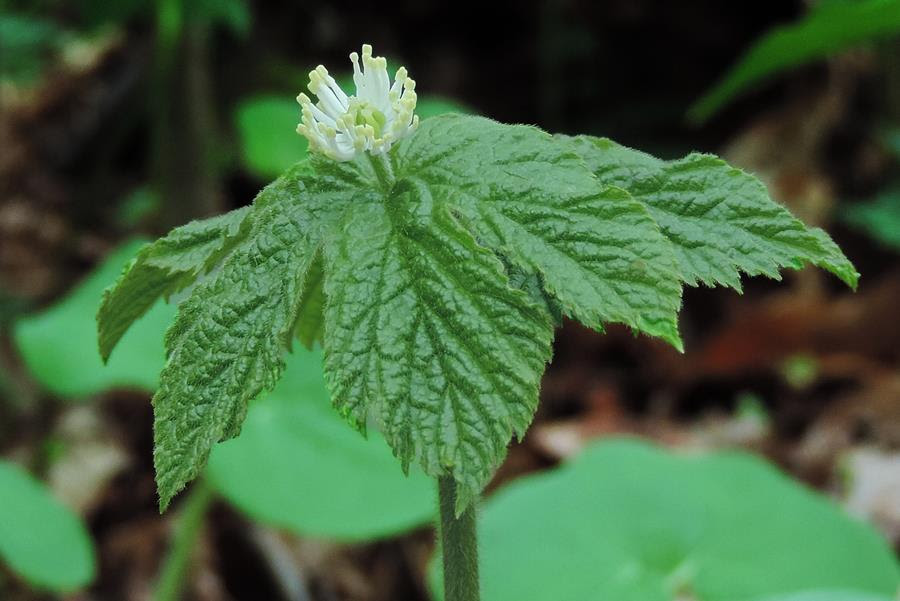
Stalking The Wild Goldenseal

Greetings!

On Thursday, May 24th, I’ll be leading an evening foraging walk in Apollo, Pennsylvania (about 30 miles east of Pittsburgh).  We’ll be exploring a beautiful area known as Roaring Run along the Kiskiminetas River in search of wild edible plants and mushrooms.  If you’re interested in attending this walk, click here for more info!

Moving forward, let’s talk about Goldenseal.

Perhaps you’re familiar with this plant in supplement form.  Several immune-boosting formulas contain Goldenseal as the primary ingredient, and it’s one of the top-selling herbs in the world today.

Goldenseal is not an exotic plant.  This understory species is native to North America and can be found in rich, deciduous woodlands… usually in association with tulip poplar, American beech, white ash, and sugar maple trees.

For centuries, various Native American cultures utilized Goldenseal as a medicinal plant.  Early European settlers also took a liking to this plant and quickly reduced wild populations to perilous numbers.

Today, Goldenseal is listed as endangered, threatened, or vulnerable in at least 10 states.  In some areas, however, it can still be quite abundant.

I recently explored the woods in search of Goldenseal and documented the experience on film.  If you’re interested in learning more about this incredibly special plant, as well as how to receive the benefits of Goldenseal without harvesting Goldenseal (there’s a great alternative!), check out the new video!

Some fungi eat plants, and some fungi eat animals.  Some fungi eat both plants and animals!  The edible Oyster mushroom is just one among the many species of omnivorous fungi that consume non-segmented roundworms called nematodes.  Check out this Instagram post to learn more!

Thanks for reading and watching, and as always, thank you for your support!

-Adam Haritan

Herb Guide: Chamomile

By Crooked Bear Creek Organics

Crooked Bear Creek Organic Herbs's avatarCrooked Bear Creek Organic Herbs

  • German Chamomile – Matricaria chamomilla
  • Roman Chamomile – Anthemis nobilis

The chamomile herb is another well-known plant, used in making effective herbal remedies for the treatment of a variety of illnesses. The herb has a great relaxant action on the nervous system and the digestive system. The herbal remedies made from this plant are considered to be a perfect remedy for the treatment of disorders affecting babies and children. The main action of the chamomile is that it brings about relaxation in all the smooth muscles throughout the body of an individual. The herb acts on the digestive tract and rapidly brings relief from any muscular tension and spasms, it alleviates disorders such as colic, and it can reduce the amount of abdominal pain, and remedy excess production of wind and abdominal distension in patients.

Chamaemelum-German_1

The other major effect of the herb lies in its ability to regulate peristalsis along the…

View original post 2,224 more words

Astrorisamoon Forecaster: Uranus in Taurus for May 2018

IN THE LOFT 
May 15 2018, 3:00  PM
Uranus (Sango’s Planet) 0°00′ entered the sign of Taurus,
the archetype of Osun,  in House 8
We’re now at the beginning stages in the process of re-creating ourselves individually, collectively, and institutionally. Yes, those institutions which we hold so dear are up for some form of renovation and maybe even rejuvenation. As Orisa says “after the fat is fried we will see what remains,” and so that is where we are beginning.

Herb Guide: Echinacea

By Crooked Bear Creek Organics

Crooked Bear Creek Organic Herbs's avatarCrooked Bear Creek Organic Herbs

Echinacea, pronounced ek-i-NAY-see-a, is one herb that has become a “household” name in the 1990’s. Many refer to it as “Purple Cone Flower” because of its large purple daisy petals, which contain a hard and spiny center cone. These spines probably give the plant its name, since sea animals with spines are called “echinoderms”. Echinacea is indigenous to the U.S. and can be found both growing wild in many areas as well as in cultivated gardens. There are actually nine different species of the plant; two are most popular as remedies: Echinacea Angustifolia and Echinacea purpurea.

Echinacea for Immuno-Excellence…

Adapted from The Natural Medicine Chest, by Ellen Kamhi, PhD RN and Eugene Zampieron, ND
______________________________________________________________________________

FACTS:

Echinacea is a North American plant, native to the prairies…

Echinacea is an important plant for treating immune dysfunction…

Echinacea juice can be placed directly on wounds to promote healing…

_______________________________________________________________________________

Echinacea is…

View original post 1,106 more words

Racing’s Efforts to Grapple with Horse Slaughter not Enough, at least for now

by R.T. Fitch

R.T. Fitch's avatarStraight from the Horse's Heart

by Daniel Ross as published on The Guardian

The US racing industry has stepped up its game significantly when it comes to re-homing its retired equine athletes in recent years, but there’s still plenty of work to be done

Ginerous Legacy (Harley) saved from slaughter and adopted by Terry and R.T. Fitch ~ photo by Terry Fitch

Dina Alborano rescues ex-racehorses bound for slaughter. A savvy social media operator, the New Jersey resident drums up donations through platforms like Facebook and Twitter, then purchases and plucks horses from ‘feed lots’ – facilities, also known as ‘kill lots’, where horses are penned before going to slaughter in Mexico or Canada. Through her horse rescue organization, she then endeavors to find these horses new homes.

Alborano’s efforts have recently received support from some of the most respected jockeys, trainers, owners and journalists in the industry. Some say that she has…

View original post 943 more words

Herb Guide: Wild Thyme {Thymus serpyllum}

By Crooked Bear Creek Organics

Crooked Bear Creek Organic Herbs's avatarCrooked Bear Creek Organic Herbs

Also, Known As:

  • Creeping Thyme
  • Mother-of-thyme
  • Wild Thyme

The wild thyme is native to the larger parts of Europe where the land is dry. The wild thyme is rare compared to the common thyme’s and is farmed extensively. Normally, wild thyme is found growing up to a certain altitude on the Alps, on high plateaus, in valleys, alongside trenches, roads, on rocks and also in infertile and dry soil. Wild thyme may also be found growing in moisture-laden clay soil that is improvised of chalk. Wild thyme’s can also be found in old rocky, deserted grounds, dried-up grass turfs and also on open lands. Particularly in England, wild thyme’s grow normally on moorlands and rocky terrains. Wild thyme is frequently cultivated as garden borders, in rock gardens or on the sunlit banks of rivulets and streams.

Wild thyme is a perennial herb. The herb’s sulky wooded stems grow up to a…

View original post 1,531 more words