Speaking of reading landscapes more effectively, we can predict future ecosystems based on current observations.
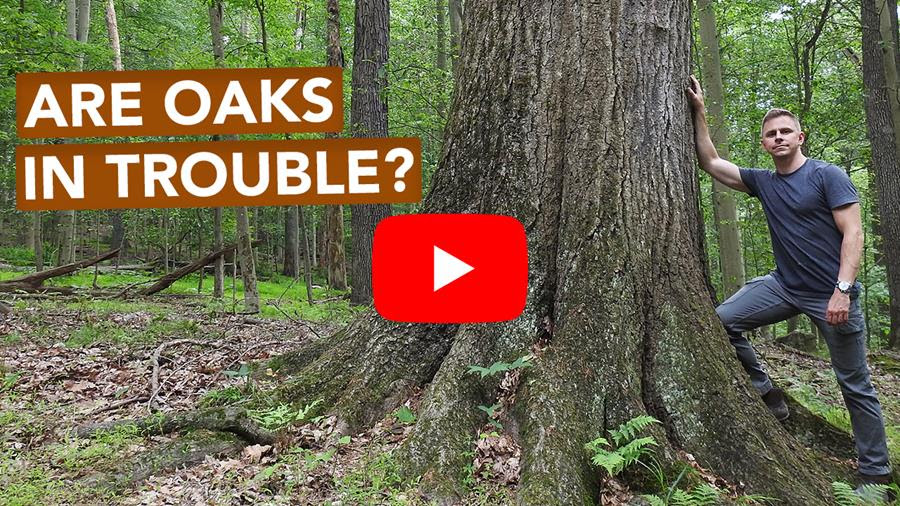
Consider a mature oak forest, for example.
Looking at an oak forest today, we might hope that conditions will remain stable for many years. Any native plant enthusiast will tell you that oak forests are repositories of biodiversity. Without oaks, other organisms that depend on oaks suffer.
But a quick glance at mature oak forests today tells us that significant changes are occurring. These changes, it turns out, aren’t particularly favorable to oaks.
Ecologists are worried about something that’s occurring underneath the towering oaks. This phenomenon has been happening to oak forests for the past 100 years. According to ecologists, it will persist without active management.
In a brand-new video, I address this important ecological issue.
Within the foraging community, people often promote rules of thumb.
• “When in doubt, throw it out.” • “Collect no more than 10% of a particular species in an area to avoid overharvesting.” • “It’s better to cut mushrooms with a knife than to pull them out of the ground with your hands.”
Generally speaking, I’m not the biggest fan of pithy guidelines such as those listed above. Some of them are helpful, but most require elaboration.
Here’s another example of a commonly promoted rule of thumb: “To find morel mushrooms, look under elm trees.”
I actually like this rule of thumb, but I don’t think it’s helpful for those of us who can’t identify elms. Some of us have trouble recognizing the ridges and furrows of elm bark. Some of us don’t notice the double serration of elm leaves.
Fortunately, a seasonal feature can help us identify elms right now. This feature will disappear in a few weeks, but if you look for it today, you will drastically increase your chances of finding elms.
And in case you missed the announcement, I will be releasing a new online course in May. Exploring Wild Ecosystems is designed to improve your ecological knowledge by introducing you to fascinating ecosystems — including alvars, barrens, bogs, dunes, fens, glades, savannas, vernal pools, and others!
I like to think that I’m a decent practitioner of this advice.
I listen to old songs. I read old stories. I admire old monuments. I befriend older people.
But I’m only human. And I live in a culture that worships youth. As a result, I sometimes find it challenging to see the merits of old age.
Fortunately, I’ve discovered a solution: I walk through a forest.
When I walk through a forest, I am reminded by nature to respect my elders.
Old trees are especially good at providing these reminders — not through words but through their presence. Humans tend to feel a certain way when they’re surrounded by ancient trees. Science can’t fully explain why this happens, but it is a wonderful phenomenon.
During a recent walk through a forest, I encountered a few old eastern hemlocks. Fantasies of eternal childhood vanished the moment I saw them. Sensing an opportunity to showcase what I witnessed, I decided to film the experience.
It’s always a good day when I find an American chestnut tree. It’s an even better day when I find an American chestnut tree of a decent size.
Admittedly, I mostly feel this way because American chestnut isn’t an incredibly common species where I live.
A fungal disease known as chestnut blight kills most American chestnuts. The fungus cuts off the flow of water and nutrients within trees. Starved of nutrients, the trunks of American chestnuts die.
But the roots remain alive. They give rise to sprouts which eventually become new trunks. Sometimes these trunks live for many years, and sometimes I find them in the woods.
Such was the case a few days ago when I encountered a living American chestnut by chance. More than just a stump sprout, this particular American chestnut was a decent-sized tree.
Needless to say, I was excited. I promptly decided to capture the experience on film to show you what an American chestnut looks like in the autumn season.
Speaking of decent-sized organisms, I recently found a large enoki mushroom. In fact, it was the largest enoki mushroom I’ve ever seen. To view a short video on that experience, check out the Learn Your Land Instagram and Facebook pages.
Thanks for reading and watching, and thanks for your continued support!
Conventional ways of doing things aren’t always the most effective ways of doing things.
Take tree identification, for instance.
We might think that we have to strain our necks in order to identify trees. If we don’t look up into the canopy, how else are we supposed to learn?
We can look down instead.
When we look down at the forest floor, we discover clues. After analyzing these clues, we can easily determine which trees are growing nearby — without even looking up.
During a recent walk, I attempted to identify trees based on what I observed beneath my feet. I brought my camera along to show you just how effective (and fun!) such an exercise can be.
I also recently posted a new video in which I discuss an edible mushroom known as hen-of-the-woods. To view that video, check out the Learn Your Land Instagram and Facebook pages.
Thanks for reading and watching, and thanks for your continued support!
In recent years, a new disease has been threatening its health. Leaves are falling off prematurely. Trees are dying. Researchers are scratching their heads.
Since its initial detection, this mysterious disease has been spreading throughout 12 states and one Canadian province. Some people are already predicting what a world without American beech might look like.
What is this new disease? How bad is it really? Who is the culprit? And will chemical treatments work this time?
Before I share a new video with you, I’d like to mention that I’ll be opening up registration for my online tree identification course on Monday, May 15.
Trees In All Seasons is an online video course designed to teach you how to successfully identify over 100 trees in every season. Registration will be open for one week only — from Monday, May 15 to Monday, May 22. Once you register, you will have immediate and unlimited access to the course.
If you’re interested in improving your tree identification skills, check your email on Monday for more information on how to register.
Two years ago, I explored a remote bog in northern Pennsylvania. It was the peak of the autumn mushroom season, but I wasn’t there to look for mushrooms. Archery season had just begun, but I wasn’t there to harvest deer either.
After a few hours of wandering through the bog, I eventually encountered the only person I’d see the entire day. His name was Bill and he was heading home for the day.
Taking one good look at Bill, I immediately knew why he was in this isolated part of Pennsylvania. He was hunting deer.
Bill, on the other hand, wasn’t too sure why I was there. He noticed that I had no hunting gear, no camouflage, no truck, and no apparent desire to look for deer.
Instead, I had a tripod, a camera, and a paper map printed off the internet.
After exchanging formalities, I explained to Bill why I was in the bog: to film and photograph balsam fir.
Bill was a lifelong woodsman. He hunted. He fished. He knew his way around the woods better than most people did. Bill spent his entire life in Pennsylvania, but he had never heard of balsam fir.
“We call them all pines,” he said as he watched me point out a few balsam fir trees.
Pines. I wasn’t too surprised to hear that response. Heck, I could even relate. Years ago, I called every conifer a “pine.” It didn’t matter if I was looking at a spruce or a fir. As long as the tree had evergreen leaves and woody cones, it was a pine.
Today, things are different. Disciplined tree study has allowed me to appreciate the beautiful differences between conifers. I now love observing the distinctive Christmas tree shapes of balsam firs. I love watching fir cones fall apart in the autumn season. I love smelling fir leaves (they smell better than any conifer I’ve ever smelled). And I love knowing that firs, despite being in the pine family, aren’t true pines. They’re firs, and thank God they are.
Noticing the distinctions between conifers is an important skill if you want to learn how to identify trees. Tree identification skills are important if you want to improve your ecological literacy.
To get you started, I created a video in which I teach you the major differences between conifers.
Thanks for reading and watching. If you are interested in learning how to identify over 100 trees, check your email on Monday for information on how to register for Trees In All Seasons.
Have you ever said to yourself or others, “My garden is my therapy?” If you have noticed that you feel more relaxed and even rejuvenated after imbibing the beauty, fragrance, and even hard work in your garden, you are not alone! Gardening provides physical exercise, as well as a rewarding intellectual and emotional connection. When recognized on a personal level, it is not a stretch to see how people in a wide variety of care environments who are facing diverse personal challenges can benefit from professionally facilitated horticultural experiences as well.
The profession of horticultural therapy (HT) was formalized in the early 1970s, though people have sought out gardens and gardening activities for respite and health recovery well before then. The practice of horticultural therapy involves a plant-based activity, a horticultural therapist, client(s), and identified treatment goals and objectives. Either in a group or as individuals, clients participate in outdoor…
You must be logged in to post a comment.