Are you interested in learning more about the herbal uses of plants from around the world? Are you ready to challenge your horticultural skills in a public garden setting? Are you enthusiastic about sharing that knowledge with people? Then, consider joining our team!
The National Herb Garden, located on the grounds of the U.S. National Arboretum in Washington, DC, is looking to hire an intern to assist with all gardening tasks, including plant propagation, record keeping, and educational programming. This internship runs from April/May 2022 through spring of 2023. It is full-time, but part-time may be considered on a case-by-case basis. Schedule includes one weekend day August through October; the rest of the year, it is Monday through Friday. The position is open to U.S. citizens and is paid by stipend through The Herb Society of America. Housing is not provided. If you, or someone you know, is…
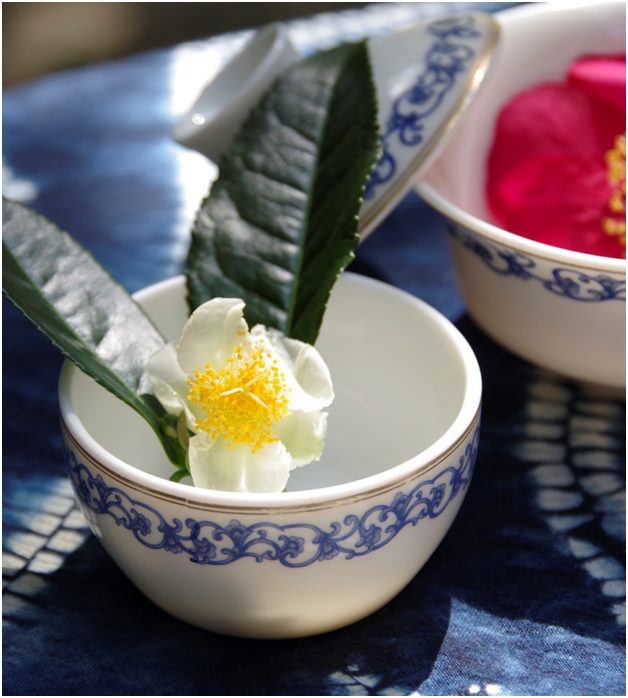
Many gardeners are surprised to learn that Camellia sinensis is the most popular camellia in the world. And most tea drinkers in the U.S. have no idea that tea is made from the leaves of a camellia. Like them, I enjoyed tea for decades without giving a second thought to its origin. All I knew was that Golden-tips came from Assam, Genmaicha from Japan, and Red Rose Tea from the grocery store. I got my daily dose of caffeine from coffee and drank as much herbal tea (tisanes) as traditional caffeinated teas. Flash forward 25 years, I’ve given up on coffee and become intimately involved with tea – a relationship grown, both literally and figuratively, through gardening.
Much has been written about herbal tea gardening. I have several of these books, along with various texts on herbal medicines, and an older favorite from my grandmother’s bookshelf, The…
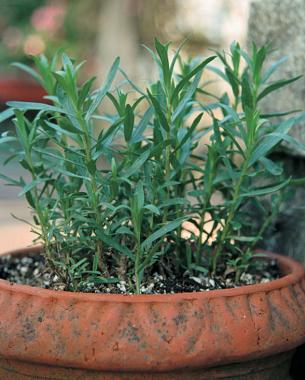
It pays to pay attention to plant labels. Especially in the case of tarragon–especially if you are planning to use tarragon in your cooking. If you are growing tarragon for culinary purposes, be sure the label on the plant or seed that you buy says “French tarragon” or Artemisia dracunculus ‘Sativa’, to be sure. If the label says only “tarragon,” you may be purchasing Russian tarragon, which is not the tarragon you want for your roast chicken or béarnaise sauce.
The botanical name for tarragon, Artemisia dracunculus, comes from the Latin word meaning “little dragon” or “snake.” It is thought that the plant was given this name because its roots…
For most of us, our garden tools are cleaned and stored, the holidays have passed, and we have a little more time to simply enjoy what we find in meadows, forests, fields, and even in our own backyards. Lichens can fill a part of the void we may be feeling. Their curious forms and means of growing and spreading, with which many of us are unfamiliar, can fill our minds with the wonders of things we normally pass without notice.
There are more than 5,000 species of lichen and lichen-dependent fungi in North America, with colors ranging from blues, lavender, yellow, red, orange, and gray to many beautiful greens. Color in lichens can depend on whether they are wet or dry. A major paint company even created a color they call Lichen to mimic the natural, earthy beauty of the organism. Perfectly described by Ed Yong in…
This is a good question to ponder, but it’s a difficult question to answer unless clarification is provided.
How much land are we talking about? And what is the time frame in question?
Even with such clarification, answers do not come easy. The original question often persists and we are prompted to further refine our inquiry.
What did the eastern forests look like 300 years ago? Which trees were present, and what was the composition of the trees in these earlier forests?
American chestnut, it turns out, can help us answer those questions.
American chestnut (Castanea dentata) is a tree whose numbers have dwindled over the past 100 years. A fungal disease known as chestnut blight has been the major culprit, but other factors have contributed to the decline of mature American chestnut trees in eastern forests.
When we study accounts of American chestnut, we routinely hear the same thing: “American chestnut was a dominant tree in eastern North America prior to the introduction of chestnut blight.”
We also hear this: “One in every four hardwood trees in eastern North America was an American chestnut.”
Believing both statements to be true, we might imagine an unbroken expanse of chestnut trees in eastern North America. The proverbial squirrel might have been able to travel from Maine to Florida on chestnut tree limbs without ever touching the ground.
But was that ever the case? Was American chestnut really the most dominant tree in eastern North America?
Or, have the claims been exaggerated? Could it be possible that American chestnut was not so dominant of a tree in these earlier forests?
That’s the topic of this week’s brand new video. If you are interested in learning what the land might have looked like in the not too distant past, check it out!
Most maples are leafless this time of year in eastern North America. Fortunately, bark features are still available and very useful for proper identification. Check out these side-by-side images of 8 different maple trees to assist you with your winter identification skills.Click to view post
If you are eager to pursue educational opportunities during the winter months, check out Foraging Wild Mushrooms.This 4-season online course is designed to help you safely, successfully, and confidently forage wild mushrooms from the forest, from the field, and from your own backyard.Click to learn more
Thanks for reading and watching, and thanks for your continued support!
American Holly is one of the most wonderful trees for getting us through dark times. And as the season of darkness is upon us once more, it is a good time to consider the magic, meanings, and mystery of this incredible holly tree!
American Holly has many names including white holly, prickly holly, Christmas Holly, Yule Holly and Evergreen Holly. It is quite similar to European Holly (Illex Aquifolium) with similar leaves, berries, and an overall growth habit. The American Holly has larger, brighter leaves and berries, but the trees are otherwise quite similar. While I often argue against importing meanings and uses of European trees into American contexts (with Ash being a great case in point), in this case, I think that the myths and old-world understandings of Holly apply!
This post is part of my Sacred Trees of Eastern North America series–here you can learn about the…
Nothing really needs to be said. Nothing more needs to happen. The fact that such an encounter occurs at all in the 21st century is enough.
But occasionally something else does happen, and silence is broken not by statements or declarations but by questions and inquiries.
A few years ago, I encountered a massive white oak (Quercus alba) in the woods. With deeply furrowed bark and a wide-spreading canopy, the tree was certainly the largest forest-dwelling white oak I had ever seen.
Since that first encounter, I have returned to see the massive white oak on numerous occasions. In every instance, curiosity has prompted my meddling mind to ask questions.
During the most recent encounter, I decided to wonder aloud (and on camera) about Quercus alba — a species that was once regarded as being the most common tree in many forests. Over the years, however, white oak has slipped in status. No longer does it hold the title of being the most common tree in many forests.
How did this happen? And which trees took its place?
If you are interested in seeing a massive old growth white oak, all while learning how an incredibly common tree became less common over time (despite a relative increase in forested land), check out the brand new video!
Conifers display huge variation in bark features. If you are interested in identifying conifer trees by bark alone, check out these side-by-side images of 15 different conifer trees that grow in eastern North America.Click to view post
Thanks for reading and watching, and thanks for your continued support!
The spice that we call cloves comes from the clove tree, Syzygium aromaticum. This evergreen herbal tree is in the Myrtle (Myrtaceae) family and is native to the Molucca Islands in the Pacific Ocean. These islands were once called the Spice Islands and now are a part of Indonesia.
The tree needs a warm, humid climate, and deep, loamy soil to grow well. It is said that it also needs to see the sea in order to thrive. It does indeed grow well near the coasts of tropical islands. The clove tree can reach a height of 26 – 40 feet and begins to flower when it is about five years old. At 20 years, it is ready to begin harvesting the cloves, which are the unopened flower buds, growing in clusters of 10 – 15 buds. The tree continues to produce cloves for more than 80 years…
“I may here observe, that the disease of cancer is not confined to civilized nations. It is known among our Indians. I am informed that the Cheerake cure it with a plant which is thought to be the Hydrastis Canadensis, one of our fine native dies [dyes].”
– Benjamin Smith Barton, 1766-1815
Goldenseal, Hydrastis canadensis, has been known for centuries for its medicinal uses ranging from a gastrointestinal aid, stimulant, tonic, emetic, and febrifuge, to helping with ear and eye complaints, heart problems, liver issues, pulmonary complaints, and more.
Europeans learned of goldenseal’s value as a medicinal plant not long after arriving in North America. The initial knowledge of its use is often credited…
You must be logged in to post a comment.