Garlic: Rooted in Folklore

Ditch the Screen, Embrace the Green, Part II: Taking Action!

Ditch the Screen, Embrace the Green Part I: Five Arguments for the Elimination of Screens

Exploring Wild Ecosystems Is Now Open For Enrollment

Greetings,

I am excited to announce that my newest online course, Exploring Wild Ecosystems, is now open for enrollment!

You can register here.

This course is designed to improve your ecological knowledge by introducing you to fascinating ecosystems — including alvars, barrens, bogs, dunes, fens, glades, savannas, vernal pools, and others!

Learning to recognize ecosystems is an essential step toward understanding how nature works.  When we pay attention to the bigger picture, we see beyond individual components.  We see connections, we see relationships, and we see where humans fit into the story. 

If you want to develop ecological literacy; if you want to be able to read landscapes more effectively; if you want to see how all the components within nature are connected, consider enrolling in Exploring Wild Ecosystems today.

Please note that Exploring Wild Ecosystems is open for one week only — from today until Monday, September 30.  After that, registration will be closed.  Upon registration, you can immediately access all course content and view the lessons at your own pace.

To learn more about the course, check out this video which gives you an overview of what you can expect.

Thanks for supporting nature education!  I hope to see you in there!

—Adam Haritan

Metaphysical Land Healing: A Druid’s Garden Guide

How The Passenger Pigeon Changed North American Forests

In 1857, the Ohio State Legislature famously wrote:

The passenger pigeon needs no protection. Wonderfully prolific, having the vast forests of the North as its breeding grounds, traveling hundreds of miles in search of food, it is here today and elsewhere tomorrow…

Forty-five years later, the last wild passenger pigeon was shot and killed in Indiana.  In 1914, the last member of the species died in captivity at the Cincinnati Zoo.

The passenger pigeon — a species once numbering in the billions — became extinct in a few short decades.

Barring a miracle in the field of de-extinction, no human alive today will ever see a living passenger pigeon that isn’t a biological novelty.  No human alive today will stand in awe as massive flocks of passenger pigeons eclipse the sun and darken the skies.

But whether or not scientists actually figure out how to resurrect the dead, there is something many humans can experience today:  the legacy left behind by the passenger pigeon on the North American landscape.

In a brand-new video, I discuss how the passenger pigeon profoundly altered North American forests.

You can watch the video here.

Thanks for reading and watching, and thanks for your continued support!

— Adam Haritan

The Great Hemlock Decline

I can’t say I’m the biggest fan of Shakespeare, but a particular line from Hamlet has always stuck with me.

“There is nothing either good or bad, but thinking makes it so.”

These words come to mind particularly when I think about the current state of our forests. 

Understandably, people are worried about the “unprecedented changes” occurring in woodland ecosystems.  Invasive species are taking over, diseases are killing trees, and desirable organisms are failing to regenerate.

At any given moment, the state of our forests can seem rather bleak.

But when we recall the words of William Shakespeare, our perception of this matter shifts — especially when we consider something fascinating about eastern hemlock.

Many people know that an insect is currently threatening the health of eastern hemlock.  Nothing about this situation seems good until we understand a critical piece of information:  eastern hemlock is no stranger to threats. 

In a brand new video, I discuss an important event of the past that may help us better understand modern-day forests.

You can watch the video here.

Thanks for reading and watching, and thanks for your continued support!

— Adam Haritan

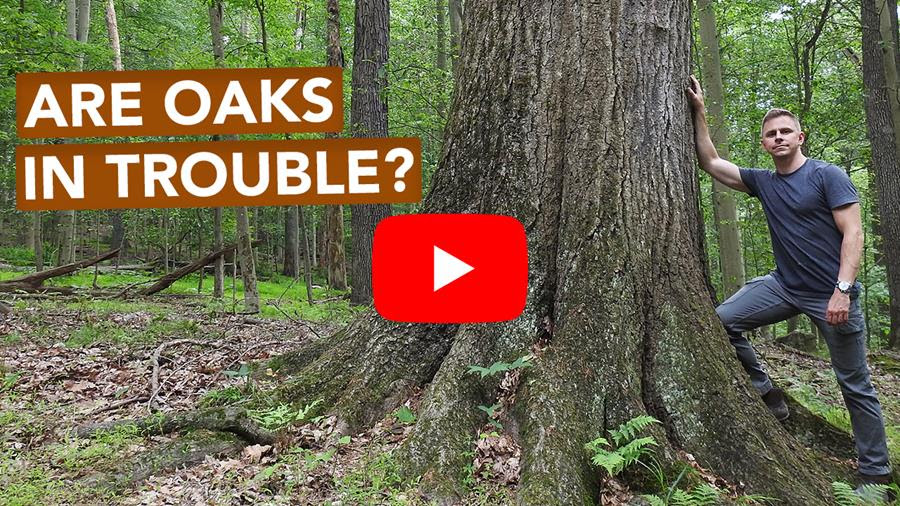
Are Oaks in Trouble?

Before I share a brand-new video with you, I’d like to remind you that enrollment for Exploring Wild Ecosystems closes on Monday, June 3.

This online course improves your knowledge of ecology by introducing you to fascinating terrestrial and wetland ecosystems.

If you want to develop ecological literacy and be able to read landscapes more effectively, consider enrolling in Exploring Wild Ecosystems today.

Speaking of reading landscapes more effectively, we can predict future ecosystems based on current observations.

Consider a mature oak forest, for example.

Looking at an oak forest today, we might hope that conditions will remain stable for many years.  Any native plant enthusiast will tell you that oak forests are repositories of biodiversity.  Without oaks, other organisms that depend on oaks suffer.

But a quick glance at mature oak forests today tells us that significant changes are occurring.  These changes, it turns out, aren’t particularly favorable to oaks.

Ecologists are worried about something that’s occurring underneath the towering oaks.  This phenomenon has been happening to oak forests for the past 100 years.  According to ecologists, it will persist without active management.

In a brand-new video, I address this important ecological issue.

You can watch the video here.

Thanks for reading and watching, and thanks for your continued support!

— Adam Haritan

The Medicine, Magic, and Spirit of Trees: A Druid’s Garden Guide

Avoiding Counterfeit Tarot and Oracle Decks