
If you taste echinacea’s powerful root, you’ll be surprised by the tingling sensation that soon follows. While many herbalists enjoy echinacea’s root, the entire plant can be used for its immune boosting properties.* The alkyamides in echinacea help stimulate the immune system, but this is only one set of constituents that work in harmony with many others in the plant. Perhaps this is why it is one of the most studied plants in Western herbalism. The true identity of all the active principles still remains open, making echinacea’s true powers another plant mystery!
All the plants in the echinacea genus are indigenous to North America and originally dwelled in prairie lands. In the mid-1800s, the American Eclectic physicians began to use echinacea and its healing powers reached beyond the New World. By the beginning of the 20th century, it was one of the most frequently used herbal preparations in the United States, and overharvesting of the wild perennial flower soon followed.
Fortunately, United Plant Savers works to restore native populations of plants, and echinacea can now be cultivated in many different regions of the world. The best way to start your echinacea seeds is to have them endure a period of cold, moist stratification. What’s that, you ask? Some seeds are very hardy and lay dormant until awakened by the cold weather. Stratification either stimulates or creates winter conditions to encourage germination or sprouting. In the wild, echinacea’s dormancy is naturally overcome by spending time in the ground and enduring long winters.
The easiest way to start echinacea at home is to sow echinacea seeds about ¼ inch deep in fall, cover with a thin layer of rich compost and let nature take its course over the winter. Another option is to place the seeds in a small jar with some sawdust, vermiculite or peat moss. Then moisten and place the jar in the refrigerator for about a month. Once spring arrives, the seeds can be planted a ¼ inch deep into a large pot or directly into the soil. These purple coneflowers enjoy partial to full sun, ample water (but can handle some drought) and good drainage. You can expect the perennial to bloom fully by the summer of its second year.
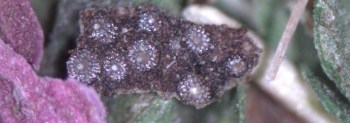
The leaves of Echinacea purpurea sometimes have “covering trichomes,” which are hairs, emerging right from the skin (or epidermis) of the leaf. Our microscopist helps to identify plants and saves photos like the above to deepen our knowledge of key plant identification features.
If you think you have found this plant in the wild, you will be able to identify it by some of its most pronounced features. All members of the Echinacea genus are perennials that bloom with both disk and ray flowers. The purple ray flowers attach to a round, high and spiky cone – hence the common name “purple coneflower.” Technically speaking, this thick and spiky cone is actually hundreds of more flowers, all tightly packed together.
So when you’re feeling like you need a plant ally to give you a boost, think of echinacea.
Now when you see a beautiful echinacea flower while you are out and about, its radiant purple flowers and sturdy structure will remind you of just how powerful this plant really is.
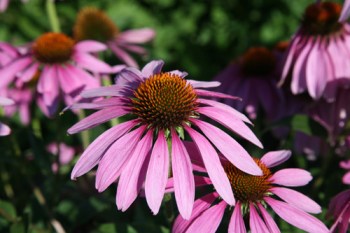 Cold Stratification of Seeds for Growing Echinacea Purpurea
Attract goldfinches and butterflies to your garden with a healthy stand of Echinacea purpurea, or purple coneflower. The plant is a native perennial that thrives in U.S. Department of Agriculture plant hardiness zones 3 through 9. Purple coneflower grows from 2 to 4 feet tall, depending on variety, producing purple petals around a cone-shaped center in late summer that first draws butterflies, then finches as it becomes a bristly seed head. Once established, the plant is easy to care and readily self-seeds in place. When starting purple coneflower from seed indoors, you’ll get the best germination rates if seeds are cold stratified.
Cold Stratification
Cold stratification is a seed treatment developed to help gardeners mimic the winter conditions many seeds need to break dormancy and germinate. Many plants, both perennial and annual, that grow in a cold-winter climate evolved winter seed dormancy to keep them from sprouting when conditions are too cold or dry for sprouts to survive outdoors. Some seeds need only dry stratification — exposure only to temperatures between 33 and 50 degrees Fahrenheit — to germinate, while others need moisture in addition to the cold treatment. The length of stratification required also varies by plant species.
Purple Coneflower Stratification
Purple coneflower seed germinates best with moist stratification. Mixing the seeds with a small amount of sawdust, vermiculite or peat moss inside a plastic zipper bag or small jar for cold stratification keeps the seeds moist without hindering germination later. Seeds are sown one-quarter inch deep in containers of moist potting soil and covered with plastic to retain moisture. These containers go inside a refrigerator or other area where the temperature is consistently between 33 and 60 F for the entire stratification period. The temperature experts specifically recommend for E. purpurea coneflowers varies from 40 through 59 F, with the majority at the lower end of the range. Gardeners in areas with winter temperatures consistently in this range can place trays outdoors. Packaged seed often is pre-stratified and does not require any chilling to germinate.
Timing Stratification
The time required for stratification to be effective varies as well, from as little as two weeks up to a month for the seed to break dormancy. Planning for four weeks of cold prevents any question, as chilling for too long is not harmful to the seeds. Stratification time should be figured into your propagation time so that seeds are removed from chilling when it is time to sow. Seeds germinate in 10 to 30 days at 65 to 70 F and are often ready for transplanting within 30 days. The higher the temperature for both the seed and the seedling, the faster the germination and early growth. Purple coneflowers prefer slightly cool temperatures as seedlings and can be planted out just after the last predicted frost. Stems may be stronger and develop more flower buds when they experience cool temperatures of about 40 F after planting out.
Growing Purple Coneflower
Purple coneflowers grow in full sun to partial shade — dappled shade is ideal — in pH neutral, well-drained soil. Plants started from seed may not bloom for two years after planting. Transplants need at least 15 inches between them for the air circulation necessary to avoid disease, but no more than 24 inches to avoid spindly growth that requires staking. They are drought tolerant once established, but low to moderate water throughout the summer results in the prettiest plants. Like most natives, coneflowers have low fertilizer requirements, although a slow-release, high nitrogen fertilizer, like a 12-6-6, is beneficial in early spring as new growth begins. Deadheading keeps the plant blooming and compact and prevents self-seeding. Basal foliage is evergreen in zone 9 but can be cut back in early spring if it needs to be refreshed.
Source: Echinacea 101 – Crooked Bear Creek Organic Herbs

 Paths I Walk
You must be logged in to post a comment.