WINTER SOLSTICE ~ Celebrating the Return of the Sun

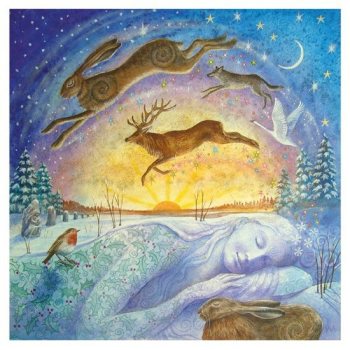
For thousands of years, people all over the Planet Earth have celebrated the Winter Solstice, the time when the Sun returns after the winter’s cold and darkness.

In pre-Christian Northern Europe, this festival was called Yule. The celebration of Yule predates the Christian holiday by thousands of years.

The etymology of the word Yule has been the object of much debate. Some believe it to be derived from the old Anglo-Saxon word Iul, which means wheel and connected to the Celtic concept of the Wheel of the Year. Other linguists say that this interpretation is unlikely, since the word for Yule, which they spell Yehwla, predates the invention of the wheel by more than a thousand years. Still, others have attempted to trace the word to Julius Caesar, or to Jolnir, which is another name for the Norse god Odin.

In the Northern Hemisphere, the Winter Solstice occurs on December 21 or 22, and practitioners of neo-pagan religions there celebrate Yule at the same time as the Christians celebrate Christmas.

In the Southern Hemisphere, the Winter Solstice occurs on June 22 or 23. In Australia, the Christian holiday is observed on the same dates as in the Northern Hemisphere (although Christmas dinner may be a backyard barbecue or a picnic on the beach). Australian neo-pagans, however, celebrate Yule at the Winter Solstice in June, the time when Scandinavians hold their Midsummer festivals.

Why is Christmas celebrated on December 25 when historical and biblical evidence indicate that Jesus Christ was not born on December 25, but in the Spring? A common theory is that the Christian church designated this date as the day of Christ’s birth to coincide with the Roman Saturnalia festival and the Northern European pagan midwinter solstice celebrations, in order to “facilitate” the conversion of “heathens.”

Most so-called Christmas traditions are rooted deep in ancient Yule rituals.

The Vikings decorated the yule log, usually a large oak log with sprigs of fir, holly, or yew. They carved runes on it to call on the Gods to protect from misfortune in the coming year.  A piece of the previous year’s Yule log was used to light the new log, and a piece of the log was always saved to protect the home during the coming year and to use to light next year’s fire. Today, most know the Yule log as a sweet edible.

Even the Christmas tree also goes back to pre-Christian times. The Vikings decorated evergreen trees with pieces of food and clothes, small statues of the Gods, carved runes, etc., to entice the tree spirits to come back in the spring. The Romans also decorated trees with trinkets and candles at the Saturnalia festival.

Ancient myths also surround the mistletoe. The Vikings believed it could resurrect the dead, a belief connected to a legend about the resurrection of Balder, the Sun God.

The Druids considered holly a sacred plant and believed that woodland spirits lived in it during winter time. (The Druids were the priests of the Celtic people, believed to have come from the Black Sea region about 4,000 years ago and spreading through southern and middle Europe, England, Scotland, and Ireland.)In ancient Rome, holly was the sacred plant of the Saturn, the god of sowing and harvest, and during the Saturnalia festival, holly was used to decorate homes, palaces and marketplaces in honor of Saturn. Romans also sent gifts of holly boughs to friends during the Saturnalia time.

Santa Claus is a combination of several pre-Christian legends. His origins have been traced back to Odin, who was depicted as a wise old man with a beard, riding on his eight-legged horse Sleipner. Another pre-Christian Santa forebear appeared at British, and later Saxon, pagan midwinter festivals. The Saxons called him Father Time, King Frost or King Winter and he was represented by an actor dressed in a green hooded cloak, wearing a wreath of holly, ivy or mistletoe.

The Yule Goat is an old Scandinavian Christmas symbol, whose origins may go back to the legend about Thundergod Thor who rode in the sky in a wagon pulled by two goats. In the 19th century, the goat became the giver of gifts, with a person dressing up as a goat, a character later replaced with “jultomten” (Santa Claus). Today, Yule Goats made of straw are common Christmas decorations in Scandinavian homes.

The European Christmas ham is a heritage from Viking times when a wild boar was killed and sacrificed to the god Frey to assure a good spring. The meat was cooked and eaten at the mid-winter festival. This was accompanied by the burning of a giant Sunwheel, which was put on fire and rolled down a hill, to entice the Sun to return.

Today, neo-pagan, or Earth religions, are bringing many of the old customs back to life. Neo-pagan religions include wicca, pantheism, asatru, druidism, shamanism and many others.

From ancient times to the present day, the sun and its light have been celebrated by people all over the Planet.

In ancient Egypt, the Feast of the Burning Lamps honored the gods Isis and Osiris.

In ancient Rome, the Solstice Celebration was called Saturnalia in honor of Saturn, the Roman god of harvest.

The Hindu holiday Diwali, meaning Rows of Lighted Lamps, is celebrated like Christmas with decorating of homes, eating of sweets, etc., and is the most important festival in India. Different regions attach different legends to it, telling about deities winning victory over demons, symbolizing the victory of good over evil.

At the Jewish Hanukkah in December, one candle is lit for each day of an eight-day Feast of Lights.

The Chinese new year, usually celebrated in January or February, is based on a legend where fireworks and lanterns were used to chase away a dragon that came out of the Yellow River.

In Thailand, Loy Krathong, which means “Festival of Floating Leaf Cups”, has been celebrated for over 6,000 years. Leaf shaped boats with candles burning on them are launched into rivers to take away sins and grant good wishes for the new year.

The ancient Incas celebrated Inti Raymi, where the Sun god Wiracocha, was honored. The festival was banned by the Catholic church in the 16th century. Quecia Indians in Cusco, Peru, revived the festival about 1950, and it is now a major festival.

Native North Americans have celebrated both Solstices and equinoxes from ancient times, as shown by many stone structures aligned with the position of the Sun. The Pueblo tribes celebrate the Winter Solstice with rites focusing on Spring and rebirth. The Hopi Indians’ Soyal ceremony lasts for 20 days and includes purification rituals, blessings, and feasting. Other Native American winter celebrations include the Bear Dance, the Feather Dance, and the Navajo Night Chant.

Source: WINTER SOLSTICE ~ Celebrating the Return of the Sun

From the Gutter, the Stars Shine Brilliant — Spiritual Awakening

Oscar Wilde wrote, “We are all in the gutter, but some of us are looking at the stars.”

While literary critics have pondered the meaning of that provocative line, anyone pursuing spirituality in recovery knows immediately – and with great personal empathy – exactly what Wilde was saying: Even in the roughest storm of life, we can see the startling beauty of the heavens.

Despite his considerable literary talent, Wilde died an impoverished alcoholic at 46, in exile from England and mostly estranged from his family. He was imprisoned for two years for homosexuality, and for the rest of his life he was barred from seeing his two children from an earlier marriage.

In the darkness of the gutter, the stars can shine incredibly bright.

In a recent song by the metal band, Disturbed, they say, “Sometimes darkness can show you the light.”

The contrast between the dank despair of human decent and the eye-burning shine of spiritual revelation is shocking – sometimes it’s shock enough to lift us up to the world of the living. Other times, it’s merely the faint call of a promising world on the other side of death.

The light-filled world of connection and hope is a blink away. It’s right here in your breath. The path to this warm earthly home is visible through the stars that we see from the gutter. Even in the sour sink of fear, we are always strong enough to climb through. Yet many will die tonight for the lack of seeing that path. Their time will come again and again even so.

via From the Gutter, the Stars Shine Brilliant — Spiritual Awakening

MORAG: “The Mysteries, Myths, And Magic Of Meditation”

ipad-148


What is meditation?

Meditation is prayer, before the kabal took the heart from it.  Meditation is sacred ritual before it became outlawed as wiccan and wicked.  Meditation is being one with nature before we were plugged in to the 3D matrix.  Meditation is being still, at peace, present and connected.

We meditate when we walk in nature.  We meditate when we color in.  We meditate when we dance, free and connected to the music.  We meditate when we quieten our ego and hear our soul.  We already do it.  If you step off the grid, step into your bubble of present you are tuning your cellular frequency to the universal frequency of peace, love and abundance.

When we hug a loved one we are raising our vibrations to the love wavelength.  When we laugh we are releasing denser energy, lightening our energetic load.  When we make love we are embracing the universal flow of love.  When we smell our child’s hair we are fully present, mindful and grateful.  The emotion, the vibration of gratitude, like love, can connect us to the higher dimensions, by its very nature it is present, graceful and humble.

When we sit down, comfortable though preferably with the chakras open, lying down is good for some people, we choose to connect, to meditate.  Using our breath we can raise the vibrations of our cellular system in turn raising the energetic frequency of our whole being.  This enables us to tune in, like a tuning fork, to different wavelengths of energy.

The matrix manipulates us into breathing in a very shallow way, barely into our throat.   When people experience panic and anxiety they are told to breathe into a paper bag.  This is because it slows our breathing down, helping us to reach a calmer place.  This inner equilibrium is the space we start from to meditate.  Using long deep breaths we can calm our system down and raise our frequency.

As our ego (you know…that annoying voice that goes on and on in your head) faces this calm stillness it can freak out.  This lessens the more you meditate as the ego is programmed to fear anything it doesn’t know so familiarity calms it.  The ego also fears this stillness as it is trained by the matrix to be ‘doing’ and not meditating.  We are to obey, conform, work, rest and play.  Not connect to the universal love vibrations of the multi verse.  Reassure your ego, give it a hug, tell it to quieten down and have a rest, everything is easy.

The ego will continue to pop thoughts of doom and gloom, fear, insecurities, anxieties and stresses into your mind, breathe these out.  As you inhale draw in love, peace, calm and positivity as you exhale release pain.  Say in your head ‘I breathe in love I release tension and doubt’.  Do this for as long as you want or need or have time for.

This is meditation.  Reaching a state where your ego is quiet, your body is connected and your mind is open.  Where you go from there is entirely up to you.  Deep relaxation, chakra balancing, guided healing visualizations, higher self and guide meetings… the multiverse is your oyster.

You can ask your guides for love and protection, for healing and guidance for you and your loved ones.  You can send healing heart led love energy to people and places.  You can anchor your light to the  Gaia grid.  You can float on a cloud in a rainbow chakra shower.

Meditation is one of the keys to awakening, transition, alignment and eventually ascension.  If you are a lightworker, starseed, indigo or Rainbow it’s a way of phoning home.  It’s a way of detoxing from the system, of expanding your heart and your mind, releasing stuck karma and growing as a spiritual being.  A key to evolutionary growth, wisdom and enlightenment and in a practical sense a brilliant way to manage stress, anxiety and tension.  Meditation is the Jedi tool to awakening the force within you.  Embrace it, harness it and own it, making it apart of you.  Can I get an Ommmm up in here! Ommmmmmm!

Namaste _/\_.

Source:   MORAG: “The Mysteries, Myths, And Magic Of Meditation”

The Story Behind The Movie Hidden Figures …

melbaroy-jpg__800x600_q85_crop_subject_location-1310768
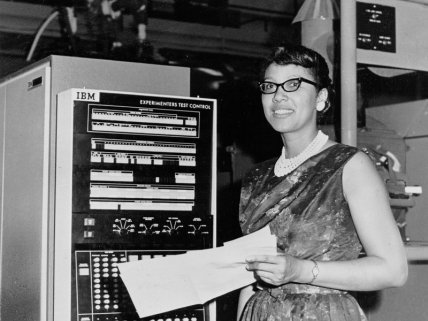
Melba Roy

As America stood on the brink of a Second World War, the push for aeronautical advancement grew ever greater, spurring an insatiable demand for mathematicians. Women were the solution. Ushered into the Langley Memorial Aeronautical Laboratory in 1935 to shoulder the burden of number crunching, they acted as human computers, freeing the engineers of hand calculations in the decades before the digital age. Sharp and successful, the female population at Langley skyrocketed.

Many of these “computers” are finally getting their due, but conspicuously missing from this story of female achievement are the efforts contributed by courageous, African-American women. Called the West Computers, after the area to which they were relegated, they helped blaze a trail for mathematicians and engineers of all races and genders to follow.

“These women were both ordinary and they were extraordinary,” says Margot Lee Shetterly. Her new book Hidden Figures shines light on the inner details of these women’s lives and accomplishments. The book is being adapted into a movie that will receive a wide release release in January.

“We’ve had astronauts, we’ve had engineers—John Glenn, Gene Kranz, Chris Kraft,” she says. “Those guys have all told their stories.” Now it’s the women’s turn.

 Growing up in Hampton, Virginia, in the 1970s, Shetterly lived just miles away from Langley. Built in 1917, this research complex was the headquarters for the National Advisory Committee for Aeronautics (NACA) which was intended to turn the floundering flying gadgets of the day into war machines. The agency was dissolved in 1958, to be replaced by the National Aeronautics and Space Agency (NASA) as the space race gained speed.

The West Computers were at the heart of the center’s advancements. They worked through equations that described every function of the plane, running the numbers often with no sense of the greater mission of the project. They contributed to the ever-changing design of a menagerie of wartime flying machines, making them faster, safer, more aerodynamic. Eventually their stellar work allowed some to leave the computing pool for specific projects—Christine Darden worked to advance supersonic flight, Katherine Johnson calculated the trajectories for the Mercury and Apollo missions. NASA dissolved the remaining few human computers in the 1970s as the technological advances made their roles obsolete.

The first black computers didn’t set foot at Langley until the 1940s. Though the pressing needs of war were great, racial discrimination remained strong and few jobs existed for African-Americans, regardless of gender. That was until 1941 when A. Philip Randolph, pioneering civil rights activist, proposed a march on Washington, D.C., to draw attention to the continued injustices of racial discrimination. With the threat of 100,000 people swarming to the Capitol, President Franklin D. Roosevelt issued Executive Order 8802, preventing racial discrimination in hiring for federal and war-related work. This order also cleared the way for the black computers, slide rule in hand, to make their way into NACA history.

Katherine Johnson at her desk at Langley with a
Katherine Johnson at her desk at Langley with a “celestial training device.” (NASA)

Exactly how many women computers worked at NACA (and later NASA) over the years is still unknown. One 1992 study estimated the total topped several hundred but other estimates, including Shetterly’s own intuition, says that number is in the thousands.

As a child, Shetterly knew these brilliant mathematicians as her girl scout troop leaders, Sunday school teachers, next-door neighbors and as parents of schoolmates. Her father worked at Langley as well, starting in 1964 as an engineering intern and becoming a well-respected climate scientist. “They were just part of a vibrant community of people, and everybody had their jobs,” she says. “And those were their jobs. Working at NASA Langley.”

Surrounded by the West Computers and other academics, it took decades for Shetterly to realize the magnitude of the women’s work. “It wasn’t until my husband, who was not from Hampton, was listening to my dad talk about some of these women and the things that they have done that I realized,” she says. “That way is not necessarily the norm”

The spark of curiosity ignited, Shetterly began researching these women. Unlike the male engineers, few of these women were acknowledged in academic publications or for their work on various projects. Even more problematic was that the careers of the West Computers were often more fleeting than those of the white men. Social customs of the era dictated that as soon as marriage or children arrived, these women would retire to become full-time homemakers, Shetterly explains. Many only remained at Langley for a few years.

But the more Shetterly dug, the more computers she discovered. “My investigation became more like an obsession,” she writes in the book. “I would walk any trail if it meant finding a trace of one of the computers at its end.”

She scoured telephone directories, local newspapers, employee newsletters and the NASA archives to add to her growing list of names. She also chased down stray memos, obituaries, wedding announcements and more for any hint at the richness of these women’s lives. “It was a lot of connecting the dots,” she says.

“I get emails all the time from people whose grandmothers or mothers worked there,” she says. “Just today I got an email from a woman asking if I was still searching for computers. [She] had worked at Langley from July 1951 through August 1957.”

Langley was not just a laboratory of science and engineering; “in many ways, it was a racial relations laboratory, a gender relations laboratory,” Shetterly says. The researchers came from across America. Many came from parts of the country sympathetic to the nascent Civil Rights Movement, says Shetterly, and backed the progressive ideals of expanded freedoms for black citizens and women.

Read more: The True Story of “Hidden Figures,” the Forgotten Women Who Helped Win the Space Race

Millennials on Spirit Quests Are Ruining Everything About Ayahuasca

When you loose connection to the rituals or your Ancestors, some people look outward to the flavor of the month instead of looking inward …

8 Herbs and Supplements to Help Treat Depression — Crooked Bear Creek Organic Herbs

Depression isn’t just feeling sad or “blue.” It is a serious mood disorder with symptoms that range from mild to debilitating, and potentially life-threatening. Depression is a relatively common disorder in that it affects millions of people each year. People of all ages and ethnicities experience depression, including children and adolescents. Depression does not only […]

via 8 Herbs and Supplements to Help Treat Depression — Crooked Bear Creek Organic Herbs

The Secret of the Voice in Your Head

Excellent advice …

voices

All day long, we go around with a monologue inside our head – the chatter of our thinking. Much of it includes thoughts such as: what do I have to do next, why is this or that person making things difficult, what am I going to have to eat or drink in the next? Will I be late? Am I good enough to do what’s expected from me? What happens if I lose my income? How am I going to stop this pain?

Often – if not almost always – it’s a mixture of fear and stress.

We sometimes mix the negative voice with fantasies of escape or revenge. These fantasies are not tangible nor rational enough to produce satisfying action.

The voice in your head sounds like your own, but it’s not. It tends to be a compiled rumble of childhood messages mixed with adult conflicts and disappointments. The fears and stress are enunciated in your own words and in your own voice.

On the bright side, we can replace the negative thoughts with positive affirmations or steps toward solutions. Even then, a negative voice will pop up out of nowhere. Chasing those negative thoughts is like hitting the plastic moles in What-A-Mole. So, how do you untangle this mess of unhappy inner quarrels?

Here’s a secret for the ages: you don’t have to believe in your own thoughts.

Your thoughts are just thoughts, words streaming through your head like the crawl at the bottom of a news channel. Let those thoughts be. They are not you. You don’t have to own them. They actually get quieter if you pay them no mind.

It’s a tiny thing to learn, but it’s helped me a great deal.

Source:  The Secret of the Voice in Your Head

Rob Spiegel's avatarSpiritual Awakening

voices

All day long, we go around with a monologue inside our head – the chatter of our thinking. Much of it includes thoughts such as: what do I have to do next, why is this or that person making things difficult, what am I going to have to eat or drink in the next? Will I be late? Am I good enough to do what’s expected from me? What happens if I lose my income? How am I going to stop this pain?

Often – if not almost always – it’s a mixture of fear and stress.

We sometimes mix the negative voice with fantasies of escape or revenge. These fantasies are not tangible nor rational enough to produce satisfying action.

The voice in your head sounds like your own, but it’s not. It tends to be a compiled rumble of childhood messages mixed with adult conflicts and disappointments. The…

View original post 137 more words

~ December Magick ~

A little something for your toolkit …

Donate to the “My People Fund”

Help Dolly Parton provide a hand up to those families who have lost everything in the fires in Sevier County, TN through Dolly’s “My People Fund.” #SomePlaceSpecial #MyPeopleFund

_92782331_dollyparton

Source: Donate to the “My People Fund”

Festive Hazards

A safe holiday for all creatures …