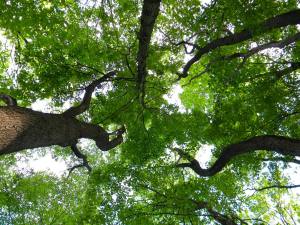
A Tree for Year Challenge

Dana's avatarThe Druid's Garden

Into the trees

One of the most common questions that people ask when they start down a druid or other nature-based spiritual path is: how do I connect deeply with nature?  Connecting to nature can happen in such a wide variety of ways.  It can happen through connecting with our heads, through learning, study, and engaging with books or classes.  It can happen through our hearts, where we emotionally connect with nature and places.  It can also happen through our bodies when we physically experience the natural world.  It can be through our spirits when we connect with the spirit of the tree.  But regardless of which of our selves and methods we use, it requires an investment of ourselves, our time, and building a relationship.

A while back, I wrote about the Druid’s Anchor Spot, which is a spot that you can use to regularly engage and observe…

View original post 1,512 more words
The Evergreen Cult – Podłaźniczka

Sacred Tree Profile: Black Locust’s Medicine, Magic, Mythology and Meanings

Dana's avatarThe Druid's Garden

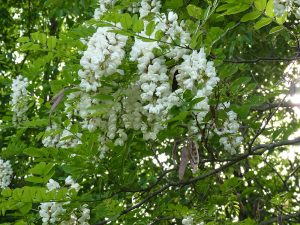
Black locust in bloom

Black Locust (Robinia pseudoacacia) is a spiny, scraggly tree that is found abundantly along the US East Coast. Very little is written about this tree from a magical or mythological perspective, although certainly, anyone who works wood or practices permaculture is aware of the more tangible benefits this tree provides. In today’s post, we explore this amazing tree and start building some more specific magical knowledge to incorporate this tree into local druidic or nature-spirituality practices.

My parents’ land in Western PA, land where I grew up, consisted primarily of old potato fields.  We had two sets of tree lines where the farmers had let the trees grow; these lines were full of huge cherry and maple trees grew.  In between those tree lines as the land sloped down the mountain were open areas populated with blackberry bushes, hawthorn, and black locusts–several acres of them…

View original post 2,141 more words

A Journey through the Senses: Breathe Deeply

Dana's avatarThe Druid's Garden

An Ancient Black Oak An Ancient Black Oak

Over the summer, I spent the weekend at a beautiful farm with my family for a family reunion. That land had gifted me, and all of us, much that weekend. I had found some stunning new stones for pigments, I had spent tranquil time on the lake, and I had talked with many of the trees there. So, as I was preparing to leave, I walked up to a giant oak on my way out. I gave it a big hug. It had rained the night before and the trunk was covered in lichen. I took a breath and the smell was that sweet and earthy smell of lichen. I remember the smell the first time I smelled such a lichen. It was down in Louisiana, and I had visited an ancient live oak with some druid friends. A branch had fallen on the ground…

View original post 1,481 more words

Sacred Tree Profile: Chestnut’s Magic, Medicine, Mythology and Meaning (Castanea dentata)

Dana's avatarThe Druid's Garden

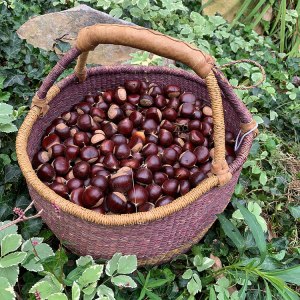
Basket of abundant chestnuts!

Just a few weeks ago, I went and checked the local chestnut trees that are in a field near where I live.  Ever since I moved to the new homestead, I have been eagerly visiting these trees.  Last year, they dropped plenty of husks but with only shriveled nuts inside. This year, I was extraordinarily pleased to find that both trees had produced a bumper crop of the delicious nuts–some almost 2″ across, but most smaller, almost all worm-free, and delicious. I eagerly filled my basket with the nuts, stepping carefully around the extremely prickly husks.  I sat with each of the trees and we conversed as I harvested the nuts. I took home 25 lbs of nuts that day, and these nuts will sustain myself, my geese (who love them), and my friends and family for many a Samhain, Thanksgiving, and Yule feast!  Chestnut trees…

View original post 2,037 more words

Health Benefits of Slippery Elm

Crooked Bear Creek Organic Herbs's avatarCrooked Bear Creek Organic Herbs

Slippery Elm is a perennial tree native to the central and eastern United States and Ontario, Canada, and can reach a height of 60-80 feet. They can live up to 200 years. Slippery Elm is also called Red Elm or Indian Elm. Native Americans used the inner bark for its soothing effect on the digestive tract and to heal wounds. Today, Herbalists use Slippery Elm for its mucilaginous and nutritive properties, for a sore throat, and for soothing the mucous membranes lining the stomach and intestines. The inner bark is the only part used for therapeutic purposes. When it is moistened, the gummy mucilaginous substance surrounding its fibers swell, producing a soothing softening remedy.  This gooey ingredient is very similar to Flaxseed. Slippery Elm is known by Herbalists for its soothing effect on whatever part of your body it comes into contact with. Slippery Elm has also been used during times of stress. Given that our mental…

View original post 1,021 more words

Sacred Tree Profile: Cherry (Prunus Serotina)’s Magic, Mythology, Medicine and Meaning

Dana's avatarThe Druid's Garden

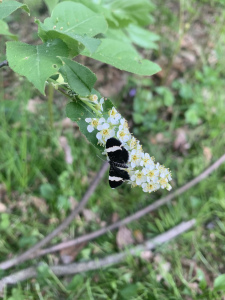
Butterfly on choke cherry

When most people think of cherry trees, they think about plump, juicy, red or purple cherries from cultivated cherry trees.  However, here in the USA, we have a variety of wild cherries that are an interwoven and rich part of our landscape. An enigmatic tree found throughout the eastern part of North America and South America is prunus serotina, the wild cherry, black cherry, mountain black cherry, or rum cherry tree. Most people interact with this tree not in its living form, but through the beautiful reddish-brown heartwood that this tree produces, and that can be frequently found in their furniture and flooring.  And yet, this tree has so much more to offer than just beautiful wood! While I’m targeting my comments today about the black cherry, many of the material found here can be about *any* cherry tree local to you, including domesticated cherries.  Many…

View original post 2,743 more words

Magic Wand

A Fire and Smoke Ritual for Land Healing and Blessing

Dana's avatarThe Druid's Garden

A few years ago, I led a smoke cleansing (smudge) stick making workshop at the OBOD’s East Coast Gathering event. As that event often has upwards of 100 attendees, I spent months growing and harvesting materials for the event so that everyone could make 1-2 sticks.  Sure enough, everyone got to make some smudge sticks and the workshop went great.  After the workshop, one of my friends and event fire tenders, Derek, came up to me and asked me about the leftover materials.  I had been placing them in a paper bag, and had planned on taking them home to make more sticks or return to the land. He said, “I want to make a smudge bomb and send healing smoke to this entire land.”  I said, “Yes, what a great idea!” So we tightly bundled up the remainder of the material, which filled at least 1/3 of the paper…

View original post 2,443 more words

Druidry for the 21st Century: Plant-Based Spiritual Supplies and Global Demand

Dana's avatarThe Druid's Garden

Can you even imagine druidry without plants or trees?  Plants and trees are some of our strongest allies for the work that we do, and are often connected to almost everything that we do spiritually. Plant spirits are teachers, guides, and allies.  From before we had recorded history in any culture, the plant spirits were there, growing with us, guiding us, healing us, and supporting us on our journey. Today’s modern druid practice continues that tradition: we burn plants for smoke cleansing, clearing, and helping to energize spaces. We use trees as part of divination and sacred rites. We use plants as healers, for magical healing and physical healing, and to connect with on deep levels.  Plants have long been friends of humans–and have long walked beside us, hand in hand, as we do our sacred work.  And today, we’ll explore ways we can offer that same kind of honor…

View original post 3,203 more words