~ Ostara ~ Spring Equinox ~ Ye Olde Dark Arts

By Dark Witch

Source: ~ Ostara – Spring Equinox ~ – Ye Olde Dark Arts

 ostara

Vernal or Spring Equinox, the Rites of Spring, Lady Day, Alban Eiber and Bacchanalia.The Spring Equinox occurs between March 19th and 22 in the Northern Hemisphere and between September 19 and the 22 in the Southern Hemisphere. Ostara marks the day when night and day are equal and balanced.

Altar decorations: Colored eggs, seeds, earth, flowers and herbs appropriate

Animal: Hares, Lambs, Rabbits, Snakes

Colors: All pastels, yellow, pink, green, blue

Drinks: wines, dandelion, lindon teas, hyssop

Flowers And Herbs: all spring flowers. Irish moss, crocus flowers, daffodils, Easter lilies, honeysuckle, iris, jasmine, roses, strawberry, tansy and violets. Acorn, Celandine, Cinquefoil, Dandelion, Dogwood, Honeysuckle, Iris, Jasmine, Rose, Tansy, Violet

Foods: Eggs, honey, bread, seeds, sprouts and green leafy vegetables

Incense: Jasmine, African violet, rose, sage, strawberry, violet flowers, orange peel, rose petals, lotus, magnolia, ginger

Oils: Magnolia, ginger, lotus

Spells: Healing, purification, psychic awareness, fertility and Air Magic

Stones: Amethyst,  aquamarine, jasper, moonstone and rose quartz.

Traditions:  Decorating Eggs,  getting rid of old and unwanted items that are no longer used, planning and preparing land for herbal, floral and vegetable gardens.

Copyright © 2002 – Present Ye Olde Dark Arts
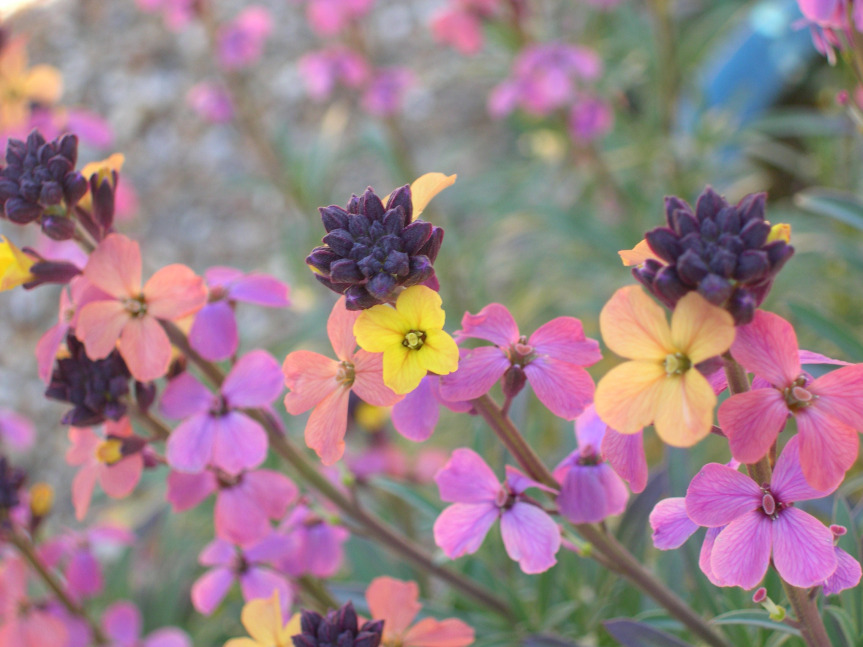
Late Spring Flower ~ Wallflower – Good Witches Homestead

Source: Late Spring Flower ~ Wallflower – Good Witches Homestead

COMMON NAME:  wallflower
GENUS:  Cheiranthus
SPECIES:  C. allioni, C. cheiri
FAMILY:  Cruciferae
BLOOMS:  late spring-summer
TYPE:  perennial
DESCRIPTION:  Wallflowers come in lovely shades of orange, apricot, and yellow. Plants grow to a height of 14 to 18 inches. Numerous flowers occur at the ends of spikes. Leaves are long and narrow.
CULTIVATION:  Wallflower plants cannot tolerate extreme heat and humidity. Given a sunny, airy spot in a mild climate, though, wallflower produce bright blossoms over a long period, if it is watered regularly. The plants grow easily from seed, which should be sown directly in the flowering site in spring. Blossoms often come the first year from seed.

The following legend tells us of the origin of wallflower: The daughter of a Scottish lord fell in love with the son of an enemy border chieftain  The fathers, of course, took offense at the match, and the lord betrothed his daughter to a prince of his choosing and locked her up in a tower until the wedding was to take place. The chieftain’s son, posing as a minstrel, sang at the foot of the tower, suggesting that she throw down a rope ladder and run away with him. The girl threw him a blossom of a wallflower to indicate she understood and then began to climb down to her lover. Tragically, she slipped and fell to her death. The heartbroken young man adopted the wallflower as his emblem and wandered over the countryside singing of his beloved.
Because of this legend, the wallflower is a symbol of faithfulness in adversity, according to the Victorian language of flowers. During the Middle Ages, troubadours and minstrels wore bunches of wallflower blossoms as a sign of good luck.
The genus name is from two Greek words meaning “hand” and “flower” and refers to the custom of carrying these sweet-scented flowers as a bouquet to ward off the evil odors resulting from poor sanitation practices of the past. They were especially popular during spring festivals.
The French call it giroflee violier because it has the same sweet scent as does the carnation, often called gilloflower.
The common name comes from the growth habit of some species, which prefer to climb stone walls or fences.
Wallflower has also been called blood drops of Christ, for the deep red wallflower was supposed to have grown under the cross. Also known as the bloody warrior, wallflower was planted outside the cottage gate as protection against invaders.
Wallflower has always been valued as a medicine. The water of the distilled flowers, drunk twice a day for three to four weeks, was thought to make a woman fruitful. It has been used for uterine and liver disorders, to treat enlarged glands, and to purify the blood. Other remedies made from wallflowers have been used to ease pain during childbirth, treat palsy, and clear up cataracts. According to the doctrine of signatures, the yellow wallflower was used to treat jaundice. Scientists have discovered substances within the seeds, roots, and leaves that affect the heart, and for this reason, it is not recommended for a home remedy.

The plant was originally found growing in the Aegean Islands.

GRAPE HYACINTH – Good Witches Homestead

Source: GRAPE HYACINTH – Good Witches Homestead

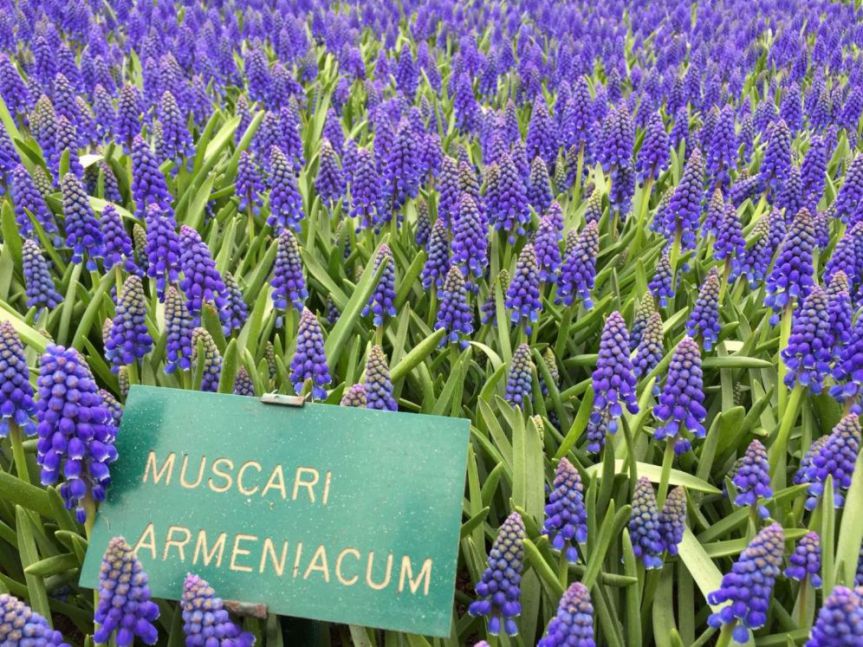
COMMON NAME:  grape hyacinth
GENUS:  Muscari
SPECIES, HYBRIDS, CULTIVARS,
M. armeniacum ‘Early Giant’-blue
M.a. ‘Blue Spike’-up to 12-inch blossoms.
M. a. ‘White Beauty’-white.
M. botryoides-pure white.
FAMILY:  Liliaceae
BLOOMS:  early spring
TYPE:  perennial
DESCRIPTION:  Most grape hyacinths grow 6 to 8 inches tall and produce spikes full of round, almost closed blossoms. They spread about 3 inches and have foliage that is long, narrow and grasslike.
CULTIVATION:  Grape hyacinths come from small bulbs, which should be planted 3 inches deep and 3 inches apart. For best effect, the bulbs should be planted in quantities. They are particularly effective under trees or shrubs. Grape hyacinth does equally well in full sun or partial shade. The leaves should be left to die back naturally after the flowers bloom.

Some species of the genus Muscari have a sweet, musky scent, and this is the reason for the name, for Muscari is from the Greek word moschos, or “musk.” Many gardeners originally grew the plant for its scent and not its beauty. The species name botryoides is also from Greek and means “a bunch of grapes.” This, along with the plant’s physical resemblance to the hyacinth, gives us the common name, grape hyacinth.
M. botryoides is also called the starch hyacinth, for it smells like starch.

Muscari_armeniacum2

Grape hyacinths are native to southern Europe, Northern Africa, and western Asia. The small bulbs have been used extensively in cooking. It has been suggested that boiled in vinegar {to reduce the bitterness}, the bulbs of M. comosa and M. atlanticum can be made into very tasty pickles. Other species are so bitter that they have earned the name Bulbus vomitorium. The first-century Greek physician Discorides wrote, “of this wort it is said that it was produced out of dragon’s blood, on top of mountains, in thick forests.”


HYACINTH – Good Witches Homestead

Source: HYACINTH – Good Witches Homestead

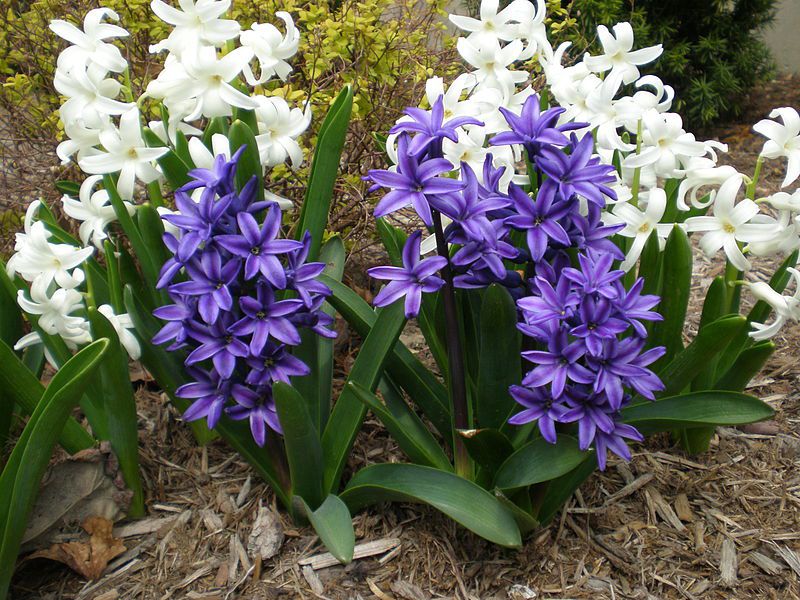
COMMON NAME:  hyacinth
GENUS:  Hyacinthus
SPECIES, HYBRIDS, CULTIVARS,
H. Orientalis ‘Amsterdam’-bright red to pink.
H. o. ‘Anne Marie’-light pink.
H. o. ‘Carnegie’-creamy white.
H. o. ‘Delft Blue’-blue
FAMILY:  Liliaceae
BLOOMS:  early spring
TYPE:  perennial
DESCRIPTION:  Hyacinths are widely used as a spring bulb. The top flower size is 7 to 7 1/2 inches in circumference. The flower spike is composed of neatly rounded mounds of small blossoms. Flowers are available in pink, white, cream, reddish pink, blue, yellow, and violet blue.
CULTIVATION:  Good drainage is a must for this plant because the bulbs rot easily if water stands on them. Bulbs should be planted in the fall, 6 inches deep, 6 to 8 inches apart. Mulch them in the fall to protect the tender spring growth from frost damage. Bulbs should be planted in an area that bets full sun or partial shade.

According to mythology, hyacinths originated because of the wrath of Zephyr, a god of the wind. Apollo, king of all the gods, fell in love with Hyacinthus, son of the king of Sparta. One day as Apollo and Hyacinthus were playing quoits {a game similar to today’s horseshoes}, Apollo threw the metal ring and Zephyr, jealous and enraged, caused the wind to make the metal ring hit Hyacinthus and kill him. Broken hearted, Apollo created the hyacinth flower out of the blood of his friend. Some even say that the petals look like the Greek syllables ai ai, meaning “woe.”
The Victorian language of flowers hyacinth means sport or play, and the blue hyacinth is a symbol of sincerity.
The Greeks dedicated this plant to Ceres, the goddess of agriculture. In ancient Sparta, annual Hyacinthian feasts were held. A Greek girl wore a crown made from hyacinth blossoms when she assisted at her brother’s wedding.
Greeks used concoctions made from the plants to treat dysentery and the bite of poisonous spiders. Such a concoction was also reputed to have the power to prevent a young boy’s voice from changing during puberty, making it very popular with singing masters of the time.
Hyacinths were first found growing in Asia Minor, as is suggested by the species name orientalis. Cultivated in Turkey and Persia, hyacinths were brought to England from Persia in 1561.

hycinths

The following story is told of how hyacinths got to Holland: Trading ships carrying crates of these exotic and expensive bulbs wrecked off the coast of Holland. The crates broke open, and the waves washed the bulbs ashore, where they rooted and produces beautiful flowers. However hyacinths got to them, the Dutch lent their magical hands to the plant, and by 1724 more than 2,000 varieties of hyacinth were found in Europe. Though interest in the bulbs never quite reached the level that tulips created, the price of hyacinth bulbs was quite high and competition for new varieties fierce.


Scilla – Good Witches Homestead

Source: Scilla – Good Witches Homestead

COMMON NAME:  scilla
GENUS:  Scilla
SPECIES:  S. sibirica
FAMILY:  Liliaceae
BLOOMS:  early spring
TYPE:  perennial
DESCRIPTION: Scilla has short {4 to 6 inches} spikes of bright blue or white flowers. The foliage is attractive and the growing habit neat, making it an excellent plant to use as a border or edging plant. It also lends itself well to an informal setting and looks very good naturalized under trees or shrubs.
CULTIVATION:  The small bulbs should be planted 4 inches deep in the early fall. Give them an open, sunny spot, and they will multiply rapidly.

Ten species of Scilla are native to Europe, and several of these have been cultivated for many centuries. Some records indicate that at least five species of Scilla were being cultivated as early as 1597.
The genus name means “I injure” and refers to the poisonous properties of the plant. Red scilla was even used as rat poison.
Scilla is often called squill. The bulbs of both the red and white squills were made into a concoction called a “syrup of squills.” This supposedly had medicinal properties, and a drug found in the bulbs was used as a component in heart tonics. The physiological effects of eating this bulb were thought to be similar to those of inhaling tobacco, for both acts on the nervous system. Roman statesmen suggested Scilla was a diuretic. It was also used to treat asthma and dropsy.
The Welsh name for this plant is cuckoo’s boot. S. bifolia was described by John Gerard, author of a sixteenth-century herbal, as “small blew flowers consisting of sixe little leaves spread abrode like a star. The seed is contained in small round bullets.”

During Elizabethian times, the starch used for stiffening collars was made from the bulbs of this plant.


Saint Patrick’s Day – secretsoftheserpent

By

March 16, 2017

kissmepaganheritage

St. Patrick’s day is the day people celebrate St. Patrick. He is the British born missionary who is credited with converting Ireland to Christianity. Why are we celebrating a foreigner going into to Ireland and enforcing his will on the people? St. Patrick’s parents were not Irish either, they were Roman. I have always said that everything goes back to Egypt and this holiday is no exception.

I was going to do a post on St. Patrick himself, but the history of him has been monopolized by the church. Everything we know about him and his history is basically from his writings after he became a bishop. I have found some ancient texts that say he burned pagan books, but that is no surprise with the history of Christianity. I find it amusing that researchers scratch their heads about him casting out all the serpents from Ireland. Ireland has never been known to have snakes. The serpent is code for intelligent people. Most of the intelligent people were Druids or Witches. He either ran them off, converted them or killed them. If they were converted they weren’t serpents in the first place and given the history of Christianity I have no doubt he burned them with the books. He didn’t just become a bishop in the fifth century by converting people. In the Thesaurus Paleohibernicus it states “Patrick fought the Druids with a hard heart and crushed the proud”.

St. Patrick’s day first began during the revolutionary war. Britain and America were both trying to rally their troops and several had Irish ancestry. It was mainly a celebration by protestants. General George Washington declared that March 17, 1780 become a national holiday. Washington proclaimed “it was an act of solidarity with the Irish in their fight for independence”. This was the first holiday the soldiers had in two years. Washington and most of the American army were Masons. Masonry goes all the way back to Egypt. This was the beginning of St. Patrick’s day in America. In Ireland, St. Patrick’s day was always a religious holiday. Up until the 70’s the Irish government even had laws that closed pubs on March 17. It was in 1995 that the Irish government used St. Patrick’s day as a way to drive tourism and showcase Ireland. […]

Entire post at its Source: Saint Patrick’s Day – secretsoftheserpent

Leprechaun – secretsoftheserpent


By

Originally Posted August 14, 2016

index

The Leprechaun was a little tough to pinpoint. First I thought that, like so many other myths, it had to do with the mind. As you will see, the Leprechaun has more with preserving history of this character than anything else. I started with the myths and legends in Ireland. First thing I come across is the leprechaun has something to do with the Faery people of the Tuatha De Danann. If you have read my previous work, you know this is right in my wheelhouse. I won’t go into depth here about the Tuatha De Danann, but if you don’t know much about these matriarchal people from ancient Ireland, your are definitely missing out on great history.

Come to find out leprechaun comes from the Sun God Lugh. I found out that it is pronounced luck. This doesn’t surprise me because London, Loudan, Lyons and other cities are named after Lugh. Leprechaun actually comes from Luchchromain meaning little Lugh or little Luck. Now you know where the luck of the Irish comes from. The original leprechaun were not green like they are today. In the past they always had a red outfit. Why would leprechauns be in red? Why were they changed to green? Why rainbows? Why gold? Just like so many things, we have to look to Egypt for the answer. If you have followed my earlier work, you know that Gaythelos was a Pharaoh of Egypt. He married a daughter of Akhenaton named Scota. Together they came to Ireland and Scotland and this is how we got the names Scotland and Ireland.  The term gaelic comes from Gaythelos.

Looking to Egypt, I found a dwarf bearded god named Bes. Bes was associated with sexuality, humor, music and dancing. Although he was the protector of Pharaohs, he was very popular with the Egyptian people because he protected women and children. I’m not saying that Bes is Lugh. I know better. Gaythelos conquered the Tuatha De Danann. The conquered pagans needed to keep the spirit of the people of Ireland intact and they made the Tuatha De Danann into Faery people. This way the history would be remembered. St. Patrick and the Christians made the Faery people evil. Then Disney made them what they are today. Lugh was incorporated with Bes by  scribes who were ardent to Gaythelos and his group.  I have shown before that the scribes love to outwit each other.  These scribes were preserving the the Egyptian connection of Ireland and Scotland.   Gaythelos was very close to Akhenaton and Bes was found all over the city that Akhenaton built. I have seen where some researchers have said that Bes comes from Ethiopia or Nubia. Again this shows just how well are history has been hidden from us or lost. As I have shown before, the scribes have purposely made Upper Egypt to be Ethiopia. (See Patriarch Pharaohs) Bes originated in Upper Egypt. Because he was a sun-god, Akhenaton used him. Aton is the sun god Akhenaton worshipped. If it had to do with the sun, Akhenaton was on board.

Bes had a female version named Beset. So where are the female leprechauns? Early legends of leprechauns had women. It wasn’t till St. Patrick and the Christians that the female leprechauns were first turned into “little women that lure away men for secret adventures”, then just disappearing. Yes, Christians turned the leprechaun into the solitary male that some how reproduces. Is this surprising? The leprechaun wore red to show that they were brought from Egypt with Gaythelos. Gaythelos was from the red crown of Lower Egypt. They switched the leprechauns to green to hide this fact. Because there are true illuminati out there, they hid clues in plain sight. The stuff on the internet about the Illuminati is ridiculous(See Lemurian Magic). They had to hide clues that the papacy wasn’t smart enough to figure out. If they actually came out and told the truth, they would be burned at the stake. This is where the rainbow and gold come in.

I started with the shoes, but the only thing I could find is shoes symbolize walking your path.  Leprechauns being shoe builders, I believe symbolizes creating your own path. I switched to the rainbow and found that the ancients saw rainbows as a serpent coming out of the ground then going back in. Serpents have to do with wisdom, but I was none the wiser. Christians see the rainbow as a promise from god not to flood the earth again. Bullocks! Then I found Lugh’s sling. Lugh’s sling was the rainbow!!! This was put into the leprechaun legend to show where it came from. These scribes are clever. The color was changed to green to show the leprechaun origins are from Upper Egypt? Osiris is from Upper Egypt and the green man all over the world is Osiris. Yes the little green men and gargoyles on churches is Osiris. One researcher I found even linked Bes to a form of Osiris. Just to add to the wittiness of the myth the Irish name for the sun is Grian(pronounced green).  So the rainbow is showing you the leprechauns connection to Lugh and green is showing the Egyptian connection.  When you think of Egypt, besides pyramids, what is the first things that comes to mind? Gods and gold is it not? The gold is yet another clue where to look, Egypt. Figure out the rainbow and you get the gold and the knowledge.

Source: Leprechaun – secretsoftheserpent

Slowing Down the Druid Way, Part IV: Slow Movements and Slow Spirituality | The Druid’s Garden

When I lived in Michigan, each Christmas, a local church just down the road from me put on a drive-by nativity scene. Cars full of people would line up for over half a mile and drive around this circular loop surrounding the church, where church members dressed up and enacted various kinds of nativity scenes.  I’m sure from the perspective of the church (who, clearly, invested a lot of time and resources, taking weeks to build the sets in the bitter cold in the time leading up to the event), it was a way to reach people who might otherwise not come through the church doors.  This same church also offered “speedy sermons” and other “quick” ways of getting busy people in the door. The idea behind these different initiatives was reaching out to people who were otherwise too busy to come to church–a reasonable and rather creative thing to do, given the time crunch everyone seems to be in these days. But for all that was gained (new members, new donations, etc) what was lost in the process of converting religion into a drive-through experience? Of course, just like the burger at McDonald’s vs. the burger you grill at home with time and care, there are likely some big differences not only in taste but also in presentation, nutrition, and energy.


In my last three posts in “Slowing Down the Druid Way”, we explored the history of time and our relationship to our working hours, and how we might begin to honor our time more fully.  This directly leads me to the topic of my final post on time and work: looking at the slow movements as a way of slowing down, making slowing down a conscious choice, and embracing leisure time.


The “Slow” Movements

The term “slow” has been increasingly used to describe many of the movements connected to sustainable living: you might have heard of slow food (as opposed to fast food or industrialized food) or slow money (in terms of investing, saving, and spending and in opposition to current derivatives/investment market).  We now also have slow schools, slow books, and even (in my own field) discussion of slow writing! The slow movement has, in fact, been around since the 1980’s; it was started by Carlo Petrini, who protested the opening of the “fast” food joint, McDonalds, in Rome, Italy. Since then, the movement has spread and deepened, connecting now to all aspects of life: travel, food, parenting, education, working, gardening, and more. Of course, you won’t see any discussion of this movement in mainstream culture–mainstream culture, here in the US, is focused on the idea that more and faster is better, and that kind of thinking takes some time to overcome.


A good slowing down spot!

The slow movements suggest that we are all the victims of “time poverty” and the slow movements are deliberate attempts by people to live at a reasonable pace (rather than a frantic one).  But these movements are more than just about slowing down–they recognize inherently that the faster we move, the fewer connections we make: with ourselves, with each other, with our creative gifts, and with the world as a whole.  So let’s now explore some of these slow movements and what they provide.


Nature Spirituality and Slow Spirituality

I’m going to start by introducing my own kind of “slow” movement: slow spirituality.  Cultivating a deeper relationship with time is certainly a principle that seems inherent in the druid traditions and in related nature-spiritual traditions. Anyone following the wheel of the year is certainly concerned a tremendous amount with time: the eight holidays on the wheel of the year are all about timing and the sun and it’s slow movement across the sky.  The phases of the moon reflect this on a monthly cycle. We focus on the interplay of light and dark, the slow changing of the seasons, the minute changes from day to day of weather patterns.  All of this takes observation and interaction with nature and a lot of time dedicated to understanding this larger cycle of the seasons.  Sure, there are ways of going about these practices that are “fast”, but moving fast means you miss most of the important pieces. In the AODA, for example, we ask that all members spend weekly time in nature, daily time in meditation, and time just observing and interacting with the world. This time is critical–and it is through these activities that deepest understandings are often cultivated.


In fact, I think part of the reason that so many people are drawn to meditation, ritual and other druid practices is that it offers a way to slow down and change pace. The more time you spend with these practices, the deeper they will go and the richer the rewards will be.  There is much room for exploration in linking the slow movements to the druid tradition and key practices within it. […]

Rest of the story at its Source: Slowing Down the Druid Way, Part IV: Slow Movements and Slow Spirituality | The Druid’s Garden

The Natural Health Benefits of Gentian Root – Good Witches Homestead

Gentian, one of the “bitter” herbs, has been used by herbalists for over 2,000 years to help stimulate liver function. It was named as a tribute to Gentius, an Illyrian king who was believed to have discovered that the herb had tonic properties. He used the herb for treating wounds and as a natural antidote for various types of poisons. Traditional folk healers believed that gentian root could improve the digestive process by stimulating the flow of saliva, bile, and stomach acids if you took the herb before your meal. During the Middle Ages, it was used as an antidote to certain poisons.

Today, it is used specifically to protect the liver, stimulate its function, help regenerate its cells, and increase the flow of bile. It is also known to inhibit the development of viruses that affect the liver. This should come as no surprise for herbalists, as gentian has been used for centuries to stimulate appetite, improve overall digestion, and treat a host of gastrointestinal issues such as diarrhea, heartburn, stomach aches, and vomiting.

Gentian is also helpful in improving the overall health of the kidneys. It helps with the detoxification process by aiding in the elimination of harmful substances from the body. The root itself also has antiseptic properties which help with the removal of harmful microorganisms that can be found in the digestive system. In fact, the herb has even been used to help eliminate parasitic worms in the intestines. […]

Read the entire article at the Source: The Natural Health Benefits of Gentian Root – Good Witches Homestead

~ March Magick ~ – Ye Olde Dark Arts

Activities and Rituals: consecration of tools, earth blessings, grounding work, planting/sowing, rejuvenation spells, spring cleaning

Animals:  chicks, hares, lambs, rabbits

Birds: swallows

Colors: dark green, light pastel colors

Deities: Artemis, Astarte, Hecate, Isis, The Morrigan

Flowers: crocus, daffodil, honeysuckle, iris, lilly […]

Read the entire post at the Source: ~ March Magick ~ – Ye Olde Dark Arts