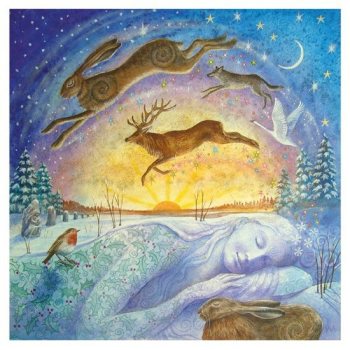
For thousands of years, people all over the Planet Earth have celebrated the Winter Solstice, the time when the Sun returns after the winter’s cold and darkness.
In pre-Christian Northern Europe, this festival was called Yule. The celebration of Yule predates the Christian holiday by thousands of years.
The etymology of the word Yule has been the object of much debate. Some believe it to be derived from the old Anglo-Saxon word Iul, which means wheel and connected to the Celtic concept of the Wheel of the Year. Other linguists say that this interpretation is unlikely, since the word for Yule, which they spell Yehwla, predates the invention of the wheel by more than a thousand years. Still, others have attempted to trace the word to Julius Caesar, or to Jolnir, which is another name for the Norse god Odin.
In the Northern Hemisphere, the Winter Solstice occurs on December 21 or 22, and practitioners of neo-pagan religions there celebrate Yule at the same time as the Christians celebrate Christmas.
In the Southern Hemisphere, the Winter Solstice occurs on June 22 or 23. In Australia, the Christian holiday is observed on the same dates as in the Northern Hemisphere (although Christmas dinner may be a backyard barbecue or a picnic on the beach). Australian neo-pagans, however, celebrate Yule at the Winter Solstice in June, the time when Scandinavians hold their Midsummer festivals.
Why is Christmas celebrated on December 25 when historical and biblical evidence indicate that Jesus Christ was not born on December 25, but in the Spring? A common theory is that the Christian church designated this date as the day of Christ’s birth to coincide with the Roman Saturnalia festival and the Northern European pagan midwinter solstice celebrations, in order to “facilitate” the conversion of “heathens.”
Most so-called Christmas traditions are rooted deep in ancient Yule rituals.
 The Vikings decorated the yule log, usually a large oak log with sprigs of fir, holly, or yew. They carved runes on it to call on the Gods to protect from misfortune in the coming year. A piece of the previous year’s Yule log was used to light the new log, and a piece of the log was always saved to protect the home during the coming year and to use to light next year’s fire. Today, most know the Yule log as a sweet edible.
 Even the Christmas tree also goes back to pre-Christian times. The Vikings decorated evergreen trees with pieces of food and clothes, small statues of the Gods, carved runes, etc., to entice the tree spirits to come back in the spring. The Romans also decorated trees with trinkets and candles at the Saturnalia festival.
Ancient myths also surround the mistletoe. The Vikings believed it could resurrect the dead, a belief connected to a legend about the resurrection of Balder, the Sun God.
 The Druids considered holly a sacred plant and believed that woodland spirits lived in it during winter time. (The Druids were the priests of the Celtic people, believed to have come from the Black Sea region about 4,000 years ago and spreading through southern and middle Europe, England, Scotland, and Ireland.)In ancient Rome, holly was the sacred plant of the Saturn, the god of sowing and harvest, and during the Saturnalia festival, holly was used to decorate homes, palaces and marketplaces in honor of Saturn. Romans also sent gifts of holly boughs to friends during the Saturnalia time. The Druids considered holly a sacred plant and believed that woodland spirits lived in it during winter time. (The Druids were the priests of the Celtic people, believed to have come from the Black Sea region about 4,000 years ago and spreading through southern and middle Europe, England, Scotland, and Ireland.)In ancient Rome, holly was the sacred plant of the Saturn, the god of sowing and harvest, and during the Saturnalia festival, holly was used to decorate homes, palaces and marketplaces in honor of Saturn. Romans also sent gifts of holly boughs to friends during the Saturnalia time. |
 Santa Claus is a combination of several pre-Christian legends. His origins have been traced back to Odin, who was depicted as a wise old man with a beard, riding on his eight-legged horse Sleipner. Another pre-Christian Santa forebear appeared at British, and later Saxon, pagan midwinter festivals. The Saxons called him Father Time, King Frost or King Winter and he was represented by an actor dressed in a green hooded cloak, wearing a wreath of holly, ivy or mistletoe.
 The Yule Goat is an old Scandinavian Christmas symbol, whose origins may go back to the legend about Thundergod Thor who rode in the sky in a wagon pulled by two goats. In the 19th century, the goat became the giver of gifts, with a person dressing up as a goat, a character later replaced with “jultomten” (Santa Claus). Today, Yule Goats made of straw are common Christmas decorations in Scandinavian homes.
The European Christmas ham is a heritage from Viking times when a wild boar was killed and sacrificed to the god Frey to assure a good spring. The meat was cooked and eaten at the mid-winter festival. This was accompanied by the burning of a giant Sunwheel, which was put on fire and rolled down a hill, to entice the Sun to return.
Today, neo-pagan, or Earth religions, are bringing many of the old customs back to life. Neo-pagan religions include wicca, pantheism, asatru, druidism, shamanism and many others.
From ancient times to the present day, the sun and its light have been celebrated by people all over the Planet.
In ancient Egypt, the Feast of the Burning Lamps honored the gods Isis and Osiris.
In ancient Rome, the Solstice Celebration was called Saturnalia in honor of Saturn, the Roman god of harvest.
The Hindu holiday Diwali, meaning Rows of Lighted Lamps, is celebrated like Christmas with decorating of homes, eating of sweets, etc., and is the most important festival in India. Different regions attach different legends to it, telling about deities winning victory over demons, symbolizing the victory of good over evil.
At the Jewish Hanukkah in December, one candle is lit for each day of an eight-day Feast of Lights.
The Chinese new year, usually celebrated in January or February, is based on a legend where fireworks and lanterns were used to chase away a dragon that came out of the Yellow River.
In Thailand, Loy Krathong, which means “Festival of Floating Leaf Cups”, has been celebrated for over 6,000 years. Leaf shaped boats with candles burning on them are launched into rivers to take away sins and grant good wishes for the new year.
The ancient Incas celebrated Inti Raymi, where the Sun god Wiracocha, was honored. The festival was banned by the Catholic church in the 16th century. Quecia Indians in Cusco, Peru, revived the festival about 1950, and it is now a major festival.
Native North Americans have celebrated both Solstices and equinoxes from ancient times, as shown by many stone structures aligned with the position of the Sun. The Pueblo tribes celebrate the Winter Solstice with rites focusing on Spring and rebirth. The Hopi Indians’ Soyal ceremony lasts for 20 days and includes purification rituals, blessings, and feasting. Other Native American winter celebrations include the Bear Dance, the Feather Dance, and the Navajo Night Chant.






 Paths I Walk
You must be logged in to post a comment.