Category: Herbs
HERBAL HOLIDAY TIP: STAY WELL WITH WINTER EOS

Virtually all essential oils have some antimicrobial properties, but winter is the season of the virus—which is particularly difficult to combat.
While there is no research to show that EOs can stop the flu in its tracks, there are several wonderful things essential oils CAN do to help us during the cold and flu season!
Citrus oils are known to get rid of airborne germs (Valnet, 1982) and can support the immune system and immune response. Several other essential oils are known for their affinity for the respiratory system and their ability to ease some of the symptoms of cold and flu.
Two of these essential oils are peppermint (Mentha x piperita) and eucalyptus (usuallyE. globulus). Note that these oils can overwhelm some respiratory systems, especially those of young children, so opt for an alternative if needed.
Spearmint (Mentha spicata) can be used instead of…
View original post 130 more words
25 Days of Herbal Holidays Countdown
2018 Holiday Sale on herbal courses!

Sunday, December 2
SPECIAL OFFER:
SUPER HOLIDAY DEAL ENDS TODAY!
SUPER HOLIDAY DEAL ENDS TODAY!
All programs are on sale, but our Herbalist Path Packages have super deals this weekend only to make the holidays even sweeter!
What are your goals as you explore your herbal path and education? Do you want to support your family with herbs and natural approaches to your health and wellness? Do you want to learn herbalism to round out your knowledge so you can start a business?
SHOP HERBALIST PATH PACKAGES – Super Sale ends Sunday!
Whether you are just getting started in herbalism or have been exploring this natural path for some time, you might realize that there are several directions to take as an herbalist! Perhaps you are interested in opening up an herb shop or selling your own natural body care products. Maybe your passion is for people, and therefore…
View original post 1,103 more words
Practice Essential Oil Safety

By Beth Schreibman-Gehring, Chairman of Education for The Western Reserve Herb Society unit of The Herb Society of America
 I love working with essential oils and have for several decades. It’s been lovely to witness their surge in popularity over the past 15 years. Essential oils are wonderful for diffusing and creating a relaxing aura of comfort. Certain oils like lavender, frankincense, and rose are skin care standards which, when used correctly, are lovely additions to any wellness program
While essential oils are great, consumers must know proper safety.
Without safety measures, bad things happen. For example, I’ve been to a yoga class where a well-meaning yogi dabbed oils directly onto my skin during shavasana to promote relaxation. In theory this would be lovely, but it could cause an allergic reaction for some people. The yogi should be aware of the participants’ sensitivities.
 In another case, I saw a young woman…
View original post 256 more words
Food as Medicine: Anise (Pimpinella anisum, Apiaceae)


Anise or aniseed (Pimpinella anisum, Apiaceae) is an herbaceous annual that grows to almost a meter (3.3 feet) in height.1,2 The lower leaves of the plant are dark green, heart-shaped, and shallowly lobed, while the upper leaves are feathery. In the summer, the plant produces small, white flowers in an umbrella-shaped head, and, in the fall, these flowers produce aromatic fruits that are three to four millimeters in length. These fruits, called “anise seeds” in the market and referred to in the rest of this article as “seeds,” are the medicinal and culinary portion of the plant.
The cultivation of anise, which is native to the Anatolian peninsula, Greece, and Egypt, has spread to other countries. The plant grows well in warm, frost-free climates.3,4 Anise should not be confused with fennel(Foeniculum vulgare, Apiaceae), licorice (Glycyrrhiza glabra, Fabaceae), or star anise (Illicium verum, Schisandraceae), which have…
View original post 2,028 more words
Bittersweet … A Tale of Two Sisters
By Kathleen M Hale, Western Reserve Herb Society
The Sisters’ Shame
We were two daughters of one race;
She was the fairest in the face.
The wind is blowing in turret and tree.
They were together, and she fell;
Therefore revenge became me well.
O, the earl was fair to see!
Alfred, Lord Tennyson
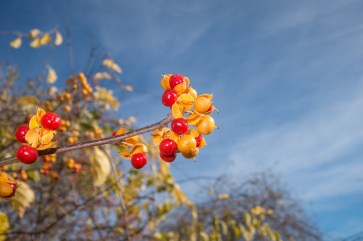 A lot of legends of magic, revenge and sorcery begin with two sisters. Sometimes they are friends. Sometimes they are rivals. But an unspoken message in many stories is, “Don’t pick the wrong one!” Increasingly, North American gardeners are finding themselves faced with this dilemma. The choice may be between a native plant and its sometimes seductive, sometimes invasive sister, introduced from elsewhere.
Bittersweet gives us such a story. American bittersweet, Celustrus scandens, is seen everywhere this time of year in wreaths and dried arrangements. It has tiny vivid orange fruits…
View original post 434 more words
Home-Grown and Wildcrafted Smudge Sticks: Plant List and Recipes

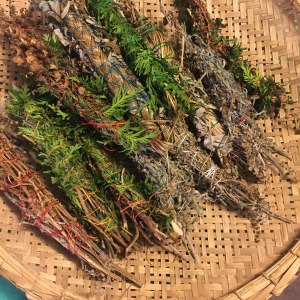 Basket of newly made smudge sticks
Creating homemade smudge sticks with local ingredients is a wonderful activity to do this time of year. As the plants die back, you can harvest whatever you aren’t using for other purposes and create a number of beautiful smudges that can be used for many different purposes: clearing, honoring spirits, protection, setting intentions, letting go, bringing in, preparing for ritual or mediation, and much more.
A few years ago, I wrote an initial post on homemade smudge sticks using local ingredients–this has become my most popular post on my blog. Given that, I wanted to offer a follow-up post with some additional information and share a few smudge stick recipes for specific purposes. For initial instructions on how to make your sticks, please see my first post. This post expands the plant list that you can use to make smudges and also offers…
View original post 2,497 more words
Making Smudge Sticks from Homegrown Plants and Wildharvested Materials: Step by Step Instructions with Cedar, Rosemary, Sage, Mugwort, and More!
I recently posted about my research on Eastern White Cedar, and I wanted to follow-up that post with information on making smudge sticks, inspired by Eastern White Cedar. Smudge sticks are bundles of herbs that are dried and burned for purification and ceremonial uses. They come out of Native American traditions, but today they are broadly used by many for their purification purposes. I use them as a druid in my ceremonies, to bless and cleanse my house, to cleanse outdoor spaces that are in some kind of energetic funk. But I also use them practically–as a blessing for my garden at the start of the growing season, as a way to remove hostile energies from my chickens who aren’t getting along, or to pass among friends before sharing a meal. They are a great way to bring a bit of ceremony and the sacred into the everyday.
 Freshly Wrapped…
View original post 2,564 more words
Food as Medicine: Date (Phoenix dactylifera, Arecaceae)
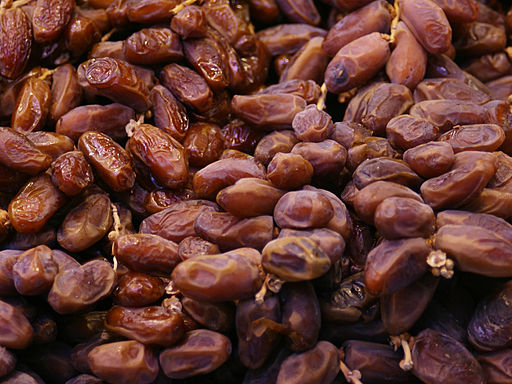
The date palm (Phoenix dactylifera, Arecaceae) has been cultivated for more than 5,000 years.1 Because of this long history of use and cultivation, the exact origin of the date palm is difficult to pinpoint. Dates have been harvested for centuries in northern Africa and the Arabian Peninsula, and have played a large role in the economies of countries where the plant grows.1,2 The largest global producers of dates are Iraq, Egypt, Saudi Arabia, Tunisia, Algeria, the United Arab Emirates, Oman, Libya, Pakistan, Sudan, and the United States.3
The date palm is a large palm tree and grows about 49-82 feet tall.1 The palm leaves are 1.5 to 11.5 inches long.1 Around the trunk of the date tree, the palm branches grow in a spiral pattern and form a crown with hundreds of leaves that are gray in color.2,4 The leaves have a…
View original post 2,299 more words

 Paths I Walk
You must be logged in to post a comment.