Author: Paula Cas
I write fiction, non-fiction, verbiage for all our websites, and have been publishing my fan fiction on my various sites for many years. https://paulacas.com
I am a Spiritual Medium and use Tarot cards as one my primary tools in doing readings. For 30 plus years have been doing readings in settings from my living room to truck stops. I tell you what Spirit wants you know for your betterment, not what you think you need to know.
I’ve worked on computers since before there was such a creature as Windows.
A Mountain Maryland native, but have spent years spent living in Oklahoma, Colorado, Texas, Oregon, California, Nevada, and Arizona. My husband, Oro Cas, and I spent 10 years driving tractor-trailer across the 48 contiguous states.
Oro Cas and I produced and hosted Internet Radio shows on BlogTalk Radio, video productions on KDCL Media and Oro Expeditions YouTube Channels.
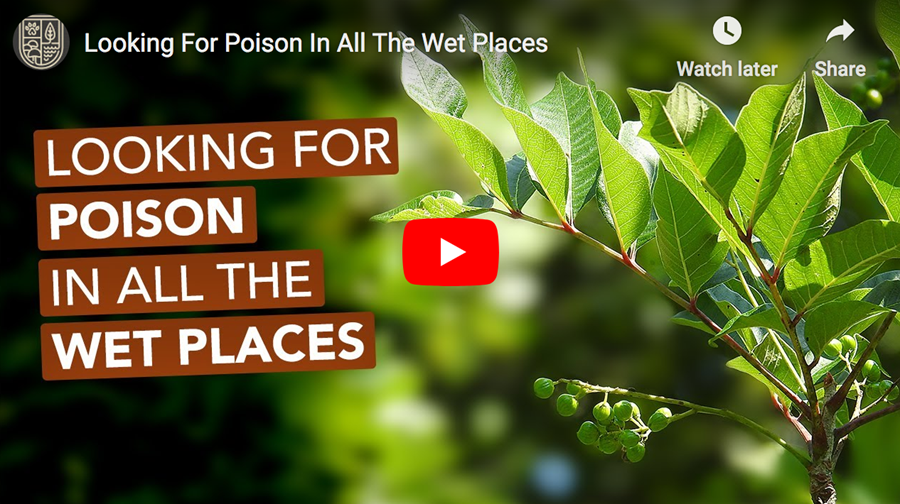
Looking For Poison In All The Wet Places

Greetings,
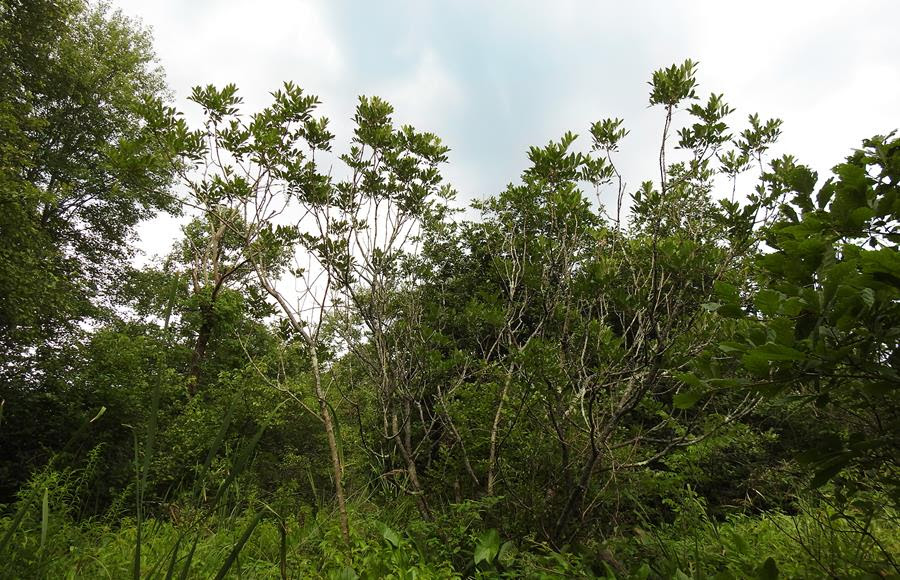
Swampy wetlands can be unforgiving places during the summer months. The vegetation is thick, the mosquitoes are hungry, and the lack of tree cover forbids any kind of refuge from the mid-day sun.
Strange as it may seem, I still find myself drawn to these soggy habitats in search of organisms that are not commonly encountered elsewhere. Wet feet and insect bites are small prices to pay in exchange for opportunities to observe and learn new species.
During a recent trip to one of these remote wetlands in western Pennsylvania, I experienced quite a spectacle: the flowers of swamp rose; the immature fruits of winterberry; and the thread-like stems of dodder intimately engaging with every herbaceous plant in sight.
Amongst this activity, I couldn’t help but notice a shrubby plant inhabiting the margins. Insects were crawling up and down its branches and birds were singing in its canopy, but I knew that any physical contact between the plant and my skin could result in serious consequences.
This plant, which is known as poison sumac, can lead to painful rashes in over 85% of humans. Susceptible individuals experience symptoms similar to (and reportedly worse than) the reactions caused by poison ivy.
Instead of avoiding the plant, I decided to film a video in which I discuss not only the unique ability of poison sumac to cause skin irritations in humans, but also its ecological value in supporting the health of other organisms.
If you are interested in learning more, check out the new video!

I was a recent guest on the Wild Fed Podcast hosted by Daniel Vitalis. We covered lots of topics in this interview including plant and fungal interactions, the sustainability of gathering food from the land, the importance of learning non-edible species, and lots more. You can listen to the conversation here.

Speaking of plant and fungal interactions, did you know that wild blueberries depend on fungi for sustenance? Without these inter-kingdom relationships, far fewer blueberry shrubs would probably exist. Check out a recent Instagram post to learn more.
Thanks for reading and watching, and thanks for your continued support!
-Adam Haritan
Lughnasadh for Solitary Practitioners

In a typical year, at Lughnasadh, my grove would be gathering for our favorite celebration of the year. This is typically a weekend of rituals, feasting, fire, and merriment, all hosted here at our homestead in Western PA. With the pandemic raging around us, this kind of gathering cannot happen at present. As much as I enjoy our yearly Lughnasadh gathering, I’m taking time this year to focus on my solitary practice and enjoy Lughnasadh in a different way. Looking at the history and lore of Lughnasadh offers some wonderful solitary practices that honor the history of this holiday and have a fun time. For a historical look at Lughnasadh (and where some of the inspiration for this post was drawn), you can see Máire MacNeill (1962) The festival of Lughnasa: a study of the survival of the Celtic festival of the beginning of harvest published by Oxford University Press…
View original post 881 more words
Spicebush to the Rescue


By Kaila Blevins
 While on a volunteer trip in Orlando, Florida, I was desperate for bug spray. In the middle of December, the mosquitoes nibbled on any exposed skin they could find, leaving me and the rest of the unprepared Maryland native participants with patches of red swollen bumps on our ankles and arms. Our guides, a retired couple who volunteers with the state parks, became our heroes on the second day of the trip. During our lunch break, the husband saunters over to us, carrying a branch from a nearby shrub and states, “This is spicebush. Crush its leaves and rub it onto your arms. Keeps the bugs away and helps the itch.” Immediately, we passed the branch around, ripped the leaves off the branch, crumpled them, and rubbed the lemon-peppery scented oil onto our skin.
A couple years later, I would learn that spicebush (Lindera benzoin)…
View original post 547 more words
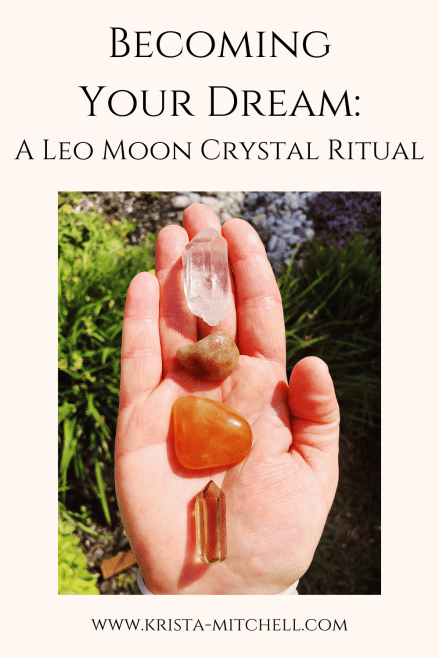
BECOMING YOUR DREAM: A LEO MOON CRYSTAL RITUAL
Blessed new moon 🌚
This is an interesting one, because astrologically-speaking, this new moon went into Cancer a second time before going void of course and changing into Leo at 4:16pm ET today (where it will remain there until it goes void of course tomorrow at 8:27pm ET).
I got to the game late, only attuning to the moon through the crystal consciousness at about 4:50pm, so while everyone else is posting about the Cancer new moon, here I am writing about the Leo moon!
I’ve decided to go with it, because honestly, I think many of us (myself included) could do with a little Leo moon juice + some joyfully mad-passionate crystals right now…
MY LITTLE LEO MOON CRYSTAL RITUAL
When I tuned in to this new moon energy through the crystal consciousness, this question came through to me:
“What if you could be the biggest, boldest version of yourself?
This world is demanding the best of us – what does that mean to you?
The radiance of Leo is the enlightened leader. The creator. The warrior. The golden-crowned heart.
What does that inspire inside you?
What dreams or visions does that stir?”
Here’s something I have learned from my experience: Anything you can envision or desire, that feels in alignment with your heart and spirit, already exists as a spark in your soul.
This means that the energetic alignment, the blueprint that can manifest, co-create, or attract it into being only needs your energy to fuel it.Your energy is your thoughts, your feelings, and your actions, all focused in the direction of your vision.
What can halt us is believing in lack: not enough courage, or resources, or inspiration, or worth to see it through.
Here are the crystals, all very Leonine in nature, that are speaking up for you right now in favor of your dream:
Read original article at: Krista Mitchell ~ Becoming Your Dream: A Leo Moon Crystal Ritual
Entering the Corn Moon Cycle | New Moon in Cancer Moonthly Lunar Report
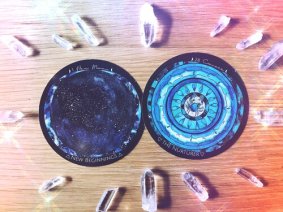
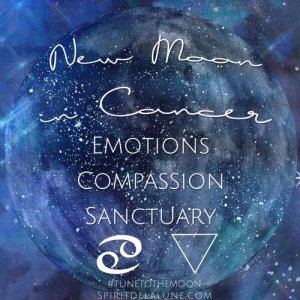
Happy New Moon in Cancer!
This new moon is known as a “Double New Moon” because it is the second new moon in a row in Cancer. This means that you might need to revisit or rethink your intentions from last month. Look at this new moon as a second chance when it comes to reaching for your goals. You might find some aspects of your intentions or goals from last month need reviewing or rethinking before they can really take off.
This new moon in Cancer also happens to be opposite Saturn, which can mean many will be faced with restriction or feeling overburdened. Remember that it’s just a phase and whatever challenges you might be facing right now will not last forever.
The moon turns new on July 20th in her home sign of Cancer. When the moon is in Cancer, you might feel called towards tending and nurturing your own home, family or cultivating a sense of home wherever you are.
Read original article at: Spirit de la Lune ~ Entering the Corn Moon Cycle|New Moon in Cancer
Sacred Tree Profile: Staghorn Sumac (Rhus Typhina)
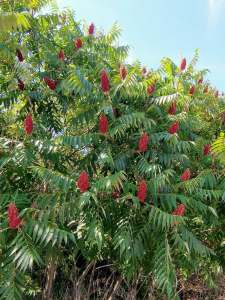 A lovely stand of staghorn sumac in bloom!
As we begin the march from summer into fall, the Staghorn Sumac are now in bloom. With their flaming flower heads reaching into the sky, the Staghorn sumac are striking upon our landscape. As fall comes, the Staghorn Sumac leaves turn fiery red before dropping and leaving their beautiful, antler-like, and hairy stems behind. All through the winter months, the Staghorn Sumac stems stand like antlers reaching into the heavens, until they bud and spring returns again. This post explores the medicine, magic, ecology, herbalism, craft, and bushcraft uses, and lore surrounding these amazing trees.
This post is a part of my Sacred Trees in the Americas series, which is my long-running series where I focus on trees that are dominant along the Eastern USA and Midwest USA, centering on Western PA, where I live. Previous trees in this series have included:
View original post 2,327 more words
Lift Your Personal Power, Health, and Success with Herbs of the Sun | Guest Contributor

Herbs of the Sun: angelica, ash, bay, calendula, chamomile, celandine, eyebright, frankincense, juniper, mistletoe, rosemary, saffron, safflower, Saint-John’swort, sunflower, tormentilla, walnuts
THEIR PROPERTIES:
Colors: gold, orange
Energies: self-confidence, success, vitality, courage, authority, dignity, fame, self-knowledge
Number: 1
Metal: gold
Stones/materials: diamond, citrine, yellow jasper, topaz
Deities: Ra, Apollo, Helios, Lugh, Isis, Diana, Brigit
In Astrology, the Sun and Moon are called “Planets” for ease of interpretation, but they are obviously not Planets in the scientific sense. In medicinal terms, the Sun could be considered the great restorative. Even as the returning Sun allows plant life to flourish on the Earth, the herbs attributed to the Sun act to restore health and vitality. They stimulate and balance the human health system that suffers from either excess or deficiency.
Many of the plants attributed to the Sun may be considered Solar simply on the…
View original post 835 more words
A Day In the Garden – Urban Moonshine


GO INTO THE GARDEN EVERY DAY, NO MATTER WHAT.
That’s the promise I made at the start of the season. It will be a daily ritual, a practice to keep me in tune with the growth and health of the garden, and a sure way not to miss a bit of garden gossip. Like a bustling city full of honking horns, buses whizzing by, and street conversations half-heard, there is endless activity to observe. Cucumber beetles rapidly working to destroy the cucumber crop. Birds ravishing the cherry tree singing loudly to their friends to join in on the feast. Earthworms patiently turning the soil underfoot. Never a dull moment, but you need to go to the garden every day to keep up.
That has been my biggest lesson gardening this year. If you’re not there to enjoy the first ripe strawberries, the squirrels will be happy to take on that…
View original post 1,040 more words
Herbalism: A new era (Coronavirus – an Invitation) — John J Slattery Bioregional Herbalist, Forager, Author

A bioregional herbalist’s look at the Coronavirus (CoV 2019) and important herbs to consider prior to and during exposure
So I thought I’d take some time to write about some of the herbs that I feel will be important upon exposure to CoV-2, but first, to help put some of this in perspective.

Mexican elder leaf (Sambucus mexicana, syn. S. cerulea subsp. mexicana, syn. S. cerulea, etc.)
Elder s one that is often brought up in any discussion of viruses. Not only does elder help prevent attachment through inhibition of neuraminidase, but it also protects ACE-2 making it exceptionally important at the early stages of prevention and limiting the initial impact of the virus. Another aspect of the elder’s effect on humoral immunity is to increase T cell production. This is important due to the virus’ effects on the dendritic cells of the lungs as the progression advances. This hinders…
View original post 1,386 more words


You must be logged in to post a comment.