The dryad is the spirit of the tree, its essential pattern. It is a living being linked to the tree and growing with it, but at the same time, it is a trans-temporal and trans-spacial creature, living in the Astral dimension as much as in the mundane world. When a branch falls off a tree or is pruned, the dryad spirit is still in the wood. It is not really correct to speak of “parts” of a spirit, but one might consider the spirit of the wand to be part of the tree’s consciousness.
Some writers suggest that trees withdraw their life from a branch when they sense it is going to be cut and there is doubtless something to such observations. Nevertheless, in my experience, the spirit always remains to some degree and can be awoken by enchantment when the branch is crafted into a wand.
Now, of course, orthodox mundane botany does not usually accord consciousness to trees. In the Alferic tradition and in most schools of Druidry, trees are considered to have spirit, mind, and consciousness, as well as will and emotions. Indeed, in my experience, trees have a larger proportion of emotion than intellect in their souls. They do not ratiocinate the way we do, but they do ponder and brood.
As Prof. Tolkien so rightly observed in Lord of the Rings, many trees today are sleepy. If the druid touches them and makes contact with their dryad spirit, they sometimes at first seem sluggish and hard to reach. Other trees respond immediately to such attention with the same kind of reaction many of us would have if suddenly touched by the mind of another being.
Still, it is misleading to anthropomorphize dryads. They share many of the spiritual qualities with us, but they do not think or live like human beings. In their present incarnation, trees are fixed and immobile. A great deal of their attention is directed into the ground through their roots and outward into the air through their branches and leaves. They do move, of course, in the process of growth and in harmony with the winds, rain, and sunlight. Deciduous trees drop their leaves and grow new ones, many drop seeds or flowers.
So there is a great deal of activity in trees but it is the sort that, in humans, remains largely unconscious. We too produce seeds and eggs, grow hair and nails and new skin, and throughout childhood, our whole body is growing. Even in adulthood, the body changes shape.
But trees have very different bodies and their spirits are diffused throughout their bodies without the distracting narrow focus of a brain steeped in language. Thus trees, unlike humans, have never suffered from the dichotomy of mind and body. If their consciousness dwells on different parts of their being, it is on the roots, the trunk, and the branches. The leaves are the most sensitive organs of trees, but the bark is also very sensitive, flowing with tree-blood underneath, just like skin.
Although many of the woods are traditionally associated with one of the four classical elements (Air, Fire, Water, Earth), dryads are spirits that do not fall simply into one of these elements. Rather, they embody the fifth element recognized in the Taoist system: Wood. They are representative of all of the four elements combined into a fifth that is a living organism.
Trees are the pinnacle of the plant kingdom, as humans are often imagined to be the pinnacle of the animal kingdom, filled with nobility, grandeur, often great age, and wisdom that comes from a long life in one place. We are indebted to them in ways that are often incompletely realized: in the gift of oxygen, wood, and paper trees have made human civilization possible. They are, thus, mystically speaking, the midwives of all intelligent life and human creativity. The Quintessence is often described as Spirit, but it is enlightening to consider this “Fifth Element” as Wood for the trees point upwards to the sun, stars, and heavens, to the invisible Spirit, which is not an “element” at all, but the essence that underlies all manifestation.
The Magical Properties of Trees
The Celtic Oghams and druid traditions identify certain properties with certain sacred trees. The oghams of old are rather enigmatic, to say the least. In Gaelic “ogham” is pronounced oh-um while in Elvish the word is spelled ogam and pronounced og-am, with a short “o.” The Irish oghams seem to have originated as a counting system and the numerical values later given phonetic values, and then poetic ones as part of a complex mnemonic system used by the bards in the Middle Ages. In Elvish the word itself might be translated as correspondences; that is, the use of runes to symbolize a complex of associations and archetypes.
The Elvish Rianar (or “runes”) which are in a form similar to Norse Futhark, are more than just letters and their use as symbols of different trees is highly significant to their use. Ogam, in Elvish, might also be translated as “mysteries.” The Irish ogham reconstructed by the poet Robert Graves in his book The White Goddess has been adopted by many modern druid orders. While some of these properties or characters accords with the Alferic Ogam, there are also differences. In the latter system, each wood is linked to a rune which symbolizes the complex of magical correspondences embracing not only wood, but also stone, bird, animal, color, and time.
I have included here only those types of wood that are currently available for wand making. Some are more plentiful than others. the exotics are available only in milled stock but the others are mostly taken from natural branches. I have here indicated their primary Elemental association, connections to the Mellarin (the Mighty Ones), and correspondences through the elvish ogam system to the solar calendar and principal festivals. These are according to the Elvish traditions, but I have also included associations with divinities from other pantheons and folklore from other sources.
Some magical applications are listed for each wood, but it should not be thought that any wand is limited to particular types of magic. Rather, I intend to indicate those powers that are especially suited for each respective wood and best fit the common character of a species. At the end of each entry are also included links to other web pages containing articles on each respective tree.

Trees of Elemental Earth
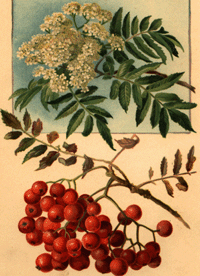
Rowan (Luis)
Also called the Mountain Ash, and Quickbeam for its powers of bestowing and enhancing life, Rowan is sacred to Capricorn. It especially bears the power of the Dark Goddess, the Crone aspect of Mother Earth, and through her the power of fiery Abban, Vulcan, Lord of craft, mountain, and metalwork. Rowan flowers and bright orange berries are marked by the pentagram, symbol of the five Elements; the berries, often retained through Winter, symbolize the endurance of Life through the dark of the year. Also called Witchen or Witchbane Rowan has been considered the enemy of all evil witchery, and protects against one being carried off to Faerie against one’s will.
A tree of astral vision and protection, particularly good for warding off evil spirits, Rowan traditionally is said to avert storms and lightning and bring peace. The fondness of songbirds for Rowan berries gives the tree a link to the bards, and the Goddess Brigid in her role as Muse of poets. It is a tree associated with serpents and dragons and sacred places, the leylines or dragon-lines of Earth energy. The dragon embodies primal energy, a strong force of creativity and natural flow, which cannot be “slain” or “tamed”. Indeed “slaying the dragon” in Christian legend is sometimes confused with modern technology’s notions of dominion over Nature.
Dragon energy is drawn into harmony when we enter into a partnership with it through the erection of standing stones at intersections of the dragon lines, or by directing it in a Rowan wand. Rowan’s power is doubled by the inclusion of a dragon-scale core when it is fashioned as a wand. It’s Elvish name, Luis, comes from the root lu “time” also found in luras “to judge.” Elves frequently hold their judicial assemblies under old Rowans. Especially suited for magic giving form and order, ritual, growth, fertility, protection, women’s autonomy, poetry, weaving and spinning, and geomancy or work with ley lines.
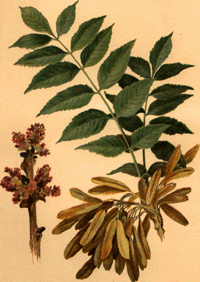
Ash (Nuin)
Sacred to Virgo and its ruler Mercury, the planet of intellect and reason, Ash is a wood associated with many divinities. The number of its house is nine (thrice three). The Ash appears in Norse myth as Yggdrasil, the World-Ash or Tree of Life from which all the worlds spring. In this respect, it is the pathway or bridge by means of which the wizard may travel among the worlds. Mystically, Ash signifies the Astral dimension and its myriad doorways. Beneath the World-Tree, Yggdrasil, the three Norns or Fates dispense judgment over gods and men. A dragon lives in the roots of the World Ash and an eagle in its branches; the goat of Odin feeds upon the leaves and turns that food into Ambrosia, the drink of the gods that provides immortality.
Hanging upside down on the Ash tree, Odin drank of the spring of destiny at its roots and the runes were revealed to him. Tradition holds the Ash also to be sacred to Llyr and the Greek Poseidon, Lord of Sea, horses, and metamorphosis. Like the Sea-Goat Capricornus, Ash unites Earth and Water in the primordial energy in which all potential lies. Poseidon, Odin, and Thor each wielded a spear of Ash, symbolic of an irresistible magical Will and invincible protection. The Greek goddess Nemesis carried an ash wand as a symbol of divine justice. With it, she ensures that fortune (good or ill) is shared among all people and not only by the few. Nemesis is also called “Nemesis of the rainmaking ash” identified as Andrasteia, daughter of the sea god Oceanus.
One of the few surviving Druid wands of old, found in an archeological dig, was made of Ash with a sunwise spiral design, symbolizing Ash’s links to the Sun. So generally magical is the Ash that it is the wood used for Yule logs and Maypoles and in some traditions the brooms of witches. In the Alferic pantheon Olobaal, the Sea Mother, whose body moves with the moon is a feminine figure. She is the devouring Mother who consumes, swallows, and gives birth to all life. She is the goddess of water, sea, and ocean, twin sister of Vashaan, the Wind Lord, as Poseidon is the brother of Zeus. She is great and terrible when incited to Tempest by her brother; calm and beautiful when she is embraced by the Sun Obraash; fecund when touched by the Moon. She can take any form and is also a goddess of war.
In Alferic tradition, it is out of ash-wood that Olobaal fashioned her scepter and the haft of her magical harpoon. Thus, it may be seen that Ash is as much attuned to Elemental Water as Earth, and so is the consummate wood of growth and fecundity, mothers and daughters, and female sovereignty. It is a wood of balance and the marriage of opposites. Well-suited for shamanic magic, protection, and to enhance one’s skills at any art or craft, the magic of wells and caves, Earth as the vessel of water, finding roots or working with plant roots, the magic of horses, oceans, conquest, justice, and weather working.
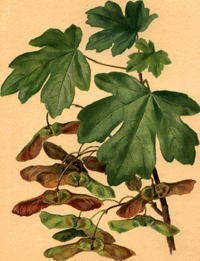
Maple (Shorin)
Sacred to Alban Elved (the Autumnal Equinox) because of its fiery red and orange colors as its leaves turn — a bold celebration of the season and the cycle of death and rebirth. Poised on the equinox, it is linked to both Libra and Virgo, Hazel and Ash. Maple’s sacred bird is the Great Horned Owl who is the herald of the coming Feast of Samhuinn with its magic and mystery. The owl is a bird associated with wizards and wisdom, and the bearing of messages in the night.
In North America, especially in its northern parts, the Maple is a dominant tree with many varieties, including the sugar maple from which maple syrup was made by the Native Americans. As such it is associated with the life-giving sap of the trees, providing food and sweetness for those who treat it with respect and care. Alban Elved is also known as the Feast of Mabon, dedicated to the reborn son-consort of the Great Mother. The Dying God is also the Giant Ymir of Norse myth, from whose body the world was made. Maple is a strongly masculine wood, somewhat rebellious and tough, but with a beautiful smooth grain; hard, yet excellent for carving. Well-suited to spells of sending and communication, binding, transmutations, creation, revolution, rebirth, healing, beauty, art, and abundance.
 Elm (Elma)
One of the tallest ancient forest trees, graceful in its chalice shape, Elm is sacred to the Great Goddess in her form as Wise Grandmother. She is the Qabbalist’s Briah, manifest in the planet Saturn. Elm is also called “Elven” for its connection to the Elves and Faerie mounds, and so to burial mounds, and to death as the doorway eternal life.In recent times, as many ancient Elms have been killed off by Dutch Elm disease, the tree has come to symbolize and embody the struggle of Nature against humanity’s destruction of the old forests through short-sightedness or the transportation of diseases from other parts of the world. Elm’s spirit is majestic and expansive, rooted and wise. Well-suited to the magic of Earth and invocation of the Goddess, healing, fertility, gardening, rebirth, destiny, wisdom., a passage from one life (or phase of life) to another, metamorphosis, endurance.

Blackthorn or Plum (Emrys)
Plum wood is not a wood expressly included in the sacred tree lists of the Elves or the Celts; however, it is closely related to its sister, the Blackthorn, which is known as a Faerie tree of dark omen, strong in protective magic. They are treated together here because I have better access to plum than to blackthorn. Besides this, when it comes to wandmaking, I feel that it is better not to mess with the blackthorn tree. Plum trees are much less severe and do not seem to be used by the Good People to guard their hollow hills.
Sacred to Abban, God of Craft and Mountains, Plum is a fruit wood and so bears powers of fertility but its thorns evoke powers of great reserve and protection, the setting of boundaries, and the ability to dissolve them. Abban, like the Greek Hephaestos, is a jealous spirit of creative fire, whose devotion to art transcends all other concerns. The wood itself is harder than Apple but has a similar creamy color, and the branches are tough, knotty, and thorny.
Thus Plum is a consummate wand wood for the creative artist or anyone desiring to focus on magic that will enhance skill, overcome barriers, keep people or disturbance at bay, evoke toughness and persistence, patience, protection, and healing, especially of the blood. It is also well-suited for the divining of precious metals or minerals.

Trees of Elemental Air
Hawthorn (Huathe)
Hawthorn or Whitethorn is sacred to Aquarius and Vashaan, the Windlord, the Thunderer, whom the Elves call Valma. He is the Norse Thor and the Greek Zeus, god of Sky and storm. This is a tree of defense with its twisted branches and sharp thorns, and it holds the power of lightning. Some loremasters say it can detect the presence of magic because it is a tree in which magical powers enter the manifest world from beyond. Its sacred color is violet and it is especially attuned to this band of the magical spectrum with its focus on powers over other kinds of magic.
Well-suited for all protective magic and all magic aimed at strengthening one’s magical powers, spells of control, or warding, sending, detection, concealment, weather working. and protection against lightning and evil spirits.
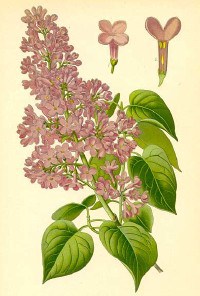
Lilac (Galad)
Sacred to Gemini, the Twins, lilac brings the root energy of expansion and growth, that underlies intellectual and spiritual prosperity. Such energy is the burgeoning of Spring flowers, sacred to the androgynous and quicksilver Mercury, whose domain is writing, speech, song, reason, and travel by sea, air, and star.
Lilac is sacred to bards and its intoxicating fragrance bespeaks erotic and creative power. Galad comes from the root gal, meaning “gift” from which other words derive: galian “hospitality,” agalla “sexual pleasure,” gaellië “delight,” melengal “mystic union.” All of which suggests the mysteries of gifts and giftedness, talent, and the communication of love through delight.
Lilac wood is close-grained, creamy, and smooth, excellent for carving intricate interlace patterns. Well-suited to the magic of union, attraction, enhancement of sexual pleasure, intellectual pursuits, imagination, information, mental concentration, travel, illusion, detection, divination.
Hazel (Koll)
Sacred to Libra and the Celtic goddess Arianrhod, called Shava and Ardiana by the Elves – the White Goddess of Stars and the Queen of Heaven. In Roman and Greek myth she is Venus and Aphrodite, goddess of love, but for the Elves, she is the goddess not so much of carnal love itself, but of the enchanting power of beauty. She is named Danu by the Celts, the grandmother, and is called Spider Grandmother because she created the starry net of the night sky. Her web is manifested in the twining limbs of the forest trees as they reach upwards in the worship of her.
Hazelnuts feed the Salmon of Wisdom in its deep pool. Its color is midnight blue, its stone lapis lazuli or blue sapphire. It’s bird is the crane. Shava is considered the teacher of enchanters and all worthy wizards and bards are summoned to her table. Sacred to Shava, Hazelwood is imbued with magical power. It’s nuts feed the Salmon of Wisdom in its deep pool. The hazelnut is also connected magically to the heart chakra. Well-suited to the magic of wisdom, beauty, charm, love, stars, navigation, and creativity.

Cedar (Chakris)
Sacred to the cross-quarter feast of Imbolc, which in the Elvish tradition, is the Feast of Shava, Queen of Stars. Yet it Cedar is also associated with the goddess Sezh or Persephone in her Underworld time, withdrawn from the mundane surface of existence during the season of snows. Evergreen Cedar is sacred, like Juniper, for the promise of eternal life. Its number is thirty, its color pale yellow, and its bird the goldfinch. Chakris recalls the Cedars of Lebanon, the wood from which the great Jewish Temple of Solomon was built. Associations with Solomon are, of course, always magical, that great king being legendary for his powers of magic and ability to bind spirits to his service.
Cedar is a wood of protection and preservation. Imbolc or Oimelc is also, traditionally, the time of the lambing when the milk of the ewes comes, thus the linkage of the festival to milk, as well as to light. Chakris symbolizes and embodies the light in the darkness, and the brilliance of the Star Goddess in the inky blackness of the interstellar void. Cedar is especially powerful for clearing negativity from an area prior to magical work. The tree is also called Arbor Vitae, Tree of Life.
Especially suited to preservation of sacred places, forests, and groves, the dedication of sacred space for worship and magic, bringing of light out of darkness, star magic of all kinds, and summoning of helpful spirits.
Apple (Queris)
Sacred to the Feast of Lughnasa and the Celtic Goddess Rhiannon, who is also one of Shava’s masks, as Goddess of Stars and also of horses. Apple harvest comes on and after the feast of Lughnasa (August 1st) and marks one of the major foods of the Elves, often associated with the Faerie realms and the Isle of Avalon. Thus the wood has the power of Avalon and the immortality of the Faerie realms. The Q-rune is also called Quenda, in Elvish Eranor, which is the Rose bush whose bright colors evoke the spirit of light and love in the season of Lugh, or Obraash, Mellar of the Sun. It’s sacred number is seventy; its sacred bird the rose-breasted grosbeak.
Shamans and ancient poets are often described carrying apple branches as symbols of their office and the famous Silver Bough of Apple provided entry to Faerie. Especially suited to opening the doorways into Faerie, spells to do with horses or travel, illumination, enhancing any skill, love, harmony, and beauty, harvest, and magic of divine, shamanic madness or visionary experience.

Linden (Ohm)
The Linden, also called Basswood and Lime-tree, is the tree most sacred to the goddess Shava, who may be found in Celtic Arianrhod, and Greek Aphrodite: Queen of Stars and Love. Her nature is as much fiery as airy being the spirit of Divine Light. Linden wood is laden with the power of attraction that underlies not only love, infatuation, and harmony, but also the very fabric of the material cosmos in such forces as magnetism, adhesion, and gravity. It is a wood of truly cosmic power on every dimension and sphere of the Tree of Life. Linden is a very light, airy, and smooth wood, excellent for carving and capable of supporting fine details.
Especially suited to star magic, spells of creation and transmutation, illumination, love, attraction, healing, enhancement of beauty and peace, and acts of enchantment.
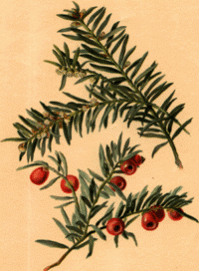
Yew (Ioho)
Sacred to Mercury, the spirit of intellect, thought, and communication and master of magic, incantations, and runes. He is also the psychopomp, guide of souls from one world to the next. As such, the evergreen Yew bears powers over travel between the worlds. In the Elvish pantheon, Mercury is Islaar, a shape-shifting, androgyne who is both the great Teacher and the mischievous Trickster. Patron of thieves as well as Poets and Seers, Islaar is a mystic power as well as the divine spirit of thought. As Trickster, he is the inspirer of wit and eloquence. The Yew is the tree of the Ovate, the seer and healer in Druid tradition. As such it bridges the worlds and opens doorways into the Otherworld.
Yew is especially suited to spells of transformation and transfiguration, illusion, astral travel, mediumism, necromancy, the conjuration of helpful spirits, guides and ancestors, and also spells to bestow knowledge, eloquence, or persuasion.

Trees of Elemental Fire
Oak (Duir, Dwyr)
The most powerful and sacred of Druid woods, Oak is magically linked to the constellation Leo. It holds power to draw lightning or the bolt of inspiration. The Sun, which rules Leo, is the source of life and light. Psychologically it is the center of the Self. Oak symbolizes all solar heroes, those who venture out from their homelands to achieve great deeds and bring home wondrous treasures. Oak traditionally provided not only one of the most durable woods for construction and fuel, but also the acorn from which the early tribes fed their pigs throughout the winter.
Oak is one of the longest lived trees, thus embodying great wisdom as well as strength. The name Duir is related to dwyn, “door,” or “portal,” the great door of a manor dwelling. It is also, of course, often linked to drwyd, “druid” or “wizard.” As the wizard wood, there is no more magical wood for wand making and it is especially noted for enhancing the endurance of spells against time and counterspell. The acorn is associated magically with a helmeted head and so to the crown chakra.
Natural branches of Oak are often twisted and gnarly and have a coarse, dark grain. It is a hard and heavy wood. Especially suited to the magic of kingship and wise rule, personal sovereignty, authority, power, protection, sealing or opening doors, endurance, and invocation of wisdom, fertility, and abundance.
Holly (Tinne)
Associated with the Holly King who defeats the Oak King at Midsummer each year and reigns until the Winter Solstice, Holly is one of the fieriest of woods and second only to Oak for its sacred regard by the Druids. The Gaelic “tinne” is thought to mean “fire.” Its rune in the Alferic Ogham is the same as the Futhark rune Tyr, and like that rune is associated with the Spear, one of the magical weapons of the Tuatha de Danann, and also of Odin. The spear is one of the prototypes of the magical wand, a phallic , yang instrument for projecting will and inseminating matter with life and creative seed-forces.
Mars, or in Elvish the god Ambash, rules Holly. Ambash is also associated with the Wildman of the Forest, the untamable power of the forest depths and its procreative essence. It is associated with Midwinter but actually reigns over the “dark half” of the year when the solar tide is waning, from Midsummer to Midwinter. Oak rules the waxing tide of the sun. It is calendrically associated with Capricorn as the Constellation presiding at the Winter Solstice; however, the Alferic tradition also associates it with Aries, a constellation ruled traditionally by Mars.
Holly has been regarded as a powerful protective wood, good against evil spirits, poisons, angry elementals, and lightning. It is also associated with dream magic and fertility and is well-suited for any magic dealing with the overthrow of old authorities, success in business or endeavor, or spells seeking progress to a new stage of development. Holly wood is very fine-grained, hard, and smooth, and almost ivory in color if it is not stained. It is a truly exquisite wood for wands.
 Redwood/Sequoia (Thor)
The giant redwood is the most magnificent of all conifers and its Elvish name, Thor, draws an association with the Norse god of that name, the spirit of thunder, storm, and lightning. As an evergreen, Redwood is the embodiment of life and the assertive phallic striving upward to the sky. Its rune in the Alferic Ogham looks like a doubling of Tinne (see Holly above), a twin spearhead, barbed perhaps, and also resembling the stately conifer form itself. It is associated with the constellation Sagittarius, the Archer, and the Centaurs. It is also associated with the Stag-god Orion, who in Greek tradition is the archetypal Hunter. Ambash, the God of Beasts is the Hunter in the Alferic tradition, but his counterpart, from whom he is inseparable, is Orion, the hunted Stag of Summer.
The Stag or White hart is the magical animal of the deep forest whose appearance invariably leads the heroic hunter into some adventure in the Otherworld. Orion is in fact regarded as a spirit most closely linked to the planet Uranus and the Greek Titan Prometheus, bringer of fire and teacher of all arts to humankind, a spirit, as the poet Shelley argued, of rebellion and revolution. However, there is also a feminine side to the redwoods, for they grow in vast groves and these resonate with the power of the Great Goddess. Such groves are called by the Sarithin, the Halls of Yavanna.
Magically, Redwood is excellent for drawing down power from Heaven to Earth, spells of religious seeking and discipline, spells of mystical union with nature and wild animals, hunting magic, the martial arts as a spiritual discipline, and spells for innovation and sudden revelation. We usually use milled redwood for wands, which has a very broad and beautiful grain, is quite lightweight and soft, and which has a dark red color without the need of any stain. The wood tears easily as so is not well-suited to detailed carving.
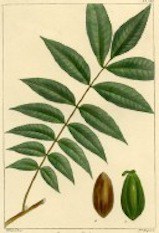
Hickory (Axara)
Hickory is sacred to Obraash, God of the Sun, who is also Lugh and Apollo. His color is golden yellow, his stones citrine, and yellow topaz. His sacred birds are the Phoenix and the peacock. Obraash is one of the principal fire spirits whose domain is kingship, the wise use of power, unification of peoples, and wholeness, both of the individual personality and of a society.
Hickory is a hard and close-grained wood, with solar energies similar to Oak. Because of its durability, it is traditionally used for making bats, sticks, and clubs — the primitive prototypes of the magic wand or royal scepter, signifying power to command and direct action. The Eranor word axara shares a root with axalla “majesty” and lex “crown.” The hickory nut is linked to the solar plexus chakra.
Hickory is especially suited to the magic of abundance, wholeness, power, presence, command, discipline, acquisition, giving of gifts, and the finding of direction.
Cherry (Oadha)
Cherrywood is sacred to Ambash, God of the Hunt, of Beasts, and of War. He is also Ares, Mars, Herne, Teutates, Tyr. Cherry is sacred likewise to female deities of hunt and battle: Artemis, Morrigan. Cherrywood is red in color and darkens with age and exposure to the sun. Its companion stones are obsidian and sard. Its sacred bird is the Red-tailed hawk. The sound of the rune Oadha carries with it the aspiration of Thor (Redwood) and the vibratory qualities of Duir (Oak).
Cherrywood carries the energy of the magical Will through which magical intentions are directed into the outer world of manifestation. Cherrywood is imbued with the power of making and doing achievement, and self-assertion over obstacles and critics. It is the pure energy of Will and desire. The cherry fruit is magically linked to the root chakra and so to sex and birth: the life force of attraction and renewal. Its sweet-scented flowers evoke eroticism and the power of love in its more subtle forms as well as the essence of springtime with its powers of renewal.
Especially suited to invocations and blessings of sacred fires, spells of finding, hunting, conflict, war, competition, sex, passion, communion with animals, unification of groups or tribes, and the amplification of magical will.
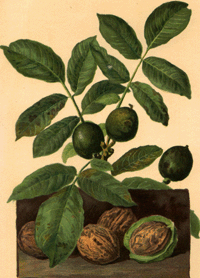
Walnut (Yuin)
Sacred to Vashaan the Lord of Winds and Lightning, Walnut partakes of Elemental Air and Fire. It is perhaps the consummate wood for weather magic. The shape of the walnut nut connects it magically to the head, and so to the crown chakra. Its color is turquoise blue, its stones turquoise, blue topaz, and sardonyx. Vashaan’s sacred bird is the Eagle, particularly the Bald Eagle. The rune Yuin depicts the “First Swirlings” of the universe. It is the centripetal force of outward movement or expansion that complements Shava’s powers of attraction. Thus Yuin has power over all magical acts of expansion: expansion of wealth, horizons, the mind, the feelings. Its scope is limitless and its age unfathomable.
The nut of the walnut tree is linked to the Windlord’s creation myth, in which his tempests shake the walnut tree so that the nuts fall to earth and are buried by the squirrels. From these nuts spring forth the race of Elves. So the war-helms of the ancient Sarith knights, the Shazarin, are shaped like half of a walnut shell. Vashaan is called by the Elves Valma and is associated with the gods Zeus, Jupiter, Thor, and Vishnu. Walnut wood ranges from light to very dark and is well-suited to wand carving.
Walnut is especially suited for wind and weather magic, spells of expansion, vortices, enhancement of the powers of breath, spells to cast or avert lightning, teleportation and astral travel, and inspiration.
Beech (Sultan)
Sacred to Obraash the Sun lord, whom the Elves call Alba, Beechwood is closely related to Oak. The Beech tree is a large and spreading tree that bears edible nuts. It was particularly valued by the ancient Celts — and the Elves — as a nut used to fodder animals, especially the sacred swine. Beech is the family of trees to which Oak belongs, thus is Beech sometimes called Atarya Dwyrion, “Grandfather of Oaks.” The name Beech relates to the Germanic word for Book and tradition tells that beech wood was used to make the first writing tablets for the runes. Hence, Beech is deeply associated with learning and lore, and with the divinatory power of the runes.
Like Greek Apollo, the Elvish Alba drives his sun-ship across the sky each day and passes to every world of manifestation, sources of light, beauty, and life. Apollo is also considered to be a spirit of youth, archery, and prophecy, the latter because of his conquest of the Pythian serpent at Delphi and subsequent assumption of the powers of the Delphic oracle. In Celtic tradition, many gods are associated with the sun’s light, among them Ogma Sunface, god of eloquence who created the ogham letters, and Oenghus mac Og, god of love and youth. The wood of the Beech has a superb grain that finishes most beautifully. The Elvish rune Sultan is the same as the Norse rune Sol, the solar rune which has also been interpreted to mean “victory.”
Magical operations especially applicable to Beech include spells of information, especially seeking old wisdom; invocation of ancient guardians or Ancestors; research into old writings and the runes; the magic of the Summer Solstice, the culmination of desires; the magic of victory.
Osier or Dogwood (Zallis)
Osier is a tree most sacred to Agni, the primordial Fire. Zallis is held, by the Elves, to be sacred to the spring fire festival of Beltane (or Agnianna as they also name it). Agni, who is not numbered among the twelve Mellarin, may be equated to the Celtic god Belinos (for whom Beltane is named). He is called Atarya Tulkazo, “Grandfather of Tulkas,” who is the fire of passion, desire, and will. Agni is often considered to be a mask of Olan, the Great Spirit who goes before all and encompasses all.
The Elves sing that Agni is the father of Shava, Star Queen, and also of Abban, the great subterranean Father of volcanic fire and the forge. The red-barked Osier is associated with fertility and sexual attraction. For Agni is not only the sacrificial fire but also the fire of loins and procreation, the energy of bud and flower. The rune Zallis, shaped like an X, is considered one of the most powerful runes for magic invoking the protective and creative power of fire and is often used alone as a sign for banishing disruptive forces and deception. By association with the Futhark rune Gifu, it also bears a sense of happiness and warmth or comfort.
The wood’s name “dogwood” also carries associations with the Irish hero Cuchullain, whose name meant “the dog of Chullain” referring to his loyalty. This gives the wood magical links to the warrior heroism and superhuman physical prowess of the hero and links to domesticated dogs, their healing and protection and their loyalty and affection too.
Magical operations especially applicable to Osier include magic of flowering; the evocation of one’s Ancestors; renewal of cycles of fertility; consecration of ritual or hearth fires; giving of comfort or healing, and spells of banishment and protection.

Trees of Elemental Water
Alder (Fearn)
Alder is sacred to the constellation Pisces, the Fishes. It is a wood which lasts a long time submerged in water and is often found on river and lake banks. When first cut its wood appears red like blood and so was traditionally viewed as ill-omened but this is an oversimplification. It’s bloody appearance may have influenced Alder’s popularity as a wood for warrior’s shields in Celtic tradition. In Elvish Eranor Fearn comes from the root feä, meaning “fey” or Faerie magic. This rune invokes astral protection as well as physical and can open the mind to the deep wisdom of the watery element in the form of dreams. It can protect one from the emotions of others, especially warlike anger or bloodlust.
Alder is particularly potent for protection against drowning or disaster by storm or flood. Its use in bridges, half submerged, symbolizes not only its power as a bridge between worlds but its mentality, amphibiously aware of the conscious and unconscious worlds, the above and below, the overt and the hidden. Fearn’s ruling Mellar is Ulmaren, the Water Mother.
Magical operations most applicable to Alder include protection against drowning and death; death curses and shielding against them; shielding against all ill-omens and destructive emotions; cultivation of the vision of inner and outer worlds; bridging of the above and below; preparation for conflict; shielding against unwanted intrusions from beyond.
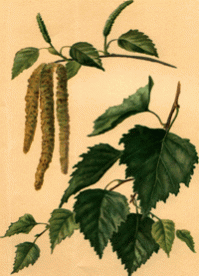
Birch (Beith)
Sacred to the festival of Alban Eiler (Vernal Equinox). Its number is forty and its bird the white egret. In the Celtic Ogham Beith is accorded prestige as the first tree, one of the trees that emerges first to establish a new forest, a harbinger of youth and springtime. It is often associated with the beginning of the year, and in the Alferic tradition is linked to the beginning of the cycle of growth and renewal in Spring. It is a tree of beginnings in general and of the Bards, as the first grade of the Druid order.
The Bards are according to first honor as the singers of the Creation epics, those who sang the worlds into existence. Birch is also a wood with great powers to purify and discipline, to create the new forest in service to the great trees that will come after, such as the oak and ash and maple. Birch forest is young and so birch is linked to youth and all things new.
Especially suited to the magic of new beginnings, spells of youth and fresh starts, bardic enchantment, creativity, procreation, renewal and rebirth, purification, and spells for discipline and service.
Willow (Awn)
Sacred to the Moon, Omulan or Diana, Willow is a wood of the Water Element. Willow is a tree of emotion, love, intuition, and poetic inspiration. Awn is pronounced ahh-oon and is related to as the Druid term awen, the sacred word of inspiration. It is linguistically rooted to Eranor awë, “inspiration” and hwenwë, “breath.”
Omulan is the White Goddess, who has affinities with both the Celtic goddesses Rhiannon and Arianrhod. She is the daughter of Shava and Vashaan, and sister to Islaar, god of magic and thought. As the Moon she rules the cycles of female life and becoming: menstruation, birth, and menopause. By extension, she is mistress of hearth and home and all whatever is considered the traditional sphere of motherhood.
As the great luminary of the night, she also is Astarte, goddess of witchcraft and moon magic, which is to say magic that aims at transformation and natural harmony. Willow is especially suited to works of the New Moon, magic related to cycles of fertility or creativity, spells of glamor and bewitchment, change, relationship and female rites of passage.
The Dark Moon, as it is called, is the time best suited for spells of dissolving and banishment, the time to get rid of old habits that no longer serve a good purpose in your life. Traditionally associated with witches, willow is the perfect wand wood for the ritual of “Drawing Down the Moon.” As the source of salicylic acid, the main ingredient in aspirin, willow is also a wood appropriate for spells intended to remove pain and give comfort.
Poplar or Aspen (Kenning)
The poplar or its sister the aspen are trees with very soft wood and a pithy core. Their bark is white which is descriptive of their delicate and sensitive character. This tree is sacred to the Lady Nienna, lady of sorrows, of memory and forgetting. Its magic is that of emotion. The subtlety of poplar lends itself to emotional healing work, but may also be used in spells designed to create particular emotions such as fear or anxiety. It is nearly impossible to use poplar to create anger or any of the more assertive passions, but it can be effective in dispelling anger or fear.
As an aid to meditation, a wand of poplar will promote a sense of peace and alertness. These trees have leaves that flutter in the wind. The aspen is sometimes called “quaking aspen” for this reason. If you desire to delve into your own emotions to heal the roots of many health problems, and larger life problems, then poplar would be a good choice for a wand.
Exotic Hardwoods
Ebony
Ebony is an exotic hardwood that comes from various sub-tropical climes. It is a wood that is used extensively for carving in Bali and in Africa because of its density and hardness. It is extremely difficult to carve, but the end result is a superb black wood (sometimes with the lighter grain) that is very heavy and magnetically powerful.
Ebony is not one of the sacred woods of the Celts, nor is it included in the version of the Elvish Ogham known to me. However, from working with this wood I have come to see it as a wand perfect for Dark Moon magic, those operations that seek to banish, dissolve, dissipate, or cast off evil or outworn influences.
The Elves tell me that it is a tree strongly attuned to Nienna, goddess of Memory and Forgetting, Joy and Sorrow. I also feel that it carries the energy of the dark of the moon, or of eclipses. Ebony is quite a popular wood for wands and is unquestionably very handsome. It’s presence and energy is very strong, and so it is not a wood for the faint of heart.
 Purpleheart
Purpleheart is another exotic tropical hardwood that is readily available in milled stock. It is a wood with very long coarse fibers and so difficult to carve without splitting. This bespeaks the wood’s sensitivity and flexibility. It is a medium density and heaviness and can be finished to a lustrous smoothness which captures its remarkable purplish-red color.
Like Ebony, Purpleheart is not a wood that has attached to it any Celtic lore, or Elvish lore that I am aware of. However, from my own work with this wood, I have come to the conclusion that it is very well-suited for work with the heart chakra. This means that it is good for emotional as well as physical healing, for opening up the seat of compassion and generosity, and for any work involving the blood. Its color gives it attunement to the violet and ultraviolet frequencies of magic, which is those centered on control, especially over other magic.















 Spring has arrived, and the energy is moving into the action phase. The Moon is full with fertility, growth, planting, and it is now the time to sow new seeds (both literally, and figuratively). This is a time for earth magick, and that dealing with growth and fertility. This is a time to empower and encourage growth. Also, now is a great time to do spell work dealing with fertility, self-confidence, self-improvement, and for seeking knowledge and wisdom. It is now time to put to actions the plans made throughout winter. For gardeners, it is the time to empower seeds.


You must be logged in to post a comment.