BLM offers whistle stop tour of wild horses imprisoned at Indian Lakes Rd. facility in Fallon, NV | Straight from the Horse’s Heart

Once wild horses at Indian Lakes Rd. facility in Fallon, NV (photo:  Debbie Coffey)

Get ready to jump on the wagon for a BLM PR blitz…

Edited Press Release       Source:  BLM

RENO, Nev. —The Bureau of Land Management (BLM) will host two free public tours of the Indian Lakes Off-Range Wild Horse and Burro Corral in Fallon, Nevada, on Friday, May 12. Tour attendees will be taken as a group by wagon around the facility to learn about it, the animals, and BLM’s Wild Horse and Burro Program.

About a 90-minute drive east of Reno, the corral is located at 5676 Indian Lakes Road, Fallon, and is privately owned and operated. The public tours will begin at 10 a.m. and 1 p.m. and each will last about one hour and accommodate up to 20 people. Attendees should wear comfortable shoes and clothes; hats and sunscreen are recommended, and photography is welcome. On-site portable toilets will be available.

Horses at the Indian Lakes facility are made available to the public for adoption or purchase throughout the year at off-site adoption events and through BLM’s Internet Adoption program. For more information on adoption opportunities, visit https://on.doi.gov/2iByqXD.

To register for the tour or to get driving directions to the facility, please contact the BLM at (775) 475-2222.

Source: BLM offers whistle stop tour of wild horses imprisoned at Indian Lakes Rd. facility in Fallon, NV | Straight from the Horse’s Heart

Ozark Encyclopedia – B – Butterfly Weed – Mountain Man Traditional Healing

Butterfly Weed, Pleurisy Root – Asclepias tuberosa

Parts used: root

Traditional uses: As an antispasmodic and expectorant the root is great for helping to clear chest congestion, hence the name “pleurisy root”. Also good for stomach issues and in remedying diarrhea. It’s sometimes combined with other diaphoretics like sassafras or dittany to reduce fevers. Caution should be taken with this plant as high doses can act as an emetic and purgative. Also, the plant should be harvested responsibly. Since you’re taking the root, only what is needed should be gathered and the rest left to go to seed.

“Antispasmodic, diaphoretic, expectorant, tonic, carminative and mildly cathartic… It possesses a specific action on the lungs, assisting expectoration, subduing inflammation and exerting a general mild tonic effect on the system, making it valuable in all chest complaints. It is of great use in pleurisy, mitigating the pain and relieving the difficulty of breathing, and is also recommended in pulmonary catarrh. It is extensively used in the Southern States in these cases, also in consumption, in doses of from 20 grains to a drachm in a powder, or in the form of a decoction. It has also been used with great advantage in diarrhoea, dysentery and acute and chronic rheumatism, in low typhoid states and in eczema. It is claimed that the drug may be employed with benefit in flatulent colic and indigestion, but in these conditions it is rarely used. In large doses it acts as an emetic and purgative.” ~Grieve MH

*** Cautions: All plant parts toxic in large quantities ***

Used for lung trouble – “A tea made from the roots of butterfly weed (Asclepias), also known as pleurisy root, is used for ‘lung trouble,’ which usually means the late stages of tuberculosis.” ~Randolph OMF 94

“Butterfly roots…is good for pneumonia. Butterfly roots are also known as pleurisy root.” ~Parler FBA III 2868

For nervousness – “A tea made from the roots of the butterfly weed (Asclepias) is supposed to be good for nervousness and restlessness.” ~Randolph OMF 113-114

Butterfly root, Virigina snakeroot, and senega snakeroot for colds – “The juice from butterfly root (Asclepius tuberosa), black snake root (Serpentaria), and Senca root (Polygala senega), mixed together and made into a tea.” ~Parler FBA II 1831

Root used for coughs – “Dig Butterfly root…Boil it in a little water. Drain water off and sweeten a little. This made a good cough syrup for children.” ~Parler FBA II 1965

Used for fevers – “To cure the fever Mrs. Landy’s cure differed from her son’s. She said the best way to cure it was to boil down pleurisy roots…and make a tea out of it and give and adult a dose of 2 tablespoons.” ~Parler FBA II 2206

Root used for measles – “Butterfly root…was used for measles.” ~Parler FBA III 2693

Tea for typhoid – “Butterfly weed…tea will break typhoid fever.” ~Parler FBA III 3483


Grieve, Margaret A Modern Herbal (MH)

Moerman, Daniel E. Native American Ethnobotany (NAE)

Parler, Mary Celestia Folk Beliefs from Arkansas (FBA)

Randolph, Vance Ozark Magic and Folklore (OMF)

Source: Ozark Encyclopedia – B – Butterfly Weed – Mountain Man Traditional Healing

Flowers That Heal – Good Witches Homestead

Source: Flowers That Heal – Good Witches Homestead

Garden flowers offer us more than their beautiful colors and smell; many contain healing properties that have been used for thousands of years. As we begin planning our gardens, we reflect on the relationship between the plants to which we tend and our own bodies.

— Tieraona Low Dog, M.D.

We often conceive of flowers as a dazzling aesthetic addition to our home or garden. We take the time to smell the roses, reveling in their centering scented offerings. Practiced gardeners and hobbyists alike can reap impressive health benefits by way of incorporating medicinal flowers into their gardens. In this way, your garden is both a wondrous green altar, as well as your own personal medicine cabinet.

Trembling with potential energy and encapsulated in a small seed are all the nutrients and structures necessary for the growth of the flower it contains. When provided with the right conditions, a seedling soon flourishes and attracts insects that are beneficial to other plants in a garden. This spring is the perfect time to create a healing ritual around the plants you tend. While you commit to caring for your bountiful blossoms, you can simultaneously tend to the soil that lies within you.
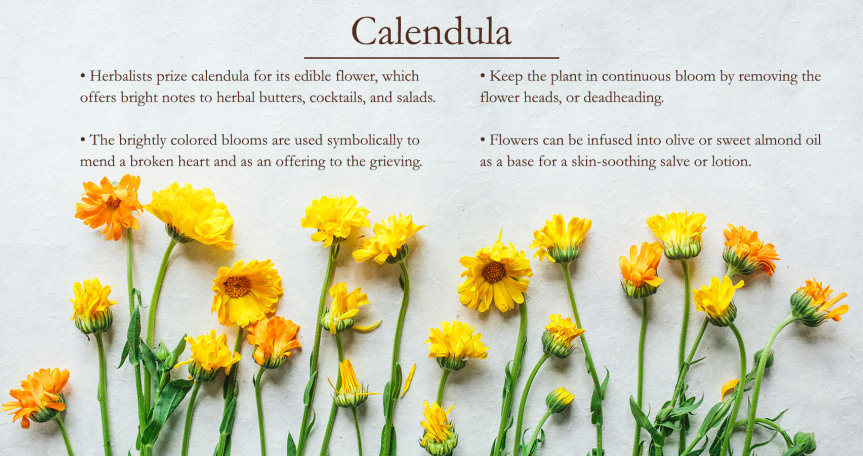
 

calendula TMCalendula (Calendula officinalis)

Growth and care: Start with real Calendula officinalis seeds (not one of the many hybrids) in flats or sow directly into the outdoor soil. Enjoying cool temperatures, calendula does well with a layer of mulch which traps moisture for use by this showy flowering annual. It is deer-resistant, non-invasive and the butterflies love it!  And by the way, the flowers are edible and will remind you of saffron in both taste and color. They can be used in salads or in cooked dishes.

Medicinal uses: Boasting lasting benefits for oral health, calendula is known to reduce gum inflammation and gingivitis. Teas are soothing to the stomach and can help soothe a sore throat. Calendula flowers are anti-inflammatory and antimicrobial, which is why they have been treasured for centuries for soothing rashes and helping mend wounds.  I keep small containers of calendula ointment around the house and up at the barn. It works as well for irritations and scrapes on the chickens and horses, as it does on us!

Harvesting: Harvest calendula as soon as flowers are fully blooming. Pick them in the morning hours on bright sunny day and harvest regularly to encourage flowering. You can use the flowers fresh, as mentioned above, or you can dry the flower heads in a warm, shaded place for use in salves, ointments or teas throughout the year.


California Poppy (Eschscholzia californica)

Growth and care: Native to California, the Golden or California Poppy can be sown directly into the rich soil. Golden poppies prefer full sun and sparse watering. They are annuals in some parts of the country, though our California poppies are perennial here at our ranch. These beautiful flowers are such a beautiful addition to the garden. The flowers are edible and look wonderful in salads.

Medicinal uses: California poppy is one of my favorite herbs for relaxation and relief of minor aches and pains. It is useful anti-inflammatory and antispasmodic, and is a life saver for those nights when I have overdone it in the garden. California poppy helps me fall asleep and stay asleep. It can be used to ease muscle cramps and spasms and soothe anxiety in someone who is feeling overwrought and irritable. It combines nicely with passionflower, valerian, and other relaxants.

Harvesting: The entire plant is used as a medicine, so it is best to harvest it when there are both flowers and the long seedpods present. Take a small spade or shovel and dig straight down in a circle about 8-10 inches from the plant and lift up the root and entire plant. Rinse off any dirt from the roots, chop the root, leaves, stem and flowers into small pieces, put in a mason jar and completely cover with vodka. Steep a few weeks covered, strain, and you have your tincture. I generally use 50-80 drops at night before bed or a few times per day for minor pain.
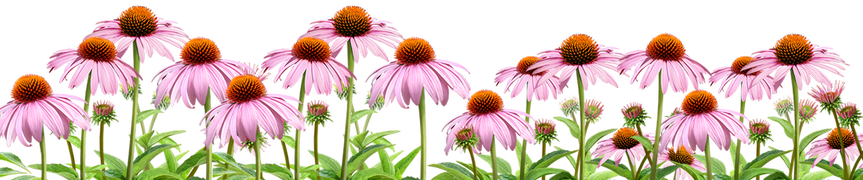
 

echinacea-finalEchinacea AKA Coneflower (Echinacea Angustifolia, E. purpurea)

Growth and care: Echinacea, also known as coneflower, appreciates well-drained soil in full sun or light shade. These perennials are plants of the open woodlands and prairie and send out deep tap roots that allow them to tolerate periods of low rainfall. They flower throughout the summer. You can scatter seed in the fall or propagate from root cuttings. Echinacea is fabulous in the garden; the butterflies and birds love them!

Medicinal uses: Echinacea is celebrated for its ability to ease colds, sore throats, and respiratory tract infections. I have used the tincture for both my family and patients for more than 35 years. As a matter of fact, many patients told me it was the first herbal medicine that they had ever used that made them really believe that “this stuff works.” Topically, Echinacea is used for cuts and minor abrasions.

Harvesting: You can prune the leaves and flower heads throughout the summer to enhance the health of your plant, as well as encourage blooming. Cut the flowering stem above the node or the place where the leaves/stem emerges from the stalk. The leaves and flower heads can be dried or made into a tincture. Wait for at least two years before harvesting the roots. Harvest in late summer. Sink your spade down about 24 inches from the stalk. Go deep and lean back on the spade to lift the root ball. Take the entire plant. You can dry or tincture the leaves and flowers. Trim some of the roots that you are going to use for medicine, leaving some roots with the crown, so that you can replant it in the garden. Washing the roots that you are going to dry with a good scrub brush. Use a sharp knife to cut the roots into small pieces. These can be set aside in a warm but shaded place for a week to dry and then stored, or you can make a tincture from the fresh roots. (Healthy at Home contains all the information you need for making fresh and dried herb tinctures).


Hyssop (Hyssopus officinalis)

Growth and care: Hyssop is a popular aromatic perennial member of the mint family that displays beautiful purplish blue flowers (or sometimes pink) and boasts a large root system beneath the earth. This is a great flower to plant in your garden to attract pollinators and prefers well-drained soil and partial or full sunlight.

Medicinal uses: Hyssop possesses antiviral properties and promotes the expulsion of mucus from the respiratory system. The use of hyssop flower tea has long been used to ease colds, coughs, and congestion. The tea is quite pleasant and I have found to be a very good expectorant when taken in small doses throughout the day.  When diffused, hyssop essential oil is often used to purify the air indoors. Hyssop leaves can be added to soups and salads.

Harvesting: Cut the flowering tops of hyssop. Harvest and dry the herb at the peak of maturity to assure the highest possible potency of active ingredients.


Lavender (Lavandula angustifolia)

Growth and care: Lavender enjoys full sun and well-drained, slightly alkaline soil. This gorgeous and fragrant perennial does not like to be overwatered and will not tolerate excessive moisture. While there are many different types of lavender, I admit that I am very partial to English lavender or L. Angustifolia. You can grow from seeds but cuttings are quicker. Lavender makes a beautiful border in the garden but also does great in pots.

Medicinal uses: Lavender flowers are often put in small cotton bags and put in linen and clothing drawers for their wondrous aroma. You can make an infusion and add it to a bath to soothe itchy skin or help relax before bed. Lavender essential oil touts many impressive benefits and can be used as aromatherapy to ease insomnia, headaches, and anxiety. Topically, diluted lavender essential oil can help ease sunburn, bug bites and mend wounds. I put ¼ cup of dried lavender flowers in 1 cup of honey and let it steep for 2-3 weeks. This lavender honey can be used on minor wounds to help them heal. And it serves double duty when drizzled over Manchego cheese and served with some grapes on a warm summer evening. Delicious!

Harvesting: To harvest, cut the stems just above the first set of leaves, as soon as some of the flowers just begin to open. Bundle your stems together (no thicker than the opening on a soda pop bottle), tie with a string and hang upside down in a cool, dry place for 3-4 weeks.
BLM’s Wild Horse & Burro Program in a Death Spiral | Straight from the Horse’s Heart

Open Letter by Author Terry Farley

“BLM’s wild horse and burro math is statistically bizarre…”

As a journalist, I first interviewed BLM Wild Horse and Burro Program staffers in 1976, shortly after I moved to Nevada. Since then, I’ve followed the program’s death spiral.

Those who say wild horses and burros ruin the range claim there are too many of them, and yet there’s little agreement about how many wild equines remain on America’s public lands.

BLM’s wild horse and burro math is statistically bizarre. Even the National Academy of Sciences, charged by BLM to analyze the program (2013) concluded: “The Wild Horse and Burro Program has not used scientifically rigorous methods to estimate the population sizes of horses and burros …”

NAS warned “continuation of business-as-usual practices will be expensive and unproductive for BLM and the public it serves.” Worse, NAS pointed out that BLM’s lack of science has actually backfired on its stated goal of protecting the range.

BLM’s reaction? Keep paying independent contractors to chase, trap and corral the West’s remaining wild horses and offer $10 million to anyone who found a new means of mustang birth control.

BLM asked for a new method because PZP “didn’t work,” ignoring recent science and BLM personnel who admitted that — counter to instructions – contraceptives are not always kept frozen or even cold in the field.

Band dynamics: During round-ups, family bands are shattered, routinely divided into stallions, mares and contractor-determined weanlings. Horses are prey animals. They know safety is with the band and the resulting cacophony and blood of these separations is haunting. Fewer than 2 percent are ever reunited.

Injury: Compare injection site abscess to BLM documentation of a single round-up in which 113 mustangs died. Death from shattered pelvises, broken necks, skulls and spine were sometime attributed to natural causes or pre-existing conditions. Those diagnoses would strain my credulity even if I hadn’t been there.

If you still oppose contraception, please consider this: Proponents of selling wild horses without limitation have made in-roads at BLM and those who’d destroy mustang captives as they stand in government pens have visited the White House.

The extermination of a Western icon is near, and your choice can hasten or slow its approach.

PZP is reversible. Death is final.

Source: BLM’s Wild Horse & Burro Program in a Death Spiral | Straight from the Horse’s Heart

Euthanasia drug found in dog food « Jon Rappoport’s Blog

By Jon Rappoport

From WebMD (4/28/17): “Party Animal is recalling dog food that tested positive for a pet euthanasia drug…The voluntary recall affects the company’s Cocolicious dog food brand…The affected products include 13-ounce cans of Cocolicious Beef & Turkey dog food (Lot #0136E15204 04, best by July 2019) and 13-ounce cans of Cocolicious Chicken & Beef dog food (Lot #0134E15 237 13, best by August 2019)… Party Animal is working with distributors and retailers to find out if any other beef-flavored foods are still being sold, and if so, to recall them immediately, the company said.”

KDVR (FOX) reports: “Party Animal is recalling two lots of its Cocolicious dog food because it might contain pentobarbital.”

CNN: “Party Animals, a California-based pet food maker, is recalling two lots from its line of Cocolicious dog foods after some cans in Texas tested positive for pentobarbital — a chemical that’s used to euthanize animals. In a statement on its website, Party Animal said a customer in Texas had given Cocolicious samples to a lab and the dog food tested positive for pentobarbital. Party Animal is asking for those test results, and ‘out of an abundance of caution’ is recalling the two lots of dog food sold nationwide. The company is also sending cans of its dog foods to an independent lab for testing.”

How would this drug, used to euthanize animals, find its way into pet food? The suggestion is: the pet food contains meat from previously euthanized animals (not cows).

Concerning a previous recall by another company, Evanger’s, the Detroit Free Press stated: “In researching the supply chain, Evanger’s learned that ‘pentobarbital is very highly controlled, and that, if an animal is euthanized, it is done so by a veterinarian. Once this process has been done, there is absolutely no regulation that requires the certified vet to place any kind of marker on the animal indicating that it has been euthanized and guaranteeing that product from euthanized animals cannot enter the food chain’.”

If this is true, we would be talking about euthanized dogs and cats somehow entering the pet-food manufacturing process—and pet dogs would end up eating dog and cat meat.

Veterinarians are selling euthanized animals to middle men, who in turn supply meat to pet-food manufacturers?

There is another possibility. The American Society for the Prevention of Cruelty to Animals (ASPCA) states, on its website: “Approximately 6.5 million companion animals enter U.S. animal shelters nationwide every year… Each year, approximately 1.5 million shelter animals are euthanized (670,000 dogs and 860,000 cats).” Are shelters selling the euthanized animals? Do a few (or more than a few) animals end up in pet food?

Knoji.com states: “Cremation allows for the shelter to burn the bodies of pets. However, not all animal shelters can afford this so many send the bagged bodies of animals to a special part of the city landfill (garbage dump). The third option is not as common as it use[d] to be, and generally not done in the charity run shelters, but more common in city run ‘pounds’ – this is when the bodies are sold to research labs, dissection supply companies, or rendering facilities where they may actually be rendered down and put into pet food.”

“It might surprise some dog owners to know that dog meat has been used in dog food. This practice was relatively common until the late 1990’s. Even today there are no laws preventing man’s best friend from ending up in dog food.”

“Please note the below information on dead dogs being used in dog food is true to the United States but may also occur in Canada and possibly other countries.”

“At some time or another pet food companies realized there was a cheap source of meat available… Dog Meat, and it could be purchased cheaply from animal shelters and the dog pound. These were places where dogs were euthanized weekly and there was always a need to dispose of the bodies. Nobody said anything and there were no laws preventing such from happening.”

“However what started to tip the scales was that the veterinarians who performed the euthanasias at the animal shelters started noticing it was taking more and more drugs to put these animals to sleep. They realized that somehow pets in animal shelters were building up an immunity to the medications used to end their lives. Typically veterinarians are called to shelters every week to euthanize between 10 and 200 animals (or more in larger centers) so this was where they saw the problems develop quite easily.”

“As such several investigations were launched to see how pets were building up immunities to the drugs. The FDA (Food and Drug Administration) launched an investigation. They found that sodium pentobarbital (the drug often used to euthanize pets) passed through the rendering process and ended up in pet food. They admitted finding the drug in some pet foods and stated ‘several retail feeds were confirmed for the presence of phentobarbital which could only have come from euthanized animals.’ Most of these investigations were exposed by television news groups such as Seattle’s King 5, and KMOV in St. Louis, Missouri.”

“What they exposed was something that many people already knew – dead dogs were being used to make dog food. Many animal shelters are government run. These poorly funded shelters found a way of generating extra income and disposing of the animal bodies all at once—Sell them cheaply to a [pet food] rendering plant. You will note your local SPCA probably does not do this.”

This account suggests that the FDA already knows dog meat in dog food is an ongoing problem, and the FDA also knows that euthanized dogs, whose bodies contain the euthanasia drug, are used for dog food. This is not a new discovery or a puzzling problem.

If the FDA is scratching its collective head and trying to solve a mystery, that would be a pose.

It would be like saying, on a human level, “Well, we know several companies have been polluting the water and soil of a town for years, and the chemicals are exceedingly toxic and dangerous, but we’re not sure where the cancer clusters are coming from. Much more investigation is needed.”

It appears we’re looking at a situation where all the parties—government animal shelters, veterinarians, pet food rendering plants, pet food companies, and the FDA—know exactly what’s going on…and say nothing, or pretend surprise when a new case of dogs eating drug-poisoned dog meat shows up.

The FDA is famous for ignoring their own responsibility, when a medical drug they’ve approved, as safe and effective, starts killing people.

Apparently, this same know-nothing attitude applies to pets and the euthanasia drug they’re ingesting.

I wonder how many humans, living on the extreme margins, eating pet food, have succumbed…

Source: Euthanasia drug found in dog food « Jon Rappoport’s Blog

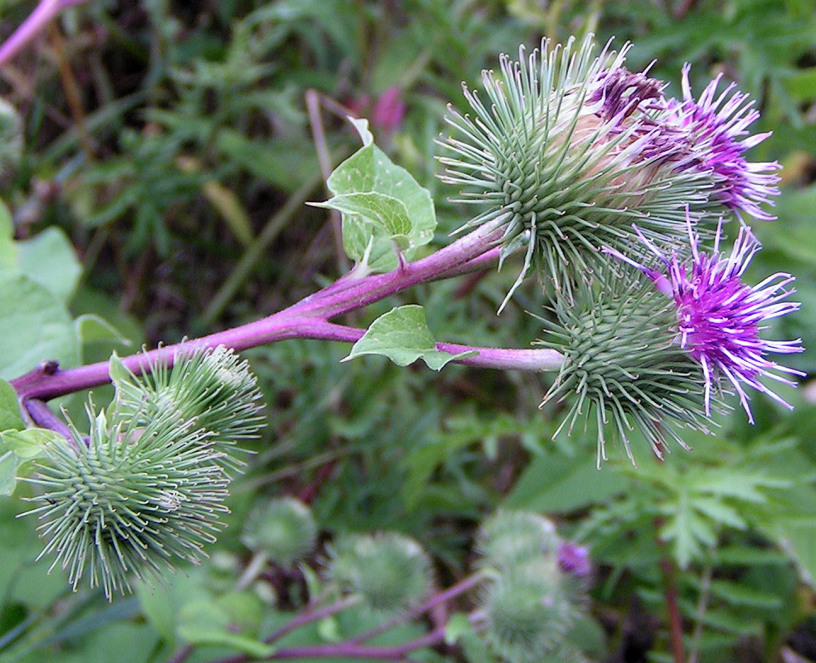
Ozark Encyclopedia – B – Burdock – Mountain Man Traditional Healing

Burdock – Arctium lappa, A. minus, A. tomentosum

Parts used: root, leaf

Traditional uses: Root used in washes for boils and skin complaints. Leaf infusion used to tone stomach. Leaf poultice used for tumors and swellings and to reduce inflammation. Blood purifier, alterative, diuretic, and diaphoretic.

“Alterative, diuretic and diaphoretic. One of the best blood purifiers. In all skin diseases, it is a certain remedy and has effected a cure in many cases of eczema, either taken alone or combined with other remedies, such as Yellow Dock and Sarsaparilla.” ~Grieve MH

Used in formula for chills – “A gentleman in Cyclone, Missouri, tells me that his family made a ‘chill remedy’ that was in great demand; the exact formula was kept secret, he says, but the main ingredient was crushed burdock seeds.” ~Randolph OMF 107

“Burdock roots…boiled were given for chills.” ~Parler FBA II 1747

Beads worn as protection from witchcraft – “A basket maker at Eureka Springs, Arkansas, told me that children are best protected against witches by wearing a neck-lace of dried burdock roots, cut into small pieces and strung like beads.” ~Randolph OMF 291

 Boiled in compound drank for colds – “There used to be a plant called burdock. They’d dig that up and get the root and soak it in whiskey. Then they’d take that and put other ingredients such as nutmeg and butter and ginger in it. You’d drink that hot and go to bed of a night it’d suck that cold out.” ~Carter and Krause HRIO

Medicine for the blood of young folks – “From the weed Burdock (Arctium minus) you make a medicine for the blood of young folks. You boil the weed down and give the youngin’ a dose of 1 tablespoon before meals.” ~Parler FBA II 1357

Burdock, Witch Hazel, and Dogwood as a spring tonic – “Mix burdock roots, witch hazel bark, dogwood bark and take 1 teaspoonful before breakfast in the spring. This is called a spring tonic.” ~Parler FBA II 1369

Root chewed to purify blood – “To purify the blood chew the roots of the burdock plant.” ~Parler FBA II 1516

Root water used for boils – “To cure boils and sores that children have use Burdock roots…that have been soaked in water and drink the water.” ~Parler FBA II 1564

Roots worn against nosebleed – “A necklace of burdock roots…used to be worn to prevent nosebleeding.” ~Parler FBA III 2786

Wild cherry and burdock used for rheumatism – “Wild Cherry bark and Burdock root…boiled and mixed with whiskey is good for rheumatism.” ~Parler FBA III 2974


Carter, Kay & Bonnie Krause Home Remedies of the Illinois Ozarks (HRIO)

Grieve, Margaret A Modern Herbal (MH)

Moerman, Daniel E. Native American Ethnobotany (NAE)

Parler, Mary Celestia Folk Beliefs from Arkansas (FBA)

Randolph, Vance Ozark Magic and Folklore (OMF)

Source: Ozark Encyclopedia – B – Burdock – Mountain Man Traditional Healing

Storytime with Rachel F Hundred

Creating stories for pleasure

Sibyl Moon

Shh I'm Writing

Sylum Clan

Nothing is True. Everything is Connected.

Laura Bruno's Blog

Medical Intuition, Astrology, Soul Readings, Intuitive Coaching, Tarot, Reiki: Inspiring and Empowering Visionaries, Artists and Healers

Fire Family Conflagration

Weekly Challenge from the 118, 126, & 113

Kiayea's Corner

all things fanfic...

Crystal Dawn Books & Gifts

Crystals, and all things Magical

Starkindler's Realm

welcome to the inner workings of my mind...

The Herb Society of America Blog

Learn • Explore • Grow

Dr. Gary Samuelson

A Journey of Discovery

Kylia's World

Where Canon has No Meaning and Universes Collide

originaltempus

Just another WordPress.com site

Profilers For Christmas

The Crime Drama Advent Calendar

Entangled Wood

Just another WordPress.com site

brokenamethystwrites

Here there be Dragons

Toasterpop's Fiction

Fanfiction and original stories from Toasterpop

Breakaway Consciousness

Seeking Ideas Beyond Conventional Thought

gypsysue

Writting, Drafts, Ideas

Ellywinkle

All Things Wicked and Wonderful

Natalie J. Case

Author, Editor, Photographer, Artist

Your Stories. Your Wall.

Honoring their service and building their legacy. The official blog of the Vietnam Veterans Memorial Fund.

00Q Reverse Big Bang!

Art and Stories for all things 00Q, since 2014

The Wild Hare Project

Where the Writer Comes First.

Anthea Davis

FanFiction Author

Every Fandom Bangs

The home of the Every Fandom Bang and Reverse Bang!

Penumbria

n. pl. pe·num·brae (-br) or pe·num·bras 1. A partial shadow, as in an eclipse, between regions of complete shadow and complete illumination.

This Crooked Crown

Witchcraft for the Everyday and the Extraordinary

This is who I am...

... and this is what I like

Fanfiction Recommendations by Isabelle Disraeli

Fanfiction Recommendations ~ Slash, Femslash, & Het Fanfic Recs

Ellywinkle

EVIL AUTHOR DAY

Convivial Supper

Recipes from the Past

Kaethe Vaako's Fiction

what my demented mind comes up with

Sylum Archive

Nothing is True. Everything is Connected

Quantum Bang

The Multi-Fandom Fix-it Big Bang

by Geep 10

a place for me to share what I've written

Good Witches Homestead

Enchanted World of Magical Gardening ~ Crystals & Gemstones ~ Locally Grown Organic Herbs

tkbenjamin

m/m original fiction and fanfic for adults only

Chestnut NOLA

It's All About The Romance

Loam Ananda

Spiritual Journeys in Druidry