196 wild horses died at BLM’s Scott City feedlot (a BLM Aushwitz for wild horses)

IMG_20140823_132107_665

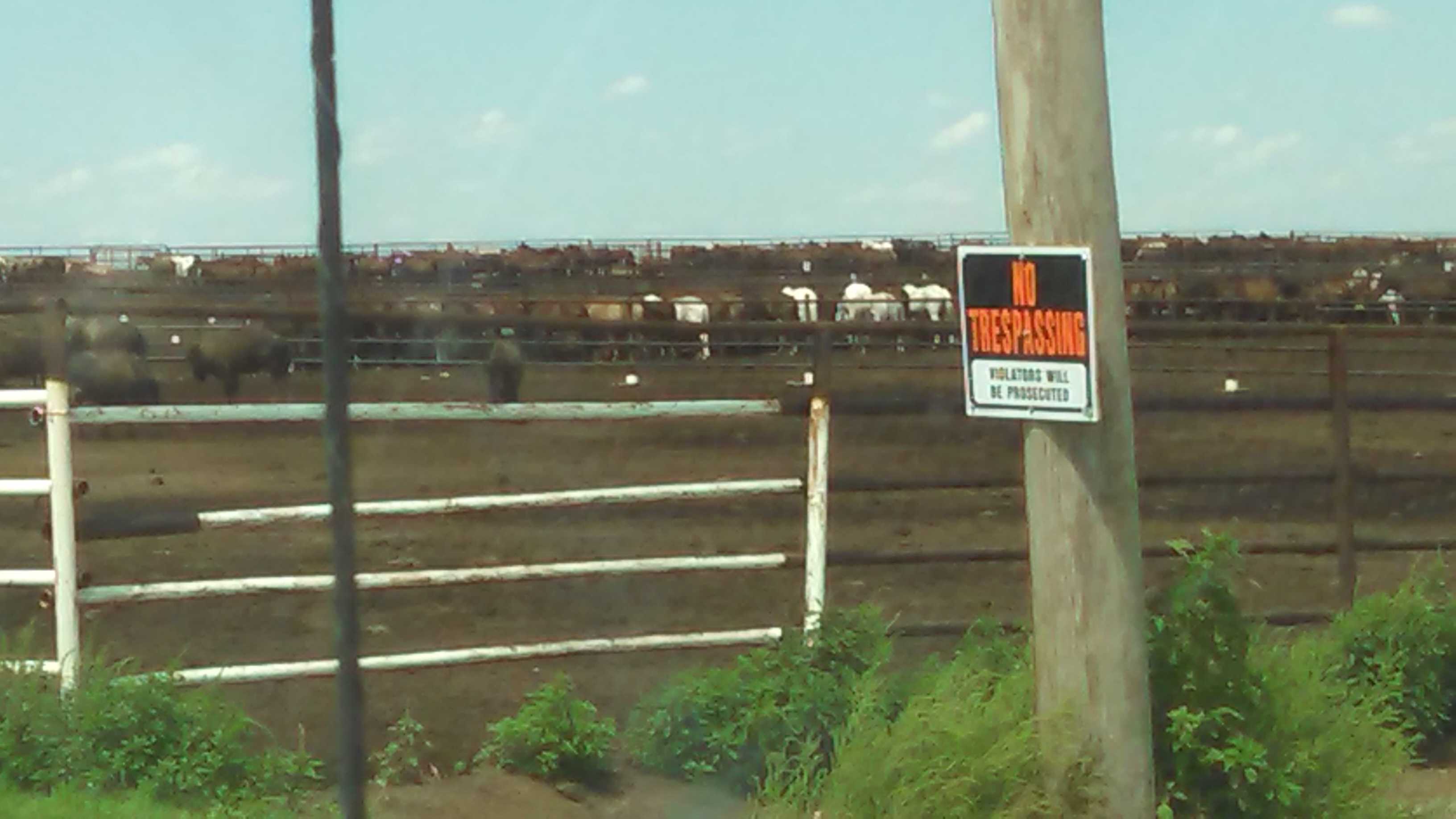
Wild horses next to bison at the Beef Belt Feedyard in Scott City, Kansas in 2014

By Debbie Coffey, V.P. and Dir. of Wild Horse Affairs, Wild Horse Freedom Federation

Copyright 2017   All Rights Reserved.

In the middle of June, 2014, the BLM moved 1,493 wild horses from the Teterville Long Term Holding pastures in Oklahoma to the Beef Belt Feedyard in Scott City, Kansas.  Over 13% of these wild horses died at this feedlot.

191 of the wild horses died in less than a year (7/7/14 – 6/30/15).

In a BLM “news” release dated 8/15/14 (over two years ago), the BLM announced that 57 wild horses had died at the BLM’s Scott City, Kansas “corral.”  In this news release, the BLM stated that it had “launched an investigation” into the cause of deaths, and promised that “Once the investigation is concluded, the team will complete a report that will be made publicly available.”

To date, over two years later, the BLM has not made any report available to the public about the Scott City feedlot deaths.

Wild Horse Freedom Federation (WHFF) filed a Freedom of Information Act (FOIA) request, and found out that 196 horses died at the Scott City feedlot from 6/17/14 – 8/2/16.

87 of the 196 wild horses were euthanized.

41 wild horses died of colic.  Many of these deaths were from sand colic.  As late as 4/13/15 (10 months after the wild horses were shipped to this feedlot), local veterinarian Corbin Stevens wrote to BLM’s Joe Stratton “Be sure hay and bunk is free of sand and rocks (try to only throw hay from feed alley into the bunk eliminating road material)” and “A necropsy was performed on one dead horse from pen 2 today and was diagnosed as a colic with small pebbles and sand present in the large colon and cecum.”  However, BLM’s FOIA did not provide WHFF with a necropsy report dated 4/13/15.

14 wild horses died of fractures of the spinal cord (neck and back).  6 horses died of leg or pelvis fractures.  On just one day, 4/3/15, 3 horses died of a brain/head injury and 2 of a broken leg/pelvis.  With the comment “Inspected by Dr. Stevens.  Result of windstorm – ran into fence.”

Timeline:

March 24, 2014 – Long Term Pasture contractor for Teterville in Oklahoma (Robert Hughes), gives short notice to the BLM by informing them he decided to renew his existing 5 year contract, but only for a reduced number of horses.  He informed the BLM that he wanted to remove 1,900 wild horses (about 1,400 mares and 500 geldings) by June 1, 2014.

(The BLM seems to have never thought of or planned for an emergency, so they begin to scramble for a place to put 1,900 wild horses on short notice.  The BLM was able to find space on other Long Term Pastures for the geldings, but not for the wild mares.)

May 28 (or 27) 2014 – Pat Williams, the WH& B State Lead for New Mexico inspected the Scott City, KS, feedlot for NEPA analysis.  Although a working facility with a squeeze (“tilt”) chute was required,  the contractor for Scott City, Phil Jennings, didn’t want to install that infrastructure until the contract was signed.  Phil Jennings, who was going to lease the Beef Belt feedlot for this emergency contract worth over $2 million, is the contractor for the BLM’s Pauls Valley facility in Oklahoma.

June 4, 2014 – BLM signed the contract.  BLM’s Zach Reichold was designated as the COR (Contracting Officer’s Representative).

June 14, 2014 – BLM began moving wild horses from Teterville Off Range Pasture (long term holding) to Scott City, KS.   The BLM crew at Teterville LTH was Scott Fluer, Bea Wade, Richard Williams, Jimmy Galloway and Pat Williams.  3 horses were euthanized before leaving Teterville.  The BLM crew at Scott City was Jerome Fox.

June 22, 2014 – BLM concluded the transfer of mares to Scott City.

July 7, 2014 – Local veterinarian, Dr. Corbin Stevens, states 3 times in a report that less than 2% of horses have a body condition score of 3 or lower.

July 17, 2014 – Dean Bolstad discovered there was no squeeze chute or BLM Project Inspector onsite and discussed the need for this with Zach Reichold (the COR).

July 25, 2014 – Dean Bolstad informed Greg Shoop that there was no squeeze chute or BLM project inspector onsite at Scott City.

July 2014 – 35 wild horses died during this month.

August 5, 2014 – after veterinarian Dr. Stevens met with BLM’s Joe Stratton, Stevens states in a report that 5% of horses were in poor body condition when they arrived at the feedyard. (this differs substantially from the 2% that Stevens claimed several times in his July 7 report)

August 8, 2014 – BLM issues it’s news release.

Aug. 11, 2014 – BLM began “transitioning” Joe Stratton as the COR of Scott City.

Aug. 12, 2014 – BLM’s Pat Williams and Al Kane (USDA APHIS veterinarian) arrive at Scott City to perform an inspection.

Aug. 13, 2014 – Joe Stratton was “to go onsite.”   The squeeze chute was to finally arrive and plans were made for working facilities to start to be made and installed.  (almost 2 months after the horses arrived)

Aug. 28, 2014 – In a KMUW news article, BLM’s Paul McGuire stated “The first full-month report we had from the facilitator operator came at the end of July.  And it was at that time that we saw numbers on the order of about 47 horses had either died or had to be put down during that time.”  (However, the records WHFF received indicate that 35 wild horses died at Scott City during July, 2014, and only 3 horses died the month before.  That totals 38 at the end of July, not 47.  WHFF found several instances of mortality numbers not matching on BLM records in connection with Scott City.)

August 2014 – Another 46 wild horses die by the end of this month.  (total 81)

September 2014 – another 25 horses die by the end of this month.  (total 106)

June 19, 2015 – Dr. Stevens informs Joe Stratton that there is a mare with a vaginal growth that appears to be infected and that Naxcel and surgery may be warranted.  No freezemark number or description was given.

Feb. 2, 16 – Dr. Stevens informs Joe Stratton that a mare with a tumor extruding from vulva needed to be euthanized.  (It is not apparent from any records if this palomino mare was the same mare with the vaginal growth from 6/19/15, that may not have received needed surgery, but since this was the only mention of a vaginal growth, it could be likely.)

May 17, 2016 and May 19, 2016 – About 2 years after horses were shipped to Scott City, even though the Teterville contractor had given the short notice that lead to this crisis, the BLM ships 5 truckloads of horses BACK TO TETERVILLE.  (The BLM started shipping horses out of Scott City after April 25, 2016 (1,311 were there end of month).  By end of May, 2016, 576 were there.  Shipping records from June 2016 show that more horses from Scott City were shipped to other long term holding pastures.  Per BLM’s Dec. 2016 Off Range Facility Reports, Scott City is no longer listed as warehousing any wild horses.

Oct. 14, 2016 – AP reporter Dave Philipps writes an article (that reads like a propoganda piece for the BLM), titled “Success Spoils a U.S. Program to Round Up Wild Horses.”  This article, filled with misinformation, included a photo of Teterville contractor Robert Hughes,  a video of wild horses at Teterville, a quote from BLM’s National Wild Horse & Burro Advisory Board member, Ben Masters (who voted to kill all the wild horses in holding), and a quote from Dean Bolstad, the Wild Horse & Burro Division Chief, stating that “We’re in a real pickle…”  (No, Dean, the BLM isn’t “in a real pickle,” the wild horses and burros are “in a real pickle.”)  There was no mention in Philipps’ article about what happened to the wild horses from Teterville at Scott City.

There were necropsy reports for 24 horses sent in response to our FOIA request for all necropsy reports.  One of the necropsy reports did not have a date or time on it, and a couple of them didn’t identify the freezemark numbers of the horses.

Excerpts from necropsy reports of wild horses at Scott City:

8/6/14, 5 p.m. – #4805 – atrophy of fat around heart.  Natural causes/old age.  Collected blood prior to euthanasia.

8/6/14, 5 p.m. – #2687 – old age.  Liver failure.

8/6/14, 5 p.m. – #6404 – natural causes/old age.

8/12/14, 5 p.m. – #020937 – small intestine hemorrhage.  Cecum torsion.  Colon enlarged and full of feed.  Died of colic.

8/12/14, 5 p.m. – #945088 – natural causes.  Old age.

8/16/14, 5 p.m. – #6940.  Natural causes.  Collected blood prior to euthanasia.

8/27/14, 6 p.m. – #8737 – cecum enlarged, displaced.  Colic.

9/6/14, 12 p.m. – #05180369 – inflammation around pericardial sac.  Died of heart disease/failure.

9/6/14, 12 p.m. – very large, infected coronary arteries.  Heart failure.

9/12/14, 6 a.m. – #3675 – small intestine inflamed.  Cecum inflamed.  Feed material in abdomen.  Colic.  Ruptured gut.

9/18/14, 5 a.m. – #0041 – colic.

10/20/14, 4:30 p.m. – #7435 – cecum enlarged & hemorrhage (sand).  Colic.  Twisted gut.

10/21/14, 4:30 p.m. – #1062 – cecum enlarged/hemorrhagic/full of sand.  Sand colic.

10/21/14, 4:30 p.m. – #9240 – cecum enlarged/hemorrhagic/full offals.  Colic.  Impaction.

11/12/14, 5 a.m. – #6761 – bloated.  Cecum ½ full of sand.  Died of sand colic.

12/15/14, 6 p.m. – #97175205 – bloated, cecum & colon full of feed.  Colic.  Impaction.

1/13/15, 6 p.m. – “mustang mare” (no ID) – bloated.  Colic.

3/11/15, 6 p.m. – #19964528 – ulcers.  Bleeding ulcer.

4/17/15, 9:30 a.m. – “grey mare” – bloated.  Cecum hemorrhage & inflammation, colon hemorrhage & inflammation – sand.  Died of colic.  Sand in large intestine.

5/11/15, 12:30 p.m. – #2074 – bcs<3.  Unable to maintain weight due to age.

5/18/15, 6 p.m. – #8724 – ulcerations & hemorrhage, bleeding ulcer

5/20/15, 5:20 a.m. – #8513 –  Bloated and cecum full of sand.  Died of sand colic.

5/20/??, 6 p.m. – #6532 – bcs<3.  Unable to maintain condition.

No date or time listed for this necropsy – #3756 – heart enlarged and infarcts.  Heart failure.

By not issuing a report regarding Scott City to the public as promised, or in a timely manner, the BLM seems to just want to sweep what happened at the Scott City feedlot under the rug.  Wild Horse Freedom Federation will not ever forget even one horse that has suffered at the hands of the BLM’s mismanagement.

WILD HORSE FREEDOM FEDERATION HAS POSTED FOIA DOCUMENTATION ON SCOTT CITY ON OUR WHFF WEBSITE DOCUMENTS PAGE – CLICK HERE.

SOURCES:

BLM news release (8/15/14) :  https://www.blm.gov/wo/st/en/info/newsroom/2014/august/NR_08_15_2014.html

KMUV news article:  http://kmuw.org/post/80-mustangs-die-after-move-scott-city
Source: 196 wild horses died at BLM’s Scott City feedlot (a BLM Aushwitz for wild horses) | Straight from the Horse’s Heart

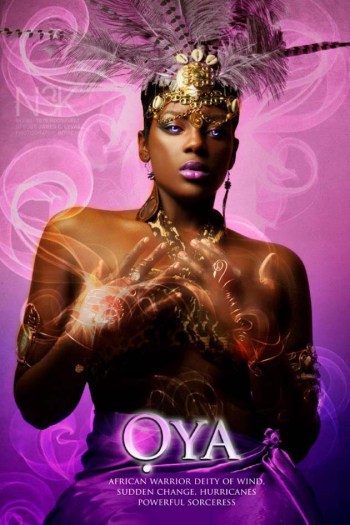
~ Oya – Orisha Of Wind and Change ~

Oya-by-James-C-Lewis

SYNCRETISM: Our Lady of Candlemas, St. Therese, Our Lady of Mount Carmel

PALO COUNTERPART: Centella

AREAS OF INFLUENCE: Storms, wind, lightning, tornadoes, death and the cemetery, the marketplace and business, change, witchcraft, athletics

ATTRIBUTES
The thunderbold, the iruke, cemeteries, a skirt made of nine colors, a rainbow, the flamboyan tree, purple fruits and vegetables, such as eggpants and plums: flowery prints also belong to her and masks.  Her main symbol is a copper crown with nine points, from which hang the working impliments of several of the orishas, especially Oggun and Ochosi. Among her other attributes are an ox cart, a machete and a hammer.

BEVERAGES: Aguardiente, red wine, beer.

COLORS: All colors except black, her main color is wine, she likes flowery prints which her initiates must never wear.

DAYS OF THE WEEK: Friday, which is chosen by the Orishas to inflict punishments on those who have broken the law.

FAVORABLE NUMBERS: 646 387 421

FEAST DAY: February 2

FOODS: White rice with eggplant and small balls made of pigeon peas. Rice with fish, rice with corn, rice with sesame seeds and rice with black beans are also among the favorites food of Oya, as are yams and chocolate pudding.

FRUIT: Papaya, legumes, plums and purple grapes

GARMENTS: Crimson and multi-colored prints

HERBS: Altamisa, cambia voz, yanten, vergonzoza, tamerindo, verbena, espanta muerto, caimito, maravilla, palo rayo, marpacifico, cimarron, palo hacha, palo caja, granada, baria, guasimilla and meloncillo.

MINERALS: Amethyst, Black Opals, Bloodstone, Bronze, Garnet, Labradorite, Tourmaline, Smokey Quartz (red stones)

NECKLACE: Her main necklace is made of red and brown beads with white and black stripes. Among her other necklaces there is one made of violet beads with yellow stripes and another alternating white beads with nine black beads.

NUMBERS: 9

ORIGIN: Celestial

SACRIFICES: She-goats, pigeons, black hens and guiena hens.

SYMBOLS: Graves, Lighting Bolts, Masks, Tornadoes

TABOOS: Rams, Palm Oil, Her initiates wearing floral prints.

TRADITIONAL COLORS: Black, Oranges, Purples and Reds

Oya is the orisha or storms and changes. She is a much feared orisha due to her powers as she can create a storm so powerful that she can destroy towns upon towns. The winds, tornadoes and lighting are at her every command. Oya also known as Xansa, Oya Yansa (Mother of Nine) was the wife of Ogun before Chango took her away from him. Oya is said to be a lovely tall amazonic woman who is dressed in a wine color dress with a belt that holds a grass skirt with 9 different color cloths. Oya is also the owner of the market place where she would go and sell her goods to maintain her children. Oya’s main home or domain is the cemetery. Now a lot of people say or believe that she is the owner of the cemetery. That’s all not true. Oya is the gatekeeper. She stands at the cemetery gates and she lets the dead into the cemetery where her sisters Obba and Yewa tends to the body.

Oya is a great warrior who loves to go to battle alongside her husband Chango. Stories say the Oya would put on a pair of pants and grow a beard just to fight like a man at war. Oya has a younger sister named Ayao who is the orisha that resides in the clouds in the sky. It is Ayao that gives her sister Oya the ability to take the spirits of the dead to go fight alongside her which makes up her powerful army.

Oya has brought down many men, many towns and many lands. But as a warrior she protects her children with a strong look and with her destruction she brings changes. Whenever there is a storm that brings destruction, change is needed to rebuild. Sometimes the land is expanded for new homes or new business. That’s Oya. She has helped all the orishas in one time or another. As well she has feuded with the orishas at one time or another. Oya is the one that convinced Obba to cut her ear to feed to Chango. Oya is the one that brought down Osain’s gourd where he kept most of his secrets of the herbs.

She also had a feud with her sister Yemaya in which she does not eat ram anymore. At one time she did but due to that disagreement she doesn’t anymore. Let me clear something. Oya and Yemaya are not enemies. The only dilemma between them is the ram. It is said that one day Chango was eating with his mother Yemaya and Oya and with his court and Oya saw that he was giving all of his attention to his mother and Oya became very jealous. Oya saw that Chango gave his mother Yemaya first bite of the ram and since that day, Oya said she will never eat it again. One of Oya’s characteristics is the wind that causes hurricanes. Hurricanes come off the coast of Africa where her town is and logically, a hurricane needs the assistance and strength of the ocean to come on shore to bring change.

Pataki of Oya 

Chango was at a party one day having the time of his life. Chango was drinking and dancing like no ever. He was swaying his hips and showing all his sexual masculinity. His crown was kept firm on his head as every moment he did, it did not move. That was to show all that he is truly Chango, a king. Everyone in the party was enjoying Chango and was cheering him on. The great king of Oyo kept on drinking and did not realize that some of his enemies were outside of the party noticing Chango.
The party was dying out and Chango decided to leave the function. He went around the room giving his good bye to everyone. He was eyeing some of his mistresses that were there to see if they would go home with him. Chango staggered to one of the corners of the party where his enemies were hiding. Within a minute, his enemies grabbed him and tied him up. No one in the party saw and Chango was taken to a cell where his enemies kept him.
Days passed by and Chango was no where to be found. Oya who was married to Ogun already had left Ogun and had a fling with Chango. Oya also did not hear anything from Chango. She did notice that Chango had left his pilon (a wooden pillar that Chango sits on) and his mortar (where Chango hides his secrets) in her house. Oya grew very weary and was worried about Chango. But besides her worries Oya was very inquisitive and wondered what was so special about Chango’s pilon and mortar. She moved the red cloth that was covering his pilon and mortar and saw nothing special about it. When she touched the mortar she noticed that it had a gleam to it. Inside the mortar there was some kind of clear liquid that vibrated. She looked closer and an image started to form in the liquid.
In the image in the mortar was the face and body of Chango. Oya saw that Chango was being held captive by his enemies. She saw that he was locked in a cage fit for a dog and his enemies were surrounding the cage making mockery of him. Oya looked harder into the mortar and saw that Chango was in a rage but he couldn’t do anything because he didn’t have his oshé and his powers. Oya grew upset and lighting sparks started to form in her hair. She yelled up in the sky and called for a centella (lighting) to come and help her and she would ride it to find Chango. With that the image of Chango’s face reflected in the liquid and Oya grabbed the liquid and put it to her lips, as in to kiss the face of her loved Chango.
In that instant Oya’s lips and mouth started to burn her furiously. She staggered back and forth wondering where the heat was coming from. She ran outside of her house to where she had a well to grab some water. The water did not do anything to ease the pain. She finally opened her mouth as she could not stand the burning sensation and when she did a huge fireball came from her mouth. Everywhere she turned and screamed out, fire was released from her mouth and everything was burned on fire. At this moment a centella crackled in the sky and fell right to her feet. Oya screamed and stepped onto the centella. The centella rose to the sky and Oya was standing on it and the centella proceeded to take her to where Chango was held captive.

In a second the centella was above the place where Chango was kept and when the centella started to come down, Oya who was riding it screamed a war cry and fire was released from her mouth. Another centella came from the sky that broke the locks that were holding Chango. When Chango’s enemies saw Oya coming down on a centella breathing fire they all ran for cover.
Chango was wondering how was he released and when he ran outside he grabbed his oshé and he saw his mistress Oya standing in the fields surrounded by centellas that crackled around her and that she was breathing fire. Chango was reluctant to run the other way because he never saw Oya in this state. Oya sent another centella to grab Chango and he to was standing on a centella alongside with Oya. Chango started to throw thunderbolts with the help of his oshé while Oya was throwing lighting and fire upon the enemies of Chango as they rose into the sky together.

They both arrived at Oya’s place safe and Chango was still in amazement of Oya’s actions. He told her that the only one who knew the secret of him throwing aiña (fire) was him and that secret was kept with his pilon and mortar. Oya turned to her lover and told him that she looked into his mortar and tasted the secret that he had there. Chango was upset that she discovered his secret but he was grateful that she saved him. From that day when Chango goes into battle, his mistress Oya goes in alongside him fighting.
Oya’s feast day is February 2nd. She is associated with Our Lady Teresa and Our Lady of Candelaria. Her number is 9 and all its association. Her color is maroon or a dark wine. Oya also takes 9 other colors that are her children. Those children make up the rainbow and they live in the skies making the crown of the orisha Ochumare. She is the queen of the dead. Oya is the official secretary of Olofi. She knows when life is being born and when life is dying. She is the air we breathe everyday. Oya stands at the cemetery gates and she marks down every body that comes through the gates of ile iku (cemetery). In the house of the priest, Oya lives in a brown or wine color tureen where her secrets and mysteries are kept. Some houses have her with water and some do not. I believe she shouldn’t be with water. The only time I put water on her is to calm her down when she is upset and to refresh her. She also takes an iruke that she uses to clean the dead and clean new paths.
Her crown is made up of copper in which that is her main metal. All of her tools and weapons are made up of copper. Oya’s sacrificial animals are black female goats, hens, pigeons and guinea hens. Oya’s children are very outgoing and strong willed people. There are very spiritual individuals at they have the gift if used correctly, to communicate with the dead. She is initiated on the heads of her followers in which is a lengthy and mysterious procedure. Her ceremonies are one of the most gorgeous due to all of the many colors that are used. Her zarasa (the throne of the dead) is made up of multiple plates that are placed for the dead. These plates range from 29 all the way to 209 plates of different offerings to the dead of her initiate and the spirits that her initiate collects to walk alongside her.
Oya is the owner of the mask as she at times is wearing one. Some people say that no one can stand to look at the face of Oya because it is too horrific to look at. I don’t believe so. I believe that she is a beautiful woman; she just doesn’t like to be messed with or fooled with. She is good to use to take masks off of people who you believe that are being two faced with you. She is also good to use when one wants change in their lives. She is a good healer but she loves to defend and be at war when war is present.

Ayao 

Ayao is the younger sister of the orisha Oya. Ayao is said to reside high in the clouds of the sky or at the top of the cieba tree. She is said to sit there and help guard the spirits that pass through her clouds to reside at the kingdom of Olofi. Ayao is an orisha that is given to the children of Oya. Now any priest or priestess can receive Ayao. Her secrets are kept in a tureen that is kept high in the house of the priest. This orisha can never touch the ground as her ceremonies are done on top of a table. It is said that when an initiate of Oya is performing their consecrating birth, the spirits that they pick up are tended by Ayao. When Oya is getting ready for battle she calls her sister Ayao who releases those spirits to aide Oya in battle. She is not initiated on the heads of anyone.


Source: ~ Oya – Orisha Of Wind and Change ~ – Ye Olde Dark Arts

~ Imbolc – Candlemas – Lupercalia ~

imbolc

Candlemas (Imbolc, Imbolg and Oimelc) is a Major Sabbat that is a celebration to mark the return of the sun and the end of winter. We celebrate the waxing sun and the beginning of Spring. Candlemas is a celebration of hope, the light returns and Spring is just around the corner.

Altar: Candles, Grain Dolly, Sun Cross

Animals: Wolf, Snake, Swan, Vulture, Robin, Burrowing Animals, Sheep, Lamb, and Deer

Birds: Cockerals, Cranes, Crows, Ducks, Eagles, Goose, Owls, Ravens, Swans and Wrens

Colors:  White, red, pink, yellow, blue

Deities: Aradia, Arachne, Arianrhod, Athena, Brighid, Blaize, Branwen, Cupid/Eros, Diancecht, Dumuzi, Februa, Februus, Gaea, Inanna, Lucina, Vesta, and Oya

Foods: Pumpkin seeds, Sunflower seeds, Poppyseed Cakes, muffins, scones, and breads, all dairy products, Peppers, Onions, Garlic, and Raisins.

Herbs: Angelica, basil, bay Laurel, blackberry, celandine, coltsfoot, heather, iris, myrrh, tansy, violets, and all white or yellow flowers.

Incense: Basil, myrrh, frankincense, wisteria, jasmine, camphor, cinnamon, and lotus.

Oils: Jasmine, Apricot, Carnation, Sweet Pea, Neroli and Olive

Stones: Amethyst, bloodstone, garnet, onyx, ruby, turquoise

Trees: Rowan

Zodiacs: Aquarius and Pisces


Imbolc Traditions and Symbols

Brigid Corn Dolly – a very old custom involved making a “Brigid” corn dolly that can be placed in a “Bride’s bed” to bring fertility and good fortune to the home.  If you made a “Corn Mother” at Lammas, you may simply re-use it.  Dress the Corn Mother as a bride in colors of white, red and or gold, and your Harvest Crone transforms herself into the Brigit Spring Bride. Place the Bride in a “Brigit’s bed” along with a priapic wand to symbolize fertility.  A priapic wand is a be-ribbonned fruit wood wand with a pine cone on the end which symbolizes the God.

Brigid’s Bed – to show your hospitality and to encourage the Goddess to spend the  night at your home, create a “Brigid’s Bed” near the hearth fire.  By inviting Brigid to stay overnight in your home you’re symbolically asking that her powers of fertility, blessing and healing be with your family all year long.  A Brigid’s bed can be a pretty wooden or cardboard box, a wicker basket or anything large enough to hold your Brigit corn dolly.  Be sure to decorate it with ribbons, flowers, herbs etc. and place a comfy blanket on the bottom of the bed. Don’t forget to place the priapic wand in the bed so that the Goddess will not be lonely.

Hearthfire  – the hearthfire is sacred to Brigid and is her altar in every home.  At Candlemas in the depth of winter the fire was more important than ever.  It was not allowed to go out and in the evening the fire was smoored ( covered with ash to preserve the hot coals) by the lady of the house

Brigid’s Crosses – are a form of woven straw or rushes symbolizing the Sun and used as talismans to bring fertility, prosperity and protection to the home.  They would be created at Candlemas and hung on the door, near the hearth, under the eaves or in the barn to bring luck and protection.

Burning the Yule Greens– the evergreens for Yuletide decoration are gathered and burned by Candlemas.  It is a symbolic way to let go of the old year and make way for the new.

Springs and Wells – toss coins in wells springs, fountains or any running water as an offering the the Goddess Brigid

Source: ~ Imbolc – Candlemas – Lupercalia ~ – Ye Olde Dark Arts

Ancient ‘lost continent’ found lurking under Indian Ocean

A complex splintering took place with fragments of continental crust of variable sizes left adrift within the evolving Indian Ocean basin.

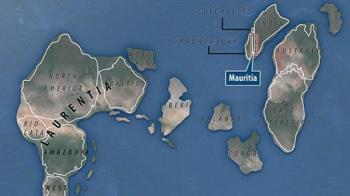
Scientists have confirmed the existence of a “lost continent” under the Indian Ocean island of Mauritius that was left-over by the break-up of the super-continent, Gondwana, which started about 200 million years ago.

The piece of crust, which was subsequently covered by young lava during volcanic eruptions on the island, seems to be a tiny piece of ancient continent, which broke off from the island of Madagascar, when Africa, India, Australia and Antarctica split up and formed the Indian Ocean.

“We are studying the break-up process of the continents, in order to understand the geological history of the planet,” said Professor Lewis Ashwal from University of the Witwatersrand in South Africa.

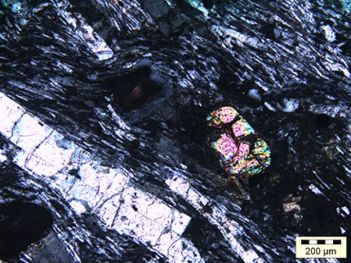
By studying the mineral, zircon, found in rocks spewed up by lava during volcanic eruptions, Ashwal and his colleagues have found that remnants of this mineral were far too old to belong on the island of Mauritius.

“Earth is made up of two parts – continents, which are old, and oceans, which are “young”. On the continents you find rocks that are over four billion years old, but you find nothing like that in the oceans, as this is where new rocks are formed,” said Ashwal.

“Mauritius is an island, and there is no rock older than nine million years old on the island. However, by studying the rocks on the island, we have found zircons that are as old as three billion years,” he said.

Zircons are minerals that occur mainly in granites from the continents. They contain trace amounts of uranium, thorium and lead, and due to the fact that they survive geological process very well, they contain a rich record of geological processes and can be dated extremely accurately.

“The fact that we have found zircons of this age proves that there are much older crystal materials under Mauritius that could only have originated from a continent,” said Ashwal.

This is not the first time that zircons that are billions of years old have been found on the island. A study done in 2013 has found traces of the mineral in beach sand.

However, this study received some criticism, including that the mineral could have been either blown in by the wind, or carried in on vehicle tyres or scientists’ shoes.

“The fact that we found the ancient zircons in rock (six-million-year-old trachyte), corroborates the previous study and refutes any suggestion of wind-blown, wave-transported or pumice-rafted zircons for explaining the earlier results,” said Ashwal.

Ashwal suggests that there are many pieces of various sizes of “undiscovered continent”, collectively called “Mauritia”, spread over the Indian Ocean, left over by the breakup of Gondwanaland.

“According to the new results, this break-up did not involve a simple splitting of the ancient super-continent of Gondwana, but rather, a complex splintering took place with fragments of continental crust of variable sizes left adrift within the evolving Indian Ocean basin,” Ashwal added.

The study was published in the journal Nature Communications.

Source: Ancient ‘lost continent’ found lurking under Indian Ocean

~ Saint Magick – Saint Brigid of Kildare ~ – Ye Olde Dark Arts

saint-brigid

FEAST DAY: February 1

DAY OF THE WEEK: Sunday

CANDLE COLOR: Yellow

LEGEND: Daughter of Dubtach, pagan Scottish king of Leinster, and Brocca, a Christian Pictish slave who had been baptized by Saint Patrick. Just before Brigid’s birth, her mother was sold to a Druid landowner. Brigid remained with her mother till she was old enough to serve her legal owner Dubtach, her father.

She grew up marked by her high spirits and tender heart, and as a child, she heard Saint Patrick preach, which she never forgot. She could not bear to see anyone hungry or cold, and to help them, often gave away things that were Dubtach’s. When Dubtach protested, she replied that “Christ dwelt in every creature”. Dubtach tried to sell her to the King of Leinster, and while they bargained, she gave a treasured sword of her father’s to a leper. Dubtach was about to strike her when Brigid explained she had given the sword to God through the leper, because of its great value. The King, a Christian, forbade Dubtach to strike her, saying “Her merit before God is greater than ours”. Dubtach solved this domestic problem by giving Brigid her freedom.

Brigid’s aged mother was in charge of her master’s dairy. Brigid took charge ,and often gave away the produce. But the dairy prospered under her (hence her patronage of milk maids, dairy workers, cattle, etc.), and the Druid freed Brigid’s mother.

Brigid returned to her father, who arranged a marriage for her with a young bard. Bride refused, and to keep her virginity, went to Bishop Mel, a pupil of Saint Patrick’s, and took her first vows. Legend says that she prayed that her beauty be taken from her so no one would seek her hand in marriage; her prayer was granted, and she regained her beauty only after making her vows. Another tale says that when Saint Patrick heard her final vows, he mistakenly used the form for ordaining priests. When told of it he replied, “So be it, my son, she is destined for great things.”

Her first convent started with seven nuns. At the invitation of bishops, she started convents all over Ireland. She was a great traveller, especially considering the conditions of the time, which led to her patronage of travellers, sailors, etc. Brigid invented the double monastery, the monastery of Kildare that she ran on the Liffey river being for both monks and nuns. Saint Conleth became its first bishop; this connection and the installation of a bell that lasted over 1000 years apparently led to her patronage of blacksmiths and those in related fields.

PETITION SAINT BRIGED: for childbirth, protection from fires, fertility, the hearth, healing, physcians, agriculture, animal husbandry, inspiriation, learning, poetry, prophecy, smithcraft, love.

PATRONAGE: babies; blacksmiths; boatmen; cattle; chicken farmers; children whose parents are not married; dairymaids; dairy workers; fugitives; infants; Ireland; Leinster, Ireland; mariners; midwives; milk maids; newborn babies; nuns; poets; poultry farmers; poultry raisers; printing presses; sailors; scholars; travellers; watermen

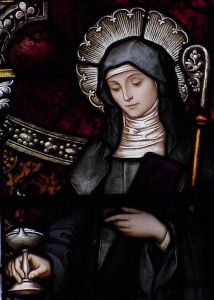
REPRESENTATION: abbess, usually holding a lamp or candle, often with a cow nearby

Source: ~ Saint Magick – Saint Brigid of Kildare ~ – Ye Olde Dark Arts

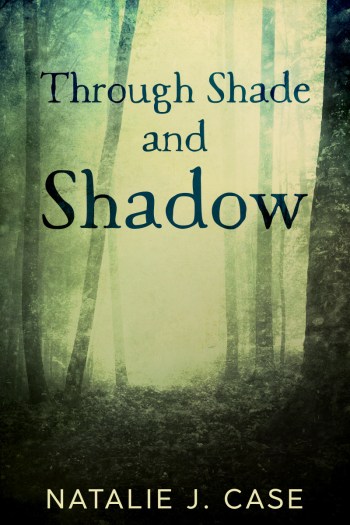
Through Shade and Shadow!! – Natalie J Case

Today is the release date for Through Shade and Shadow!!  It is now available in both paperback and kindle!

Also, today is the day that my Goodreads Giveaway is open to enter. Sign up between now and midnight on the 10th of February for your chance at one of two signed books I’m giving away.

And, NEW, if you want to order an autographed copy from me, you can now do that on my facebook author’s page! All of my current works are listed, and there’s even an option to bundle all three for a discount.

I am very excited to share this book with you and rest assured I am hard at work on the sequel so hopefully you won’t have to wait too long.

Once you’ve read it, I hope you will consider leaving a review, whether on Amazon (US, UK, CA, AU, etc) or Goodreads.  Reviews are important in getting the book in front of more people.

As always, thanks for reading.  And maybe Saturday I’ll open up an Ask Me Anything kind of post.  I love hearing from you!

Source: Through Shade and Shadow!! – Natalie J Case

Wild Horses Deserve a Better Film than ‘Unbranded’

by Libby Blanchard as published on High Country News

“I found the documentary disturbing. Scenes of negligence towards the mustangs abound…”

Unbranded CrueltyA few nights ago, I downloaded the acclaimed 2015 film Unbranded. This crowd-funded film, made by Fin and Fur Productions from Bozeman, Montana, depicts the journey of four young men who ride mustangs from the Mexican border up to Canada, traveling through some of the most beautiful public lands in the American West.

Unbranded is marketed as a celebration of the American mustang, both wild and under saddle. It was featured at the Banff Mountain Film and Telluride Mountainfilm festivals, and continues to be promoted widely. Last year, it was a top download on iTunes and gained over 150,000 likes on Facebook. Outside Magazine and the Los Angeles Times gave it glowing reviews.

But I found the documentary disturbing. Scenes of negligence towards the mustangs abound. A dog drives a horse to jump a barbed wire fence. The horse’s hind leg gets ensnarled in the wire, and the animal struggles to pull free while the boys watch.

Another scene shows a horse limping from a torn muscle in its hindquarters, the after-effect of setting him loose to graze with his halter on. Any real horseman knows that a horse can easily catch its hoof in the webbing of a halter negligently left on, resulting in severe and potentially permanent injuries.

But the most egregious scene is when the boys force their horses up dangerous terrain. Someone notes that the route is a bad idea, but no one has the maturity or leadership to turn back. After struggling up the steep mountain face, one horse — unable to gain purchase in the loose, unstable footing — kneels down in exhaustion. When the boys provoke it back onto its feet, the mustang struggles for a foothold. Unable to find purchase, it tumbles off the mountainside, rolling through the air down a significant drop before crashing onto flatter ground.

At this point, I turned off the film, disgusted. When I finished it later, I discovered — unsurprisingly, given the negligence and ignorance throughout — that one of the horses dies. This fatal injury, likely a cervical spine fracture, is never explained. Instead, the death is romanticized by these self-identified cowboys, who say it is “satisfying to know that he died in the wild where he belonged, not in a holding pen.” Yet there’s little moral high ground for the cowboys to stand on: A horse was fatally injured under their care, a circumstance that is neither common nor acceptable on a horse-packing trip.

The film’s storyline is also troubling. A veterinarian and various Bureau of Land Management officials talk about how hard it is to protect public lands from overgrazing while still conserving the mustang as an American icon. The solution: moving “surplus” mustangs from the range to federally run holding pens to prevent further degradation of the land and starvation of the horses. Yet the filmmakers make only a slight attempt to explore the contentious political context of too many mustangs roaming the public land. The title, Unbranded, by the way, makes little sense as the BLM freeze-brands every horse that it rounds up for adoption or life in a holding pen.

The only comprehensive thread woven through the documentary is the account of four fame-seeking boys who disregard the welfare of their horses to inflate their own egos. Instead of being exalted, the American mustang is treated as a cheap, easily replaceable commodity available for irresponsible use.

While some reviewers have criticized the choices of the protagonists, virtually all conclude that the film is redeemable because of its cinematography. Unbranded does depict sweeping vistas, but this doesn’t excuse the behavior of the people we’re watching. As Aristotle observed, when storytelling goes bad, spectacle is substituted for substance. Richly painted sunsets and the drama of needlessly frightened, panicking horses become ends in themselves.

As wrong as it was for these young men to treat their mustangs neglectfully, it is also unfortunate for the public to accept this behavior. To celebrate this documentary at film festivals, to mount no outcry about it in over a year, is to condone behavior that is neither common nor acceptable. Those of us who love the West and its mustangs should stay away from this documentary.

Source: Wild Horses Deserve a Better Film than ‘Unbranded’ | Straight from the Horse’s Heart

Emu Oil: Uses, Benefits, and Side Effects – Crooked Bear Creek Organic Herbs

Emu oil has become popular recently due to health claims surrounding its uses and benefits.

Before using emu oil, it is important to understand what it is used for and what possible health benefits it has. It is also important to learn about the possible risks and side effects of using the oil.

What is emu oil?

Emu
The emu is the second largest living bird by height and is native to Australia.

An emu is a flightless bird, scientifically named Dromaius novaehallandiae. The bird is native to Australia but is now found in many countries because of a rising popularity of nutritious emu meat and medicinal emu oil.

Emu oil itself is a bright yellow liquid, made up of mostly fat, which is collected from the deposits below the skin of the bird. Once the fats are collected, they are passed through various filters and processes until pure oil is produced. It is a widely available commercial product with some unique benefits.

There are also different types of emu oil, based on different levels of filtration and processing. Most emu oils will go through full processing in order to reduce bacteria and contaminants. Some emu oils are refined more than others in order to create higher contents of fatty acids.

Organizations such as the American Emu Association have certification programs that aim to ensure that the emu oil people buy is pure and that the emus enjoyed the best possible lives. Completely pure emu oil will always be fully refined and is the type of emu oil studied for its beneficial effects.

Uses and health benefits

The use of emu oil originates from the Australian Aborigine culture. According to their oral history, emu oil has been used for over 40,000 years. The oil has been used to relieve minor aches and pains, help wounds heal quicker, and protect skin from the elements.

The Aborigines first introduced emu oil into European culture as a natural sunscreen and moisturizer. European settlers soon adopted the use of emu oil and many other natural remedies that the Aborigines provided. Since then, people have discovered many more benefits to emu oil.

Anti-Inflammatory

Aboriginals
Emu oil has been used for over 40,000 years by Australian Aboriginal people.

The most popular benefit of emu oil is its use as an anti-inflammatory. In a review posted to the journal Nutrition, researchers noted that the potent anti-inflammatory effect of emu oil may be beneficial in treating conditions like ear inflammation, inflammatory bowel syndrome, and even prevent bone loss induced by chemotherapy.

Emu oil is also popular with massage therapists, who use it to help treat people with arthritis.

Enhancing skin moisture and absorption

The skin easily absorbs emu oil. This can help lock in skin moisture, making the skin less prone to cracking or drying out. Emu oil is often suggested for the dry skin associated with cancer radiation.

It appears that emu oil can pass this absorbable trait on to other compounds when they are mixed together. This property may explain why emu oil is regularly mixed into moisturizers containing other helpful compounds.

Stimulating the skin

The research also signals that applying emu oil to the skin may help increase the number of healthy skin cells. Emu oil stimulates the skin to reduce the appearance of skin wrinkles, and rejuvenate aging or sun-damaged skin.

Emu oil has also been recommended for use in the treatment of skin conditions like alopecia, rosacea, hypopigmentation, shingles, and dermatitis.

Healing wounds

Because of its painkilling effect, antioxidant levels, and ability to reach deep into the skin, emu oil is great to apply on small wounds, cuts, bruises, or burns. It can help ease the pain of minor wounds, and the antioxidants may help protect the skin from additional damage.

Bug repellant

Applying emu oil to the skin before heading outdoors can actually help repel insects. This is partly due to substances called terpenes found in the oil. Many insects are disoriented or repelled by terpenes, and putting the oil on the exposed skin is a great way to keep bugs at bay.

Reducing cholesterol

When taken orally, emu oil may actually reduce cholesterol in the body. Researchers found that when compared to olive oil, subjects who were fed emu oil had significantly reduced cholesterol levels. More trials are needed to substantiate these claims, but the results are promising.

Treating ulcers

According to some research posted to Pharmacy Today, emu oil may also help treat ulcers.

In people who had ulcers, applications of various levels of emu oil had a protective effect. In some cases, the oil even reduced the size of the ulcers.

Breast sensitivity

breast feeding
For breastfeeding mothers who experience pain, emu oil may be used to reduce breast sensitivity.

According to a peer review posted to Nutrition, emu oil may also reduce the breast sensitivity common in breastfeeding mothers.

When newborns latch onto the breast, some women may experience pain caused by an improper latch. This can result in soreness, engorgement, cracked and dry skin, and pain. These symptoms may be severe enough to cause some new mothers to stop breastfeeding.

Researchers found that when breastfeeding mothers used an emu-based cream for a 24-hour period beginning soon after delivery, the breast areola and nipple skin was more hydrated.

Before feeding her baby, a woman should wipe her nipple and breast with a warm cloth to remove any residual oil. This is because emu oil has not been proven safe for infants and children to ingest.

How does emu oil work?

While many topical creams claim to be effective for dry skin, arthritis, and inflammation, most creams and lotions are made up of large particles that cannot penetrate the skin. However, emu oil is made up of smaller particles, which allows it to carry many healthful compounds to deep layers of the skin.

Emu oil contains high amounts of polyunsaturated fatty acids (PUFAs), antioxidants, and compounds, including:

  • Essential fatty acids: Emu oil is high in omega-3, omega 6, and omega-9 fatty acids. This help reduces inflammation, ease muscular pain, and arthritic joint pain. They may also help relieve signs of wrinkles, scars, and blemishes by nourishing the skin cells.
  • Vitamin A: An antioxidant and essential nutrient, vitamin A is an excellent skin tonic.
  • Additional compounds like carotenoids, flavones, polyphenols, tocopherol, and phospholipids.

Side effects, risks, and considerations

Emu oil is a natural product and there are few documented side effects. Some people may experience skin irritation when applying emu oil directly to the skin as a topical ointment. To prevent this, a person should apply a small amount of emu oil to a small patch of skin, such as the back of one hand. If an allergic reaction occurs, they should stop using the oil.

It may also be important to consider the source of the emu oil. Emus thrive when they have plenty of room to roam and are able to eat a rich diet. Low-quality living conditions may result in an inferior quality oil. It is best to buy oil from a reputable source, especially as the United States Food and Drug Administration (FDA) do not regulate its production.

Women who are pregnant or breastfeeding should talk to their doctor before taking emu oil by mouth. It is important to consult a doctor about the possible uses of emu oil and if it will affect a pregnancy.

Source: Emu Oil: Uses, Benefits, and Side Effects – Crooked Bear Creek Organic Herbs