People Are Killing Millions Of Donkeys Just For Their Skins

Warning: Graphic Content – What they’re used for is such a waste

Marjorie Farabee, Director of Wild Burro affairs at WHFF, and her good friend Miss Abby ~ photo by Terry Fitch

For centuries, in rural cultures across the globe, one animal has been an important part of the family, helping to keep farms and villages running.

Not only do millions of people depend on donkeys for practical purposes — many donkeys are seen more and more as smart and loyal pets.

But this friendship between people and donkeys is increasingly threatened by a growing trade in something you’ve probably never even heard of: “ejiao,” (also known as “colla corii asini” or “donkey hide glue”) a kind of gelatin made from donkey skin — and demand for ejiao is killing literally millions of donkeys per year.

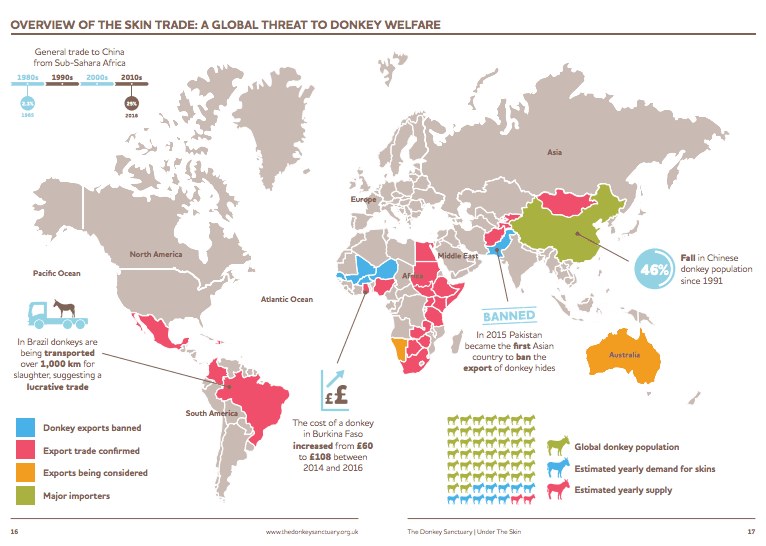
A new report from The Donkey Sanctuary in the U.K. shows just how massive this emerging global trade really is. At least 1.8 million donkey skins are being traded each year — but it could be between 4 million and 10 million. The trade is difficult to track and until now hasn’t been studied at such a large scale.

“Our report reveals the shocking scale of this global trade and how it’s causing a chain of welfare issues for the donkeys at every step, from sourcing to transport and finally to slaughter,” Mike Baker, chief executive of The Donkey Sanctuary, told The Dodo in a statement.

“Ejiao is a medicine with ancient roots and has been promoted as a product worthy of emperors,” the report says, explaining that traditional herbalists in China claim that ejiao can increase libido, slow aging and prevent disease. But ejiao has not been recognized as having medicinal properties by western medicine.

dead-donkeysThis belief means that donkeys are becoming more valuable for their skins, and therefore harder for rural families to afford. Even the loyal donkeys families already have are at risk. It is becoming more common for donkeys to be stolen right out of a family’s yard and slaughtered for their skins.

While exports of donkey skins come from South America and Asia, the largest source is in Africa, where donkeys (many of them stolen) are rounded up in “donkey markets,” where they are often packed together and left without shelter from the hot sun and without food or water, while they await slaughter.

Often, after the skins are removed, the bodies of the donkeys are burned.

“The market is far worse than I expected,” said Alex Mayers, program manager at The Donkey Sanctuary, from a donkey market in Tanzania last week. “There are about 700 donkeys basically coming here to wait to die. There’s no food or water. The donkeys are very stressed. There are lots of signs of dehydration and hunger.”

But there is hope.

Some countries have already taken action and banned exports of donkey skins, making their donkeys much safer. This includes the African countries of Niger and Burkina Faso, and Pakistan, in Asia.

The Donkey Sanctuary is calling for a stop to the trade of donkey skins worldwide, so that the damage already done to donkey populations and the people who depend on them can be assessed.

overview-mapIn particular, we urge other countries affected by this trade to follow the lead taken by Burkina Faso and Niger and ban the slaughter and export of donkeys for their skins,” Suzi Cretney, public relations manager for The Donkey Sanctuary, told The Dodo.

Cretney said that raising public awareness about where ejiao really comes from could help consumers make better choices.

“We are asking countries to follow the lead by Burkina Faso and Niger to end the slaughter and export of donkeys for their skins because it could help thousands, if not millions of donkeys — their welfare, and their real value supporting people’s livelihoods is at risk,” Baker said.

“This has to stop,” Mayers said, standing by a pen packed with donkeys awaiting their fate. “This absolutely just has to stop.”

To get action alerts about how you can help save these donkeys, join the campaign.

Click (HERE) for video and graphic photos!

https://www.thedodo.com/donkey-skin-trade-2230693220.html

Source: People Are Killing Millions Of Donkeys Just For Their Skins | Straight from the Horse’s Heart

Feel Good Sunday: Clydesdales Help Purina Deliver Surprise to Horse Shelter in Need

Source: Purina Mills TV

“Annually, many Americans wait to see the ultimate and final “Big Game” of the year which just concluded in our own backyard, here, in Houston.  But also there are many who may not be football fans but annually look forward to the next installation of the heart tugging, mini-sagas put forth by Budweiser featuring the gentle giants of the equine world, the Clydesdales.  This year, the fans of horses were disappointed when Budweiser benched the ponies and went a totally different direction and suffered poor reviews on their attempt to document immigration history.  The result was a lose/lose on both-sides with Bud slipping in the ratings and the Clydesdales fans left without a horse fix, so we are here to help correct that oversight, today.

We issue a “tissue alert” in advance and would also like to add that we are not endorsing any one horse rescue but instead tipping our hats to all of the fine organizations out there filled with good folks who donate their time, their money and their lives to the effort of finding good forever homes and futures for equines in need.  There is no need to identify them as you already know who you are and we love each and everyone of you bright points of compassion, caring and love.  May you have a wonderful ‘Feel Good Sunday’ and never give up the good fight.  Keep the faith!” ~ R.T.

Source: Feel Good Sunday: Clydesdales Help Purina Deliver Surprise to Horse Shelter in Need | Straight from the Horse’s Heart

Stunning Lack of Tranparancy in BLM’s and University of Wyoming’s Adobe Town Wild Horse Study

Source:  Wild Hoofbeats

b54p0090

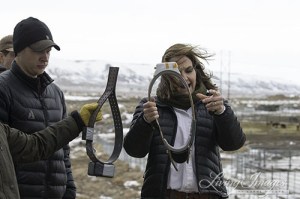
USGS holding radio collars, the one on the right is for the study

by Carol Walker, Dir. of Field Documentation for Wild Horse Freedom Federation

The BLM and the University of Wyoming are conducting a Radio Collar Study on wild mares in the Adobe Town Herd Management Area. I have done several blog posts about this study, calling for people to send in comments and calling for more clarification on how this study is going to be conducted. Some of my concerns are the the health and well being of the mares that will be captured by bait trapping, trailered to Rock Springs, put into squeeze chutes and have these collars put on. These collars will remain for 2 years. Then the mares will be transported back supposedly to where they were captured and released. This alone will be very traumatic for the mares and their families who will lose a family member.

But what happens when the mare gets her foot caught in the collar, or it grows into her neck because it is being put on when she is at her thinnest, and she will put on weight in the summer especially if she is pregnant? How will they be able to release the collar if she is in trouble?

bi4i2360

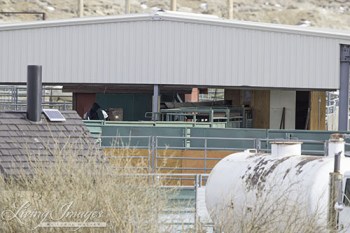
Moving the mares into the shed to put collars on

These were not popular questions at the Q and A that USGS conducted yesterday at the Rock Springs corrals. I was told that they “left room” in the collars for the mares to gain weight – wouldn’t that allow her to get it caught on something more easily? And yes there were studies of mares being injured and dying in the field due to radio collars but supposedly this design was much improved. They do have a tag they can put into the mane instead but these will fall off too soon. I did ask about using direct observation as a way of gathering data but that was deemed impossible, even though it is much less intrusive. The researchers would rather track the mares on their computers rather than on the ground, in the field. I also asked weren’t they concerned about the mares being released all alone, not with their families? There was no answer to that.

bi4i2354

The geldings in the front corral know something is going on

Before I even went to Rock Springs I had been very concerned about the lack of observation of the whole process that the BLM was allowing. Public observation helps to prevent abuse of the horses, and I am a firm believer in this.  A week ago American Wild Horse Preservation Campaign asked attorney Nick Lawton of Meyer, Glizenstein& Eubanks to write a letter asking for the opportunity to observe the bait trapping and the collaring as well as the release of the mares, as well as giving sufficient notice of at least 2 days so I could get out there. The BLM did not change its stance on the bait trapping and the collaring or the notice but did say that “the mares will be held at the facility for 24 hours after they are radio collared, and the public will be able to observe the mares from the overlook during this time period.”

b54p0092

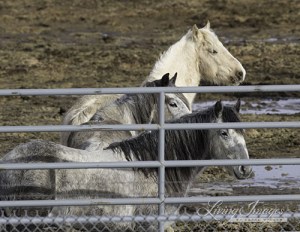
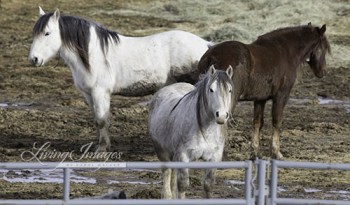
Mares that were not collared

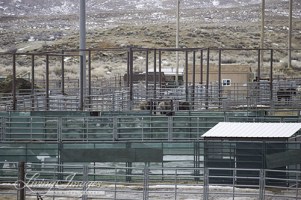
This did NOT happen. The mares after they were collared were being kept in a pen that was completely not visible from the overlook and when I asked it if could see the mares I was told no, that they have to be be kept quiet. Somehow all the torment that these mares went through was totally acceptable but having members of the public view them, even at a distance, was too hard on them.

bi4i2380

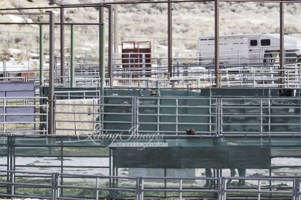
Where the collaring was done

I could see the heads of the mares that did not have collars on, and occasionally their bodies, using my long lens. Apparently they captured 9 mares who they brought to the facility, but 5 were too young. Even I could see one of the mares looked like a yearling or at the most a two year old filly – how on earth could the people trapping the horses not be able to tell the difference between very young and mature mares? And why put these poor young mares though the stress of taking them away from their families, hauling them to the facility then hauling them back, for nothing? If they had allowed me to observe the bait trapping I could have told them these mares were too young because I have spent 13 years observing these wild horses in Adobe Town.

b54p0084

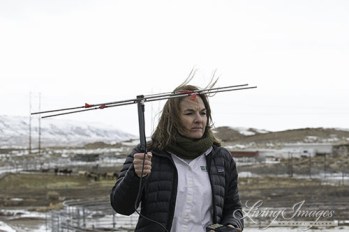
Tracking device to track collars on the ground

I am meeting the BLM at the Rock Springs corrals on Sunday morning to follow them out to release the 4 mares with collars and I assume the 5 without. Hopefully I will be close enough to actually see them and photograph them. And please let them not get into trouble, please keep them safe. They do not deserve what is being done to them.

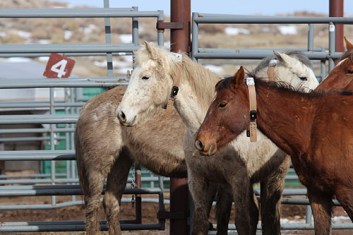
Gelding still at Rock Springs after the 2014 Checkerboard Roundup

This just in – I received a photo of the collared mares from the BLM:

Photo of collared mares, courtesy of BLM

Source: Stunning Lack of Tranparancy in BLM’s and University of Wyoming’s Adobe Town Wild Horse Study | Straight from the Horse’s Heart

NM Senate Committee Passes Horse as Livestock Bill | Straight from the Horse’s Heart

Dianne L Stallings , Ruidoso News

“Wild Horse Advocates fear new provisions could lead to the elimination of wild herds…”

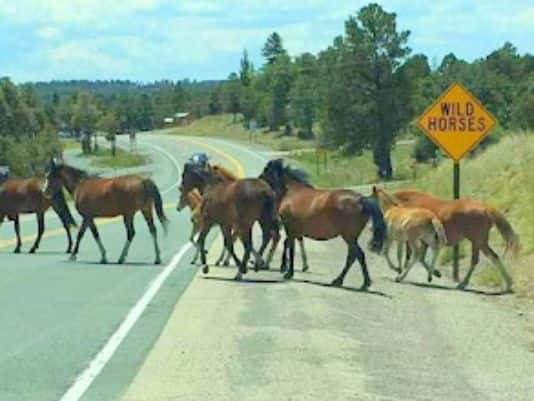
Members of the wild herd rounded up last year were photographed crossing at their designated point on the highway leading into Alto and Ruidoso.(Photo: Courtesy/Melissa Babcock)

Members of the wild herd rounded up last year were photographed crossing at their designated point on the highway leading into Alto and Ruidoso.(Photo: Courtesy/Melissa Babcock)

Local advocates for wild horse herds in New Mexico piled into a bus at 3:30 a.m. Thursday and headed to Santa Fe to voice their views on an amended version of a state senate bill they feared would lead to the elimination of wild horse herds that roam the Alto area north of Ruidoso.

Despite the efforts of advocates, they reported that members of the Senate Conservation Committee passed the bill in less than five minutes. A series of hearings led to modifications of the original bill submitted by State Sen. Pat Woods, a Republican from Quay County, that eliminates the classification of domesticated horse.

While under the amended version horses still would be lumped into the broad definition for livestock that fall under the jurisdiction of the New Mexico Livestock Board, specific exceptions were included for Spanish colonial horses and for a “wild horse” defined as an “unclaimed horse without obvious brands or other evidence of private ownership that is determined by the board to originate from public land or federal land or to be part of or descended from a herd that lives on or originates from public land; but does not include horses that are subject to the jurisdiction of the federal government pursuant to the federal Wild Free-Roaming Horses and Burros Act.”

Public land does not include federal land controlled by the Bureau of Land Management, the Forest Service or state trust land.

Under the amended version, a wild horse captured on private land in New Mexico at the discretion of the livestock board “shall be” humanely captured and relocated to state public land or to a public or private horse preserve; adopted by a qualified person (for an adoption fee); or humanely euthanized provided the option is the last resort when the horse is determined by a licensed veterinarian to be crippled or otherwise unhealthy or cannot be relocated to a public or private wild horse preserve or adopted.

A new section throws in another wrinkle for the future of “wild horses” such as the herds in Alto. That section in the amended bill provides when requested by the board to determine the viability of a specific New Mexico wild horse herd on the range they occupy, the range improvement task force of New Mexico State University will evaluate the range conditions to determine the number of wild horses that the range can support while maintaining its ecological health.

The task force will report the results of the evaluation to the board. “If required, the board may cause control of the New Mexico wild horse herd population through the use of birth control and may cause excess horses to be humanely captured” and relocated, adopted or euthanized…(CONTINUED)

http://www.ruidosonews.com/story/news/local/2017/02/09/senate-committee-passes-horse-livestock-bill/97712106/

/story/news/local/2017/02/09/senate-committee-passes-horse-livestock-bill/97712106/

Source: NM Senate Committee Passes Horse as Livestock Bill | Straight from the Horse’s Heart

Hundreds of Bison Sent to Slaughter Over Tribes’ Objections | Straight from the Horse’s Heart

Tribal Chairman Floyd Azure said state and federal officials “slapped the Fort Peck tribes in the face” by not using the facility.

Yellowstone National Park on Wednesday started shipping hundreds of wild bison to slaughter for disease control, as a quarantine facility on a Montana Indian reservation that could help spare many of the animals sat empty due to a political dispute.

Fifteen female bison initially slated for quarantine on the Fort Peck Reservation were instead loaded onto trailers near the town of a Gardiner, Montana and sent to slaughter. Hundreds more will be shipped in coming days and weeks, park officials said.

More than 400 bison, also known as buffalo, have been captured this winter attempting to migrate out of the snow-covered park to lower elevations in Montana in search of food. More animals are expected to be captured and shipped to slaughter through March.

Fort Peck’s Assiniboine and Sioux tribes built their quarantine facility to house up to 300 animals in hopes of using it to establish new herds across the U.S with Yellowstone’s genetically pure bison.

Tribal Chairman Floyd Azure said state and federal officials “slapped the Fort Peck tribes in the face” by not using the facility.

“They knew we were building a quarantine facility. A lot of money and time and effort were involved in this and all of a sudden they throw a monkey wrench in it,” Azure said.

Montana livestock officials and federal animal health agents oppose transferring bison to the quarantine site because the animals have not been certified to be free of brucellosis, a disease that can cause animals to abort their young. Ranchers in the state fear bison could transmit the disease to cattle and would pose competition for grazing space on public lands.

No transmissions of the disease from wild bison to cattle have been documented.

The park and state severely limit bison migrations into Montana under a 2000 agreement intended to guard against such transmissions.

The agreement set a population goal of 3,000 bison inside the park.

There were an estimated 5,500 animals at last count. To reduce that number, park officials want to kill up to 1,300 bison this winter through a combination of slaughter and public hunting.

A Democratic lawmaker from Missoula introduced a bill Wednesday to the Montana Legislature to change a law that calls for the state veterinarian to certify bison as brucellosis free before the animals can be transferred to tribes. Rep. Willis Curdy, whose family runs a cattle operation in western Montana’s Bitterroot Valley, said he understands the ranching industry’s worries about brucellosis but thinks the tribes’ wishes deserve fair consideration.

“The state of Montana is continually getting very bad press for its policy in terms of the slaughters,” Curdy said. “We need to make a move in a positive direction, not only for the tribes but also for the bison.”

Hunters in Montana have shot more than 300 bison so far this winter. Meat from slaughtered animals is distributed to American Indian tribes. Many tribes historically relied on bison for food, clothing and other needs until the species was driven to near-extinction during the settlement of the U.S. West in the late 1800s.

Gov. Steve Bullock temporarily halted the park’s slaughter plans last month after Yellowstone Superintendent Dan Wenk said 40 animals once slated for the quarantine would be killed to make room in corrals used to hold migrating bison.

Bullock lifted the ban after the park, state and U.S. Department of Agriculture reached a deal that would spare 25 bull bison for future shipment to Fort Peck, once they undergo a lengthy quarantine at a U.S. Department of Agriculture facility just north of the park in Corwin Springs, Montana. That’s now down to 24 animals after one of the bulls was shot Tuesday when he broke his leg inside the park’s corrals.

To make room for the animals, federal officials will send to slaughter 20 Yellowstone bison that took part in a government research program at Corwin Springs, said Lyndsay Cole, a spokeswoman for the Agriculture Department’s Animal and Plant Health Inspection Service.

Bullock spokeswoman Ronja Abel said state officials continue to work toward a long-term solution to the issue. She declined to say if that could include future use of Fort Peck’s quarantine.

Yellowstone spokeswoman Morgan Warthin said the park still wants to transfer bison to the tribes’ quarantine and plans future negotiations to make that happen.

“The ultimate goal is to reduce the amount of slaughter as a first step toward conservation,” Warthin said.

Source: Hundreds of Bison Sent to Slaughter Over Tribes’ Objections | Straight from the Horse’s Heart

300 Former Wild Horses in South Dakota Need Homes as Deadline Looms | Straight from the Horse’s Heart

Source: ISPMB/Emergency Adoption Mission

“The ‘Hallelujah Horses’ Need Your Help!”

Volunteers are scrambling to find homes for hundreds of wild horses in South Dakota that were spared a possible trip to the slaughterhouse but are now suffering through a harsh winter.

The horses, some of them blind, were once kept at a troubled South Dakota sanctuary. Now a small group of volunteers from across the country is working 10 hours a day to feed and care for animals, using rented plows to carve paths through 15-foot snowdrifts. In a nearby hotel room, other volunteers are sorting through adoption applications and networking through social media, desperately trying to find homes for the horses before they are forced to leave the property next month.

“We are working to get the whole herd out of the 15-foot snow. Some are blind and are walking out right over the fences. It’s really hard to work with so many horses with so many problems,” said Elaine Nash, director of horse rescue organization Fleet of Angels, who is spearheading the operation. “Every time we get over one hurdle there’s another one waiting for us.”

Some 500 horses have already been placed in sanctuaries and ranches across the country, from Arizona and Oregon to California and Minnesota. But the effort near Lantry, in northern South Dakota, isn’t done.

The remaining 300 wild horses could be more difficult to sell or have adopted, Nash said. Nearly 200 are stallions that need gelding before anyone will want them. Dozens are old and have health problems. Others are blind from what Nash suspects was toxic farm runoff in their drinking pond.

But Nash was grateful for the response so far to the neglected herd. Many of the less desirable horses have already found homes, and Nash is hopeful that most will be out of South Dakota by their deadline.

When Nash first spread the word in October, This Old Horse rescue in Hastings, Minnesota, agreed to take two older mares.

They wound up taking seven stallions, all blind, instead.

“I don’t know how it happened,” joked Nancy Turner, board president of This Old Horse. “Elaine is really good at convincing people.”

Turner said it’s not easy. The horses are wild, after all, and need special handling and transportation. Most have never been inside a barn or trailer.

“But part of it for me is that these aren’t poor needy horses,” Turner said. “They are magnificent. I thought that we could celebrate them rather than see them as poor things that should probably be put down.”

More than 800 horses were impounded in October at the nonprofit International Society for the Protection of Mustangs and Burros after a state veterinarian found they were being neglected and a former ranch employee said they were being starved to death. All but 20 were eventually surrendered by their owner.

By mid-December, a third of the horses had been adopted or sold while the other 550 or so were being held as collateral by county officials seeking reimbursement for the cost of caring for the horses. When it didn’t come, the counties started planning to auction off the rest to recoup the cost, making animal rights groups fear many of the horses would be brought to slaughterhouses in Canada and Mexico.

Fleet of Angels and other animal rights groups raised the $78,000 still owed to the counties and stopped the auction. They then assumed the costs and responsibility of caring for the horses

The group is now gathering, microchipping, collecting blood samples and trimming the feet of the remaining horses and gelding the stallions. Meanwhile, they still need financial support to feed and care for a herd burning through $1,000 in hay each day.

Nash said horses won’t be euthanized unless they have broken bones or serious conditions — even horses that might be difficult to adopt.

“We know that someone will come forward and give them good homes. People care about these horses and about making this mission a success,” she said.

Note: “200 stallions” was the total number of the stallions out of the total 810.  Also, about 95% of the horses look great after receiving $150,000 worth of hay since mid-October.

Source: 300 Former Wild Horses in South Dakota Need Homes as Deadline Looms | Straight from the Horse’s Heart

UW, BLM to Begin Controversial and Inhumane Wild Horse Movement Study

Straight from the Horse’s Heart

Source: UWYO.edu

“From the destruction of wild horse’s genitals to the installation of dangerous collars the rogue federal agency, Bureau of Land Management (BLM), continues to enlist the aide of America’s institutions of higher learning to be partners in their crimes.” ~ R.T.

It works on cows

“It works on cows, duuuuuhhhh!”

The Bureau of Land Management (BLM) and the University of Wyoming are beginning a study to learn more about wild horse seasonal use and movements in the Adobe Town herd management area (HMA).

The study will begin with a bait-trap gather and radio collaring of up to 30 wild mares during February. No wild horses will be removed during this nonhelicopter gather.

UW scientists Derek Scasta and Jeff Beck, both in the Department of Ecosystem Science and Management, are heading the research. Jake Hennig, a Ph.D. student in the department, also will participate. They will use the information gleaned from the radio collars to learn more about how wild horses interact with their environment. Specifically, the researchers will study migration patterns and herd movements in the HMA. The BLM says it will use the study results to ensure wild horse herds continue to thrive on healthy rangelands.

The Wyoming Department of Agriculture has provided $120,000 to start the research. The BLM also has contributed funding.

Bait-trapping involves setting up temporary corrals within the HMA to attract wild horses safely into the corral. When a certain number of horses has entered the pen, the gate to the corral is closed. Once the horses are gathered, trained personnel will load and transport selected mares to the Rock Springs Wild Horse Holding Facility. After the horses arrive at the facility, staff from the U.S. Geological Survey will place collars with GPS tracking devices on the horses. The horses will then be returned to the HMA.

The 20-30 mares that BLM will select to wear GPS collars will be 5 years old or older. All other wild horses gathered will be immediately released shortly after the selected mares are sorted and held for collaring. All mares will be released at or near the same location where they were gathered. The selected contractors are in the process of identifying trap site locations and will begin the bait-trapping process soon.

Corrals could be set up in stages over a period of days to allow the horses to grow accustomed to the enclosures. About three to five trap sites are required to distribute radio-collared mares throughout the entire HMA. Bait-trapping is an effective method for capturing small numbers of selected horses.

The number of people in the trap area will be limited to key personnel to ensure a successful and safe gather for the horses.

Public viewing opportunities will be limited. Public viewing is always allowed at the wild horse holding facility overlook in Rock Springs, where the mares will be taken to be collared. Public viewing also will be allowed at the release sites of the collared mares. The BLM will keep a list of people who would like to attend the releasing of the collared mares and notify them at least one day before the releases. Media and interested public can view and photograph the mares being released with the GPS collars. To add your name to the list for public viewing, contact BLM Public Affairs Officer Tony Brown at (307) 352-0215.

The BLM’s Rawlins Field Office released the decision record and finding of no significant impact for the Adobe Town HMA Wild Horse Movements and Habitat Selection Research Gather Environmental Assessment Nov. 9, 2016. The decision was to allow enough wild horses to be gathered by bait trapping, so up to 30 selected mares could be outfitted with GPS collars. The BLM will use two separate contractors to conduct the bait-trapping operations.

Click (HERE) to view BLM Press Release


ering contamination from six years ago may have finally been found.

Source: UW, BLM to Begin Controversial and Inhumane Wild Horse Movement Study | Straight from the Horse’s Heart

196 wild horses died at BLM’s Scott City feedlot (a BLM Aushwitz for wild horses)

IMG_20140823_132107_665

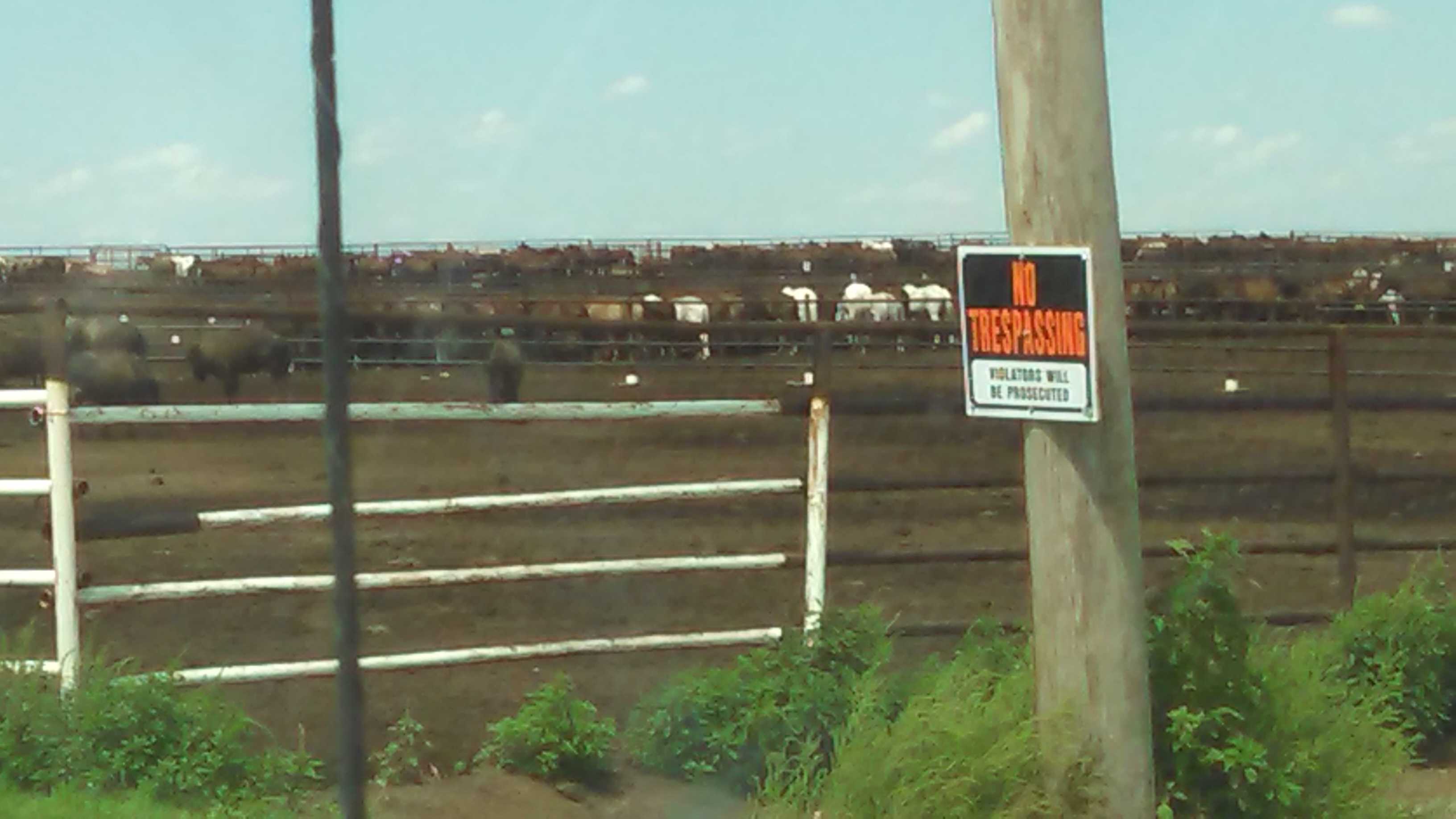
Wild horses next to bison at the Beef Belt Feedyard in Scott City, Kansas in 2014

By Debbie Coffey, V.P. and Dir. of Wild Horse Affairs, Wild Horse Freedom Federation

Copyright 2017   All Rights Reserved.

In the middle of June, 2014, the BLM moved 1,493 wild horses from the Teterville Long Term Holding pastures in Oklahoma to the Beef Belt Feedyard in Scott City, Kansas.  Over 13% of these wild horses died at this feedlot.

191 of the wild horses died in less than a year (7/7/14 – 6/30/15).

In a BLM “news” release dated 8/15/14 (over two years ago), the BLM announced that 57 wild horses had died at the BLM’s Scott City, Kansas “corral.”  In this news release, the BLM stated that it had “launched an investigation” into the cause of deaths, and promised that “Once the investigation is concluded, the team will complete a report that will be made publicly available.”

To date, over two years later, the BLM has not made any report available to the public about the Scott City feedlot deaths.

Wild Horse Freedom Federation (WHFF) filed a Freedom of Information Act (FOIA) request, and found out that 196 horses died at the Scott City feedlot from 6/17/14 – 8/2/16.

87 of the 196 wild horses were euthanized.

41 wild horses died of colic.  Many of these deaths were from sand colic.  As late as 4/13/15 (10 months after the wild horses were shipped to this feedlot), local veterinarian Corbin Stevens wrote to BLM’s Joe Stratton “Be sure hay and bunk is free of sand and rocks (try to only throw hay from feed alley into the bunk eliminating road material)” and “A necropsy was performed on one dead horse from pen 2 today and was diagnosed as a colic with small pebbles and sand present in the large colon and cecum.”  However, BLM’s FOIA did not provide WHFF with a necropsy report dated 4/13/15.

14 wild horses died of fractures of the spinal cord (neck and back).  6 horses died of leg or pelvis fractures.  On just one day, 4/3/15, 3 horses died of a brain/head injury and 2 of a broken leg/pelvis.  With the comment “Inspected by Dr. Stevens.  Result of windstorm – ran into fence.”

Timeline:

March 24, 2014 – Long Term Pasture contractor for Teterville in Oklahoma (Robert Hughes), gives short notice to the BLM by informing them he decided to renew his existing 5 year contract, but only for a reduced number of horses.  He informed the BLM that he wanted to remove 1,900 wild horses (about 1,400 mares and 500 geldings) by June 1, 2014.

(The BLM seems to have never thought of or planned for an emergency, so they begin to scramble for a place to put 1,900 wild horses on short notice.  The BLM was able to find space on other Long Term Pastures for the geldings, but not for the wild mares.)

May 28 (or 27) 2014 – Pat Williams, the WH& B State Lead for New Mexico inspected the Scott City, KS, feedlot for NEPA analysis.  Although a working facility with a squeeze (“tilt”) chute was required,  the contractor for Scott City, Phil Jennings, didn’t want to install that infrastructure until the contract was signed.  Phil Jennings, who was going to lease the Beef Belt feedlot for this emergency contract worth over $2 million, is the contractor for the BLM’s Pauls Valley facility in Oklahoma.

June 4, 2014 – BLM signed the contract.  BLM’s Zach Reichold was designated as the COR (Contracting Officer’s Representative).

June 14, 2014 – BLM began moving wild horses from Teterville Off Range Pasture (long term holding) to Scott City, KS.   The BLM crew at Teterville LTH was Scott Fluer, Bea Wade, Richard Williams, Jimmy Galloway and Pat Williams.  3 horses were euthanized before leaving Teterville.  The BLM crew at Scott City was Jerome Fox.

June 22, 2014 – BLM concluded the transfer of mares to Scott City.

July 7, 2014 – Local veterinarian, Dr. Corbin Stevens, states 3 times in a report that less than 2% of horses have a body condition score of 3 or lower.

July 17, 2014 – Dean Bolstad discovered there was no squeeze chute or BLM Project Inspector onsite and discussed the need for this with Zach Reichold (the COR).

July 25, 2014 – Dean Bolstad informed Greg Shoop that there was no squeeze chute or BLM project inspector onsite at Scott City.

July 2014 – 35 wild horses died during this month.

August 5, 2014 – after veterinarian Dr. Stevens met with BLM’s Joe Stratton, Stevens states in a report that 5% of horses were in poor body condition when they arrived at the feedyard. (this differs substantially from the 2% that Stevens claimed several times in his July 7 report)

August 8, 2014 – BLM issues it’s news release.

Aug. 11, 2014 – BLM began “transitioning” Joe Stratton as the COR of Scott City.

Aug. 12, 2014 – BLM’s Pat Williams and Al Kane (USDA APHIS veterinarian) arrive at Scott City to perform an inspection.

Aug. 13, 2014 – Joe Stratton was “to go onsite.”   The squeeze chute was to finally arrive and plans were made for working facilities to start to be made and installed.  (almost 2 months after the horses arrived)

Aug. 28, 2014 – In a KMUW news article, BLM’s Paul McGuire stated “The first full-month report we had from the facilitator operator came at the end of July.  And it was at that time that we saw numbers on the order of about 47 horses had either died or had to be put down during that time.”  (However, the records WHFF received indicate that 35 wild horses died at Scott City during July, 2014, and only 3 horses died the month before.  That totals 38 at the end of July, not 47.  WHFF found several instances of mortality numbers not matching on BLM records in connection with Scott City.)

August 2014 – Another 46 wild horses die by the end of this month.  (total 81)

September 2014 – another 25 horses die by the end of this month.  (total 106)

June 19, 2015 – Dr. Stevens informs Joe Stratton that there is a mare with a vaginal growth that appears to be infected and that Naxcel and surgery may be warranted.  No freezemark number or description was given.

Feb. 2, 16 – Dr. Stevens informs Joe Stratton that a mare with a tumor extruding from vulva needed to be euthanized.  (It is not apparent from any records if this palomino mare was the same mare with the vaginal growth from 6/19/15, that may not have received needed surgery, but since this was the only mention of a vaginal growth, it could be likely.)

May 17, 2016 and May 19, 2016 – About 2 years after horses were shipped to Scott City, even though the Teterville contractor had given the short notice that lead to this crisis, the BLM ships 5 truckloads of horses BACK TO TETERVILLE.  (The BLM started shipping horses out of Scott City after April 25, 2016 (1,311 were there end of month).  By end of May, 2016, 576 were there.  Shipping records from June 2016 show that more horses from Scott City were shipped to other long term holding pastures.  Per BLM’s Dec. 2016 Off Range Facility Reports, Scott City is no longer listed as warehousing any wild horses.

Oct. 14, 2016 – AP reporter Dave Philipps writes an article (that reads like a propoganda piece for the BLM), titled “Success Spoils a U.S. Program to Round Up Wild Horses.”  This article, filled with misinformation, included a photo of Teterville contractor Robert Hughes,  a video of wild horses at Teterville, a quote from BLM’s National Wild Horse & Burro Advisory Board member, Ben Masters (who voted to kill all the wild horses in holding), and a quote from Dean Bolstad, the Wild Horse & Burro Division Chief, stating that “We’re in a real pickle…”  (No, Dean, the BLM isn’t “in a real pickle,” the wild horses and burros are “in a real pickle.”)  There was no mention in Philipps’ article about what happened to the wild horses from Teterville at Scott City.

There were necropsy reports for 24 horses sent in response to our FOIA request for all necropsy reports.  One of the necropsy reports did not have a date or time on it, and a couple of them didn’t identify the freezemark numbers of the horses.

Excerpts from necropsy reports of wild horses at Scott City:

8/6/14, 5 p.m. – #4805 – atrophy of fat around heart.  Natural causes/old age.  Collected blood prior to euthanasia.

8/6/14, 5 p.m. – #2687 – old age.  Liver failure.

8/6/14, 5 p.m. – #6404 – natural causes/old age.

8/12/14, 5 p.m. – #020937 – small intestine hemorrhage.  Cecum torsion.  Colon enlarged and full of feed.  Died of colic.

8/12/14, 5 p.m. – #945088 – natural causes.  Old age.

8/16/14, 5 p.m. – #6940.  Natural causes.  Collected blood prior to euthanasia.

8/27/14, 6 p.m. – #8737 – cecum enlarged, displaced.  Colic.

9/6/14, 12 p.m. – #05180369 – inflammation around pericardial sac.  Died of heart disease/failure.

9/6/14, 12 p.m. – very large, infected coronary arteries.  Heart failure.

9/12/14, 6 a.m. – #3675 – small intestine inflamed.  Cecum inflamed.  Feed material in abdomen.  Colic.  Ruptured gut.

9/18/14, 5 a.m. – #0041 – colic.

10/20/14, 4:30 p.m. – #7435 – cecum enlarged & hemorrhage (sand).  Colic.  Twisted gut.

10/21/14, 4:30 p.m. – #1062 – cecum enlarged/hemorrhagic/full of sand.  Sand colic.

10/21/14, 4:30 p.m. – #9240 – cecum enlarged/hemorrhagic/full offals.  Colic.  Impaction.

11/12/14, 5 a.m. – #6761 – bloated.  Cecum ½ full of sand.  Died of sand colic.

12/15/14, 6 p.m. – #97175205 – bloated, cecum & colon full of feed.  Colic.  Impaction.

1/13/15, 6 p.m. – “mustang mare” (no ID) – bloated.  Colic.

3/11/15, 6 p.m. – #19964528 – ulcers.  Bleeding ulcer.

4/17/15, 9:30 a.m. – “grey mare” – bloated.  Cecum hemorrhage & inflammation, colon hemorrhage & inflammation – sand.  Died of colic.  Sand in large intestine.

5/11/15, 12:30 p.m. – #2074 – bcs<3.  Unable to maintain weight due to age.

5/18/15, 6 p.m. – #8724 – ulcerations & hemorrhage, bleeding ulcer

5/20/15, 5:20 a.m. – #8513 –  Bloated and cecum full of sand.  Died of sand colic.

5/20/??, 6 p.m. – #6532 – bcs<3.  Unable to maintain condition.

No date or time listed for this necropsy – #3756 – heart enlarged and infarcts.  Heart failure.

By not issuing a report regarding Scott City to the public as promised, or in a timely manner, the BLM seems to just want to sweep what happened at the Scott City feedlot under the rug.  Wild Horse Freedom Federation will not ever forget even one horse that has suffered at the hands of the BLM’s mismanagement.

WILD HORSE FREEDOM FEDERATION HAS POSTED FOIA DOCUMENTATION ON SCOTT CITY ON OUR WHFF WEBSITE DOCUMENTS PAGE – CLICK HERE.

SOURCES:

BLM news release (8/15/14) :  https://www.blm.gov/wo/st/en/info/newsroom/2014/august/NR_08_15_2014.html

KMUV news article:  http://kmuw.org/post/80-mustangs-die-after-move-scott-city

Source: 196 wild horses died at BLM’s Scott City feedlot (a BLM Aushwitz for wild horses) | Straight from the Horse’s Heart
Wild Horses Deserve a Better Film than ‘Unbranded’

by Libby Blanchard as published on High Country News

“I found the documentary disturbing. Scenes of negligence towards the mustangs abound…”

Unbranded CrueltyA few nights ago, I downloaded the acclaimed 2015 film Unbranded. This crowd-funded film, made by Fin and Fur Productions from Bozeman, Montana, depicts the journey of four young men who ride mustangs from the Mexican border up to Canada, traveling through some of the most beautiful public lands in the American West.

Unbranded is marketed as a celebration of the American mustang, both wild and under saddle. It was featured at the Banff Mountain Film and Telluride Mountainfilm festivals, and continues to be promoted widely. Last year, it was a top download on iTunes and gained over 150,000 likes on Facebook. Outside Magazine and the Los Angeles Times gave it glowing reviews.

But I found the documentary disturbing. Scenes of negligence towards the mustangs abound. A dog drives a horse to jump a barbed wire fence. The horse’s hind leg gets ensnarled in the wire, and the animal struggles to pull free while the boys watch.

Another scene shows a horse limping from a torn muscle in its hindquarters, the after-effect of setting him loose to graze with his halter on. Any real horseman knows that a horse can easily catch its hoof in the webbing of a halter negligently left on, resulting in severe and potentially permanent injuries.

But the most egregious scene is when the boys force their horses up dangerous terrain. Someone notes that the route is a bad idea, but no one has the maturity or leadership to turn back. After struggling up the steep mountain face, one horse — unable to gain purchase in the loose, unstable footing — kneels down in exhaustion. When the boys provoke it back onto its feet, the mustang struggles for a foothold. Unable to find purchase, it tumbles off the mountainside, rolling through the air down a significant drop before crashing onto flatter ground.

At this point, I turned off the film, disgusted. When I finished it later, I discovered — unsurprisingly, given the negligence and ignorance throughout — that one of the horses dies. This fatal injury, likely a cervical spine fracture, is never explained. Instead, the death is romanticized by these self-identified cowboys, who say it is “satisfying to know that he died in the wild where he belonged, not in a holding pen.” Yet there’s little moral high ground for the cowboys to stand on: A horse was fatally injured under their care, a circumstance that is neither common nor acceptable on a horse-packing trip.

The film’s storyline is also troubling. A veterinarian and various Bureau of Land Management officials talk about how hard it is to protect public lands from overgrazing while still conserving the mustang as an American icon. The solution: moving “surplus” mustangs from the range to federally run holding pens to prevent further degradation of the land and starvation of the horses. Yet the filmmakers make only a slight attempt to explore the contentious political context of too many mustangs roaming the public land. The title, Unbranded, by the way, makes little sense as the BLM freeze-brands every horse that it rounds up for adoption or life in a holding pen.

The only comprehensive thread woven through the documentary is the account of four fame-seeking boys who disregard the welfare of their horses to inflate their own egos. Instead of being exalted, the American mustang is treated as a cheap, easily replaceable commodity available for irresponsible use.

While some reviewers have criticized the choices of the protagonists, virtually all conclude that the film is redeemable because of its cinematography. Unbranded does depict sweeping vistas, but this doesn’t excuse the behavior of the people we’re watching. As Aristotle observed, when storytelling goes bad, spectacle is substituted for substance. Richly painted sunsets and the drama of needlessly frightened, panicking horses become ends in themselves.

As wrong as it was for these young men to treat their mustangs neglectfully, it is also unfortunate for the public to accept this behavior. To celebrate this documentary at film festivals, to mount no outcry about it in over a year, is to condone behavior that is neither common nor acceptable. Those of us who love the West and its mustangs should stay away from this documentary.

Source: Wild Horses Deserve a Better Film than ‘Unbranded’ | Straight from the Horse’s Heart

South Dakota Reaches Settlement Transferring Control of 520 at-risk Horses to Fleet of Angels; Public’s Help Needed in Massive Rescue Operation

Source: Fleet of Angels

“The settlement sets the stage for one of the largest known equine rescue and adoption efforts in U.S. history…”

SD Horses South Dakota state’s attorneys have reached a settlement agreement with the International Society for the Protection of Mustangs and Burros that will transfer full control of 520 horses to Fleet of Angels, an equine welfare-related not for profit organization. After 810 horses were originally impounded on Oct. 11, 2016 by the court in Ziebach and Dewey Counties, a Fleet of Angels emergency event team- in a heroic effort headed by Palomino Armstrong facilitated the adoptions of over 270 horses that were transported from the ISPMB location in SD to new homes by Christmas, in spite of multiple challenging circumstances including blizzards, sub-zero temperatures, and logistical limitations.

The settlement sets the stage for one of the largest known equine rescue and adoption efforts in U.S. history by allowing the wild horses to be placed in safe homes rather than sold at auction, where they could have fallen into the hands of kill buyers who would transport them to Canada or Mexico for slaughter.

State’s attorneys in Ziebach and Dewey Counties on Jan. 5 filed a motion requesting that the management and placement of the horses be turned over to a suitable caretaker. Fleet of Angels, an organization that provides emergency assistance and transportation to at-risk equines in the United States and Canada, was asked by SD state’s attorneys to assume that role. Fleet of Angels has received a large number of applications for the 520 horses included in the settlement agreement.  The horses will be placed in approved homes, sanctuaries and rescues as soon as transportation can be arranged.  The organization’s goal is to have every horse in its new home within 60 days, after most of them are moved to a facility in Colorado that will offer a better climate, safer and better loading options, and more suitable conditions for the effort.

Fleet of Angels’ executive director Elaine Nash, who is spearheading the effort said, “After almost four months of working nearly around the clock to get these horses out of an extremely cold and inhospitable environment, it’s nice to now have the freedom to relocate them to a much more suitable adoption hub. We are preparing to relocate the horses to a facility where each horse can be properly vetted and readied for their adopters. or one of the participating Fleet of Angels transporters to pick them up and take them to safe, new homes.  When we say ‘Teamwork works’, we mean it!  Without the efforts of the many concerned people who are helping with this mission in a variety of ways, a massive emergency rescue like this could never be possible.”

Return to Freedom, an organization known nationally for its work with wild horses, has also played a vital role in providing solutions that averted an auction scheduled for Dec. 20, when where many of the horses likely would have been lost to the slaughter pipeline.

“RTF will continue to partner with Fleet of Angels and other Wild Horse and Burro Sanctuary Alliance members and partners to do what we can to facilitate the responsible placement of stallions, bonded horses and whole herds when possible,” said Neda DeMayo, president of Return to Freedom.

The Humane Society of the United States, the Griffin-Soffel Equine Rescue Foundation, and another national equine welfare organization generously contributed toward a fund to cover what the counties expended in feeding and caring of the horses since October, when state and local authorities impounded the 810 ISPMB wild horses following a finding of neglect. Their contributions made it possible to prevent the horses from going to auction.

The health of the wild horses varies. While some are in good condition, many are underweight.  Some also suffer from blindness or vision impairment.

Fleet of Angels and its partners, Return to Freedom and the Wild Horse and Burro Sanctuary Alliance members need the public’s support to pay for veterinary and farrier care, feed and transportation. Feed costs alone are $40,000 per month. That and other expenses will continue to mount — making donations absolutely critical to successfully getting these horses adopted to new homes.

The Fleet of Angels team has nicknamed the 520 horses that will be heading to new homes, ‘The Hallelujah Horses’.

For more background information, please click here [link to previous press release]

How the public can help

Feed and Care Fund: The public can support the wild horses while adoptions continue by donating to a fund created to for feed, veterinary care, and all other costs related the lifesaving mission for the ISPMP horses by donating to the Wild Horse and Burro Sanctuary Alliance.

Adopt:  Over 200 people have applied to adopt two or more of these special horses. However, Fleet of Angels and partners are hoping to get more of the horses adopted in family bands, larger groups and herds.  Anyone who is interested in adopting some of these horses in larger bonded groups please contact: Fleet of Angels at HoldYourHorses@aol.com or on the ISPMB Horses / Emergency Adoption Mission page on Facebook.

Transport:  (Update: 1-28-2017) To reduce travel distances for some of the horses and to reduce costs for adopters, all previously approved adopters who live in northern states, and transporters who cover that part of the country are encouraged to connect ASAP to make arrangements to have horses picked up from their current SD location before all the herds are moved to the new adoption hub in Colorado.  All other adopters are welcome to start working toward having their horses transported from western Colorado soon.  The exact location of the new adoption hub will be provided within a few days.

All approved adopters seeking discount transportation through Fleet of Angels can submit a Request for Transport Quotes at http://www.FleetOfAngels.org,  so transporters in their areas can reach out to them.  Adopters are also encouraged to use FOA’s Map of Angels and Directory, as well as the org’s networking page on Facebook at https://www.facebook.com/groups/FleetOfAngels/  to make their transport needs known to FOA transporters.

http://www.fleetofangels.org/

Source: South Dakota Reaches Settlement Transferring Control of 520 at-risk Horses to Fleet of Angels; Public’s Help Needed in Massive Rescue Operation | Straight from the Horse’s Heart