BLM offers whistle stop tour of wild horses imprisoned at Indian Lakes Rd. facility in Fallon, NV | Straight from the Horse’s Heart

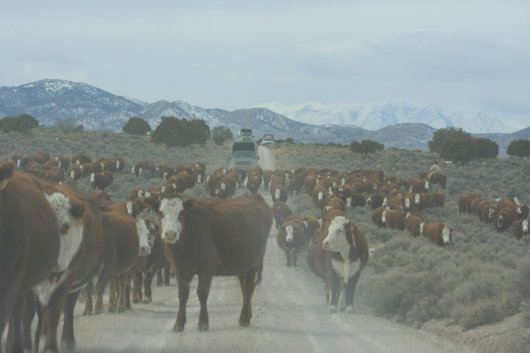
Once wild horses at Indian Lakes Rd. facility in Fallon, NV (photo:  Debbie Coffey)

Get ready to jump on the wagon for a BLM PR blitz…

Edited Press Release       Source:  BLM

RENO, Nev. —The Bureau of Land Management (BLM) will host two free public tours of the Indian Lakes Off-Range Wild Horse and Burro Corral in Fallon, Nevada, on Friday, May 12. Tour attendees will be taken as a group by wagon around the facility to learn about it, the animals, and BLM’s Wild Horse and Burro Program.

About a 90-minute drive east of Reno, the corral is located at 5676 Indian Lakes Road, Fallon, and is privately owned and operated. The public tours will begin at 10 a.m. and 1 p.m. and each will last about one hour and accommodate up to 20 people. Attendees should wear comfortable shoes and clothes; hats and sunscreen are recommended, and photography is welcome. On-site portable toilets will be available.

Horses at the Indian Lakes facility are made available to the public for adoption or purchase throughout the year at off-site adoption events and through BLM’s Internet Adoption program. For more information on adoption opportunities, visit https://on.doi.gov/2iByqXD.

To register for the tour or to get driving directions to the facility, please contact the BLM at (775) 475-2222.

Source: BLM offers whistle stop tour of wild horses imprisoned at Indian Lakes Rd. facility in Fallon, NV | Straight from the Horse’s Heart

BLM’s Wild Horse & Burro Program in a Death Spiral | Straight from the Horse’s Heart

Open Letter by Author Terry Farley

“BLM’s wild horse and burro math is statistically bizarre…”

As a journalist, I first interviewed BLM Wild Horse and Burro Program staffers in 1976, shortly after I moved to Nevada. Since then, I’ve followed the program’s death spiral.

Those who say wild horses and burros ruin the range claim there are too many of them, and yet there’s little agreement about how many wild equines remain on America’s public lands.

BLM’s wild horse and burro math is statistically bizarre. Even the National Academy of Sciences, charged by BLM to analyze the program (2013) concluded: “The Wild Horse and Burro Program has not used scientifically rigorous methods to estimate the population sizes of horses and burros …”

NAS warned “continuation of business-as-usual practices will be expensive and unproductive for BLM and the public it serves.” Worse, NAS pointed out that BLM’s lack of science has actually backfired on its stated goal of protecting the range.

BLM’s reaction? Keep paying independent contractors to chase, trap and corral the West’s remaining wild horses and offer $10 million to anyone who found a new means of mustang birth control.

BLM asked for a new method because PZP “didn’t work,” ignoring recent science and BLM personnel who admitted that — counter to instructions – contraceptives are not always kept frozen or even cold in the field.

Band dynamics: During round-ups, family bands are shattered, routinely divided into stallions, mares and contractor-determined weanlings. Horses are prey animals. They know safety is with the band and the resulting cacophony and blood of these separations is haunting. Fewer than 2 percent are ever reunited.

Injury: Compare injection site abscess to BLM documentation of a single round-up in which 113 mustangs died. Death from shattered pelvises, broken necks, skulls and spine were sometime attributed to natural causes or pre-existing conditions. Those diagnoses would strain my credulity even if I hadn’t been there.

If you still oppose contraception, please consider this: Proponents of selling wild horses without limitation have made in-roads at BLM and those who’d destroy mustang captives as they stand in government pens have visited the White House.

The extermination of a Western icon is near, and your choice can hasten or slow its approach.

PZP is reversible. Death is final.

Source: BLM’s Wild Horse & Burro Program in a Death Spiral | Straight from the Horse’s Heart

Cactus Fire Threatening AZ Salt River Wild Horses | Straight from the Horse’s Heart

Source: Cactus Fire Threatening AZ Salt River Wild Horses | Straight from the Horse’s Heart

More Fake News in Nevada about Wild Horses | Straight from the Horse’s Heart

Source: More Fake News in Nevada about Wild Horses | Straight from the Horse’s Heart

Wild horse & burro advocate Bonnie Kohleriter gives her opinion below about an article in Range Magazine written by Rachel Dahl, a sixth generation Nevadan.  Dahl worked as a campaign manager for the former Sen. John Ensign and served on his Senate staff by managing his Carson City office.  (Sen. John Ensign later resigned after an ethics investigation.)

The Queen of Fake News in Nevada

by Bonnie Kohleriter

Rachel Dahl is a writer for the Range magazine in Nevada, a pro cattle magazine, and is a resident in Mesquite, Nevada.

Grabbing a twisted tidbit from here and a twisted bit from there, Rachel Dahl attempts to impress her readers as a journalist. Having read her winter rant in the Range magazine, I feel compelled to retort with the following comments.

As Ms. Dahl reported, in the fall of 2016, at the National Wild Horse and Burro Advisory Board Meeting, the Board did not vote to remove excess horses nor did it vote to sell the animals with no limitations or to euthanize the sick and the aged.  The Board, on the other hand, voted to euthanize 47,000 wild horses and burros in holdings off the range.

The horses, according to Ms. Dahl, are to blame for the ruinous condition of our public lands.  All hope is rested in removing them.  Or is all hope rested in removing cattle from the 27 M acres where the horses only are able to be and allowing cattle to be on the other 155 M acres of our public lands where they are currently.  It is understood cattle grazing on our public lands is a privilege and not a right as some ranchers want the public to believe.  Then, in addition, perhaps all hope is rested in the ranchers not being allowed to divert and cut off water from the horses.  Oh, horrors, Ms. Dahl, that there should be another way to look at managing our resources.

Again as Ms. Dahl reported, in the fall of 1916, the Board spent the day viewing where horses forage and viewing dead horses.  The Board spent the day viewing no dead horses and viewing where horses drink.  Dead horses were dramatically reported by Goicoechea who is a known horse hater and multi-generational cattle rancher.  The devastated land, according to the permittee, was done when overgrazing was done by  animals other than horses and burros and not by the horses themselves.

According to Ms. Dahl, Ben Masters, a member of the Board,  said the viewing that day was “one of the worst disasters he had ever seen.”  Ben is a young man who made a “movie” using Mustangs who were abused in the movie.  It is an absurdity that Ms. Dahl should use him as a source to substantiate her argument that horses have devastated our public lands.  Masters is no expert on our public lands.  He is also new to the wild horse and burro issues on our public lands.

Then Ms. Dahl brought up the name of Boyd Spratling to substantiate her argument as well.  Boyd Spratling had been on the National Wild Horse and Burro Advisory Board and is from Elko, where the Board was currently conferring.  Boyd is primarily a cattle veterinarian, represents cattlemen on the State Agricultural Board, promotes harvesting our wild horses, and presents falsified pictures to tug at the heartstrings to convince the public of those poor, poor horses on the range.  But he can’t tell you where he gets his pictures and the dates they were taken.  Boyd Spratling is a traitor to wild horses and burros.  He does not have their best interests in mind.

Ms. Dahl sounds the alarm wild horses and burros are dying everywhere on the range and in private sanctuaries in Nevada and even in WOW!   South Dakota.  Wild animals die in times of environmental disaster just as humans are dying due drought  and famine in Kenya, South Sudan, and Niger.  Is the answer to kill them?

Ms. Dahl has pulled out all stops to degrade horses using Mrs. Pickens and Mrs. Sussman, who have taken care of wild horses, but have nothing to do with our herd management areas for wild horse and burros on our public lands.  Can she find any other areas in which to attack horses or the people who have and/or care for horses.  Her article is like “Let’s talk about dinner foods, now think about Cheerios.”

“Every ranch kid learns you are responsible for taking care of an animal when you take custody of them,” says Ms. Dahl.  So Ms. Dahl, you are a part of the public who by law, has custody of our wild horses and burros?  Are you simply going to kill them for meat because some ranchers and politicians have manipulated their allowable numbers on the range to be less than genetically viable numbers for perpetuity?  Or are you going to try to come up with solutions for them to keep them on the range as healthy horses, celebrating their place on our public lands as part of our cultural, historical heritage?

BLM claims selling wild horses to kill buyer Tom Davis was selling them to a “good home” | Straight from the Horse’s Heart

by Debbie Coffey, V.P. & Dir. of Wild Horse Affairs, Wild Horse Freedom Federation All Rights Reserved. Copyright 2017

On the Bureau of Land Management’s new website, on the Program Data page for the Wild Horse & Burro Program (under the Wild Horse and Burro Sales to Private Care tab), the BLM claims “It has been and remains the policy of the BLM, despite the unrestricted sales authority of the Burns Amendment, NOT to sell or send any wild horses or burros to slaughterhouses or to “kill buyers.”

The BLM claims “Wild Horses and Burros Sold to Good Homes” but then includes a total of 402 wild horses and burros sold in Fiscal Year 2012. (In this 402 total, 320 were horses and 82 were burros.)

BLM sale logs obtained by us in Freedom of Information Act requests indicate that in Fiscal Year 2012, the BLM sold 239 wild horses (about 74% of the 320 horses that were sold) to kill buyer Tom Davis. Many, if not all, of these wild horses went to slaughter in Mexico.

Does this look like a “good home” to you?

BLM states it has a policy not to sell wild horses and burros to kill buyers, but:

  1. On 1/11/12, Lester T. Duke (BLM Burns, Oregon) sent an email to BLM’s Bea Wade, regarding 50 sale authority horses, noting that a “large portion”of the mares were “possibly pregnant.” Lester asked if they should ship to long term holding or hold them at the corrals for sale. Bea responded that she forwarded the email to Sally Spencer. After a couple of more emails regarding this, Sally finally sent email on 2/23/12 that Tom Davis would purchase the horses, starting with the load of mares from Burns, Oregon. (About a week later, BLM sold 32 horses to Tom Davis from Burns, OR.  19 of these horses were mares)
  2. On 4/19/12, Deanna Masterson, Public Affairs specialist for the BLM Colorado state office, sent an “Early Alert” email to “WO BLM/DOI Officials” (Jeff Krause, Leigh Espy, Helen Hankins, Steven Hall, Tom Gorey and Sally Spencer) that “The Colorado Department of Agriculture notified the BLM Colorado State Office of a Colorado Open Records request from David Phillips, a freelance journalist, for brand inspection and transfer paperwork for horses the BLM sold to Tom Davis of La Jara, Colorado. Phillips indicated he suspected Davis of selling these horses for slaughter to Mexico.”
  3. On 4/24/12, the BLM, alerted that Tom Davis was suspected of selling horses for slaughter, still sells 106 wild horses to Tom Davis.
  4. On 5/17/12, Sally Spencer sent out an email, marked “High” importance, to 21 people (Joe Stratton, Roger Oyler, Amy Dumas, Fran Ackley, Karen Malloy, Christopher Robbins, Jared Bybee, Robert Mitchell, Alan Shepherd, Rob Sharp, Robert Hopper, Gus Warr, June Wendlandt, Joan Guilfoyle, Mary D’Aversa, Dean Bolstadt, Jeff Krause, Tom Gorey, Debbie Collins, Lili Thomas, Bea Wade) and BLM_WO_260 WHB Communications, telling them a reporter was calling about Tom Davis. Spencer asked Joe Stratton to send out a message to all facility managers and the state leads to send a message out to all WHB Specialists that if they were asked “specifics” about a purchaser, they shouldn’t respond for privacy issues…”

If BLM personnel were so convinced that they sold the wild horses and burros to a “good home,” why all of the urgency and secrecy?

If the BLM truly believes these horses were sold to a “good home,” why isn’t Tom Davis’ photo featured on the BLM’s Wild Horse & Burro Program page on the BLM’s new website, instead of the photo of the young blonde girl? After all, the BLM sold Tom Davis 1,794 wild horses and burros from 2008-2012.

If the BLM thinks they’re fooling us, they’re only fooling themselves.

All documents referenced above can be seen HERE.

Source: BLM claims selling wild horses to kill buyer Tom Davis was selling them to a “good home” | Straight from the Horse’s Heart

The Easter Bunny’s “Horse Cousin” – WARHorses

The Easter Bunny’s “Horse Cousin”

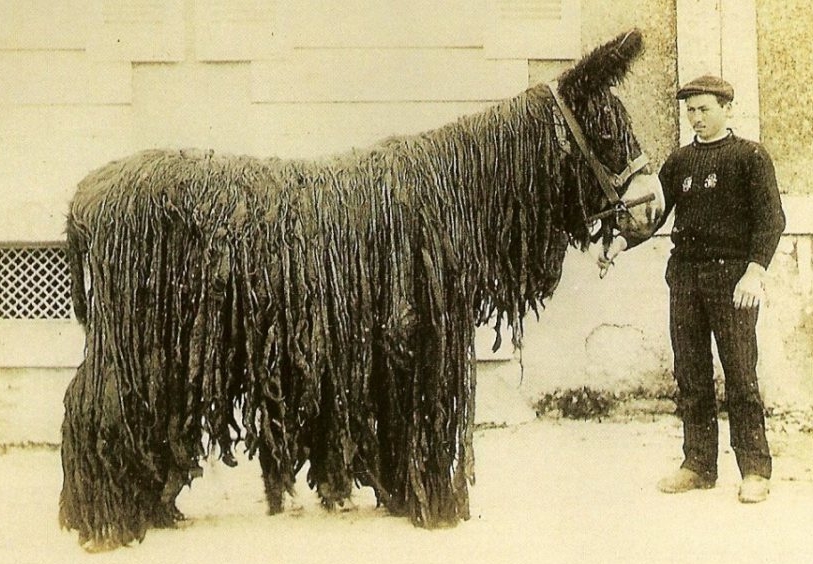
They look like BIG bunnies but we can attest that they are pure genus equus – meet the Poitou donkey.

Poitou donkeys originated in southern France, developed from donkeys imported from ancient Rome. They are the largest donkey breed historically used as breeding stock to produce working mules. Their coats are dark brown and black, they have white underbelly, nose and rings around their eyes. They have large features – heads, leg joints and ears. Some ears are so large that their weight causes they to flop sideways. The Poitou’s most distinctive feature is their matted coat, hanging cords of soft hair called a “cadanette”.


Poitou donkeys became status symbols of the wealthy during the middle ages – the shaggier the coat, the more highly valued the animal. By the 18th century the breed’s characteristics were well defined and a studbook was established. As many as 15,000 were sold annually. By the next century mechanization (and war) obliterated the breed. By 1977 only 44 donkeys survived and the mortality rate for foals was nearly 30%. Public and private breeders joined forces to save the Poitou. The studbook, abandoned for nearly a century was reestablished and split between pure and part breds. By 2005 there were 450 registered purebreds.

The American Livestock Breeds Conservancy lists the Poitou as Critical, a category for breeds with less than 2,000 animals worldwide. Science has certainly impacted efforts to save the breed. In 2001 Australian scientists implanted a Poitou embryo in a Standardbred mare resulting in a healthy birth. More recently, establishment of a sperm bank coupled with improved means for artificial insemination using the frozen semen has helped conservation efforts on a global scale.

Source: The Easter Bunny’s “Horse Cousin” – WARHorses

The Bureau of Land Management is scrubbing their trail on the internet | Straight from the Horse’s Heart

After NBC News wrote about the Bureau of Land Management featuring a photo of a coal bed at the top of their website, the BLM changed it… to now feature this photo of an oil & gas pipeline.

by Debbie Coffey, V.P. & Dir. of Wild Horse Affairs, Wild Horse Freedom Federation                                                                    All Rights Reserved.          Copyright 2017

The Bureau of Land Management is scrubbing most of its links off of the internet, and in doing so, erasing much of its history from public view.

Many of the blm.gov links that are still remaining on the internet at this point say “page not found,” or the links are no longer cached.

The BLM also suddenly removed state and district websites.  Instead, you will now find “landing pages” that direct you to only one main Bureau of Land Management website.  (You can look at the new BLM website HERE.)

I called a BLM Public Affairs Specialist to ask some questions about the defunct websites and links.  This person said in the past there were about 90,000 pages (and then a bit later stated that it could possibly be only about 60,000 pages) of BLM content on the internet, but that all of these pages couldn’t be maintained or updated, and weren’t centralized.  This person said the BLM’s prior content management system was outdated.

Most importantly, this person also said there were now standards to reduce the amount (of pages/content).

Who made the decision to even have a standard to reduce content available to the public on the internet?  During this website transition, who is making the decisions, and on what basis, of what data to migrate, or not to migrate, to the new BLM website?  These decisions cherry pick what information will be available to the public in the future.

Make no mistake, this “reducing the amount” of content on the internet is erasing many of this agency’s past actions, activities, and government documentation.  Many of these links had historical value.  For example, the BLM activities of BLM employees Sally Spencer and Lili Thomas over the years are now gone.  These types of links on the internet didn’t need to be “maintained” or “updated.”  They were historical in nature.

In the past, in doing a google search for Sally Spencer (a longtime BLM employee, and the Marketing Specialist famous for selling so many wild horses and burros to kill buyer Tom Davis), she was included on many, many BLM government links.  I went to the BLM’s new website and searched “Sally Spencer,” and only 3 items appeared.  When I searched “Lili Thomas” (another longtime BLM Wild Horse & Burro Program employee who oversaw the BLM’s Long Term Holding facilities for wild horses for many years), only 4 items appeared.  And when I searched “John Neill” (a longtime Palomino Valley Center manager), all that came up was “No results found.”

These individuals are BLM personnel who have been central in management issues in the BLM’s Wild Horse & Burro Program, as evidenced by FOIA documentation garnered by the late Dr. Patricia Haight of The Conquistador Program.

Even when I searched the new BLM website for “Dean Bolstad” (the Division Chief of the Wild Horse & Burro Program) only 2 items appeared.

(Although, luckily, thanks to In Defense of Animals, you can still go online and see this youtube video of Lili Thomas saying “working with wild horses is not a pretty sight” at a public meeting.)

What I can’t understand is, if the new content management system is bigger and better, why couldn’t the new content management system have contained all of the old data along with new data?  If this agency were truly transparent, they would add data, not reduce data, available to the public on the internet.

At first the Bureau of Land Management only removed the Directories for District offices and Field Offices, making it difficult, for example, to find out who was the Wild Horse & Burro Specialist, Hydrologist, Range Management Specialist or other personnel in any particular district or field office or to find an email address or telephone number for them.  BLM personnel frequently transfer to other offices and states, so it was already hard enough to try to keep up with who was where.  But now the public really doesn’t have a clue who is doing what or where.

You used to be able to go to the home pages of BLM state and district websites, and get a quick overview of not only roundup plans for wild horses & burros, but mining expansion plans, oil & gas lease sale plans, and other uses of our public lands in that area, all in one place.

Now, the BLM has divided these by topics or by “regions,” on their new website.   Under the “region” of Nevada (we call them states here in the U.S.A.), there isn’t a box for wild horses & burros (only oil and gas leasing, greater sage grouse, Great Basin Landscape Conservation Cooperative, Information Access Center, Nevada Resource Advisory Councils & Federal Register Notices).

By scattering information all over this one “centralized” website, the BLM has made it much harder for the public to put together the pieces of information for a clear picture about the multiple uses of our public lands in any one area.

The Program Data page for the Wild Horse & Burro Program is HERE.  When I clicked on the box for Historical Program Data and Public Lands Statistics, I noticed something was missing that used to be available to the public.  It was the column on Adoptions by Locations & Date.  Information from the years 2009-2015 were previously available.

The biggest reason this data was important is because it let the public know the dates of adoption events (including internet adoptions), the locations of the events, the number of the wild horses and burros offered for adoption (until Fiscal Year 2014) and the number of wild horses and burros that were actually adopted at each event.

The BLM likely stopped reporting the number of horses & burros offered at adoption events in Fiscal Year 2014 because it didn’t want the public to know how many horses & burros were racking up “strikes” by not being adopted.  When a wild horse or burro isn’t adopted after 3 events and gets 3 “strikes” it can be sold without restriction (to slaughter), no matter how young it is.  Even this seemingly small reduction of data indicated a lack of transparency by this agency.

Another reason this data is important to the public is because it let the public see what areas of the country adopt the most (and the least) wild horses & burros.

While the new BLM website contains a lot of information, it seems we have lost much more information that was once available on the internet, but was not migrated to the new BLM website.  For example, the BLM News Release on its promised investigation into the deaths of wild horses at the Scott City feedlot is on the internet, but as of today, is not one of the 63 News Releases available to the public on the BLM’s new website.

We will never know how much, or what, the BLM has removed from the internet.  The BLM’s scrubbing of their trail on the internet has not only erased part of the history of this government agency, it is censorship, and it is the equivalent of a modern day book burning.

SEE EXAMPLES REFERENCED ABOVE HERE.

Source: The Bureau of Land Management is scrubbing their trail on the internet | Straight from the Horse’s Heart

Get real, John Ruhs | Straight from the Horse’s Heart

Source: Get real, John Ruhs | Straight from the Horse’s Heart

  John Ruhs, BLM Nevada State Director

Yosemite Sam, Ruhs’ doppelganger

Dadgummit!  After John Ruhs, Nevada’s BLM State Director, said that he wanted to round up 4,000 wild horses in Elko County last summer (supposedly in response to the continued lies blaming wild horses and burros for the “deterioration of drought-stricken rangeland”), we’re noting that many mines that will use billions of gallons of water are now on the verge of expanding in Nevada.

Ruhs recently spoke at the Elko Convention Center, and stated that “We are pretty proud of the fact that this last year we have worked with the Nevada Cattlemen’s Association, the Nevada Department of Agriculture, the Forest Service, Fish and Wildlife Service and NDOW to provide some public opportunities to talk about sage grouse land use amendments and what they mean to the grazing program. A lot of work still needs to be done.”

The BLM ALWAYS works with the Nevada Cattlemen’s Association.  And the National Cattlemen’s Association.  Actually, the BLM works FOR them.  Notice that the focus of talking about sage grouse land use amendments is all about what they mean to the grazing program?

Ruhs also lamented that wild horse and burro issues dominate a large part of the Nevada BLM and Ruhs went on to talk about the difficulties in wild horse management.

Wild horse and burro issues dominate?  Like, bigger than all of the mines and outnumbering all of the livestock?

And talk about difficulties?  How about all those abandoned mines in Nevada, John?

And management?  There is only wild horse and burro “MISmanagement.”

Ruhs then said “We are somewhere in excess of 37,000 horses on the rangeland that is a big priority for us and it’s one of the things that I hope in the new administration that we will see some changes that will finally allow us to get some work done on the ground.”

We hope that the work that Ruhs is referring to getting done “on the ground” will include getting an accurate count of the wild horses and burros, rescinding some livestock overgrazing permits and making sure the extractive industries don’t use every last drop of water.

Why even bother to imply that the BLM “manages” anything, except impending environmental damage from the “multiple uses” that make a buck?  Don’t stash the truth, John.

Public comment needed on Nevada mine that will use over 2 billion gallons of water in 10 years | Straight from the Horse’s Heart

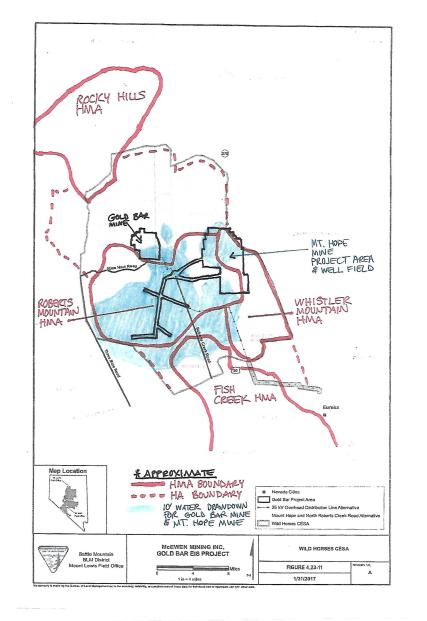
This map shows the Gold Bar Mine area, the approximate HMA (in solid red) and HA boundaries(in broken red lines), the approximate Mt. Hope Mine Project area and well field, and the approximate combined Gold Bar Mine and Mt. Hope Mine 10′ water drawdown area (in blue).  The 10′ water drawdown (in blue) effects almost the entire Roberts Mountain HMA.  The 1″ water drawdown will effect a much larger area.  (Streams can dry up with as little as a 1′ water drawdown.)

BE SURE TO LOOK AT ALL 8 MAPS AT THE BOTTOM OF THIS ARTICLE.

It’s best to write comments in your own words so that the BLM counts each comment as one, instead of counting a thousand similar comments/form letter as only one.  You can read the joint comments submitted by Wild Horse Freedom Federation and The Cloud Foundation below, and a quick summary on pages 5-41 of the DEIS HERE.  Comments are due by April 17, 2017.

Some suggested talking points are:

  1. Be sure to ask for the NO ACTION ALTERNATIVE.
  2. The Gold Bar mine project will use over 2 billion gallons of water in 10 years.  The BLM needs to take into consideration past (historic), current and likely future droughts and climate change when deciding if they will approve this DEIS.
  3. The Project will negatively impact the water, forage, safety, and “free-roaming” abilities of the Roberts Mountain wild horse herd on the Roberts Mountain HMA, as well as the nearby wild horse herds on Whistler Mountain and Fish Creek Herd Management Areas.
  4. The BLM is minimizing the area of impact by only indicating the 10′ water drawdown, and not the 5′ or 1′ water drawdown.  The 5′ and 1′ water drawdown will cover a much larger area of land.  A stream can dry up with as little as 1′ of water drawdown.
  5. When the nearby Mt. Hope mine becomes operational, it is proposed that it will use an additional 7,000 gallons per minute for the life of the mine (40-50 years).  Mt. Hope mine will use over 3 1/2 billion gallons of water per year and over 36 billion gallons of water in 10 years.
  6. The BLM refers to the Cyanide Management Plan (1992), (noted in Vol. 1A, 1.4.3) and the Solid Minerals Reclamation Handbook (1992), (noted in Vol. 1A, 1.4.4).  These are 25 years old and outdated.  Ask for updates of this Plan and Handbook for this DEIS.
  7. The area of Gold Bar Mine will be expanded by 40,000 acres or 62.5 square miles, creating more environmental degradation.

The DEIS is available online at HERE.   Interested individuals should address all written comments to Christine Gabriel, Project Manager, using any of the following ways:

Fax: (775) 635-4034

Email:  blm_nv_bmdo_mlfo_gold_bar_project_eis@blm.gov

Mail:  Bureau of Land Management

Mount Lewis Field Office

50 Bastian Road

Battle Mountain, NV 89820

Wild Horse Freedom Federation and The Cloud Foundation submitted these joint comments regarding the BLM’s Gold Bar Mine Project:
           

Bureau of Land Management

Mount Lewis Field Office

50 Bastian Road

Battle Mountain, NV 89820

Email: blm_NV_bmdo_mlfo_gold_bar_project_eis@ blm.gov

DATE:  April 5, 2017

Subject: DEIS MMI Gold Bar Mine Project

Dear Ms. Gabriel:

On behalf of The Cloud Foundation (TCF) and Wild Horse Freedom Federation (WHFF), 501(c)3 non-profit corporations, and our hundreds of thousands of supporters throughout the United States, we would like to thank you for the opportunity to submit scoping comments on the Draft Environmental Impact Statement (DEIS) for McEwen Mining Inc.’s (MMI) Gold Bar Mine Project (Project).

TCF, a wild horse and burro advocacy group and an advocacy group for all wildlife on our public lands in the West, and Wild Horse Freedom Federation, a voice for the protection of wild horses and burros and public lands, strongly oppose the expansion of the Gold Bar mining project and we urge the NO ACTION ALTERNATIVE in this DEIS for the following reasons:

Wild Horse Herds To Be Affected:

The Project will negatively impact the Roberts Mountain Wild Horse Herd as well as the nearby herds of Whistler Mountain and Fish Creek Herd Management Areas.

Sage Grouse Habitat Affected:

Not only wild horses will be affected in this area. All wildlife will suffer.

Open pit mining is the most environmentally destructive type of mining anywhere. Extreme weather events can overwhelm all mandated precautions, threatening migratory birds and small mammals. In the case of a flood, even large mammals like wild horses risk exposure to potentially lethal mining waste.

Direct habitat damage due to mining plus further fragmentation by roads and large equipment traveling on these roads will eliminate hopes for the recovery of the Greater Sage Grouse in this area. The transport process in itself is dangerous—accidents, dust, spread of contaminants, noise, etc.

Greater Sage Grouse were once so numerous that the “sky was black” with these large birds, according to Ginger Kathrens’ late Uncle, Allan Ralston, who spoke of this area after his return from WWII. Now the birds are threatened and a species of critical environmental concern. BLM should prioritize these risks.

Impacts on Water Sources:

Per the Gold Bar DEIS, page 4-147, under 2 different scenarios, the mine will either pump 380 gpm (gallons per minute) or 500 gpm (gallons per minute).

If the mine pumps 380 gpm, this equals 22,800 gallons per hour, 547,200 gallons per day, and 199,728,000 gallons per year.  Over 10 years, it will pump over 2 billion gallons of water.

If the mine pumps 500 gpm, this equals 30,000 gallons per hour, 720,000 gallons per day, and 262,800,000 gallons per year.  Over 10 years, it will pump over 2 1/2 billion gallons of water.

This does not include the water which the Mt. Hope mine will use once mining begins.  Mt. Hope is projected to use 7,000 gallons per minute for the life of the mine (40-50 years).

The project will deplete surface and ground water resulting in the drying up of ephemeral streams. Reducing water tables to dangerously low levels will negatively impact perennial streams. This DEIS minimizes the impact on water resources by not providing 5’ or 1’ water drawdown maps and thus minimizing the additional area of land that will be effected.  A stream can dry up with as little as 1’ of water drawdown.

Maps created by Wild Horse Freedom Federation are included in the Appendix.

Map 1 – (Figure 4.23-11 of DEIS) Gold Bar Mine Wild Horse CESA (Cumulative Effects Study Area).  On page 4-265 of the DEIS, it states “The CESA for the wild horses and burros includes Roberts Mountain, Whistler Mountain, and portions of the Fish Creek HMAs, as well as Kobeh Valley and Roberts Mountain HAs where wild horses existed based on past inventories, and where they could be potentially affected by the Project…”

Map 2 – shows the addition of the approximate 10′ water drawdown area – (Figure 4.19-3 of Gold Bar Mine Project), 500 gpm (gallons per minute) for 10 years.

Map 3 – shows the addition of the approximate HMA and HA boundaries.

Map 4 – shows the addition of the approximate Mt. Hope Mine Project area and well field – (Figure 3.13.1 Mt. Hope Project EIS).

Map 5 – shows the addition of the approximate Mt. Hope Mine 10″ water drawdown area – (Figure 3.2.18 Mt Hope Project EIS).

Map 6 – shows approximate sketch of Gold Bar Mine and Mt Hope Mine with HMA and HA boundaries

Map 7 – shows approximate HMA boundaries over grazing allotments map – (Figure 3.7 – 1, Gold Bar Mine EIS)

Map 8 – shows approximate mining, water drawdown, and grazing with the HMA and HA boundaries.

BLM writes in their description of the Roberts Mountain HMA: Water availability is a key influence to wild horse use during summer months. Wild horses will generally travel much farther to water than will livestock. In many HMAs water sources are plentiful and supplied by perennial streams, springs, and human constructed water developments such as livestock water tanks and ponds. In other cases, water sources are limiting, and in drought years, wild horses may have difficulty accessing sufficient water, (emphasis added) especially if the population exceeds the Appropriate Management Level (AML). In these cases, wild horse distribution is closely tied to the location of the available waters, which becomes very important to the health of the herd.

Drought Ridden Region

Drought is common in this driest state in the Union. Emergency removals of wild horses because of the lack of water are common. Removals of 14 wild horse herds occurred in 2009 south of Ely by BLM. The Agency cited the lack of reliable water sources as the reason for the removal of wild horses on 1.4 million acres of public land.

The proposed expansion and creation of more water dependent, extractive uses of the land is irresponsible.

Outdated Plan and Manual

This DEIS is based, in part, on a plan and a manual that are each about 25 years old and outdated.  We are referring to the BLM Cyanide Management Plan (1992), (noted in Vol. 1A, 1.4.3) and the Solid Minerals Reclamation Handbook (1992), (noted in Vol. 1A, 1.4.4).  We ask that you review these outdated materials and update them if you are going to base any part of this DEIS on these outdated plans.

Economic Uncertainty

The potential for failure of this project is so high that the Securities and Exchange Commission (SEC) states: . . .in addition to greater uncertainty as to the economic feasibility of Mineralized Material compared to proven and probable reserves, there is also greater uncertainty as to the existence of Mineralized Material. U.S. investors are cautioned not to assume that measured or indicated resources will be converted into economically mineable reserves. The estimation of inferred resources involves far greater uncertainty as to their existence and economic viability than the estimation of other categories of resources.

Couple the above with the failure of the previous mine developers, Atlas Corporation, who filed for bankruptcy and abandoned the land in an unreclaimed condition in 1999.

Wide Scale Damage

McEwen Mining, a Canadian Mining company, is poised to take over and create even more environmental degradation. The area would be expanded by 40,000 acres or 62.5 square miles, or about 1/3 the size of the Colorado Springs metropolitan area where TCF is headquartered. In other words, this is destruction on a grand scale.

Damage from gold mining is permanent. No amount of mitigation can return the landscape to anything approaching a natural state. Over flights of the area reveal large-scale destruction. Increasing this permanent destruction for the hope of short-term gain is not a reasonable, and certainly not an environmentally friendly decision.

For the above reasons, we urge you to select the NO ACTION ALTERNATIVE for the Gold Bar Mine Project.

Thanks very much for your consideration of our position on this important issue.

Sincerely,
          

Ginger Kathrens                             Debbie Coffey

Executive Director,                         Vice-President,

The Cloud Foundation, Inc.          Wild Horse Freedom Federation

107 S. 7th Street                                P.O. Box 390

Colorado Springs, CO 80905        Pinehurst, TX  77362

MAPS:

Map 1

http://wildhorsefreedomfederation.org/wp-content/uploads/2017/03/Gold-Bar-Mine-Map-1.pdf

Map 2

http://wildhorsefreedomfederation.org/wp-content/uploads/2017/03/Gold-Bar-Mine-Map-2.pdf

Map 3

http://wildhorsefreedomfederation.org/wp-content/uploads/2017/03/Gold-Bar-Mine-Map-3.pdf

Map 4

http://wildhorsefreedomfederation.org/wp-content/uploads/2017/03/Gold-Bar-Mine-Map-4.pdf

Map 5

http://wildhorsefreedomfederation.org/wp-content/uploads/2017/03/Gold-Bar-Mine-Map-5.pdf

Map 6

http://wildhorsefreedomfederation.org/wp-content/uploads/2017/03/Gold-Bar-Mine-Map-6.pdf

Map 7

http://wildhorsefreedomfederation.org/wp-content/uploads/2017/03/Gold-Bar-Mine-Map-7.pdf

Map 8

http://wildhorsefreedomfederation.org/wp-content/uploads/2017/03/Gold-Bar-Mine-Map-8-with-mining-water-drawdown-and-grazing.pdf

Source: Public comment needed on Nevada mine that will use over 2 billion gallons of water in 10 years | Straight from the Horse’s Heart
Fish and Wildlife may propose a horse hunt on the Navajo Nation – Navajo Times

Navajo Times | Adron Gardner
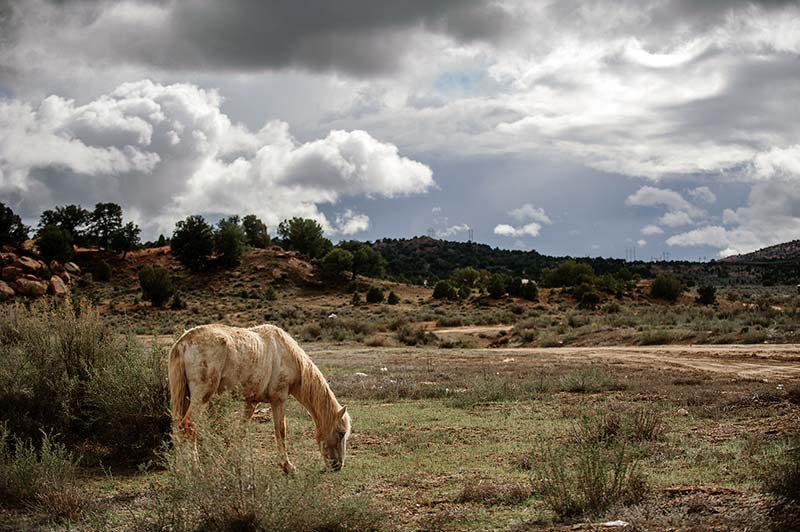
A gaunt horse grazes along State Route 264 near Tse Bonito, N.M. on March 27.

WINDOW ROCK

With multiple efforts to reduce the number of wild horses on the Navajo Nation, officials are considering a hunt.

The Navajo Nation Department of Fish and Wildlife asked hunters and sportsmen for their support for a hunt as a potential means to reduce the number of wild horses on the Navajo Nation at the 2017 Navajo Nation Sportsman’s Expo on March 25. NNDFW staff confirmed after the conference that a proposal has not yet been completely drafted, so the department hadn’t yet anticipated details of how the possible hunt would work such as weapons to be used, number of tags to take horses, and hunt unit maps.

Department manager Gloria Tom said the department hoped to address the problem and would propose a solution to Navajo Nation governance once drafted, but also called on the hunters present to add their voices to the conversation around the feral herds and what to do about them.

“Our leaders, they really need to hear from people like you,” Tom said. “People who live out there, people who hunt.”

She said government officials sometimes take information from NNDFW as something that employees are paid to say as part of their jobs and concerns from experts who work for the government might have less impact on elected officials than the voices of their constituents and voters.

“To me, you have a greater chance of success,” she said.

She said previous attempts to trap, round up, or allow horses to be adopted had not made a large enough impact. NNDFW officials said the department is drafting a proposal to get support from Navajo Nation leaders.

“I compare this problem to our cat and dog problem,” she said.

Source: Fish and Wildlife may propose a horse hunt on the Navajo Nation – Navajo Times

Storytime with Rachel F Hundred

Creating stories for pleasure

Sibyl Moon

Shh I'm Writing

Sylum Clan

Nothing is True. Everything is Connected.

Laura Bruno's Blog

Medical Intuition, Astrology, Soul Readings, Intuitive Coaching, Tarot, Reiki: Inspiring and Empowering Visionaries, Artists and Healers

Fire Family Conflagration

Weekly Challenge from the 118, 126, & 113

Kiayea's Corner

all things fanfic...

Crystal Dawn Books & Gifts

Crystals, and all things Magical

Starkindler's Realm

welcome to the inner workings of my mind...

The Herb Society of America Blog

Learn • Explore • Grow

Dr. Gary Samuelson

A Journey of Discovery

Kylia's World

Where Canon has No Meaning and Universes Collide

originaltempus

Just another WordPress.com site

Profilers For Christmas

The Crime Drama Advent Calendar

Entangled Wood

Just another WordPress.com site

brokenamethystwrites

Here there be Dragons

Toasterpop's Fiction

Fanfiction and original stories from Toasterpop

Breakaway Consciousness

Seeking Ideas Beyond Conventional Thought

gypsysue

Writting, Drafts, Ideas

Ellywinkle

All Things Wicked and Wonderful

Natalie J. Case

Author, Editor, Photographer, Artist

Your Stories. Your Wall.

Honoring their service and building their legacy. The official blog of the Vietnam Veterans Memorial Fund.

00Q Reverse Big Bang!

Art and Stories for all things 00Q, since 2014

The Wild Hare Project

Where the Writer Comes First.

Anthea Davis

FanFiction Author

Every Fandom Bangs

The home of the Every Fandom Bang and Reverse Bang!

Penumbria

n. pl. pe·num·brae (-br) or pe·num·bras 1. A partial shadow, as in an eclipse, between regions of complete shadow and complete illumination.

This Crooked Crown

Witchcraft for the Everyday and the Extraordinary

This is who I am...

... and this is what I like

Fanfiction Recommendations by Isabelle Disraeli

Fanfiction Recommendations ~ Slash, Femslash, & Het Fanfic Recs

Ellywinkle

EVIL AUTHOR DAY

Convivial Supper

Recipes from the Past

Kaethe Vaako's Fiction

what my demented mind comes up with

Sylum Archive

Nothing is True. Everything is Connected

Quantum Bang

The Multi-Fandom Fix-it Big Bang

by Geep 10

a place for me to share what I've written

Good Witches Homestead

Enchanted World of Magical Gardening ~ Crystals & Gemstones ~ Locally Grown Organic Herbs

tkbenjamin

m/m original fiction and fanfic for adults only

Chestnut NOLA

It's All About The Romance

Loam Ananda

Spiritual Journeys in Druidry