The Bureau of Land Management is scrubbing their trail on the internet | Straight from the Horse’s Heart

After NBC News wrote about the Bureau of Land Management featuring a photo of a coal bed at the top of their website, the BLM changed it… to now feature this photo of an oil & gas pipeline.

by Debbie Coffey, V.P. & Dir. of Wild Horse Affairs, Wild Horse Freedom Federation                                                                    All Rights Reserved.          Copyright 2017

The Bureau of Land Management is scrubbing most of its links off of the internet, and in doing so, erasing much of its history from public view.

Many of the blm.gov links that are still remaining on the internet at this point say “page not found,” or the links are no longer cached.

The BLM also suddenly removed state and district websites.  Instead, you will now find “landing pages” that direct you to only one main Bureau of Land Management website.  (You can look at the new BLM website HERE.)

I called a BLM Public Affairs Specialist to ask some questions about the defunct websites and links.  This person said in the past there were about 90,000 pages (and then a bit later stated that it could possibly be only about 60,000 pages) of BLM content on the internet, but that all of these pages couldn’t be maintained or updated, and weren’t centralized.  This person said the BLM’s prior content management system was outdated.

Most importantly, this person also said there were now standards to reduce the amount (of pages/content).

Who made the decision to even have a standard to reduce content available to the public on the internet?  During this website transition, who is making the decisions, and on what basis, of what data to migrate, or not to migrate, to the new BLM website?  These decisions cherry pick what information will be available to the public in the future.

Make no mistake, this “reducing the amount” of content on the internet is erasing many of this agency’s past actions, activities, and government documentation.  Many of these links had historical value.  For example, the BLM activities of BLM employees Sally Spencer and Lili Thomas over the years are now gone.  These types of links on the internet didn’t need to be “maintained” or “updated.”  They were historical in nature.

In the past, in doing a google search for Sally Spencer (a longtime BLM employee, and the Marketing Specialist famous for selling so many wild horses and burros to kill buyer Tom Davis), she was included on many, many BLM government links.  I went to the BLM’s new website and searched “Sally Spencer,” and only 3 items appeared.  When I searched “Lili Thomas” (another longtime BLM Wild Horse & Burro Program employee who oversaw the BLM’s Long Term Holding facilities for wild horses for many years), only 4 items appeared.  And when I searched “John Neill” (a longtime Palomino Valley Center manager), all that came up was “No results found.”

These individuals are BLM personnel who have been central in management issues in the BLM’s Wild Horse & Burro Program, as evidenced by FOIA documentation garnered by the late Dr. Patricia Haight of The Conquistador Program.

Even when I searched the new BLM website for “Dean Bolstad” (the Division Chief of the Wild Horse & Burro Program) only 2 items appeared.

(Although, luckily, thanks to In Defense of Animals, you can still go online and see this youtube video of Lili Thomas saying “working with wild horses is not a pretty sight” at a public meeting.)

What I can’t understand is, if the new content management system is bigger and better, why couldn’t the new content management system have contained all of the old data along with new data?  If this agency were truly transparent, they would add data, not reduce data, available to the public on the internet.

At first the Bureau of Land Management only removed the Directories for District offices and Field Offices, making it difficult, for example, to find out who was the Wild Horse & Burro Specialist, Hydrologist, Range Management Specialist or other personnel in any particular district or field office or to find an email address or telephone number for them.  BLM personnel frequently transfer to other offices and states, so it was already hard enough to try to keep up with who was where.  But now the public really doesn’t have a clue who is doing what or where.

You used to be able to go to the home pages of BLM state and district websites, and get a quick overview of not only roundup plans for wild horses & burros, but mining expansion plans, oil & gas lease sale plans, and other uses of our public lands in that area, all in one place.

Now, the BLM has divided these by topics or by “regions,” on their new website.   Under the “region” of Nevada (we call them states here in the U.S.A.), there isn’t a box for wild horses & burros (only oil and gas leasing, greater sage grouse, Great Basin Landscape Conservation Cooperative, Information Access Center, Nevada Resource Advisory Councils & Federal Register Notices).

By scattering information all over this one “centralized” website, the BLM has made it much harder for the public to put together the pieces of information for a clear picture about the multiple uses of our public lands in any one area.

The Program Data page for the Wild Horse & Burro Program is HERE.  When I clicked on the box for Historical Program Data and Public Lands Statistics, I noticed something was missing that used to be available to the public.  It was the column on Adoptions by Locations & Date.  Information from the years 2009-2015 were previously available.

The biggest reason this data was important is because it let the public know the dates of adoption events (including internet adoptions), the locations of the events, the number of the wild horses and burros offered for adoption (until Fiscal Year 2014) and the number of wild horses and burros that were actually adopted at each event.

The BLM likely stopped reporting the number of horses & burros offered at adoption events in Fiscal Year 2014 because it didn’t want the public to know how many horses & burros were racking up “strikes” by not being adopted.  When a wild horse or burro isn’t adopted after 3 events and gets 3 “strikes” it can be sold without restriction (to slaughter), no matter how young it is.  Even this seemingly small reduction of data indicated a lack of transparency by this agency.

Another reason this data is important to the public is because it let the public see what areas of the country adopt the most (and the least) wild horses & burros.

While the new BLM website contains a lot of information, it seems we have lost much more information that was once available on the internet, but was not migrated to the new BLM website.  For example, the BLM News Release on its promised investigation into the deaths of wild horses at the Scott City feedlot is on the internet, but as of today, is not one of the 63 News Releases available to the public on the BLM’s new website.

We will never know how much, or what, the BLM has removed from the internet.  The BLM’s scrubbing of their trail on the internet has not only erased part of the history of this government agency, it is censorship, and it is the equivalent of a modern day book burning.

SEE EXAMPLES REFERENCED ABOVE HERE.

Source: The Bureau of Land Management is scrubbing their trail on the internet | Straight from the Horse’s Heart

Get real, John Ruhs | Straight from the Horse’s Heart

Source: Get real, John Ruhs | Straight from the Horse’s Heart

  John Ruhs, BLM Nevada State Director
Yosemite Sam, Ruhs’ doppelganger

Dadgummit!  After John Ruhs, Nevada’s BLM State Director, said that he wanted to round up 4,000 wild horses in Elko County last summer (supposedly in response to the continued lies blaming wild horses and burros for the “deterioration of drought-stricken rangeland”), we’re noting that many mines that will use billions of gallons of water are now on the verge of expanding in Nevada.

Ruhs recently spoke at the Elko Convention Center, and stated that “We are pretty proud of the fact that this last year we have worked with the Nevada Cattlemen’s Association, the Nevada Department of Agriculture, the Forest Service, Fish and Wildlife Service and NDOW to provide some public opportunities to talk about sage grouse land use amendments and what they mean to the grazing program. A lot of work still needs to be done.”

The BLM ALWAYS works with the Nevada Cattlemen’s Association.  And the National Cattlemen’s Association.  Actually, the BLM works FOR them.  Notice that the focus of talking about sage grouse land use amendments is all about what they mean to the grazing program?

Ruhs also lamented that wild horse and burro issues dominate a large part of the Nevada BLM and Ruhs went on to talk about the difficulties in wild horse management.

Wild horse and burro issues dominate?  Like, bigger than all of the mines and outnumbering all of the livestock?

And talk about difficulties?  How about all those abandoned mines in Nevada, John?

And management?  There is only wild horse and burro “MISmanagement.”

Ruhs then said “We are somewhere in excess of 37,000 horses on the rangeland that is a big priority for us and it’s one of the things that I hope in the new administration that we will see some changes that will finally allow us to get some work done on the ground.”

We hope that the work that Ruhs is referring to getting done “on the ground” will include getting an accurate count of the wild horses and burros, rescinding some livestock overgrazing permits and making sure the extractive industries don’t use every last drop of water.

Why even bother to imply that the BLM “manages” anything, except impending environmental damage from the “multiple uses” that make a buck?  Don’t stash the truth, John.

Is Donkey Skin the New Ivory? | Straight from the Horse’s Heart

by Alixandra Caole Vila as published at Nature World News

African Donkeys are Being Slaughtered to Extinction

While China’s taste for elephant ivories have died down, it seems like their fondness has shifted to Donkey skin this time.

According to the National Council of Societies for the Prevention of Cruelty Against Animals (NSPCA), South African donkeys are being slaughtered to extinction for the gelatin found in their skin and their meat.

While the donkey-hide gelatin has no commercial value in Africa, it is a popular ingredient used to create Chinese medicine to treat anemia and menopause-linked ailments. The gelatin, called Ejiao in Chinese, reportedly stops bleeding and strengthens the blood.

“[Ejiao] is quite a popular ingredient in China that people may self-prescribe,” Chinese medicine expert Mazin Al-Khafaji told The Independent. “It’s a hard gel, made from donkey hide, which is then dissolved in hot water or alcohol. It’s also used topically in a cream, for leg ulcers for instance.”

CNN noted that because donkey skin is highly sought-after in China, the donkey population went down from 11 million to six million in the past 20 years. Approximately 80,000 animals had been sold in the first nine months of 2016. While the demand had delivered a valuable stream of foreign currency, it has placed small-scale farmers in a difficult situation.

China File said that because the price of donkeys increased, rural communities who depend on the animals for livelihood are suffering.

Speaking with Science Times, a donkey owner in Mogosani village named Ikgopeleng Tsietsoane shared that currently, the price of a donkey is 2,000 rand. It used to be only 400 rands ($30 or 29 euros).

At present, a number of African countries, including Niger and Burkina Faso, have banned China from buying their donkeys to save the docile beast’s population and the livelihood of locals. However, smuggling still persists in areas where it is considered illegal to do so…(CONTINUED)

http://www.natureworldnews.com/articles/37104/20170406/is-donkey-skin-the-new-ivory-african-donkeys-are-being-slaughtered-to-extinction.htm

Source: Is Donkey Skin the New Ivory? | Straight from the Horse’s Heart

Public comment needed on Nevada mine that will use over 2 billion gallons of water in 10 years | Straight from the Horse’s Heart

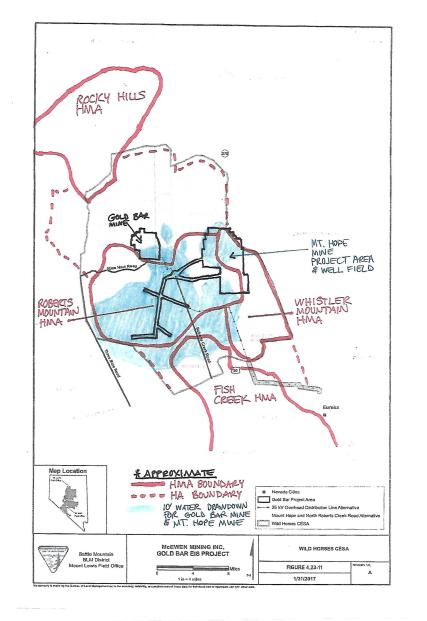
This map shows the Gold Bar Mine area, the approximate HMA (in solid red) and HA boundaries(in broken red lines), the approximate Mt. Hope Mine Project area and well field, and the approximate combined Gold Bar Mine and Mt. Hope Mine 10′ water drawdown area (in blue).  The 10′ water drawdown (in blue) effects almost the entire Roberts Mountain HMA.  The 1″ water drawdown will effect a much larger area.  (Streams can dry up with as little as a 1′ water drawdown.)

BE SURE TO LOOK AT ALL 8 MAPS AT THE BOTTOM OF THIS ARTICLE.

It’s best to write comments in your own words so that the BLM counts each comment as one, instead of counting a thousand similar comments/form letter as only one.  You can read the joint comments submitted by Wild Horse Freedom Federation and The Cloud Foundation below, and a quick summary on pages 5-41 of the DEIS HERE.  Comments are due by April 17, 2017.

Some suggested talking points are:

  1. Be sure to ask for the NO ACTION ALTERNATIVE.
  2. The Gold Bar mine project will use over 2 billion gallons of water in 10 years.  The BLM needs to take into consideration past (historic), current and likely future droughts and climate change when deciding if they will approve this DEIS.
  3. The Project will negatively impact the water, forage, safety, and “free-roaming” abilities of the Roberts Mountain wild horse herd on the Roberts Mountain HMA, as well as the nearby wild horse herds on Whistler Mountain and Fish Creek Herd Management Areas.
  4. The BLM is minimizing the area of impact by only indicating the 10′ water drawdown, and not the 5′ or 1′ water drawdown.  The 5′ and 1′ water drawdown will cover a much larger area of land.  A stream can dry up with as little as 1′ of water drawdown.
  5. When the nearby Mt. Hope mine becomes operational, it is proposed that it will use an additional 7,000 gallons per minute for the life of the mine (40-50 years).  Mt. Hope mine will use over 3 1/2 billion gallons of water per year and over 36 billion gallons of water in 10 years.
  6. The BLM refers to the Cyanide Management Plan (1992), (noted in Vol. 1A, 1.4.3) and the Solid Minerals Reclamation Handbook (1992), (noted in Vol. 1A, 1.4.4).  These are 25 years old and outdated.  Ask for updates of this Plan and Handbook for this DEIS.
  7. The area of Gold Bar Mine will be expanded by 40,000 acres or 62.5 square miles, creating more environmental degradation.

The DEIS is available online at HERE.   Interested individuals should address all written comments to Christine Gabriel, Project Manager, using any of the following ways:

Fax: (775) 635-4034

Email:  blm_nv_bmdo_mlfo_gold_bar_project_eis@blm.gov

Mail:  Bureau of Land Management

Mount Lewis Field Office

50 Bastian Road

Battle Mountain, NV 89820

Wild Horse Freedom Federation and The Cloud Foundation submitted these joint comments regarding the BLM’s Gold Bar Mine Project:


Bureau of Land Management

Mount Lewis Field Office

50 Bastian Road

Battle Mountain, NV 89820

Email: blm_NV_bmdo_mlfo_gold_bar_project_eis@ blm.gov

DATE:  April 5, 2017

Subject: DEIS MMI Gold Bar Mine Project

Dear Ms. Gabriel:

On behalf of The Cloud Foundation (TCF) and Wild Horse Freedom Federation (WHFF), 501(c)3 non-profit corporations, and our hundreds of thousands of supporters throughout the United States, we would like to thank you for the opportunity to submit scoping comments on the Draft Environmental Impact Statement (DEIS) for McEwen Mining Inc.’s (MMI) Gold Bar Mine Project (Project).

TCF, a wild horse and burro advocacy group and an advocacy group for all wildlife on our public lands in the West, and Wild Horse Freedom Federation, a voice for the protection of wild horses and burros and public lands, strongly oppose the expansion of the Gold Bar mining project and we urge the NO ACTION ALTERNATIVE in this DEIS for the following reasons:

Wild Horse Herds To Be Affected:

The Project will negatively impact the Roberts Mountain Wild Horse Herd as well as the nearby herds of Whistler Mountain and Fish Creek Herd Management Areas.

Sage Grouse Habitat Affected:

Not only wild horses will be affected in this area. All wildlife will suffer.

Open pit mining is the most environmentally destructive type of mining anywhere. Extreme weather events can overwhelm all mandated precautions, threatening migratory birds and small mammals. In the case of a flood, even large mammals like wild horses risk exposure to potentially lethal mining waste.

Direct habitat damage due to mining plus further fragmentation by roads and large equipment traveling on these roads will eliminate hopes for the recovery of the Greater Sage Grouse in this area. The transport process in itself is dangerous—accidents, dust, spread of contaminants, noise, etc.

Greater Sage Grouse were once so numerous that the “sky was black” with these large birds, according to Ginger Kathrens’ late Uncle, Allan Ralston, who spoke of this area after his return from WWII. Now the birds are threatened and a species of critical environmental concern. BLM should prioritize these risks.

Impacts on Water Sources:

Per the Gold Bar DEIS, page 4-147, under 2 different scenarios, the mine will either pump 380 gpm (gallons per minute) or 500 gpm (gallons per minute).

If the mine pumps 380 gpm, this equals 22,800 gallons per hour, 547,200 gallons per day, and 199,728,000 gallons per year.  Over 10 years, it will pump over 2 billion gallons of water.

If the mine pumps 500 gpm, this equals 30,000 gallons per hour, 720,000 gallons per day, and 262,800,000 gallons per year.  Over 10 years, it will pump over 2 1/2 billion gallons of water.

This does not include the water which the Mt. Hope mine will use once mining begins.  Mt. Hope is projected to use 7,000 gallons per minute for the life of the mine (40-50 years).

The project will deplete surface and ground water resulting in the drying up of ephemeral streams. Reducing water tables to dangerously low levels will negatively impact perennial streams. This DEIS minimizes the impact on water resources by not providing 5’ or 1’ water drawdown maps and thus minimizing the additional area of land that will be effected.  A stream can dry up with as little as 1’ of water drawdown.

Maps created by Wild Horse Freedom Federation are included in the Appendix.

Map 1 – (Figure 4.23-11 of DEIS) Gold Bar Mine Wild Horse CESA (Cumulative Effects Study Area).  On page 4-265 of the DEIS, it states “The CESA for the wild horses and burros includes Roberts Mountain, Whistler Mountain, and portions of the Fish Creek HMAs, as well as Kobeh Valley and Roberts Mountain HAs where wild horses existed based on past inventories, and where they could be potentially affected by the Project…”

Map 2 – shows the addition of the approximate 10′ water drawdown area – (Figure 4.19-3 of Gold Bar Mine Project), 500 gpm (gallons per minute) for 10 years.

Map 3 – shows the addition of the approximate HMA and HA boundaries.

Map 4 – shows the addition of the approximate Mt. Hope Mine Project area and well field – (Figure 3.13.1 Mt. Hope Project EIS).

Map 5 – shows the addition of the approximate Mt. Hope Mine 10″ water drawdown area – (Figure 3.2.18 Mt Hope Project EIS).

Map 6 – shows approximate sketch of Gold Bar Mine and Mt Hope Mine with HMA and HA boundaries

Map 7 – shows approximate HMA boundaries over grazing allotments map – (Figure 3.7 – 1, Gold Bar Mine EIS)

Map 8 – shows approximate mining, water drawdown, and grazing with the HMA and HA boundaries.

BLM writes in their description of the Roberts Mountain HMA: Water availability is a key influence to wild horse use during summer months. Wild horses will generally travel much farther to water than will livestock. In many HMAs water sources are plentiful and supplied by perennial streams, springs, and human constructed water developments such as livestock water tanks and ponds. In other cases, water sources are limiting, and in drought years, wild horses may have difficulty accessing sufficient water, (emphasis added) especially if the population exceeds the Appropriate Management Level (AML). In these cases, wild horse distribution is closely tied to the location of the available waters, which becomes very important to the health of the herd.

Drought Ridden Region

Drought is common in this driest state in the Union. Emergency removals of wild horses because of the lack of water are common. Removals of 14 wild horse herds occurred in 2009 south of Ely by BLM. The Agency cited the lack of reliable water sources as the reason for the removal of wild horses on 1.4 million acres of public land.

The proposed expansion and creation of more water dependent, extractive uses of the land is irresponsible.

Outdated Plan and Manual

This DEIS is based, in part, on a plan and a manual that are each about 25 years old and outdated.  We are referring to the BLM Cyanide Management Plan (1992), (noted in Vol. 1A, 1.4.3) and the Solid Minerals Reclamation Handbook (1992), (noted in Vol. 1A, 1.4.4).  We ask that you review these outdated materials and update them if you are going to base any part of this DEIS on these outdated plans.

Economic Uncertainty

The potential for failure of this project is so high that the Securities and Exchange Commission (SEC) states: . . .in addition to greater uncertainty as to the economic feasibility of Mineralized Material compared to proven and probable reserves, there is also greater uncertainty as to the existence of Mineralized Material. U.S. investors are cautioned not to assume that measured or indicated resources will be converted into economically mineable reserves. The estimation of inferred resources involves far greater uncertainty as to their existence and economic viability than the estimation of other categories of resources.

Couple the above with the failure of the previous mine developers, Atlas Corporation, who filed for bankruptcy and abandoned the land in an unreclaimed condition in 1999.

Wide Scale Damage

McEwen Mining, a Canadian Mining company, is poised to take over and create even more environmental degradation. The area would be expanded by 40,000 acres or 62.5 square miles, or about 1/3 the size of the Colorado Springs metropolitan area where TCF is headquartered. In other words, this is destruction on a grand scale.

Damage from gold mining is permanent. No amount of mitigation can return the landscape to anything approaching a natural state. Over flights of the area reveal large-scale destruction. Increasing this permanent destruction for the hope of short-term gain is not a reasonable, and certainly not an environmentally friendly decision.

For the above reasons, we urge you to select the NO ACTION ALTERNATIVE for the Gold Bar Mine Project.

Thanks very much for your consideration of our position on this important issue.

Sincerely,


Ginger Kathrens                             Debbie Coffey

Executive Director,                         Vice-President,

The Cloud Foundation, Inc.          Wild Horse Freedom Federation

107 S. 7th Street                                P.O. Box 390

Colorado Springs, CO 80905        Pinehurst, TX  77362

MAPS:

Map 1

http://wildhorsefreedomfederation.org/wp-content/uploads/2017/03/Gold-Bar-Mine-Map-1.pdf

Map 2

http://wildhorsefreedomfederation.org/wp-content/uploads/2017/03/Gold-Bar-Mine-Map-2.pdf

Map 3

http://wildhorsefreedomfederation.org/wp-content/uploads/2017/03/Gold-Bar-Mine-Map-3.pdf

Map 4

http://wildhorsefreedomfederation.org/wp-content/uploads/2017/03/Gold-Bar-Mine-Map-4.pdf

Map 5

http://wildhorsefreedomfederation.org/wp-content/uploads/2017/03/Gold-Bar-Mine-Map-5.pdf

Map 6

http://wildhorsefreedomfederation.org/wp-content/uploads/2017/03/Gold-Bar-Mine-Map-6.pdf

Map 7

http://wildhorsefreedomfederation.org/wp-content/uploads/2017/03/Gold-Bar-Mine-Map-7.pdf

Map 8

http://wildhorsefreedomfederation.org/wp-content/uploads/2017/03/Gold-Bar-Mine-Map-8-with-mining-water-drawdown-and-grazing.pdf

Source: Public comment needed on Nevada mine that will use over 2 billion gallons of water in 10 years | Straight from the Horse’s Heart

Fish and Wildlife may propose a horse hunt on the Navajo Nation – Navajo Times

Navajo Times | Adron Gardner
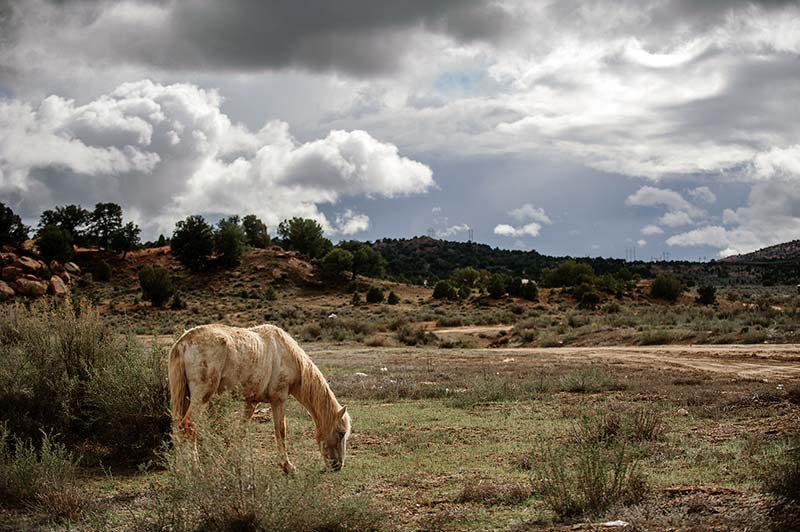
A gaunt horse grazes along State Route 264 near Tse Bonito, N.M. on March 27.

WINDOW ROCK

With multiple efforts to reduce the number of wild horses on the Navajo Nation, officials are considering a hunt.

The Navajo Nation Department of Fish and Wildlife asked hunters and sportsmen for their support for a hunt as a potential means to reduce the number of wild horses on the Navajo Nation at the 2017 Navajo Nation Sportsman’s Expo on March 25. NNDFW staff confirmed after the conference that a proposal has not yet been completely drafted, so the department hadn’t yet anticipated details of how the possible hunt would work such as weapons to be used, number of tags to take horses, and hunt unit maps.

Department manager Gloria Tom said the department hoped to address the problem and would propose a solution to Navajo Nation governance once drafted, but also called on the hunters present to add their voices to the conversation around the feral herds and what to do about them.

“Our leaders, they really need to hear from people like you,” Tom said. “People who live out there, people who hunt.”

She said government officials sometimes take information from NNDFW as something that employees are paid to say as part of their jobs and concerns from experts who work for the government might have less impact on elected officials than the voices of their constituents and voters.

“To me, you have a greater chance of success,” she said.

She said previous attempts to trap, round up, or allow horses to be adopted had not made a large enough impact. NNDFW officials said the department is drafting a proposal to get support from Navajo Nation leaders.

“I compare this problem to our cat and dog problem,” she said.

Source: Fish and Wildlife may propose a horse hunt on the Navajo Nation – Navajo Times

Please Comment to Protect Wyoming’s Wild Horses from the Devastating 2017 Checkerboard Roundup | Wild Hoofbeats

Adobe Town Family

Please Comment by April 4, 2017 on the Checkerboard 2017 Roundup

The BLM was unable to roundup wild horses from Salt Wells Creek, Adobe Town and Great Divide Basin in 2016 because we won a lawsuit that prohibits the BLM from managing the wild horses in the Checkerboard using only Section 4 of the Wild Free Roaming Horse and Burro Act, which allows them to remove wild horses from private lands. Because the Checkerboard includes public lands, it is illegal to manage them as if they were privately owned by the ranchers demanding these roundups. In order to legally roundup wild horses from the Checkerboard, the BLM must prove that the numbers are above Appropriate Management Level, or AML. Now, they are not even conducting a census to prove this, instead they are “projecting” that the horses are over the high end of AML.

Roundups cause the destruction of hundreds of wild horse families, as well as injuries and death to the horses as they are chased by helicopters and flee in terror into traps. These captured wild horses are chased into trailers and taken away from the only home they have ever had to end up spending the rest of their days languishing in holding corrals with no shelter. Only a lucky few are adopted by members of the public and these do not always mean good homes – the return rate back to the BLM for adopted or purchased wild horses is over 50%. Many many of these horses will end up at slaughter in Mexico. There is no good reason to roundup and remove these horses from Adobe Town, Salt Wells Creek and Great Divide Basin.

I have been following and observing and photographing the wild horses in these three herd management areas for the last 13 years. These horses are uniquely suited to this sometime harsh high desert environment. They are the last three largest herds in Wyoming, and they deserve to be preserved on our public lands. Although the Checkerboard presents challenges to BLM management because of its pattern of public alternating with private lands, that is no reason to cave into petty demands from the Rock Springs Grazing Association, which is made up from less than 25 members. These wild horses are valuable to us, the American public, and so every effort must be made to preserve them here where they were found at the time the 1971 Wild Free-Roaming Horse and Burro Act was passed. These horses were here long before the Grazing Association, and now what needs to happen is land swaps to consolidate blocks of public land that the horses can continue to roam upon. Managing the wild horses on the range, on our public lands where they can continue to roam free and making these necessary land swaps happen is what the BLM needs to be working on, not perpetuating this every 3 year pattern of roundup, removal, then warehouse our wild horses. The Field Manager of the Rock Springs BLM Field Office has been quoted as saying: “For all intents and purposes, we consider the Checkerboard private.” But it is NOT private. In fact, over half of the Adobe Town, Salt Wells Creek and Great Divide Basin Herd Management Areas are public land, that belongs to us, the citizens of the United States of America, not the Rock Springs Grazing Association.

Great Divide Basin Family

This time, the BLM wants to remove 1029 wild horses: 584 removed from Salt Wells Creek, 210 removed from Adobe Town, and 235 removed from Great Divide Basin.

They are not even calculating their numbers from an actual aerial census – they are making these numbers up. Every year, the BLM conducts and aerial census in late April, but now they are just “projecting” the numbers.

2017 “Projections”

Great Divide Basin  650

Salt Wells Creek       835

Adobe Town              820

Here are past census numbers provided by the BLM for these three areas:

2016 Statistically Corrected Census Counts
HMA Total within HMA Total within Checkerboard
Great Divide Basin 542 272
Salt Wells Creek 696 187
Adobe Town 684 25
Total 1,922 484

2015 April Census Numbers:

Adobe Town: 858
Salt Wells Creek: 616
Great Divide Basin: 579

2014 Post Roundup Census 2014

Adobe Town: 519
Salt Wells Creek: 29
Great Divide Basin: 91

As you can see with these numbers, they randomly go wildly up and down but somehow are considered “statistically corrected.”  The BLM has to prove that Adobe Town has more than 800 wild horses, Great Divide Basin has more than 600 wild horses and Salt Wells Creek has more than 365 wild horses in order to legally proceed with a roundup. There is no attempt to account for mortality rates due to deaths of older horses and foals, which can be very high when there is a harsh winter, which this last winter certainly has been, with storm after storm, much more snow and much more freezing temperatures than normal.

A real, professionally done, independent census needs to be conducted to get a real, accurate count of the wild horses in each of these three HMAs before any plans are made to roundup and remove wild horses from their rightful homes.

Radio Collared Adobe Town mare

I have been following the Adobe Town Radio Collar Study which is currently going on in conjunction with the University of Wyoming. Their plan to study the movements of wild horses through tracking 20 mares wearing radio collars will be completely disrupted if they round up wild horses in Adobe Town, so this is yet another reason that this proposal is senseless. I contend that there are NOT more than 800 wild horses in Adobe Town and therefore there is no legal reason to proceed with a roundup, and they will be subverting their own study by removing wild horses from this HMA, so this is yet another reason not to roundup and remove horses from Adobe Town. But none of the horses from any of these three HMAs should be removed without an accurate count of how many wild horses are in each area.

The biggest reason for not going forward with the Checkerboard 2017 Roundup is the well being of the wild horses themselves. This seems to be very low on the BLM’s priority list. What will happen to these 1029 formerly wild horses? We, the taxpaying public, will be paying to warehouse and feed them, at huge cost. The horses themselves will live out miserable lives in the holding facility, without their families, without shelter, and under the possibility that at any moment the BLM could elect to “euthanize” the more than 45,000 wild horses in captivity. This must stop.

Adobe Town mare and foal

Please comment by April 4. These wild horses need your help.

You are welcome to use any points from this blog but please use your own words. The BLM counts any form letter or form email as 1.

blm_wy_adobetown_saltwells_hma@blm.gov (Please include “2017 AML Gather” in the subject line), mailed or hand-delivered during regular business hours (7:45 a.m. to 4:30 p.m.) to:   BLM Rock Springs Field Office, 2017 AML Gather, 280 Highway 191 North, Rock Springs, WY 82901.

For more information, please contact the BLM at 307-352-0256.

Here is a link to the Scoping Document:

https://eplanning.blm.gov/epl-front-office/projects/nepa/74247/98803/119700/2017_Scoping_Statement_-_Adobe_Town,_Salt_Wells_Creek,_Great_Divide_Basin_AML_Gather.pdf

Source: Please Comment to Protect Wyoming’s Wild Horses from the Devastating 2017 Checkerboard Roundup | Wild Hoofbeats

Myths and Facts about Wild Horses and Burros | Straight from the Horse’s Heart

Stallion of Antelope Valley HMA ~ photo by Terry Fitch of Wild Horse Freedom Federation

by Bonnie Kohleriter

MYTH 1   26,500 wild horses and burros are to be on our public lands in 10 states, as that number was on our public lands in 1971 when the Wild Horse and Burro Law was passed.  Wild horses and burros are in AZ, CA, CO, ID, MT, NV, NM, OR, UT, and WY.

FACT 1  No census of numbers of wild horses and burros was done in 1971 when the Law was passed in December of that year.  The 1971 Law did not say the number of wild horses and burros that could be on our public lands.  26,500 is an arbitrary, non-evidenced based number.

MYTH 2  Wild horses and burros are on our public lands everywhere and they are destroying our public lands.

FACT 2  The BLM manages 245 M acres of our public lands.  About 3 M livestock are on 160 M acres, wildlife is everywhere, and wild horses and burros are limited to 29 M acres in areas called Herd Management Areas (HMAs).  Within the HMAs about 400,000 livestock that reside here as well are allocated 82% of the forage while the wild horses and burros are assigned 17%.  In 1971 the wild horses and burros were in Herd Areas (HAs), but the BLM said those areas were too difficult to manage so they drew circles within the HAs and called them HMAs.  Unbeknown to the animals where the boundaries are when they go into HA land, they are fodder to be removed without question.

MYTH 3  The BLM has 177 herd management areas (HMAs) for wild horses and burros giving the illusion horses and burros are in those areas.

FACT 3  The BLM has only 160 HMAs where wild horses and burros are now found.  The other areas don’t have any horses or burros in them, or are part of the military or forest service or are double counted.  The BLM had 339 HMAs initially, but little by little has zeroed them out.

MYTH 4  The BLM sets “Appropriate Management Levels” (AMLs) for the wild horses and burros in each area.  It sets a low number at which the animals should be and allows them to breed to a higher number after which it gathers, removes and reduces the animals to the low number again.  The overall low number is 17, 810 and the high number is 27,500.

FACT 4  “Appropriate” is inappropriate.  Allowing only 17,810 horses and burros in 160 areas in 10 western states is a species that is threatened or endangered.

MYTH 5  The BLM says it strives to have healthy horses on healthy rangelands.

FACT 5  Dr. Gus Cothran, the retained geneticist for the Wild Horse and Burro Program, says the following: Conservation geneticists maintain a minimum of 150-200 animals is needed in a herd with 50 effective breeding animals to have sufficient genetic variability for continued long term viability.  Of these herds, only 28 herds have 150-200+ horses allowed in them, and of these herds, only 3 herds have 150-200+ burros allowed in them.  In other words, 82% of the herds don’t have appropriate allowable numbers in them for continued health and viability.

MYTH 6  The herd members intermingle with the herd members in other herds so the individual numbers within a herd don’t matter.

FACT 6  Intermingling of the herds has not been scientifically researched and validated, and established by the BLM.

MYTH 7  Horses and burros can be imported from other herds to sustain genetic viability.

FACT 7  The 1971 Law says the horses are supposed to be “where found.”

MYTH 8  The BLM strives to have a “thriving, natural, ecological balance” on our public lands with a multiple use mandate.

FACT 8  The wild horses and burros are not a thriving species, the arbitrary numbers are not natural, and the numbers are not in balance, (27,000 vs. 400,000) in the ecological environment in which they are to be distributed.  The National Academy of Sciences addressed this Myth in 2013, in Chapter 7 of its report, Using Science to Improve the BLM Wild Horse and Burro Program.

MYTH 9  The BLM asserted 67,000 wild horses and burros were on our public lands in 2016 and 47,000 were in off the range holding facilities.  The number of livestock within the 27 M acres needs to stay there as they feed the world.  The number of livestock have been reduced by 35% from 1971-2014.

FACT 9  Livestock within the HMAs provide less than ½ of 1% of the United States meat.  The number of livestock have been reduced due to overgrazing and drought.  Cow/calf size has increased by 1 ½, offsetting the reduction in number of allowable livestock.  Though ways of counting wild horses and burros have improved, counting continues to be a challenge.  Reducing the number of livestock only within the HMAs and increasing the number of allowable wild horses and burros has not been explored.  The Cattlemen’s Association and now the Gas, Oil, and Mining Industries are powerful competitors and lobbyists for our public lands on which the wild horses and burros depend.

MYTH 10  The BLM is mandated by the 1971 Law to manage, protect, and control the wild horses and burros on our public lands.

FACT 10  Look at the BLM’s budget.  The BLM, unlike wildlife and livestock groups, does ever so little to manage and protect the wild horses and burros on our public lands.  The BLM doesn’t tend to water, forage, or space (fence) issues.  The BLM’s focus is on control, hiring contractors to gather and remove animals, hiring contractors to house animals off the range in short-term corrals or in long-term pastures, hiring contractors to move animals around the country for adoptions, and hiring administrators to complete the paperwork.

The BLM does not engage in using fertility control treatment (PZP) as a way to keep the wild horses and burros on the range though volunteers stand ready to help.  Up to now only four small herds have used this control method but now five more larger herds  are involved in its use.  In 2013, 509 horses received PZP, in 2014, 384, and in 2015, 469, paltry numbers.  The BLM does not engage in promoting recreational tourism on the range which could and would bring in money and in which volunteers stand ready to help.  The BLM has considered sterilizing mares but the procedures are dangerous for the mares and foals and the BLM is researching geldings to be used in on the range horse and burro herds.

MYTH 11  The National Advisory Board of the Wild Horse and Burro Program and the horse advocates on the 9 Regional Advisory Councils are available to advise on what is best for the future of the wild horses and burros.

FACT 11  The advisory board members are people with livestock, wildlife and land interests, not with wild horse and burro interests.  They are cattlemen and livestock vets.  They are not horse and burro geneticists, equine vets, biologists and ecologists, recreational entrepreneurs, volunteer coordinators.

This is a broken program in need of change and a different direction.  This is a program that needs to focus on ways to retain wild horses and burros on our public lands in controlled but healthy numbers, and to focus on providing them with adequate water, forage, and space.

Wild horses evolved in the Americas.  They left during the Ice Age 10,000 years ago and were domesticated in Europe.  They were brought back to the Americas and were left to be wild again when automation was introduced.  They were used to settle our country and to fight our wars in WW1 and WW2.  Today, they are symbols of our past of the Wild Wild West.  They are symbols of our freedom. We as Americans are charged to be stewards of them.  They need to be managed and protected on our public lands,  controlled in genetically healthy numbers, and when those goals are met, in my opinion, then given fertility control treatment.

Source: Myths and Facts about Wild Horses and Burros | Straight from the Horse’s Heart

Fleet of Angels Update: WE’RE PACKIN’ UP AND MOVIN’! | Straight from the Horse’s Heart

by Elaine Nash

“…we have transported most of the 313 remaining horses to Colorado to our beautiful new adoption hub in Fort Collins.”

After a two-month long stay in Faith, SD- 30 miles from the ISPMB location, Barbara Joe Rasmussen and I are heading to Fort Collins, Colorado today to join the Hallelujah Horses and our new crew there for the final phase of this massive mission.
.
Fleet of Angels launched this mission on October 14, 2016 at the request of the SD State’s Attorney. We all dove in and worked like mad to set up a workable process, and as a result, we were able to adopt out over 270 of the 900+ at-risk ISPMB horses by December 22, 2016- the number that was allowed by the court order that was in place at that time.
.
We continued working to recruit adopters through the holidays, assuming that more horses would need us as soon as the state’s legal maneuverings allowed it. We returned to the project on January 26, 2017 when a new court order was put in place that removed all but 20 of the 600+ horses from ISPMB ownership and turned them over to Fleet of Angels to care for, manage, and find good homes for. (We were not involved in the legal aspect, but had offered to be a safety net for the horses if the courts removed them from ISPMB, to prevent their being sold at auction and the likely slaughter of most of them. In order to save them, we- thanks to a group of incredible donors, reimbursed the counties over $150,000.00 to prevent their being auctioned on December 20, 2016.)
.
Now, five and a half months later- with the help of a LOT of people and organizations, we have adopted out and transported a total of almost 600 horses to approved homes, and we have transported most of the 313 remaining horses to Colorado to our beautiful new adoption hub in Fort Collins. (Our two shippers will make one more trip this week, and then all of the remaining horses will be in Colorado.) Of the 313 still under our care, about 175 horses still need homes (IF all pending adopters who have committed to take from two to a herd of 75 horses come through).
.
For the month of April, we will be working to get the remaining horses adopted and transported, with the goal being to finish this mission by the end of the month of April. PLEASE HELP US IF YOU CAN. We need adoptive homes for 175+ horses, and we need funds to cover the costs of feed, facility use, ground team workers, lodging for some of the workers, and transportation. Literally every dollar helps, and every penny is pinched. 🙂 Our donation page is: www.ispmbhorserescuemission.org.
.
Special thanks for helping us get this far, so far, to Neda DeMayo and Return to Freedom and the Wild Horse Sanctuary Alliance, Patricia Griffin-Soffel and the Patricia Griffin-Soffel Equine Rescue Foundation, ASPCA, Victoria McCullough and the Triumph Project, Lauri Elizabeth Armstrong and Chilly Pepper Miracle Mustang, Shirley Puga and the National Equine Resource Network, HSUS, and MANY OTHERS for helping us help these horses. Please help us finish this job, so every horse in this mission has a good, loving, lifetime home.

Teamwork works!

https://www.facebook.com/groups/ISPMB.Adoptable.Horses/permalink/1283727228384737/

Source: Fleet of Angels Update: WE’RE PACKIN’ UP AND MOVIN’! | Straight from the Horse’s Heart

Public Lands Issues effect on wildlife and wild horses and burros | Straight from the Horse’s Heart

photo by Terry Fitch of Wild Horse Freedom Federation

by Bonnie Kohleriter

Our public lands are now under attack which has enormous consequences for our wild horses and burros and for our wildlife.  The attacks are coming from Trump’s cabinet members, particularly the Dept. of Agriculture and the Dept. of the Interior, and from Congressional Republicans.

First, Rep. Jason Chaffetz R UT, introduced a bill early in January, 2017, to sell off 3.3 M acres of Federal land to states.  With an outcry from conservatives and sports groups, he withdrew that bill.

Then Rep. Jason Chaffetz R UT, introduced a bill later in January, 2017, called the Local Lands Act, wherein Federal law enforcement on our Federal Forest Service (FS) and Bureau of Land Management (BLM) land, will be supplanted with State law enforcement with the States being given block grants.  The bill is currently in the Natural Resources Committee: Subcommittee on Conservation and Forestry.

Then Rep. Don Young (R) AK, moved a bill, House Joint Resolution 69, through the Congress in February, 2017, wherein the Federal Fish and Wildlife Service (FWS) on Federal Alaskan lands will no longer manage its Federal wildlife, and its Federal wildlife will be managed by the State of Alaska.  Resolution 69 went to the Senate, where Sen. Lisa Murkowski (R) AK and Sen. Dan Sullivan (R) AK, moved the resolution through the Senate in March, 2017.

It is concerning as attempts are in process to take away Federal land and give it to the States, to take away Federal law enforcement on Federal lands and give it to the States, and to take away Federal management of Federal wildlife on Federal land and give the management to the States.  What’s next?  In addition to give aways, the Senate voted 51-48 to kill the 2.0 plan which was developed by the Dept. of the Interior.  That plan authorized public lands stakeholders to give input into the use of the land.  The killing of the 2.0 plan is designed to give the local and state governments more control over the Federal public lands for development such as use for businesses.

Now Ken Ivory, a Rep. in the Utah State Legislature, under House Concurrent Resolution 22, is asking the President and Congress to repeal the Wild Free-Roaming Horses and Burros Act of 1971 and grant authority and resources to the States to manage feral horse and burro populations within their jurisdictions.  The Legislature and Governor maintain the horses and burros are damaging the rangelands for wildlife and livestock that share the same areas.  This bill would authorize the States to geld the stallions.  Some outspoken ranchers and hunters want our public land for their gains.  The ranchers in Utah have expressed they want to “harvest” (slaughter) the horses and burros like they harvest cattle.

What else is coming?  Environmental groups have identified “Public Lands Enemies.  Interestingly they are all Republicans. They are:

Sen. Mike Lee           Utah    Sen. Lisa Murkowski Al    Rep Mark Amodei        NV

Sen. Orin Hatch        Utah    Sen. Dan Sullivan      AL    Rep Dean Heller           NV

Rep. Rob Bishop       Utah    Rep. Don Young        AL    Rep Tom McClintock   CA

Rep. Jason Chaffetz Utah    Sen. Jeff Flake           AZ     Rep Doug La Malfa      CA

Rep. Chris Stewart    Utah   Rep. Paul Gosar        AZ     Rep Steve Pearce        NM

Rep. Mia Love            Utah   Sen. Barrasso            WY   Rep Raul Labrador       ID

In California, McClintock is from the Central Valley and La Malfa is from NE California.  La Malfa is a 4th generation rice farmer and has received $ 5M in federal commodity subsidies starting in 1995, or on average a quarter of a million dollars every year from the federal government.  Now that’s the real “welfare” food stamps subsidy.

While Republican Congressional Representatives primarily supported by ranchers and hunters in their respective states, wrangle in Congress to take from the Federal government and give to the States, the Wildlife Services within the U.S. Department of Agriculture yearly brutally kills millions of carnivores and omnivores on our public lands to appease the hunters and ranchers.  The hunters claim the carnivores and omnivores kill the herbivores they want to hunt and the ranchers on our public lands claim the carnivores and omnivores kill their livestock.  The killings are brutal: aerial gunning, cyanide poisoning, steel jaw and leg trapping… In 2016 the Ag Dept. Wildlife Services killed 2.7 M animals on our public lands.  415 gray wolves, 77,000 coyotes, 407 black bears, 334 mountain lions, 997 bobcats, 21,000 beavers, 4000 foxes, …

Our public lands are to have a multiple use mandate, but it seems the powerful, monied hunting and ranching lobbies, as well as now, the gas, oil and mining lobbies in Washington are dictating what will go on with our public lands through their elected congressional representatives.  Get involved.  Contact your elected congressional representatives, especially those on the natural resources, agricultural, and appropriations committees in the House and the agricultural, nutrition, forestry, and environmental and public works and appropriations committees in the Senate.  Tell your representatives what it is you want on our public lands.

Source: Public Lands Issues effect on wildlife and wild horses and burros | Straight from the Horse’s Heart

BLM Seeks Public Comment on Plan to Rip More than 1,000 Wild Horses Out Of Wyoming | Straight from the Horse’s Heart

“This is Your Chance to be a Voice for the Horses…”

Destruction of Wyoming’s Adobe Town herd by the BLM ~ photo by Carol Walker of Wild Horse Freedom Federation

The Bureau of Land Management offices in Rock Springs and Rawlins are launching a 30-day public scoping period prior to preparing an environmental assessment on proposed deadly wild horse stampedes in the Salt Wells Creek, Adobe Town, and Great Divide Basin Herd Management Areas.

The war on Wyoming’s last remaining wild horses is allegedly scheduled to begin in the fall of 2017.

Written comments should be received by April 4, and should be e-mailed to blm_wy_adobetown_saltwells_hma@blm.gov. (Please include “2017 AML Gather” in the subject line).

Mailed or hand-delivered comments can be made during regular business hours (7:45 a.m. to 4:30 p.m. local time) at: BLM Rock Springs Field Office, 2017 AML Gather, 280 Highway 191 North, Rock Springs, WY 82901.

To verbally express your disdain, please contact the BLM at 307-352-0256.

For more details on how the BLM plans to destroy wild horse families and strip them of their freedom visit (HERE)

Source: BLM Seeks Public Comment on Plan to Rip More than 1,000 Wild Horses Out Of Wyoming | Straight from the Horse’s Heart