Wildcrafted Druidry: Using the Doctrine of Signatures, Ecology and Mythology to Cultivate Sacred Relationships with Trees

Dana's avatarThe Druid's Garden

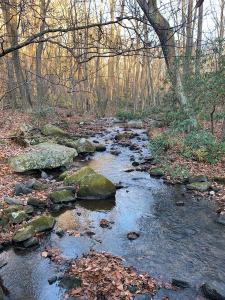
A stream in winter

Nature spirituality is most obviously tied to one’s local nature–the trees, plants, animals, landforms, and other features of what makes your own landscape unique. One of the formidable challenges before those of us practicing nature-based spiritualities in the United States and other “colonized” regions is that not only do we not have the right/access to native traditions on local uses of plants, we also have systems that are inherited from other places and may not properly fit. Ogham is a good example of this: if you use the traditional ogham in the US, it is kind of like wearing a pair of ill-fitting shoes: you can get by, but the system isn’t working with what is outside your door.

With that said, I have always been fascinated by the idea of a language of trees, a system that we can use for magical and divination purposes…

View original post 3,672 more words

The Magic of the Understory

Dana's avatarThe Druid's Garden

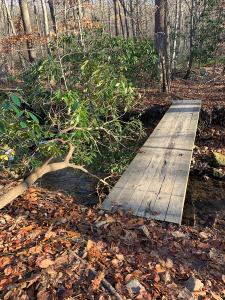
A path of evergreen mountain laurel at Laurel Hill State Park. Amazing to hike through in the winter, when the understory sings!

As you may have noticed, in the last month or so I’ve been working diligently on my “Sacred Trees in the Americas” series.  The truth is, I’ve worked through most of the trees that are well known and form the overstory of most of the forests in the US East Coast.  Trees like White Pine, Oak, Hickory, Sugar Maple, Ash, Beech, and Birch are dominant trees.  And when you do research on these trees, you find a rich tradition and lore from both the Americas and the Old World.  Recently, I’ve moved my attention to lesser-known trees like Ironwood and Devil’s Walking Stick, and have covered others like Witch Hazel (distinct and different from American Hazel) and Spicebush. There is a striking difference between the first group and…

View original post 1,244 more words

Sacred Trees in the Americas: Rhododendron (Rhododenron maximum)

Dana's avatarThe Druid's Garden

A Rhododendron overlooking a foot path at Laurel Hill State Park

I remember the first time I saw the largest Rhododendron Maximum tree. I had recently moved back to Pennsylvania, and I was driving on 422 towards my parents’ house when I looked to the left and did a double-take!  An enormous Rhododendron, in bloom, at least 40 feet across and 20 feet high was in full bloom.  And, it was dwarfing the house it was growing next to.  After doing a little local research, I learned about how famous this rhododendron has been in our region. Ever since then, each time I pass, the Rhododendron and I exchange a little greeting.

As someone who lives in the Allegheny Mountains, Rhododendron has a special place in my heart.  It is one of the dominant understory trees (and yes, it often is the size of trees here!), growing both in…

View original post 1,567 more words

Sacred Trees in the Americas: Ironwood or Hornbeam (Ostrya virginiana, Carpinus caroliniana)

Dana's avatarThe Druid's Garden

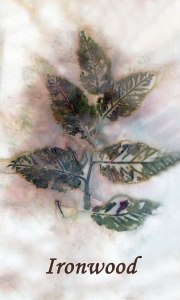
Ironwood tree ecoprint from my upcoming Tree Alchemy Oracle!

There are actually two tree species that are known as both “hornbeam” and “Ironwood” along the US East Coast and into the midwest: The American Hop Hornbeam (Ostrya virginiana) and the American Hornbeam (Carpinus caroliniana).  After doing a lot of research and interaction with both of these trees, I see them as interchangeable.  First, they are both in the Beech family (Order: Fagales, Family: Betulaceae). They actually have a very similar growth habit and look to their bark (like muscles), their wood is quite similar, and the hop-looking fruits are similar on both trees.  Thus, if you can find either of these trees, you can apply the information I’m sharing.  I have primarily focused on Ostrya Virginiana (Ironwood/Hop Hornbeam) in my comments here as it is the more dominant tree in my specific ecosystem.

This post is part of my Sacred…

View original post 1,348 more words

Sacred Tree Profile: Devils Walking Stick (Aralia Spinosa)

Dana's avatarThe Druid's Garden

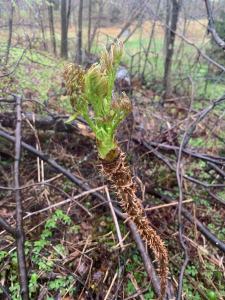
The mighty Devil’s walking stick in early spring–look at those spikes!
The Druid’s Garden Homestead is located on a 5-acre parcel of land in Western Pennsylvania that is currently regenerating from intense logging. Three years ago, just before we bought the property, the family who owned it logged about three of the five wooded acres.  This has led to a host of possibilities where we can work on forest regeneration, observing the changes in this damaged place as it regrows, and certainly, opportunities for wildtending and creating food forests. As you walk through this regenerating landscape, one of the most striking understory trees is the Devil’s Walking Stick, Aralia spinosa. Looking like a very spiky and menacing walking stick (it has a name fitting of its visage), this tree is also known as Prickly Elder, Prickly Ash, Shotbush, Pigeon Tree, Angelica Tree, or Hercules club. These varied names really…

View original post 1,552 more words

Sacred Tree Profile: Witch Hazel (Hamamelis virginiana)’s Magic, Medicine, and Mythology

Dana's avatarThe Druid's Garden

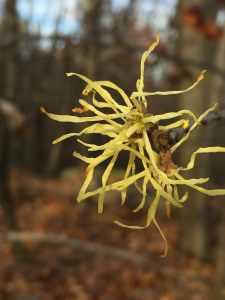
Witch Hazel in Flower, late October

As we move into the dark half of the year and move closer to Samhain, the temperatures drop, the killing frosts come and the plants die back. The leaves grow brilliant and then fall.  Brown and tan dominate the land as the earth falls asleep. But there in the waning light is the brilliant, beautiful golden yellow of the  Witch hazel!  Around here, Witch Hazel (Hamamelis Virginia) begins a magnificent display of tiny yellow flowers, appearing to explode outward with many delicate yellow petals.  As the last of the leaves fall, if you walk through a forest with Witch Hazel, you are struck by the beauty of these wild and warm yellow flowers. everything else may look dead, but Witch Hazel is alive and thriving. The time of Witch Hazel is the time of late fall and early winter, and it is a powerful…

View original post 1,425 more words

Ode to the Oak: Acorn Harvesting, Preparation, Acorn Breads, and More!

Dana's avatarThe Druid's Garden

Honoring the oak

With the cooler temperatures of September and October, the abundance of the Oaks come forth.  In my area, we have abundant oaks of a variety of species: white oak, chestnut oak, eastern red oak, swamp oak, and much more.  Each of these oaks, every 2-3 years, produces an amazing crop of nuts that simply drop at your feet. Acorn was once a staple food crop of many different peoples around the world–and in some places, it still is.  Here in North America, acorns and chestnuts were primary food sources for native American people. Cultures subsided–and thrived–on annual acorn harvests and the bread, cakes, grits, and other foods that can be made with processed acorns.  I really enjoy processing acorns and using them as ritual foods for both the fall equinox and Samhain.

Thus, in this post, we’ll explore the magic of the acorn, how to process acorns…

View original post 3,973 more words

Sacred Tree Profile: Staghorn Sumac (Rhus Typhina)

Dana's avatarThe Druid's Garden

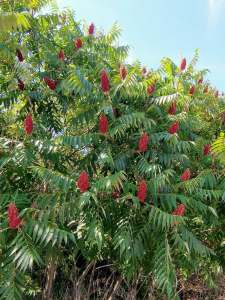
A lovely stand of staghorn sumac in bloom! A lovely stand of staghorn sumac in bloom!

As we begin the march from summer into fall, the Staghorn Sumac are now in bloom.  With their flaming flower heads reaching into the sky, the Staghorn sumac are striking upon our landscape.  As fall comes, the Staghorn Sumac leaves turn fiery red before dropping and leaving their beautiful, antler-like, and hairy stems behind.  All through the winter months, the Staghorn Sumac stems stand like antlers reaching into the heavens, until they bud and spring returns again.  This post explores the medicine, magic, ecology, herbalism, craft, and bushcraft uses, and lore surrounding these amazing trees.

This post is a part of my Sacred Trees in the Americas series, which is my long-running series where I focus on trees that are dominant along the Eastern USA and Midwest USA, centering on Western PA, where I live.  Previous trees in this series have included:

View original post 2,327 more words

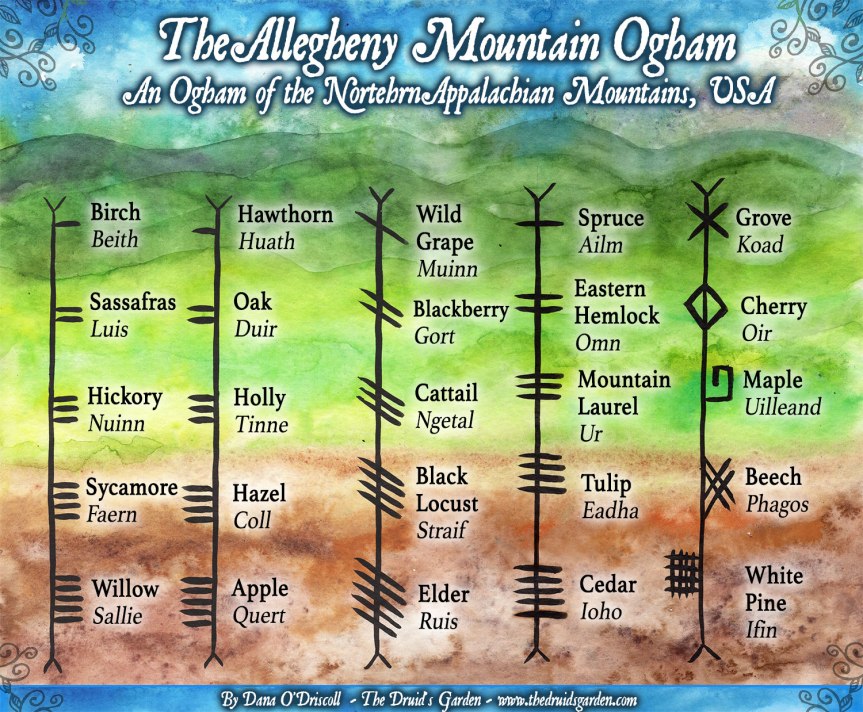
The Allegheny Mountain Ogham: An Ogham for the Northern Appalachian Mountains in the Eastern USA

Dana's avatarThe Druid's Garden

By Dana O’Driscoll, The Druid’s Garden Blog (druidgarden.wordpress.com), Copyright 2020.

The Ogham is an ancient alphabet, used to write early Irish and later Old Irish. The inscriptions that survive of Ogham, some 400 or so primarily on stone, are found throughout Ireland, Wales, and England. The inscriptions are thought to date from the 4th century and onward, although how old the tradition is is subject to some disagreement. In the modern druid tradition, the Ogham has also been associated with divination, and many druids use Ogham as a means to connect with sacred trees in the landscape. However, for people living in places outside of the British Isles, making local Oghams allows them to connect both with some of the roots of our tradition in druidry but also wildcraft and localize their druidry. This Ogham is designed for the Northern Appalachian mountain region in the United States while being…

View original post 6,877 more words

Making Acorn Ink – Instructions and Recipes

Dana's avatarThe Druid's Garden

Acorn Ink! (Great color!)

Acorn ink, derived from the mighty oak tree, can be a wonderful addition to your druid practice or art studio.  Inks can be used for all manner of useful things, from drawing and artwork to the creation of sigils, writing in a druid’s journal, or engaging in other magical work.  In this post, I’ll share a method for making an acorn ink as well as a rust garden (that you can use to strengthen the color of this and other natural inks, like walnut).  I’m posting this now because I have found that acorns are best gathered for this not right after they drop, but after they’ve sat on the ground for some time (such as over the winter months).  This is a way for you to use acorns pretty much year-round, connect deeply to the energy of the oak tree, and localize your practice.

Ink…

View original post 1,595 more words