Electric Universe

Building with Cob, Part II: Soil Tests and Mixing Cob

Dana's avatarThe Druid's Garden

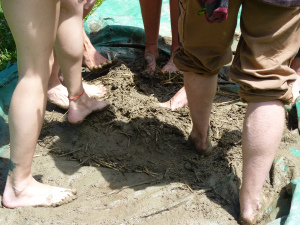
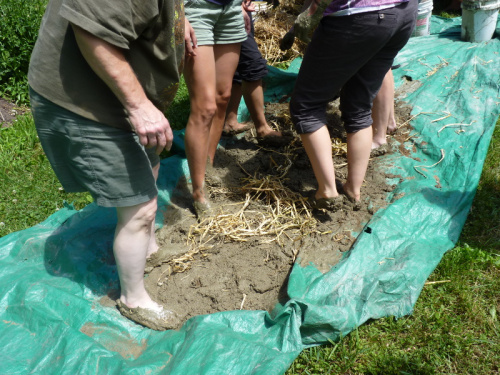
Happy feet mixing cob!

In a meadow under the summer sun, a group of dancers laugh and fling mud.  Beneath their feet, clay, sand, and water become mixed together, creating a sticky earthen blend that sticks to their feet, their legs, and, after some play, faces and fingers! This is a cob mixing party, one of the best times you can have with good friends. After the cob is mixed, it is added by others to the bench and more soil is added and the dance continues.  In last week’s post we explored some reasons to consider exploring natural building as a potential way to build sustainable structures and be more attuned with the energies of earth.  In this week’s post, we will get into how to test your soil and how to make some cob!

One thing I want to share about cob–you don’t have to build big things…

View original post 2,015 more words

Building with Cob, Part I: Project ideas and Honoring Earth

Dana's avatarThe Druid's Garden

Making some cob!

Connecting with the earth can mean a lot of things–and today, I want to talk through how to create a simple building material that can be used for a wide variety of purposes: cob.  Cob is an ancient building material that is a combination of sand, clay, and straw (or other strengthening materials) mixed with water. Cob, the synthesis of water and earth, becomes the passive forms through which we shape anything from a small earth oven to a whole living space.  In this post, I’ll introduce cob and offer some different kinds of projects that you can do with it. This post compliments last week’s post, where I shared how to make ecobricks from waste plastic materials.  Cob is certainly one of the more sustainable and local construction materials to use in conjunction with ecobricks, so I thought it would be a nice time to…

View original post 2,418 more words

Plastic Waste into Resources: Exploring Ecobricks as Sustainable Building Tools

Dana's avatarThe Druid's Garden

As I described in last week’s post, at least here in the US, we have serious challenges befalling us with plastic recycling along with a host of waste plastics that can never be recycled. A recycling infrastructure built almost exclusively on exporting masses of “dirty” recycling to China now has the recycling system here in the US is in shambles when China stopped taking recycling. Further, so many plastics simply can’t be recycled, meaning that even well meaning folks who recycle everything they can still end up throwing away enormous amounts of single-use plastics, packaging, film, and other waste. In permaculture design terms, it is time to turn some of this waste into a resource!  So in today’s post, I’d like to explore the concept of making ecobricks as a way to sink large amounts of un-recyclable waste into a productive resource and share some designs and…

View original post 1,988 more words

Fall Gourds

Crooked Bear Creek Organic Herbs's avatarGood Witches Homestead

Storage containers, bowls, utensils, tools, masks, musical instruments, jewelry, dolls, flotation devices, toys, wheels, sieves, food, birdhouses – the list goes on and on for the many functional, spiritual, and decorative uses of the humble gourd. At this time of year, gourds abound at farmer’s markets, the grocery store, and even the backyard for some dedicated growers. This oddly shaped fruit has a colorful history – and deserves a bit of spotlight.

Origin

While not a common backyard plant today, it’s believed that gourds may be the earliest domesticated plant in North America. A previous theory held that the bottle gourd originated in Africa, carried over to the Americas via the Atlantic Ocean. But as the American Gourd Society reports, archeological and DNA evidence shows them coming from Asia more than 10,000 years ago via the Bering Strait – either by boat, by floating across the water, or carried by…

View original post 1,082 more words

A Tribute To The Dog — Oro Cas Reflects

20180829_083939_HDR(1)I found the following piece of literature in a 1959 National Geographic magazine that I own. It is part of a huge collection that I purchased from an estate. This writing can also be found inscribed on “The Old Drum Memorial” in Warrensburg Missouri and was written in 1870. A Tribute To The Dog A […]

via A Tribute To The Dog — Oro Cas Reflects

When Recycling Fails: Home-Scale Solutions for Paper and Plastic Waste into Resources

Dana's avatarThe Druid's Garden

For decades here in the USA, recycling was touted as one of the more easy environmental things you could do. I, like many others, assumed that local recycling facilities processed materials, they were sent to factories, and then later, re-integrated into various products.  Boy was I wrong!  Turns out that recycling is an industrialized business like any other, and part of the reason is that it was so promoted is that there was profit in waste.  In fact, from 1992 – late 2018, most recycling produced in the US shipped to China, who paid top dollar for recycled resources that were used to build their own economy. China had very lax environmental laws, and the more “dirty” recycling the US produced was sent to China for cheap sorting and processing.  While some of those materials were recycled, many of the recycled materials ended up unusable and were discarded, moving down…

View original post 2,603 more words

Recycle Me Mosaics: Creating mosaic art from recycled bits and pieces — Life & Soul Magazine

Smashed plates, sweet wrappers and broken car windows, there’s a use in all of these discarded things for mosaic artist Katy Gailbraith. The Scottish artist, who works from her studio in Perthshire, creates mosaics from mostly recycled and upcycled bits and pieces. Among the artist’s creations include an Om plaque on slate; a turquoise tabletop […]

via Recycle Me Mosaics: Creating mosaic art from recycled bits and pieces — Life & Soul Magazine

Sylum Charity: Limbitless Solutions — Sylum Clan

Limbitless Solutions is dedicated to empowering confidence in individuals with accessibility limitations. We create personalized, creative, and expressive 3D-printed prosthetics for children with limb differences using electromyographic (EMG) technology. We also create fun and immersive video games to help our bionic kids adapt to their new prosthetic. The video games use the arm’s EMG technology…

via Sylum Charity: Limbitless Solutions — Sylum Clan

Shakespeare — secretsoftheserpent

https://youtube.com/watch?v=oU73kj5Sw9M%3Fversion%3D3%26rel%3D1%26fs%3D1%26autohide%3D2%26showsearch%3D0%26showinfo%3D1%26iv_load_policy%3D1%26wmode%3Dtransparent

This post will come as a surprise to a lot of people. Even ‘awake’ people don’t know very much about Shakespeare. His writings are taught in school as one of the greatest works ever in human history. While manuscripts of the most important writers in the history of the world have made their way […]

via Shakespeare — secretsoftheserpent