Public comment needed on Nevada mine that will use over 2 billion gallons of water in 10 years | Straight from the Horse’s Heart

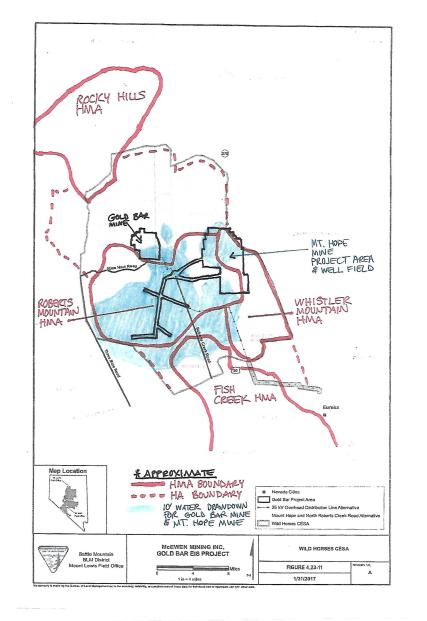
This map shows the Gold Bar Mine area, the approximate HMA (in solid red) and HA boundaries(in broken red lines), the approximate Mt. Hope Mine Project area and well field, and the approximate combined Gold Bar Mine and Mt. Hope Mine 10′ water drawdown area (in blue).  The 10′ water drawdown (in blue) effects almost the entire Roberts Mountain HMA.  The 1″ water drawdown will effect a much larger area.  (Streams can dry up with as little as a 1′ water drawdown.)

BE SURE TO LOOK AT ALL 8 MAPS AT THE BOTTOM OF THIS ARTICLE.

It’s best to write comments in your own words so that the BLM counts each comment as one, instead of counting a thousand similar comments/form letter as only one.  You can read the joint comments submitted by Wild Horse Freedom Federation and The Cloud Foundation below, and a quick summary on pages 5-41 of the DEIS HERE.  Comments are due by April 17, 2017.

Some suggested talking points are:

  1. Be sure to ask for the NO ACTION ALTERNATIVE.
  2. The Gold Bar mine project will use over 2 billion gallons of water in 10 years.  The BLM needs to take into consideration past (historic), current and likely future droughts and climate change when deciding if they will approve this DEIS.
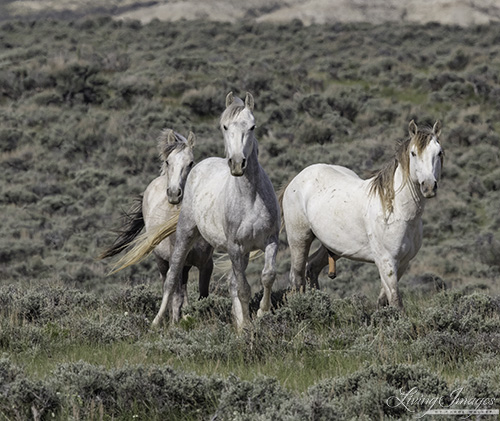
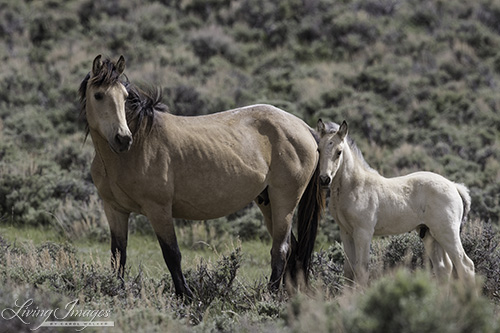
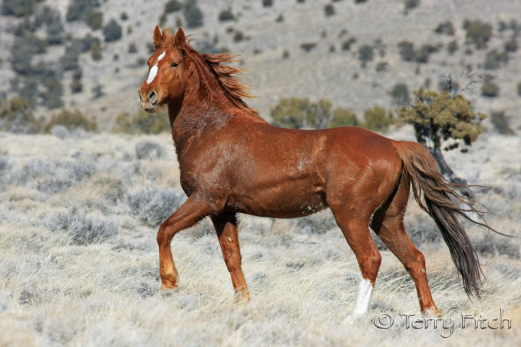
  3. The Project will negatively impact the water, forage, safety, and “free-roaming” abilities of the Roberts Mountain wild horse herd on the Roberts Mountain HMA, as well as the nearby wild horse herds on Whistler Mountain and Fish Creek Herd Management Areas.
  4. The BLM is minimizing the area of impact by only indicating the 10′ water drawdown, and not the 5′ or 1′ water drawdown.  The 5′ and 1′ water drawdown will cover a much larger area of land.  A stream can dry up with as little as 1′ of water drawdown.
  5. When the nearby Mt. Hope mine becomes operational, it is proposed that it will use an additional 7,000 gallons per minute for the life of the mine (40-50 years).  Mt. Hope mine will use over 3 1/2 billion gallons of water per year and over 36 billion gallons of water in 10 years.
  6. The BLM refers to the Cyanide Management Plan (1992), (noted in Vol. 1A, 1.4.3) and the Solid Minerals Reclamation Handbook (1992), (noted in Vol. 1A, 1.4.4).  These are 25 years old and outdated.  Ask for updates of this Plan and Handbook for this DEIS.
  7. The area of Gold Bar Mine will be expanded by 40,000 acres or 62.5 square miles, creating more environmental degradation.

The DEIS is available online at HERE.   Interested individuals should address all written comments to Christine Gabriel, Project Manager, using any of the following ways:

Fax: (775) 635-4034

Email:  blm_nv_bmdo_mlfo_gold_bar_project_eis@blm.gov

Mail:  Bureau of Land Management

Mount Lewis Field Office

50 Bastian Road

Battle Mountain, NV 89820

Wild Horse Freedom Federation and The Cloud Foundation submitted these joint comments regarding the BLM’s Gold Bar Mine Project:
           

Bureau of Land Management

Mount Lewis Field Office

50 Bastian Road

Battle Mountain, NV 89820

Email: blm_NV_bmdo_mlfo_gold_bar_project_eis@ blm.gov

DATE:  April 5, 2017

Subject: DEIS MMI Gold Bar Mine Project

Dear Ms. Gabriel:

On behalf of The Cloud Foundation (TCF) and Wild Horse Freedom Federation (WHFF), 501(c)3 non-profit corporations, and our hundreds of thousands of supporters throughout the United States, we would like to thank you for the opportunity to submit scoping comments on the Draft Environmental Impact Statement (DEIS) for McEwen Mining Inc.’s (MMI) Gold Bar Mine Project (Project).

TCF, a wild horse and burro advocacy group and an advocacy group for all wildlife on our public lands in the West, and Wild Horse Freedom Federation, a voice for the protection of wild horses and burros and public lands, strongly oppose the expansion of the Gold Bar mining project and we urge the NO ACTION ALTERNATIVE in this DEIS for the following reasons:

Wild Horse Herds To Be Affected:

The Project will negatively impact the Roberts Mountain Wild Horse Herd as well as the nearby herds of Whistler Mountain and Fish Creek Herd Management Areas.

Sage Grouse Habitat Affected:

Not only wild horses will be affected in this area. All wildlife will suffer.

Open pit mining is the most environmentally destructive type of mining anywhere. Extreme weather events can overwhelm all mandated precautions, threatening migratory birds and small mammals. In the case of a flood, even large mammals like wild horses risk exposure to potentially lethal mining waste.

Direct habitat damage due to mining plus further fragmentation by roads and large equipment traveling on these roads will eliminate hopes for the recovery of the Greater Sage Grouse in this area. The transport process in itself is dangerous—accidents, dust, spread of contaminants, noise, etc.

Greater Sage Grouse were once so numerous that the “sky was black” with these large birds, according to Ginger Kathrens’ late Uncle, Allan Ralston, who spoke of this area after his return from WWII. Now the birds are threatened and a species of critical environmental concern. BLM should prioritize these risks.

Impacts on Water Sources:

Per the Gold Bar DEIS, page 4-147, under 2 different scenarios, the mine will either pump 380 gpm (gallons per minute) or 500 gpm (gallons per minute).

If the mine pumps 380 gpm, this equals 22,800 gallons per hour, 547,200 gallons per day, and 199,728,000 gallons per year.  Over 10 years, it will pump over 2 billion gallons of water.

If the mine pumps 500 gpm, this equals 30,000 gallons per hour, 720,000 gallons per day, and 262,800,000 gallons per year.  Over 10 years, it will pump over 2 1/2 billion gallons of water.

This does not include the water which the Mt. Hope mine will use once mining begins.  Mt. Hope is projected to use 7,000 gallons per minute for the life of the mine (40-50 years).

The project will deplete surface and ground water resulting in the drying up of ephemeral streams. Reducing water tables to dangerously low levels will negatively impact perennial streams. This DEIS minimizes the impact on water resources by not providing 5’ or 1’ water drawdown maps and thus minimizing the additional area of land that will be effected.  A stream can dry up with as little as 1’ of water drawdown.

Maps created by Wild Horse Freedom Federation are included in the Appendix.

Map 1 – (Figure 4.23-11 of DEIS) Gold Bar Mine Wild Horse CESA (Cumulative Effects Study Area).  On page 4-265 of the DEIS, it states “The CESA for the wild horses and burros includes Roberts Mountain, Whistler Mountain, and portions of the Fish Creek HMAs, as well as Kobeh Valley and Roberts Mountain HAs where wild horses existed based on past inventories, and where they could be potentially affected by the Project…”

Map 2 – shows the addition of the approximate 10′ water drawdown area – (Figure 4.19-3 of Gold Bar Mine Project), 500 gpm (gallons per minute) for 10 years.

Map 3 – shows the addition of the approximate HMA and HA boundaries.

Map 4 – shows the addition of the approximate Mt. Hope Mine Project area and well field – (Figure 3.13.1 Mt. Hope Project EIS).

Map 5 – shows the addition of the approximate Mt. Hope Mine 10″ water drawdown area – (Figure 3.2.18 Mt Hope Project EIS).

Map 6 – shows approximate sketch of Gold Bar Mine and Mt Hope Mine with HMA and HA boundaries

Map 7 – shows approximate HMA boundaries over grazing allotments map – (Figure 3.7 – 1, Gold Bar Mine EIS)

Map 8 – shows approximate mining, water drawdown, and grazing with the HMA and HA boundaries.

BLM writes in their description of the Roberts Mountain HMA: Water availability is a key influence to wild horse use during summer months. Wild horses will generally travel much farther to water than will livestock. In many HMAs water sources are plentiful and supplied by perennial streams, springs, and human constructed water developments such as livestock water tanks and ponds. In other cases, water sources are limiting, and in drought years, wild horses may have difficulty accessing sufficient water, (emphasis added) especially if the population exceeds the Appropriate Management Level (AML). In these cases, wild horse distribution is closely tied to the location of the available waters, which becomes very important to the health of the herd.

Drought Ridden Region

Drought is common in this driest state in the Union. Emergency removals of wild horses because of the lack of water are common. Removals of 14 wild horse herds occurred in 2009 south of Ely by BLM. The Agency cited the lack of reliable water sources as the reason for the removal of wild horses on 1.4 million acres of public land.

The proposed expansion and creation of more water dependent, extractive uses of the land is irresponsible.

Outdated Plan and Manual

This DEIS is based, in part, on a plan and a manual that are each about 25 years old and outdated.  We are referring to the BLM Cyanide Management Plan (1992), (noted in Vol. 1A, 1.4.3) and the Solid Minerals Reclamation Handbook (1992), (noted in Vol. 1A, 1.4.4).  We ask that you review these outdated materials and update them if you are going to base any part of this DEIS on these outdated plans.

Economic Uncertainty

The potential for failure of this project is so high that the Securities and Exchange Commission (SEC) states: . . .in addition to greater uncertainty as to the economic feasibility of Mineralized Material compared to proven and probable reserves, there is also greater uncertainty as to the existence of Mineralized Material. U.S. investors are cautioned not to assume that measured or indicated resources will be converted into economically mineable reserves. The estimation of inferred resources involves far greater uncertainty as to their existence and economic viability than the estimation of other categories of resources.

Couple the above with the failure of the previous mine developers, Atlas Corporation, who filed for bankruptcy and abandoned the land in an unreclaimed condition in 1999.

Wide Scale Damage

McEwen Mining, a Canadian Mining company, is poised to take over and create even more environmental degradation. The area would be expanded by 40,000 acres or 62.5 square miles, or about 1/3 the size of the Colorado Springs metropolitan area where TCF is headquartered. In other words, this is destruction on a grand scale.

Damage from gold mining is permanent. No amount of mitigation can return the landscape to anything approaching a natural state. Over flights of the area reveal large-scale destruction. Increasing this permanent destruction for the hope of short-term gain is not a reasonable, and certainly not an environmentally friendly decision.

For the above reasons, we urge you to select the NO ACTION ALTERNATIVE for the Gold Bar Mine Project.

Thanks very much for your consideration of our position on this important issue.

Sincerely,
          

Ginger Kathrens                             Debbie Coffey

Executive Director,                         Vice-President,

The Cloud Foundation, Inc.          Wild Horse Freedom Federation

107 S. 7th Street                                P.O. Box 390

Colorado Springs, CO 80905        Pinehurst, TX  77362

MAPS:

Map 1

http://wildhorsefreedomfederation.org/wp-content/uploads/2017/03/Gold-Bar-Mine-Map-1.pdf

Map 2

http://wildhorsefreedomfederation.org/wp-content/uploads/2017/03/Gold-Bar-Mine-Map-2.pdf

Map 3

http://wildhorsefreedomfederation.org/wp-content/uploads/2017/03/Gold-Bar-Mine-Map-3.pdf

Map 4

http://wildhorsefreedomfederation.org/wp-content/uploads/2017/03/Gold-Bar-Mine-Map-4.pdf

Map 5

http://wildhorsefreedomfederation.org/wp-content/uploads/2017/03/Gold-Bar-Mine-Map-5.pdf

Map 6

http://wildhorsefreedomfederation.org/wp-content/uploads/2017/03/Gold-Bar-Mine-Map-6.pdf

Map 7

http://wildhorsefreedomfederation.org/wp-content/uploads/2017/03/Gold-Bar-Mine-Map-7.pdf

Map 8

http://wildhorsefreedomfederation.org/wp-content/uploads/2017/03/Gold-Bar-Mine-Map-8-with-mining-water-drawdown-and-grazing.pdf

Source: Public comment needed on Nevada mine that will use over 2 billion gallons of water in 10 years | Straight from the Horse’s Heart

Herbal Immersion | Southeast Wise Women – Good Witches Homestead

Join Corinna Wood for the Wise Woman Herbal Immersion ~ May 22-27, 2016, near Asheville, NC. An inspirational journey into herbal medicine, nourishment, and self-love.


Source: Herbal Immersion | Southeast Wise Women – Good Witches Homestead

13th International Herb Symposium | June 9th-11th, 2017 – Crooked Bear Creek Organic Herbs

Source: 13th International Herb Symposium | June 9th-11th, 2017 Wheaton College, Norton Massachusetts – Crooked Bear Creek Organic Herbs

Democrats Ask Teachers To Destroy Books Written By ‘Climate Deniers’ | The Daily Caller


Andrew Follett
Energy and Science Reporter

Three senior House Democrats asked U.S. teachers Monday to destroy a book written by climate scientists challenging the environmentalist view of global warming.

The Democrats were responding to a campaign by the conservative Heartland Institute copies of the 2015 book, “Why Climate Scientists Disagree About Global Warming” to about 200,000 science teachers. Democratic Reps. Bobby Scott of the Committee on Education, Raúl M. Grijalva of the Committee on Natural Resources, and Eddie Bernice Johnson of the Committee on Science, Space and Technology all issued a statement telling teachers to trash the book.

“Public school classrooms are no place for anti-science propaganda, and I encourage every teacher to toss these materials in the recycling bin,” Scott said. “If the Heartland Institute and other climate deniers want to push a false agenda on global warming, our nation’s schools are an inappropriate place to drive that agenda.”

The book’s three authors all hold doctorates and taught climate or related science at the university level. The book was written by former Arizona State University climatologist Dr. Craig D. Idso, James Cook University marine geology and paleontology professor Robert M. Carter, and University of Virginia environmental scientist Dr. Fred Singer.

Grijalv accused the scientists of “lying to children about the world we live in to further corporate polluter profits” and said that doing so was “cruel.” Johnson stated that the scientists had sent “scientifically inaccurate materials on climate change to public school teachers across the country” at the behest of ominous right wing donors and the Charles and David Koch brothers.

The best way to get adults to act like environmentalists is by brainwashing their children, according to research published by Oregon State University. Talking to kids about global warming caused their parents to use less energy and act more like environmentalists. The research was run on was run on 30 Girl Scout troops in northern California and had a “lasting impact on family energy consumption” for at least eight months after the end of the program.

Based on the study’s success, the researchers are now disseminating the curriculum to Girl Scout leaders around the country and attempting to adapt it to other groups of kids, including schools and youth-focused organizations such as 4-H with the help of other universities, such as Stanford. The research was financially supported by government grants.

Follow Andrew on Twitter

Send tips to andrew@dailycallernewsfoundation.org.

Source: Dems Tell Teachers To Trash Global Warming ‘Denier’ Books | The Daily Caller

20 Environmental Groups Jointly Demand Wildlife Services Ban M-44 Cyanide Bombs in Idaho | Straight from the Horse’s Heart

Since 2000, Wildlife Services has killed more than 50,000 members of more than 150 non-target species, including federally and/or state-protected animals such as Mexican gray wolves, grizzly bears, kangaroo rats, eagles, falcons, California condors, red-tailed hawks, great horned owls, armadillos, pronghorns, porcupines, long-tailed weasels, javelinas, marmots, snapping turtles, turkey vultures, great blue herons, ruddy ducks, sandhill cranes and ringtail cats.

On March 28, 2017, a coalition of wildlife and conservation groups petitioned the U.S. Department of Agriculture’s (USDA) Wildlife Services (WS) and Animal and Plant Health Inspection Service (APHIS) to immediately ban M-44 devices in Idaho. M-44s are cyanide bombs used by WS to kill local predators such as coyotes, as part of a larger taxpayer-funded wildlife eradication campaign wherein WS, on behalf of the federal government, slaughters millions of wild animals every single year.

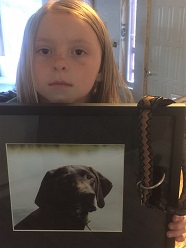
The recent hospitalization of a youth and killing of a family dog in Idaho who encountered one of these ground weapons near their home was one motivator for the creation of this petition. The document lists many other incidents of indiscriminate pet injuries and killings by M-44s in Appendix A.

The petition specifically calls on the agencies to:

1. Cease all use of M-44 explosive cyanide devices on all land ownerships in the State of Idaho, and
2. Immediately remove any and all M-44s currently deployed on all land ownerships in Idaho.

Signage on BLM contractor’s property housing former wild horses. ~ photo by R.T. Fitch of Wild Horse Freedom Federation

In November 2016, WS committed to cease the use of M-44s on Idaho’s public lands. Also, in 2016, a workplan between WS and the Bureau of Land Management (BLM) Idaho Falls District forbade the placement of these devices within a quarter mile of residences.

The recent incident with the teen and his pet occurred within a quarter mile of his home. The petition concludes this incident shows the “commitment to cease using M-44s on public lands in Idaho is inadequate to protect public safety and wildlife,” because either WS personnel are not carrying out the commitment or older bombs are still present on public land.

“Cyanide bombs are indiscriminate killers that must be banned,” Andrea Santarsiere, a senior attorney with the Center for Biological Diversity, said in a press release. “Any animal that might pull on the baited trigger is at risk, including endangered wildlife like Canada lynx and grizzlies, as well as people and pets. And in just the past few weeks these cruel devices have injured a child and killed an endangered wolf and several family dogs. Enough is enough.”

The petition explains:

Since 2000, Wildlife Services has killed more than 50,000 members of more than 150 non-target species, including federally and/or state-protected animals such as Mexican gray wolves, grizzly bears, kangaroo rats, eagles, falcons, California condors, red-tailed hawks, great horned owls, armadillos, pronghorns, porcupines, long-tailed weasels, javelinas, marmots, snapping turtles, turkey vultures, great blue herons, ruddy ducks, sandhill cranes and ringtail cats.

The petition also discusses how the cyanide bombs and other non-selective killing methods are actually unproductive because they disrupt ecosystem balances, can actually increase livestock losses and have not been shown to be economically effective.

Bethany Cotton, Wildlife Program Director for WildEarth Guardians, previously asserted to EnviroNews that “many ranchers peacefully coexist with coyotes and report no conflicts,” and that nonlethal predator response options include solar powered electric fencing and livestock dogs, amongst others.

“Ranchers can use less vulnerable types of livestock, hang flagging called ‘fladry,’ or actually put cowboys out there with their animals to discourage predator losses without resorting to demands for poisons and poisonous land mines that kill pets and non-target wildlife,” Erik Molvar, Executive Director of the Western Watersheds Project, told EnviroNews. He signed the petition on behalf of the coalition of environmental groups. “It is senseless and irresponsible for federal agencies to use taxpayer dollars to sow land mines and poisons in open country to kill native wildlife to prop up failing ranching operations,” he stated.

Federal law requires the petitioned agencies to provide a final decision in writing to the petitioners: Western Watersheds Project, Predator Defense, WildEarth Guardians, the Center for Biological Diversity, Friends of the Clearwater, Alliance for the Wild Rockies, Western Wildlife Conservancy, Nevada Wildlife Alliance, Gallatin Wildlife Association, Environmental Protection Information Center, the Wolf Conservation Center, Wilderness Watch, Klamath Forest Alliance, Northeast Oregon Ecosystems, Yellowstone to Uintas Connection, Footloose Montana, Animal Legal Defense Fund, Project Coyote, Voices of Wildlife and the Mountain Lion Foundation…(CONTINUED)

http://www.environews.tv/033017-20-environmental-groups-jointly-demand-wildlife-services-ban-m-44-cyanide-bombs-idaho/

Source: 20 Environmental Groups Jointly Demand Wildlife Services Ban M-44 Cyanide Bombs in Idaho | Straight from the Horse’s Heart

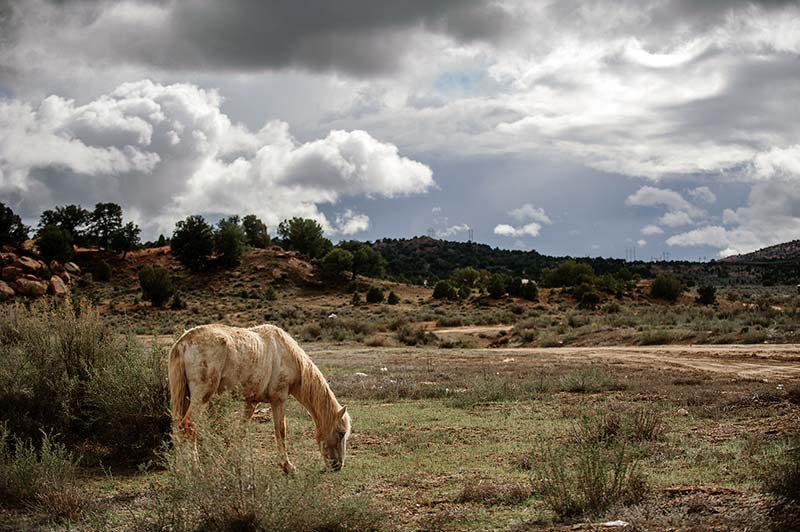
Fish and Wildlife may propose a horse hunt on the Navajo Nation – Navajo Times

Navajo Times | Adron Gardner
A gaunt horse grazes along State Route 264 near Tse Bonito, N.M. on March 27.

WINDOW ROCK

With multiple efforts to reduce the number of wild horses on the Navajo Nation, officials are considering a hunt.

The Navajo Nation Department of Fish and Wildlife asked hunters and sportsmen for their support for a hunt as a potential means to reduce the number of wild horses on the Navajo Nation at the 2017 Navajo Nation Sportsman’s Expo on March 25. NNDFW staff confirmed after the conference that a proposal has not yet been completely drafted, so the department hadn’t yet anticipated details of how the possible hunt would work such as weapons to be used, number of tags to take horses, and hunt unit maps.

Department manager Gloria Tom said the department hoped to address the problem and would propose a solution to Navajo Nation governance once drafted, but also called on the hunters present to add their voices to the conversation around the feral herds and what to do about them.

“Our leaders, they really need to hear from people like you,” Tom said. “People who live out there, people who hunt.”

She said government officials sometimes take information from NNDFW as something that employees are paid to say as part of their jobs and concerns from experts who work for the government might have less impact on elected officials than the voices of their constituents and voters.

“To me, you have a greater chance of success,” she said.

She said previous attempts to trap, round up, or allow horses to be adopted had not made a large enough impact. NNDFW officials said the department is drafting a proposal to get support from Navajo Nation leaders.

“I compare this problem to our cat and dog problem,” she said.

Source: Fish and Wildlife may propose a horse hunt on the Navajo Nation – Navajo Times

Federal Bill to Ban Lethal Wildlife Poisons Introduced after Three Dogs Killed by M-44 “Cyanide Bombs,” Kids Exposed ~ Predator Defense


March 30, 2017 – This month three dogs were killed by M-44 “cyanide bombs” in Wyoming and Idaho. In both cases children were present and put at grave risk of poisoning. This is beyond unacceptable.

M-44s are indiscriminate sodium cyanide ejectors set by USDA Wildlife Services agents and local wildlife agencies for “predator control.” Details | Diagram There is no justifiable excuse for the use of M-44s. It is insane to set poison traps in the great outdoors.

We’ve been pressuring for an M-44 ban since 1990, collaborating with Rep. Peter DeFazio (D-Oreg.). We are thrilled to announce that on March 30 Rep. DeFazio introduced the legislation we’ve been working on in Congress. The bill is called H.R. 1817, “The Chemical Poisons Reduction Act of 2017.” It would ban both lethal M-44 sodium cyanide devices and Compound 1080, which are used unnecessarily by government wildlife agents for predator control.

What we need now is your help to get this legislation passed into law. This is a nonpartisan, public safety issue, and there honestly are no valid arguments against banning wildlife poisons. Learn how to help

Background on March M-44 events

Early in March 2017 we began working with a family in Wyoming who went out for a beautiful pre-spring walk on the prairie–one they’d taken many times before–and lost two dogs in horrifying circumstances.

We’re also spreading the word about the other devastating event in Idaho, where a 14-year-old boy in Pocatello, Idaho accidentally set off an M-44 behind his back yard and watched helplessly as his dog died an excruciating death. The boy had to be hospitalized and is being closely monitored. He and his family are devastated and outraged. Here’s what our executive director, Brooks Fahy, had to say about this case in The Oregonian:

“[The] Idaho poisoning of a dog and the near poisoning of a child is yet another example of what we’ve been saying for decades: M-44s are really nothing more than land mines waiting to go off, no matter if it’s a child, a dog, or a wolf. It’s time to ban these notoriously dangerous devices on all lands across the United States.”

On March 28, 2017, we joined a coalition of environmental and wildlife groups asking for an immediate ban on M-44s in Idaho and removal of all existing devices in the state.

How You Can Help

Media Coverage

Learn More

Oregon Wolf Killed by M-44, a Poison-Filled Device that Also Endangers People, Pets


March 2017 – Just how many animals need to die a horrible death before people realize it is insane to set poison traps in the great outdoors?

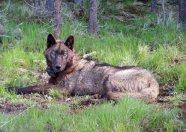
A wolf died a cruel death in Oregon on Feb. 26, 2017 because of a device set on private land by federal agents from the egregiously misnamed program within the USDA called “Wildlife Services.”

We’ve been working with U.S. Rep. Peter DeFazio (D-Oreg.) for decades to ban wildlife poisons like the M-44 sodium cyanide ejector. These indiscriminate devices also endanger pets and people.

M-44s are an outrage, and taxpayers fund their use. This travesty must be put to an end. And it will be if enough of us speak out and demand it. We are currently working on new legislation to ban M-44s and will keep you posted. Learn how you can help

Media Coverage

How You Can Help

Learn More

Source: Predator Defense – a national nonprofit helping people & wildlife coexist since 1990

Please Comment to Protect Wyoming’s Wild Horses from the Devastating 2017 Checkerboard Roundup | Wild Hoofbeats

Adobe Town Family

Please Comment by April 4, 2017 on the Checkerboard 2017 Roundup

The BLM was unable to roundup wild horses from Salt Wells Creek, Adobe Town and Great Divide Basin in 2016 because we won a lawsuit that prohibits the BLM from managing the wild horses in the Checkerboard using only Section 4 of the Wild Free Roaming Horse and Burro Act, which allows them to remove wild horses from private lands. Because the Checkerboard includes public lands, it is illegal to manage them as if they were privately owned by the ranchers demanding these roundups. In order to legally roundup wild horses from the Checkerboard, the BLM must prove that the numbers are above Appropriate Management Level, or AML. Now, they are not even conducting a census to prove this, instead they are “projecting” that the horses are over the high end of AML.

Roundups cause the destruction of hundreds of wild horse families, as well as injuries and death to the horses as they are chased by helicopters and flee in terror into traps. These captured wild horses are chased into trailers and taken away from the only home they have ever had to end up spending the rest of their days languishing in holding corrals with no shelter. Only a lucky few are adopted by members of the public and these do not always mean good homes – the return rate back to the BLM for adopted or purchased wild horses is over 50%. Many many of these horses will end up at slaughter in Mexico. There is no good reason to roundup and remove these horses from Adobe Town, Salt Wells Creek and Great Divide Basin.

I have been following and observing and photographing the wild horses in these three herd management areas for the last 13 years. These horses are uniquely suited to this sometime harsh high desert environment. They are the last three largest herds in Wyoming, and they deserve to be preserved on our public lands. Although the Checkerboard presents challenges to BLM management because of its pattern of public alternating with private lands, that is no reason to cave into petty demands from the Rock Springs Grazing Association, which is made up from less than 25 members. These wild horses are valuable to us, the American public, and so every effort must be made to preserve them here where they were found at the time the 1971 Wild Free-Roaming Horse and Burro Act was passed. These horses were here long before the Grazing Association, and now what needs to happen is land swaps to consolidate blocks of public land that the horses can continue to roam upon. Managing the wild horses on the range, on our public lands where they can continue to roam free and making these necessary land swaps happen is what the BLM needs to be working on, not perpetuating this every 3 year pattern of roundup, removal, then warehouse our wild horses. The Field Manager of the Rock Springs BLM Field Office has been quoted as saying: “For all intents and purposes, we consider the Checkerboard private.” But it is NOT private. In fact, over half of the Adobe Town, Salt Wells Creek and Great Divide Basin Herd Management Areas are public land, that belongs to us, the citizens of the United States of America, not the Rock Springs Grazing Association.

Great Divide Basin Family

This time, the BLM wants to remove 1029 wild horses: 584 removed from Salt Wells Creek, 210 removed from Adobe Town, and 235 removed from Great Divide Basin.

They are not even calculating their numbers from an actual aerial census – they are making these numbers up. Every year, the BLM conducts and aerial census in late April, but now they are just “projecting” the numbers.

2017 “Projections”

Great Divide Basin  650

Salt Wells Creek       835

Adobe Town              820

Here are past census numbers provided by the BLM for these three areas:

2016 Statistically Corrected Census Counts
HMA Total within HMA Total within Checkerboard
Great Divide Basin 542 272
Salt Wells Creek 696 187
Adobe Town 684 25
Total 1,922 484

2015 April Census Numbers:

Adobe Town: 858
Salt Wells Creek: 616
Great Divide Basin: 579

2014 Post Roundup Census 2014

Adobe Town: 519
Salt Wells Creek: 29
Great Divide Basin: 91

As you can see with these numbers, they randomly go wildly up and down but somehow are considered “statistically corrected.”  The BLM has to prove that Adobe Town has more than 800 wild horses, Great Divide Basin has more than 600 wild horses and Salt Wells Creek has more than 365 wild horses in order to legally proceed with a roundup. There is no attempt to account for mortality rates due to deaths of older horses and foals, which can be very high when there is a harsh winter, which this last winter certainly has been, with storm after storm, much more snow and much more freezing temperatures than normal.

A real, professionally done, independent census needs to be conducted to get a real, accurate count of the wild horses in each of these three HMAs before any plans are made to roundup and remove wild horses from their rightful homes.

Radio Collared Adobe Town mare

I have been following the Adobe Town Radio Collar Study which is currently going on in conjunction with the University of Wyoming. Their plan to study the movements of wild horses through tracking 20 mares wearing radio collars will be completely disrupted if they round up wild horses in Adobe Town, so this is yet another reason that this proposal is senseless. I contend that there are NOT more than 800 wild horses in Adobe Town and therefore there is no legal reason to proceed with a roundup, and they will be subverting their own study by removing wild horses from this HMA, so this is yet another reason not to roundup and remove horses from Adobe Town. But none of the horses from any of these three HMAs should be removed without an accurate count of how many wild horses are in each area.

The biggest reason for not going forward with the Checkerboard 2017 Roundup is the well being of the wild horses themselves. This seems to be very low on the BLM’s priority list. What will happen to these 1029 formerly wild horses? We, the taxpaying public, will be paying to warehouse and feed them, at huge cost. The horses themselves will live out miserable lives in the holding facility, without their families, without shelter, and under the possibility that at any moment the BLM could elect to “euthanize” the more than 45,000 wild horses in captivity. This must stop.

Adobe Town mare and foal

Please comment by April 4. These wild horses need your help.

You are welcome to use any points from this blog but please use your own words. The BLM counts any form letter or form email as 1.

blm_wy_adobetown_saltwells_hma@blm.gov (Please include “2017 AML Gather” in the subject line), mailed or hand-delivered during regular business hours (7:45 a.m. to 4:30 p.m.) to:   BLM Rock Springs Field Office, 2017 AML Gather, 280 Highway 191 North, Rock Springs, WY 82901.

For more information, please contact the BLM at 307-352-0256.

Here is a link to the Scoping Document:

https://eplanning.blm.gov/epl-front-office/projects/nepa/74247/98803/119700/2017_Scoping_Statement_-_Adobe_Town,_Salt_Wells_Creek,_Great_Divide_Basin_AML_Gather.pdf

Source: Please Comment to Protect Wyoming’s Wild Horses from the Devastating 2017 Checkerboard Roundup | Wild Hoofbeats

Myths and Facts about Wild Horses and Burros | Straight from the Horse’s Heart

Stallion of Antelope Valley HMA ~ photo by Terry Fitch of Wild Horse Freedom Federation

by Bonnie Kohleriter

MYTH 1   26,500 wild horses and burros are to be on our public lands in 10 states, as that number was on our public lands in 1971 when the Wild Horse and Burro Law was passed.  Wild horses and burros are in AZ, CA, CO, ID, MT, NV, NM, OR, UT, and WY.

FACT 1  No census of numbers of wild horses and burros was done in 1971 when the Law was passed in December of that year.  The 1971 Law did not say the number of wild horses and burros that could be on our public lands.  26,500 is an arbitrary, non-evidenced based number.

MYTH 2  Wild horses and burros are on our public lands everywhere and they are destroying our public lands.

FACT 2  The BLM manages 245 M acres of our public lands.  About 3 M livestock are on 160 M acres, wildlife is everywhere, and wild horses and burros are limited to 29 M acres in areas called Herd Management Areas (HMAs).  Within the HMAs about 400,000 livestock that reside here as well are allocated 82% of the forage while the wild horses and burros are assigned 17%.  In 1971 the wild horses and burros were in Herd Areas (HAs), but the BLM said those areas were too difficult to manage so they drew circles within the HAs and called them HMAs.  Unbeknown to the animals where the boundaries are when they go into HA land, they are fodder to be removed without question.

MYTH 3  The BLM has 177 herd management areas (HMAs) for wild horses and burros giving the illusion horses and burros are in those areas.

FACT 3  The BLM has only 160 HMAs where wild horses and burros are now found.  The other areas don’t have any horses or burros in them, or are part of the military or forest service or are double counted.  The BLM had 339 HMAs initially, but little by little has zeroed them out.

MYTH 4  The BLM sets “Appropriate Management Levels” (AMLs) for the wild horses and burros in each area.  It sets a low number at which the animals should be and allows them to breed to a higher number after which it gathers, removes and reduces the animals to the low number again.  The overall low number is 17, 810 and the high number is 27,500.

FACT 4  “Appropriate” is inappropriate.  Allowing only 17,810 horses and burros in 160 areas in 10 western states is a species that is threatened or endangered.

MYTH 5  The BLM says it strives to have healthy horses on healthy rangelands.

FACT 5  Dr. Gus Cothran, the retained geneticist for the Wild Horse and Burro Program, says the following: Conservation geneticists maintain a minimum of 150-200 animals is needed in a herd with 50 effective breeding animals to have sufficient genetic variability for continued long term viability.  Of these herds, only 28 herds have 150-200+ horses allowed in them, and of these herds, only 3 herds have 150-200+ burros allowed in them.  In other words, 82% of the herds don’t have appropriate allowable numbers in them for continued health and viability.

MYTH 6  The herd members intermingle with the herd members in other herds so the individual numbers within a herd don’t matter.

FACT 6  Intermingling of the herds has not been scientifically researched and validated, and established by the BLM.

MYTH 7  Horses and burros can be imported from other herds to sustain genetic viability.

FACT 7  The 1971 Law says the horses are supposed to be “where found.”

MYTH 8  The BLM strives to have a “thriving, natural, ecological balance” on our public lands with a multiple use mandate.

FACT 8  The wild horses and burros are not a thriving species, the arbitrary numbers are not natural, and the numbers are not in balance, (27,000 vs. 400,000) in the ecological environment in which they are to be distributed.  The National Academy of Sciences addressed this Myth in 2013, in Chapter 7 of its report, Using Science to Improve the BLM Wild Horse and Burro Program.

MYTH 9  The BLM asserted 67,000 wild horses and burros were on our public lands in 2016 and 47,000 were in off the range holding facilities.  The number of livestock within the 27 M acres needs to stay there as they feed the world.  The number of livestock have been reduced by 35% from 1971-2014.

FACT 9  Livestock within the HMAs provide less than ½ of 1% of the United States meat.  The number of livestock have been reduced due to overgrazing and drought.  Cow/calf size has increased by 1 ½, offsetting the reduction in number of allowable livestock.  Though ways of counting wild horses and burros have improved, counting continues to be a challenge.  Reducing the number of livestock only within the HMAs and increasing the number of allowable wild horses and burros has not been explored.  The Cattlemen’s Association and now the Gas, Oil, and Mining Industries are powerful competitors and lobbyists for our public lands on which the wild horses and burros depend.

MYTH 10  The BLM is mandated by the 1971 Law to manage, protect, and control the wild horses and burros on our public lands.

FACT 10  Look at the BLM’s budget.  The BLM, unlike wildlife and livestock groups, does ever so little to manage and protect the wild horses and burros on our public lands.  The BLM doesn’t tend to water, forage, or space (fence) issues.  The BLM’s focus is on control, hiring contractors to gather and remove animals, hiring contractors to house animals off the range in short-term corrals or in long-term pastures, hiring contractors to move animals around the country for adoptions, and hiring administrators to complete the paperwork.

The BLM does not engage in using fertility control treatment (PZP) as a way to keep the wild horses and burros on the range though volunteers stand ready to help.  Up to now only four small herds have used this control method but now five more larger herds  are involved in its use.  In 2013, 509 horses received PZP, in 2014, 384, and in 2015, 469, paltry numbers.  The BLM does not engage in promoting recreational tourism on the range which could and would bring in money and in which volunteers stand ready to help.  The BLM has considered sterilizing mares but the procedures are dangerous for the mares and foals and the BLM is researching geldings to be used in on the range horse and burro herds.

MYTH 11  The National Advisory Board of the Wild Horse and Burro Program and the horse advocates on the 9 Regional Advisory Councils are available to advise on what is best for the future of the wild horses and burros.

FACT 11  The advisory board members are people with livestock, wildlife and land interests, not with wild horse and burro interests.  They are cattlemen and livestock vets.  They are not horse and burro geneticists, equine vets, biologists and ecologists, recreational entrepreneurs, volunteer coordinators.

This is a broken program in need of change and a different direction.  This is a program that needs to focus on ways to retain wild horses and burros on our public lands in controlled but healthy numbers, and to focus on providing them with adequate water, forage, and space.

Wild horses evolved in the Americas.  They left during the Ice Age 10,000 years ago and were domesticated in Europe.  They were brought back to the Americas and were left to be wild again when automation was introduced.  They were used to settle our country and to fight our wars in WW1 and WW2.  Today, they are symbols of our past of the Wild Wild West.  They are symbols of our freedom. We as Americans are charged to be stewards of them.  They need to be managed and protected on our public lands,  controlled in genetically healthy numbers, and when those goals are met, in my opinion, then given fertility control treatment.

Source: Myths and Facts about Wild Horses and Burros | Straight from the Horse’s Heart

Fleet of Angels Update: WE’RE PACKIN’ UP AND MOVIN’! | Straight from the Horse’s Heart

by Elaine Nash

“…we have transported most of the 313 remaining horses to Colorado to our beautiful new adoption hub in Fort Collins.”

After a two-month long stay in Faith, SD- 30 miles from the ISPMB location, Barbara Joe Rasmussen and I are heading to Fort Collins, Colorado today to join the Hallelujah Horses and our new crew there for the final phase of this massive mission.
.
Fleet of Angels launched this mission on October 14, 2016 at the request of the SD State’s Attorney. We all dove in and worked like mad to set up a workable process, and as a result, we were able to adopt out over 270 of the 900+ at-risk ISPMB horses by December 22, 2016- the number that was allowed by the court order that was in place at that time.
.
We continued working to recruit adopters through the holidays, assuming that more horses would need us as soon as the state’s legal maneuverings allowed it. We returned to the project on January 26, 2017 when a new court order was put in place that removed all but 20 of the 600+ horses from ISPMB ownership and turned them over to Fleet of Angels to care for, manage, and find good homes for. (We were not involved in the legal aspect, but had offered to be a safety net for the horses if the courts removed them from ISPMB, to prevent their being sold at auction and the likely slaughter of most of them. In order to save them, we- thanks to a group of incredible donors, reimbursed the counties over $150,000.00 to prevent their being auctioned on December 20, 2016.)
.
Now, five and a half months later- with the help of a LOT of people and organizations, we have adopted out and transported a total of almost 600 horses to approved homes, and we have transported most of the 313 remaining horses to Colorado to our beautiful new adoption hub in Fort Collins. (Our two shippers will make one more trip this week, and then all of the remaining horses will be in Colorado.) Of the 313 still under our care, about 175 horses still need homes (IF all pending adopters who have committed to take from two to a herd of 75 horses come through).
.
For the month of April, we will be working to get the remaining horses adopted and transported, with the goal being to finish this mission by the end of the month of April. PLEASE HELP US IF YOU CAN. We need adoptive homes for 175+ horses, and we need funds to cover the costs of feed, facility use, ground team workers, lodging for some of the workers, and transportation. Literally every dollar helps, and every penny is pinched. 🙂 Our donation page is: www.ispmbhorserescuemission.org.
.
Special thanks for helping us get this far, so far, to Neda DeMayo and Return to Freedom and the Wild Horse Sanctuary Alliance, Patricia Griffin-Soffel and the Patricia Griffin-Soffel Equine Rescue Foundation, ASPCA, Victoria McCullough and the Triumph Project, Lauri Elizabeth Armstrong and Chilly Pepper Miracle Mustang, Shirley Puga and the National Equine Resource Network, HSUS, and MANY OTHERS for helping us help these horses. Please help us finish this job, so every horse in this mission has a good, loving, lifetime home.

Teamwork works!

https://www.facebook.com/groups/ISPMB.Adoptable.Horses/permalink/1283727228384737/

Source: Fleet of Angels Update: WE’RE PACKIN’ UP AND MOVIN’! | Straight from the Horse’s Heart