Mace is a wonderfully unique spice. It derives from the Myristica fragrans tree and is native to Indonesia’s Banda Islands—the legendary “Spice Islands”—though it is now also cultivated in Grenada and other tropical regions. You can’t talk about mace without mentioning its twin, nutmeg, because, even though they are different spices, they grow together hidden inside the fruit of the Myristica tree. When the fruit is ripe, it splits open to reveal the seed (nutmeg), which is covered in a delicate, lacy, red membrane, called the aril, otherwise known as mace.
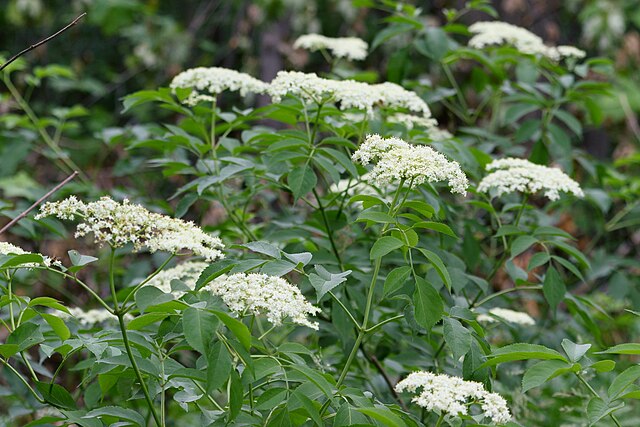
Elderberry (Sambucus canadensis) is an herb of many faces. In spring, its white, lacy blossoms brighten woodlands and hedgerows, attracting bees and butterflies with their sweet fragrance. By autumn, those delicate blooms transform into heavy clusters of deep purple berries — a feast for birds, wildlife, and humans alike. Every part of the elder — flowers, berries, leaves, and even wood — has long been treasured for food, craft, and healing.
A Storied Past
The story of elderberry stretches back to the Ice Age, between 12,000 and 9,000 BCE, when glaciers carried its seeds across North America, Europe, and Asia. By 2000 BCE, early peoples were already cultivating the plant for its medicinal and culinary gifts.
“The scent of rosemary, the smoke of sage, the whisper of bay — the old language of the earth still speaks if we pause long enough to listen.”
— Beth Schreibman Gehring, from Forage & Gather
Before Halloween, there was Samhain, the ancient Celtic turning of the year when the harvest ended and winter began to breathe at the edges of the fields. It was the time when fires were lit high on the hills to call the sun back, when families gathered to share what they’d grown, and to honor what they’d lost. They believed that on this night, the veil between worlds grew thin so that those who came before might wander close for just a moment, drawn by the scent of wood smoke and the warmth of the hearth.
The herbs of this season are the same ones that have long carried us through the threshold times, the in-between spaces when the light fades and the earth exhales. I think of them as old friends who know how to steady us when the days grow short.
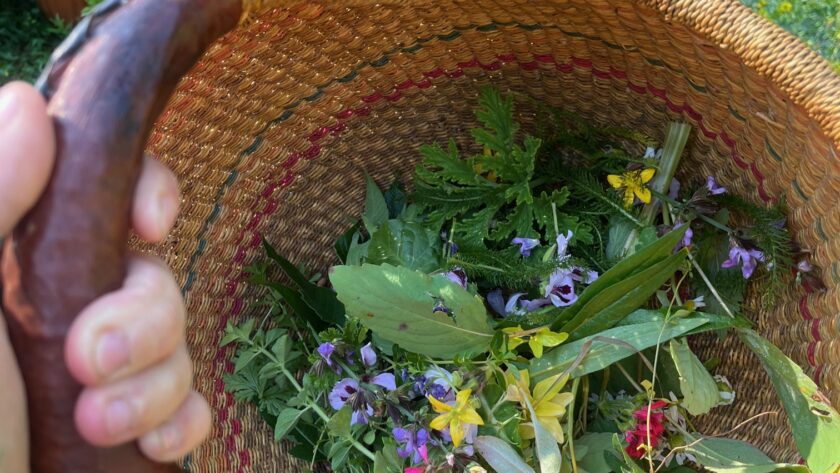
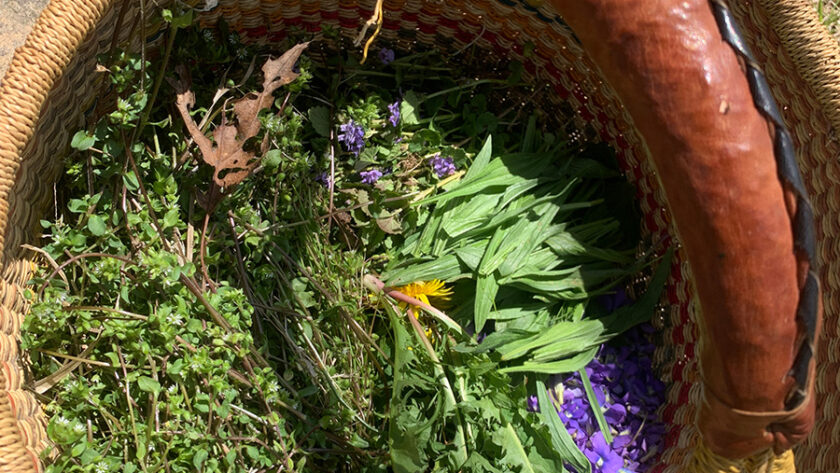
Throughout the year, including on warmer days in the deepest winter months, you will find me out on the land: scattering seeds; planting and harvesting; communing with the plants, trees, and mushrooms; and working nature magic. With baskets overflowing with abundant herbs, nuts, seeds, and mushrooms, I take only what I need, leaning into the abundant plants, and harvest with permission and gratitude. I leave offerings, scatter seeds, and weave magic and flute songs. I often have other people with me–friends, herbal apprentices, visitors, cats, geese. We honor the land while we harvest the plants that heal, soothe, and help us connect with the sacred.
The autumnal equinox, which falls on September the 22nd, is a spoke in the wheel of the year — the brief pause when day and night are perfectly balanced, before the tipping into the darker half of the seasons. In the old calendars, it was a time of harvest and gratitude, a season of preparing pantries and hearts for the coming winter.
Across cultures, this threshold was marked with festivals. The Celts observed Mabon, a harvest rite of thanksgiving where fruits, nuts, squashes, and grains were gathered in and shared with kin and community. Herbs such as sage and thyme flavored the loaves and stews, while rosemary was woven into wreaths to bless the home. It was a season of pausing, giving thanks, and carrying the abundance of the fields inward. Continue Reading …
A growing number of people are taking an interest in herbal medicine. Why learn herbalism now? For many, it is a way to deeply learn and lean into the nature right outside their door. Further, learning how to identify, prepare, preserve, and use medicinal plants helps you take health into your own hands. A lot of people who live in the US (especially in rural areas) recognize that healthcare is more costly and more difficult to access: it is harder than ever to keep a family doctor or get specialist care, and it is so costly that a lot of people can’t afford visits, tests, or medicines.
Lately, I’ve been exploring how to build relationships with all plants in the ecosystem, including opportunistic (invasive) species and in and in re-orienting our view away from just a human-centric one and re-centering nature. Just like anything else in nature, opportunistic plants have much to offer us, and learning to honor them, their uses, their medicine, and how to work with them is an important part of aligning with our local ecosystem. In today’s post, I want to do a deep dive into one such common opportunistic species throughout Eastern North America – Japanese Barberry (Berberis thunbergii)–and create a comprehensive guide. First, I will share a story of an event I recently hosted in collaboration with two organizations to help remove and educate the public on Japanese Barberry and European Barberry (two opportunistic species listed on Pennsylvania’s Invasive Species list). I’ve had multiple readers ask for how to do this and to share resources to organize.Then, I will will offer resources for this specific plant in terms of identification, harvest, processing, and medicine making.
I have intentionally made this guide very comprehensive with the goal of making this a primer for people who want to offer a similar kind of event. You have my permission to reproduce and adapt parts or all of this post and the additional PDFs and photos to help teach about barberry and the medicine of the plant.
Long before calendars and clocks, before schedules and spreadsheets, there were the sun and the stars and those of us who watched them closely—gardeners, healers, farmers, mothers. The summer solstice, the longest day of the year, was a sacred moment. A time of warmth and waiting, of ripening berries and blooming roses, of hands deep in the soil and hearts lifted to the sun.
For me, this day has always held a special kind of magic.
You must be logged in to post a comment.