The BLM Continues Lack of Transparency in Adobe Town Wild Mare Radio Collar Study | Wild Hoofbeats

Only 3 mares in the trailer?

On Sunday morning I waited at the parking lot next to the corrals at the Rock Springs BLM facility. It was 1 degree above zero, and I was bundled up accordingly. I am the only member of the public there, unaffiliated with the BLM or University of Wyoming. One trailer and two trucks drive in front of me, and I am waiting for the other trailer. There are only 3 mares in this trailer, I am assuming three of the four mares that had radio collars put on on Friday. But there were 5 other mares that I had been told by Kate Schoenecker of USGS had not been collared because they were too young. In the Environmental Assessment, it states clearly that they were only going to collar mares 5 years old and older. Young mares who are still growing can be strangled by the collars. But where were the 5 other mares? They flagged me to follow, and I pulled out of the facility. When we took a break I asked where the other mares were. I was told they were still at the Rock Springs facility and they were being “re-evaluated.” What does that mean? They are either too young for the study, under 5, or they are not. Are they being kept for some other purpose? Both the EA and the BLM’s own press release state that none of the horses from Adobe Town are to be removed – they are all supposed to go back to the Herd Management Area. So what is the BLM not telling us?

These mares need to be released back to the area where they were trapped IMMEDIATELY.

Robin comes out of the trailer

We drove to Bitter Creek Road, which is about 30 minutes from Rock Springs, and we started down the road. After we got off of the paved portion of the road, conditions got worse, from occasional mud to water and ice flooded areas. It was a challenging drive. After we passed Eversole Ranch, about 10 miles later the trailer stopped and the first mare was released, a little bay I named Robin. She ran as fast as she could once she hit the ground, only turning back to look at us when she had gone what she thought was a safe distance. There were no other wild horses in sight, and I learned that all three of the mares had been trapped about 30 miles south of this area.


Robin looks back at us

We got back in our cars and continued driving for about 8 miles before stopping again to let another mare out of the trailer, this time a little sorrel I named Felicity. She turned around immediately after jumping out, looking for her friend, the grey mare in the back of the trailer. I noticed a cut over her eye that looked swollen. Any time you transport wild horses there can be injuries. It did not look deep and it did not prevent her from running off when one of the contractors shooed her away. There were no other horses around her either.

Felicity comes out of the trailer

Felicity looks back at her friend in the trailer

Felicity finally runs away

We continued driving as the road got worse for another 10 miles, almost to the state border with Colorado before letting the last mare go, a grey mare who was pure white who I named Ghost. She ran down the road past the cars and disappeared. We turned around carefully and went back out the way we came.

Ghost jumps out

Ghost looks out, getting her bearings

Gone!

On the way back, right in the area Felicity had been released I caught sight of a wild family at a run. They ran across the road in front of us, and the grey stallion in front was magnificent with his flowing mane. I hope that Felicity can meet up with them and join their family.

The wild family

Crossing the road

We were going to meet up with the other contractors, who had been bait trapping in the northeast portion of Adobe Town who had loaded the grey mare with a collar at Rock Springs, then loaded up her family with her. They had held onto the family and were going to release them all together. After driving on the highway, we got onto muddy roads, and drove until we met up with a horse trailer full of horses. This was the grey mare and her family. they were moving quite a bit in the trailer, clearly eager to get out. We followed the trailer until they stopped and we positioned ourselves to watch them emerge, which they did at first tentatively and then faster. As they leaped out I saw a filly at the side of the grey collared mare who I named Dove, and was told she was her yearling filly. No doubt this is why they kept the family back so they could be released together.

The grey family in the trailer

Tentatively they get out

Running from the trailer

The collared mare Ghost and her young filly

Going....gone!


They ran off over the hill, and I breathed a sigh of relief that all four were back home.

One thing that really puzzled me was that I saw piles of panels used for traps, all stacked on a semi. Neither team of contractors had a new trap set up. When I asked they told me some decision was being made at 7pm this evening, they did not tell me what. According to the BLM’s own web page on the bait trapping, they had trapped for only 5 days, starting Sunday February 5. They gathered by their own report 27 horses over the four days, and shipped 9 mares to the Rock Springs corrals. The information on the study in the EA said they would be trapping in 3-5 locations. Why then were they only trapping in two locations, and had not set up any traps after Thursday? In the EA, the BLM had written that if bait trapping “fails” they would go to a helicopter roundup. I hardly think that 5 days only is enough time to “fail.” it takes time to accustom wild horses to a trap and to let them get used to it and come in. That is what they are currently doing in Sand Wash Basin, where they have given far longer than 5 days to trap the horses.  This seems to me to be a setup to fail. If they are not continuing to bait trap then they are getting ready to bring the helicopters in. Wild horses are injured and killed when driven with helicopters. There is no justification for subjecting the wild horses of Adobe Town to a helicopter roundup when they are not even over the Appropriate Management Level for their area.

The BLM should continue to use bait trapping if they have to finish getting 16 more mares for this ill-conceived research study, or better yet, they need to go back to the drawing board and redesign the study so that the researchers use non-invasive, safe direct observation, not dangerous radio collars.

Link to Daily Gather Reports:
https://www.blm.gov/programs/wild-horse-and-burro/herd-management/gathers-and-removals/2017-Adobe-Town-Wild-Horse-Gather

Stunning Lack of Tranparancy in BLM’s and University of Wyoming’s Adobe Town Wild Horse Study

Source:  Wild Hoofbeats

b54p0090

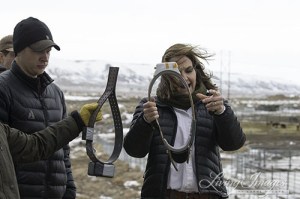
USGS holding radio collars, the one on the right is for the study

by Carol Walker, Dir. of Field Documentation for Wild Horse Freedom Federation

The BLM and the University of Wyoming are conducting a Radio Collar Study on wild mares in the Adobe Town Herd Management Area. I have done several blog posts about this study, calling for people to send in comments and calling for more clarification on how this study is going to be conducted. Some of my concerns are the the health and well being of the mares that will be captured by bait trapping, trailered to Rock Springs, put into squeeze chutes and have these collars put on. These collars will remain for 2 years. Then the mares will be transported back supposedly to where they were captured and released. This alone will be very traumatic for the mares and their families who will lose a family member.

But what happens when the mare gets her foot caught in the collar, or it grows into her neck because it is being put on when she is at her thinnest, and she will put on weight in the summer especially if she is pregnant? How will they be able to release the collar if she is in trouble?

bi4i2360

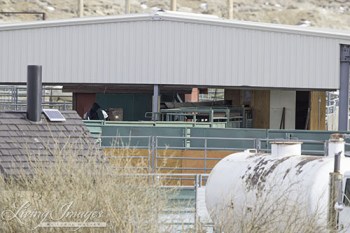
Moving the mares into the shed to put collars on

These were not popular questions at the Q and A that USGS conducted yesterday at the Rock Springs corrals. I was told that they “left room” in the collars for the mares to gain weight – wouldn’t that allow her to get it caught on something more easily? And yes there were studies of mares being injured and dying in the field due to radio collars but supposedly this design was much improved. They do have a tag they can put into the mane instead but these will fall off too soon. I did ask about using direct observation as a way of gathering data but that was deemed impossible, even though it is much less intrusive. The researchers would rather track the mares on their computers rather than on the ground, in the field. I also asked weren’t they concerned about the mares being released all alone, not with their families? There was no answer to that.

bi4i2354

The geldings in the front corral know something is going on

Before I even went to Rock Springs I had been very concerned about the lack of observation of the whole process that the BLM was allowing. Public observation helps to prevent abuse of the horses, and I am a firm believer in this.  A week ago American Wild Horse Preservation Campaign asked attorney Nick Lawton of Meyer, Glizenstein& Eubanks to write a letter asking for the opportunity to observe the bait trapping and the collaring as well as the release of the mares, as well as giving sufficient notice of at least 2 days so I could get out there. The BLM did not change its stance on the bait trapping and the collaring or the notice but did say that “the mares will be held at the facility for 24 hours after they are radio collared, and the public will be able to observe the mares from the overlook during this time period.”

b54p0092

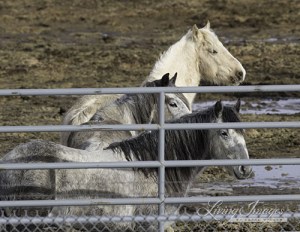
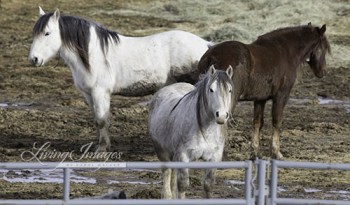
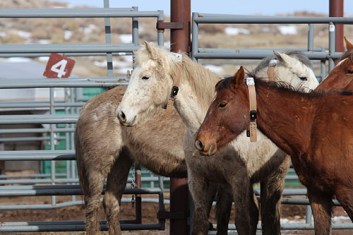
Mares that were not collared

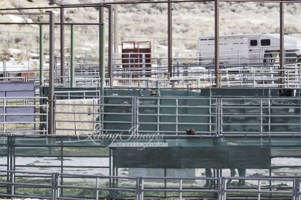
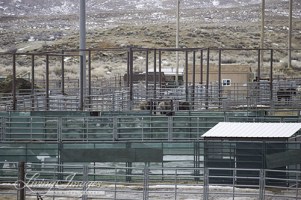
This did NOT happen. The mares after they were collared were being kept in a pen that was completely not visible from the overlook and when I asked it if could see the mares I was told no, that they have to be be kept quiet. Somehow all the torment that these mares went through was totally acceptable but having members of the public view them, even at a distance, was too hard on them.

bi4i2380

Where the collaring was done

I could see the heads of the mares that did not have collars on, and occasionally their bodies, using my long lens. Apparently they captured 9 mares who they brought to the facility, but 5 were too young. Even I could see one of the mares looked like a yearling or at the most a two year old filly – how on earth could the people trapping the horses not be able to tell the difference between very young and mature mares? And why put these poor young mares though the stress of taking them away from their families, hauling them to the facility then hauling them back, for nothing? If they had allowed me to observe the bait trapping I could have told them these mares were too young because I have spent 13 years observing these wild horses in Adobe Town.

b54p0084

Tracking device to track collars on the ground

I am meeting the BLM at the Rock Springs corrals on Sunday morning to follow them out to release the 4 mares with collars and I assume the 5 without. Hopefully I will be close enough to actually see them and photograph them. And please let them not get into trouble, please keep them safe. They do not deserve what is being done to them.

Gelding still at Rock Springs after the 2014 Checkerboard Roundup

This just in – I received a photo of the collared mares from the BLM:

Photo of collared mares, courtesy of BLM

Source: Stunning Lack of Tranparancy in BLM’s and University of Wyoming’s Adobe Town Wild Horse Study | Straight from the Horse’s Heart

NM Senate Committee Passes Horse as Livestock Bill | Straight from the Horse’s Heart

Dianne L Stallings , Ruidoso News

“Wild Horse Advocates fear new provisions could lead to the elimination of wild herds…”

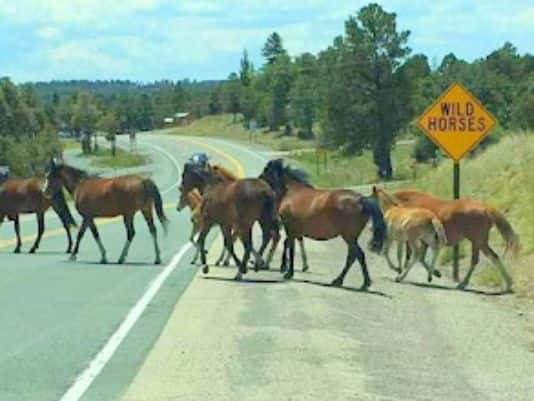
Members of the wild herd rounded up last year were photographed crossing at their designated point on the highway leading into Alto and Ruidoso.(Photo: Courtesy/Melissa Babcock)

Members of the wild herd rounded up last year were photographed crossing at their designated point on the highway leading into Alto and Ruidoso.(Photo: Courtesy/Melissa Babcock)

Local advocates for wild horse herds in New Mexico piled into a bus at 3:30 a.m. Thursday and headed to Santa Fe to voice their views on an amended version of a state senate bill they feared would lead to the elimination of wild horse herds that roam the Alto area north of Ruidoso.

Despite the efforts of advocates, they reported that members of the Senate Conservation Committee passed the bill in less than five minutes. A series of hearings led to modifications of the original bill submitted by State Sen. Pat Woods, a Republican from Quay County, that eliminates the classification of domesticated horse.

While under the amended version horses still would be lumped into the broad definition for livestock that fall under the jurisdiction of the New Mexico Livestock Board, specific exceptions were included for Spanish colonial horses and for a “wild horse” defined as an “unclaimed horse without obvious brands or other evidence of private ownership that is determined by the board to originate from public land or federal land or to be part of or descended from a herd that lives on or originates from public land; but does not include horses that are subject to the jurisdiction of the federal government pursuant to the federal Wild Free-Roaming Horses and Burros Act.”

Public land does not include federal land controlled by the Bureau of Land Management, the Forest Service or state trust land.

Under the amended version, a wild horse captured on private land in New Mexico at the discretion of the livestock board “shall be” humanely captured and relocated to state public land or to a public or private horse preserve; adopted by a qualified person (for an adoption fee); or humanely euthanized provided the option is the last resort when the horse is determined by a licensed veterinarian to be crippled or otherwise unhealthy or cannot be relocated to a public or private wild horse preserve or adopted.

A new section throws in another wrinkle for the future of “wild horses” such as the herds in Alto. That section in the amended bill provides when requested by the board to determine the viability of a specific New Mexico wild horse herd on the range they occupy, the range improvement task force of New Mexico State University will evaluate the range conditions to determine the number of wild horses that the range can support while maintaining its ecological health.

The task force will report the results of the evaluation to the board. “If required, the board may cause control of the New Mexico wild horse herd population through the use of birth control and may cause excess horses to be humanely captured” and relocated, adopted or euthanized…(CONTINUED)

http://www.ruidosonews.com/story/news/local/2017/02/09/senate-committee-passes-horse-livestock-bill/97712106/

/story/news/local/2017/02/09/senate-committee-passes-horse-livestock-bill/97712106/

Source: NM Senate Committee Passes Horse as Livestock Bill | Straight from the Horse’s Heart

Hundreds of Bison Sent to Slaughter Over Tribes’ Objections | Straight from the Horse’s Heart

Tribal Chairman Floyd Azure said state and federal officials “slapped the Fort Peck tribes in the face” by not using the facility.

Yellowstone National Park on Wednesday started shipping hundreds of wild bison to slaughter for disease control, as a quarantine facility on a Montana Indian reservation that could help spare many of the animals sat empty due to a political dispute.

Fifteen female bison initially slated for quarantine on the Fort Peck Reservation were instead loaded onto trailers near the town of a Gardiner, Montana and sent to slaughter. Hundreds more will be shipped in coming days and weeks, park officials said.

More than 400 bison, also known as buffalo, have been captured this winter attempting to migrate out of the snow-covered park to lower elevations in Montana in search of food. More animals are expected to be captured and shipped to slaughter through March.

Fort Peck’s Assiniboine and Sioux tribes built their quarantine facility to house up to 300 animals in hopes of using it to establish new herds across the U.S with Yellowstone’s genetically pure bison.

Tribal Chairman Floyd Azure said state and federal officials “slapped the Fort Peck tribes in the face” by not using the facility.

“They knew we were building a quarantine facility. A lot of money and time and effort were involved in this and all of a sudden they throw a monkey wrench in it,” Azure said.

Montana livestock officials and federal animal health agents oppose transferring bison to the quarantine site because the animals have not been certified to be free of brucellosis, a disease that can cause animals to abort their young. Ranchers in the state fear bison could transmit the disease to cattle and would pose competition for grazing space on public lands.

No transmissions of the disease from wild bison to cattle have been documented.

The park and state severely limit bison migrations into Montana under a 2000 agreement intended to guard against such transmissions.

The agreement set a population goal of 3,000 bison inside the park.

There were an estimated 5,500 animals at last count. To reduce that number, park officials want to kill up to 1,300 bison this winter through a combination of slaughter and public hunting.

A Democratic lawmaker from Missoula introduced a bill Wednesday to the Montana Legislature to change a law that calls for the state veterinarian to certify bison as brucellosis free before the animals can be transferred to tribes. Rep. Willis Curdy, whose family runs a cattle operation in western Montana’s Bitterroot Valley, said he understands the ranching industry’s worries about brucellosis but thinks the tribes’ wishes deserve fair consideration.

“The state of Montana is continually getting very bad press for its policy in terms of the slaughters,” Curdy said. “We need to make a move in a positive direction, not only for the tribes but also for the bison.”

Hunters in Montana have shot more than 300 bison so far this winter. Meat from slaughtered animals is distributed to American Indian tribes. Many tribes historically relied on bison for food, clothing and other needs until the species was driven to near-extinction during the settlement of the U.S. West in the late 1800s.

Gov. Steve Bullock temporarily halted the park’s slaughter plans last month after Yellowstone Superintendent Dan Wenk said 40 animals once slated for the quarantine would be killed to make room in corrals used to hold migrating bison.

Bullock lifted the ban after the park, state and U.S. Department of Agriculture reached a deal that would spare 25 bull bison for future shipment to Fort Peck, once they undergo a lengthy quarantine at a U.S. Department of Agriculture facility just north of the park in Corwin Springs, Montana. That’s now down to 24 animals after one of the bulls was shot Tuesday when he broke his leg inside the park’s corrals.

To make room for the animals, federal officials will send to slaughter 20 Yellowstone bison that took part in a government research program at Corwin Springs, said Lyndsay Cole, a spokeswoman for the Agriculture Department’s Animal and Plant Health Inspection Service.

Bullock spokeswoman Ronja Abel said state officials continue to work toward a long-term solution to the issue. She declined to say if that could include future use of Fort Peck’s quarantine.

Yellowstone spokeswoman Morgan Warthin said the park still wants to transfer bison to the tribes’ quarantine and plans future negotiations to make that happen.

“The ultimate goal is to reduce the amount of slaughter as a first step toward conservation,” Warthin said.

Source: Hundreds of Bison Sent to Slaughter Over Tribes’ Objections | Straight from the Horse’s Heart

UW, BLM to Begin Controversial and Inhumane Wild Horse Movement Study

Straight from the Horse’s Heart

Source: UWYO.edu

“From the destruction of wild horse’s genitals to the installation of dangerous collars the rogue federal agency, Bureau of Land Management (BLM), continues to enlist the aide of America’s institutions of higher learning to be partners in their crimes.” ~ R.T.

It works on cows

“It works on cows, duuuuuhhhh!”

The Bureau of Land Management (BLM) and the University of Wyoming are beginning a study to learn more about wild horse seasonal use and movements in the Adobe Town herd management area (HMA).

The study will begin with a bait-trap gather and radio collaring of up to 30 wild mares during February. No wild horses will be removed during this nonhelicopter gather.

UW scientists Derek Scasta and Jeff Beck, both in the Department of Ecosystem Science and Management, are heading the research. Jake Hennig, a Ph.D. student in the department, also will participate. They will use the information gleaned from the radio collars to learn more about how wild horses interact with their environment. Specifically, the researchers will study migration patterns and herd movements in the HMA. The BLM says it will use the study results to ensure wild horse herds continue to thrive on healthy rangelands.

The Wyoming Department of Agriculture has provided $120,000 to start the research. The BLM also has contributed funding.

Bait-trapping involves setting up temporary corrals within the HMA to attract wild horses safely into the corral. When a certain number of horses has entered the pen, the gate to the corral is closed. Once the horses are gathered, trained personnel will load and transport selected mares to the Rock Springs Wild Horse Holding Facility. After the horses arrive at the facility, staff from the U.S. Geological Survey will place collars with GPS tracking devices on the horses. The horses will then be returned to the HMA.

The 20-30 mares that BLM will select to wear GPS collars will be 5 years old or older. All other wild horses gathered will be immediately released shortly after the selected mares are sorted and held for collaring. All mares will be released at or near the same location where they were gathered. The selected contractors are in the process of identifying trap site locations and will begin the bait-trapping process soon.

Corrals could be set up in stages over a period of days to allow the horses to grow accustomed to the enclosures. About three to five trap sites are required to distribute radio-collared mares throughout the entire HMA. Bait-trapping is an effective method for capturing small numbers of selected horses.

The number of people in the trap area will be limited to key personnel to ensure a successful and safe gather for the horses.

Public viewing opportunities will be limited. Public viewing is always allowed at the wild horse holding facility overlook in Rock Springs, where the mares will be taken to be collared. Public viewing also will be allowed at the release sites of the collared mares. The BLM will keep a list of people who would like to attend the releasing of the collared mares and notify them at least one day before the releases. Media and interested public can view and photograph the mares being released with the GPS collars. To add your name to the list for public viewing, contact BLM Public Affairs Officer Tony Brown at (307) 352-0215.

The BLM’s Rawlins Field Office released the decision record and finding of no significant impact for the Adobe Town HMA Wild Horse Movements and Habitat Selection Research Gather Environmental Assessment Nov. 9, 2016. The decision was to allow enough wild horses to be gathered by bait trapping, so up to 30 selected mares could be outfitted with GPS collars. The BLM will use two separate contractors to conduct the bait-trapping operations.

Click (HERE) to view BLM Press Release


ering contamination from six years ago may have finally been found.

Source: UW, BLM to Begin Controversial and Inhumane Wild Horse Movement Study | Straight from the Horse’s Heart

196 wild horses died at BLM’s Scott City feedlot (a BLM Aushwitz for wild horses)

IMG_20140823_132107_665

Wild horses next to bison at the Beef Belt Feedyard in Scott City, Kansas in 2014

By Debbie Coffey, V.P. and Dir. of Wild Horse Affairs, Wild Horse Freedom Federation

Copyright 2017   All Rights Reserved.

In the middle of June, 2014, the BLM moved 1,493 wild horses from the Teterville Long Term Holding pastures in Oklahoma to the Beef Belt Feedyard in Scott City, Kansas.  Over 13% of these wild horses died at this feedlot.

191 of the wild horses died in less than a year (7/7/14 – 6/30/15).

In a BLM “news” release dated 8/15/14 (over two years ago), the BLM announced that 57 wild horses had died at the BLM’s Scott City, Kansas “corral.”  In this news release, the BLM stated that it had “launched an investigation” into the cause of deaths, and promised that “Once the investigation is concluded, the team will complete a report that will be made publicly available.”

To date, over two years later, the BLM has not made any report available to the public about the Scott City feedlot deaths.

Wild Horse Freedom Federation (WHFF) filed a Freedom of Information Act (FOIA) request, and found out that 196 horses died at the Scott City feedlot from 6/17/14 – 8/2/16.

87 of the 196 wild horses were euthanized.

41 wild horses died of colic.  Many of these deaths were from sand colic.  As late as 4/13/15 (10 months after the wild horses were shipped to this feedlot), local veterinarian Corbin Stevens wrote to BLM’s Joe Stratton “Be sure hay and bunk is free of sand and rocks (try to only throw hay from feed alley into the bunk eliminating road material)” and “A necropsy was performed on one dead horse from pen 2 today and was diagnosed as a colic with small pebbles and sand present in the large colon and cecum.”  However, BLM’s FOIA did not provide WHFF with a necropsy report dated 4/13/15.

14 wild horses died of fractures of the spinal cord (neck and back).  6 horses died of leg or pelvis fractures.  On just one day, 4/3/15, 3 horses died of a brain/head injury and 2 of a broken leg/pelvis.  With the comment “Inspected by Dr. Stevens.  Result of windstorm – ran into fence.”

Timeline:

March 24, 2014 – Long Term Pasture contractor for Teterville in Oklahoma (Robert Hughes), gives short notice to the BLM by informing them he decided to renew his existing 5 year contract, but only for a reduced number of horses.  He informed the BLM that he wanted to remove 1,900 wild horses (about 1,400 mares and 500 geldings) by June 1, 2014.

(The BLM seems to have never thought of or planned for an emergency, so they begin to scramble for a place to put 1,900 wild horses on short notice.  The BLM was able to find space on other Long Term Pastures for the geldings, but not for the wild mares.)

May 28 (or 27) 2014 – Pat Williams, the WH& B State Lead for New Mexico inspected the Scott City, KS, feedlot for NEPA analysis.  Although a working facility with a squeeze (“tilt”) chute was required,  the contractor for Scott City, Phil Jennings, didn’t want to install that infrastructure until the contract was signed.  Phil Jennings, who was going to lease the Beef Belt feedlot for this emergency contract worth over $2 million, is the contractor for the BLM’s Pauls Valley facility in Oklahoma.

June 4, 2014 – BLM signed the contract.  BLM’s Zach Reichold was designated as the COR (Contracting Officer’s Representative).

June 14, 2014 – BLM began moving wild horses from Teterville Off Range Pasture (long term holding) to Scott City, KS.   The BLM crew at Teterville LTH was Scott Fluer, Bea Wade, Richard Williams, Jimmy Galloway and Pat Williams.  3 horses were euthanized before leaving Teterville.  The BLM crew at Scott City was Jerome Fox.

June 22, 2014 – BLM concluded the transfer of mares to Scott City.

July 7, 2014 – Local veterinarian, Dr. Corbin Stevens, states 3 times in a report that less than 2% of horses have a body condition score of 3 or lower.

July 17, 2014 – Dean Bolstad discovered there was no squeeze chute or BLM Project Inspector onsite and discussed the need for this with Zach Reichold (the COR).

July 25, 2014 – Dean Bolstad informed Greg Shoop that there was no squeeze chute or BLM project inspector onsite at Scott City.

July 2014 – 35 wild horses died during this month.

August 5, 2014 – after veterinarian Dr. Stevens met with BLM’s Joe Stratton, Stevens states in a report that 5% of horses were in poor body condition when they arrived at the feedyard. (this differs substantially from the 2% that Stevens claimed several times in his July 7 report)

August 8, 2014 – BLM issues it’s news release.

Aug. 11, 2014 – BLM began “transitioning” Joe Stratton as the COR of Scott City.

Aug. 12, 2014 – BLM’s Pat Williams and Al Kane (USDA APHIS veterinarian) arrive at Scott City to perform an inspection.

Aug. 13, 2014 – Joe Stratton was “to go onsite.”   The squeeze chute was to finally arrive and plans were made for working facilities to start to be made and installed.  (almost 2 months after the horses arrived)

Aug. 28, 2014 – In a KMUW news article, BLM’s Paul McGuire stated “The first full-month report we had from the facilitator operator came at the end of July.  And it was at that time that we saw numbers on the order of about 47 horses had either died or had to be put down during that time.”  (However, the records WHFF received indicate that 35 wild horses died at Scott City during July, 2014, and only 3 horses died the month before.  That totals 38 at the end of July, not 47.  WHFF found several instances of mortality numbers not matching on BLM records in connection with Scott City.)

August 2014 – Another 46 wild horses die by the end of this month.  (total 81)

September 2014 – another 25 horses die by the end of this month.  (total 106)

June 19, 2015 – Dr. Stevens informs Joe Stratton that there is a mare with a vaginal growth that appears to be infected and that Naxcel and surgery may be warranted.  No freezemark number or description was given.

Feb. 2, 16 – Dr. Stevens informs Joe Stratton that a mare with a tumor extruding from vulva needed to be euthanized.  (It is not apparent from any records if this palomino mare was the same mare with the vaginal growth from 6/19/15, that may not have received needed surgery, but since this was the only mention of a vaginal growth, it could be likely.)

May 17, 2016 and May 19, 2016 – About 2 years after horses were shipped to Scott City, even though the Teterville contractor had given the short notice that lead to this crisis, the BLM ships 5 truckloads of horses BACK TO TETERVILLE.  (The BLM started shipping horses out of Scott City after April 25, 2016 (1,311 were there end of month).  By end of May, 2016, 576 were there.  Shipping records from June 2016 show that more horses from Scott City were shipped to other long term holding pastures.  Per BLM’s Dec. 2016 Off Range Facility Reports, Scott City is no longer listed as warehousing any wild horses.

Oct. 14, 2016 – AP reporter Dave Philipps writes an article (that reads like a propoganda piece for the BLM), titled “Success Spoils a U.S. Program to Round Up Wild Horses.”  This article, filled with misinformation, included a photo of Teterville contractor Robert Hughes,  a video of wild horses at Teterville, a quote from BLM’s National Wild Horse & Burro Advisory Board member, Ben Masters (who voted to kill all the wild horses in holding), and a quote from Dean Bolstad, the Wild Horse & Burro Division Chief, stating that “We’re in a real pickle…”  (No, Dean, the BLM isn’t “in a real pickle,” the wild horses and burros are “in a real pickle.”)  There was no mention in Philipps’ article about what happened to the wild horses from Teterville at Scott City.

There were necropsy reports for 24 horses sent in response to our FOIA request for all necropsy reports.  One of the necropsy reports did not have a date or time on it, and a couple of them didn’t identify the freezemark numbers of the horses.

Excerpts from necropsy reports of wild horses at Scott City:

8/6/14, 5 p.m. – #4805 – atrophy of fat around heart.  Natural causes/old age.  Collected blood prior to euthanasia.

8/6/14, 5 p.m. – #2687 – old age.  Liver failure.

8/6/14, 5 p.m. – #6404 – natural causes/old age.

8/12/14, 5 p.m. – #020937 – small intestine hemorrhage.  Cecum torsion.  Colon enlarged and full of feed.  Died of colic.

8/12/14, 5 p.m. – #945088 – natural causes.  Old age.

8/16/14, 5 p.m. – #6940.  Natural causes.  Collected blood prior to euthanasia.

8/27/14, 6 p.m. – #8737 – cecum enlarged, displaced.  Colic.

9/6/14, 12 p.m. – #05180369 – inflammation around pericardial sac.  Died of heart disease/failure.

9/6/14, 12 p.m. – very large, infected coronary arteries.  Heart failure.

9/12/14, 6 a.m. – #3675 – small intestine inflamed.  Cecum inflamed.  Feed material in abdomen.  Colic.  Ruptured gut.

9/18/14, 5 a.m. – #0041 – colic.

10/20/14, 4:30 p.m. – #7435 – cecum enlarged & hemorrhage (sand).  Colic.  Twisted gut.

10/21/14, 4:30 p.m. – #1062 – cecum enlarged/hemorrhagic/full of sand.  Sand colic.

10/21/14, 4:30 p.m. – #9240 – cecum enlarged/hemorrhagic/full offals.  Colic.  Impaction.

11/12/14, 5 a.m. – #6761 – bloated.  Cecum ½ full of sand.  Died of sand colic.

12/15/14, 6 p.m. – #97175205 – bloated, cecum & colon full of feed.  Colic.  Impaction.

1/13/15, 6 p.m. – “mustang mare” (no ID) – bloated.  Colic.

3/11/15, 6 p.m. – #19964528 – ulcers.  Bleeding ulcer.

4/17/15, 9:30 a.m. – “grey mare” – bloated.  Cecum hemorrhage & inflammation, colon hemorrhage & inflammation – sand.  Died of colic.  Sand in large intestine.

5/11/15, 12:30 p.m. – #2074 – bcs<3.  Unable to maintain weight due to age.

5/18/15, 6 p.m. – #8724 – ulcerations & hemorrhage, bleeding ulcer

5/20/15, 5:20 a.m. – #8513 –  Bloated and cecum full of sand.  Died of sand colic.

5/20/??, 6 p.m. – #6532 – bcs<3.  Unable to maintain condition.

No date or time listed for this necropsy – #3756 – heart enlarged and infarcts.  Heart failure.

By not issuing a report regarding Scott City to the public as promised, or in a timely manner, the BLM seems to just want to sweep what happened at the Scott City feedlot under the rug.  Wild Horse Freedom Federation will not ever forget even one horse that has suffered at the hands of the BLM’s mismanagement.

WILD HORSE FREEDOM FEDERATION HAS POSTED FOIA DOCUMENTATION ON SCOTT CITY ON OUR WHFF WEBSITE DOCUMENTS PAGE – CLICK HERE.

SOURCES:

BLM news release (8/15/14) :  https://www.blm.gov/wo/st/en/info/newsroom/2014/august/NR_08_15_2014.html

KMUV news article:  http://kmuw.org/post/80-mustangs-die-after-move-scott-city

Source: 196 wild horses died at BLM’s Scott City feedlot (a BLM Aushwitz for wild horses) | Straight from the Horse’s Heart

Our National Mammal Under Fire: Bison Slaughter | Straight from the Horse’s Heart

by the Buffalo Field Campaign

“Here at Wild Horse Freedom Federation our primary concerns lie with the government’s full blown assault against our free roaming wild horse and burros on public lands and trust me, that in itself is a full time job.  But with that being said we are not blind to the similar plights of other fellow passengers on Spaceship Earth such as whales, dolphins, wolves, coyotes and in the case of this information Bison.

Right now, there is massive concern over what is happening to the wild Bison in Yellowstone and the information below speaks to this issue.  We share this story, not to dilute our work with the wild equines but to further demonstrate the abject stupidity of government be it local, state or federal.  It is a shame that the court system does not allow us the capability to sue such entities for the simple cause of just being “STUPID”.  If that were possible the courts would be clogged beyond imagination and I would be first in line with case in hand.  Keep the faith.” ~ R.T.


The horror of what is happening daily to these buffalo families are events that could fill thousands of pages…

2017-01-26-02-003-mourning-bfcsesay2017800The very same government who declared the American bison our National Mammal with such pomp and ceremony is hell bent on destroying the last wild, migratory population. Approximately 190 Yellowstone buffalo have been trapped by Yellowstone National Park employees who wear the image of buffalo on their badges. These and hundreds more of the world’s most beloved and important buffalo are destined to be reduced to meat within the cold walls of slaughterhouses. Just this week, however, Montana Governor Steve Bullock issued an executive order prohibiting Yellowstone from moving buffalo through Montana to slaughter until Yellowstone finds a “temporary home” for the forty young buffalo who have been held captive in Yellowstone’s trap since last February. These buffalo don’t need a “temporary home.” They have a home, the Yellowstone Ecosystem, where they roamed freely until last winter. While this executive order may stall the slaughter, it will not prevent it, and will likely result in the nearly 200 buffalo who have been captured for slaughter being confined in the trap for a longer period of time.  This is a game of political chess being played with the sacred buffalo used as pawns in an attempt to push a quarantine (domestication) plan through. Quarantine is not a solution, and does not prevent slaughter; it is part of the larger problem of control and manipulation of wild, migratory buffalo which results in buffalo being repeatedly tested, many slaughtered, and survivors living behind fences until they are reduced to meat or die in captivity.  Some quarantined buffalo have even been sent to zoos. Yellowstone’s trap serves a livestock model paradigm — quarantine and slaughter — and is an extreme danger to these wild gentle giants, the last of their kind. Buffalo who are able to evade capture by slipping past the trap face another imminent danger just a mile north of the trap at Yellowstone’s north boundary, and also along the park’s west boundary, in tiny portions of southwest Montana where so-called hunting is taking place. At least 185 buffalo have been stopped dead in their tracks with bullets. By the time you read this, that number will likely have risen.

he horror of what is happening daily to these buffalo families are events that could fill thousands of pages, and while we can’t share every detail, here is some of what has been happening to the buffalo:

The other morning we supported a solitary bull buffalo who was walking along dangerous part of U.S. 191. Following at a safe distance with our hazards on, we stayed with him to warn traffic. There is so much snow piled up on the sides that it is very difficult for any buffalo to vacate the highway, so on he went. Unfortunately, a group of passing state hunters spotted him too, and they immediately positioned their truck just ahead of the bull, moving at his speed, their exhaust blowing in his face. This part of the highway runs through Gallatin National Forest, so the hunters only needed to get him to move a few feet off the road in order to kill him. Their opportunity came when he got spooked by a passing vehicle. The bull jumped into the snowbank and the hunters — if you can call them that —  parked their truck (illegally, it turns out) and the man with the tag grabbed his rifle and post-holed though the deep snow after him. We mistakenly thought they needed to be much further off the road before they could shoot, and we told them so. They yelled at us, saying we were interfering, and the man with the rifle screamed “I’ve waited fifty-seven years for this!” and pressed on, trudging a few more feet after the bull who had moved a little deeper into the tree line. But the bull got away. At least for the moment. Authorities arrived and gave the hunters a warning for parking illegally, and asked us to move on. We were elated in thinking that this handsome bull who had struggled so hard to just walk down the road had escaped with his life. Disaster narrowly averted. Or so we thought. Afternoon patrols took over, and when they came home they shared the bad news that the hunter had gone after the bull again, shooting and injuring him without pursuing him. Instead he sat in the warmth of the truck waiting for him to emerge from the forest. How could the hunter anticipate where the wounded buffalo might go and how could he not pursue him? The bull did emerge again, limping. He kept falling and getting up, disoriented and badly hurt. He was heading down a road that leads to the town dump, where he could not legally be shot. Authorities arrived, and, because the bull was so badly wounded, the hunter was given special permission to kill him in the road. He took four shots at close range to finally end the life of this bull he had injured earlier…(CONTINUED)

http://buffalofieldcampaign.org/bfc-news/our-national-mammal-under-fire-act-now

gave the hunters a warning for parking illegally, and asked us to move on.

Source: Our National Mammal Under Fire: Bison Slaughter | Straight from the Horse’s Heart

Wild Horses: Please Comment on BLM’s Plan to Reduce North Lander Complex in Wyoming Herds to Dangerously Low Numbers

Wild Horses in the North Lander Complex Herds in Danger of Extinction

The Bureau of Land Management’s Lander, Wyoming Field Office has released a Scoping Document for the North Lander Complex in Wyoming. The most current population count has the numbers of the wild horses in the North Lander Complex to be 1026. They do not differentiate between foals and adult horses in their number, they say 1016 “individuals,” so it is misleading – the BLM is not supposed to count the current year’s foal crop because mortality is high for foals in their first year.

Here are the four Herd Management Areas in the 368,000 acre Complex:
Conant Creek, Dishpan Butte, Muskrat Basin, Rock Creek Mountain
They call it a “complex” because “there is no geographic separation of the HMAs and the gates between them are left open a significant part of the year.”
This is the excuse given for bringing the numbers in 3 of the 4 herds down way below the level needed for genetic viability. However, if there is no separation at all, why are there four different herd management areas?
Horses tend to stay in familiar areas, areas they know where the waterholes, shelter and grazing are located. I would seriously doubt that there is very much intermixing of herds – when visiting the Red Desert Complex, where there are adjacent areas, the horses tend to stay in their range, and there is very little intermixing.

They plan to bring the herds down to these numbers:
Conant Creek 60
Dishpan Butte 50
Muskrat Basin 160
Rock Creek Mountain 50

and end up with a total number of horses for the North Lander Complex of 310.
According to Gus Cothran, the leading geneticist for wild horses, a herd needs a population of at least 150 adults to maintain genetic viability. This plan of the BLM’s which not only brings all but one of the herds down to dangerously low levels also includes giving birth control to all the mares that are released. If the herds are at dangerously low levels it makes absolutely no sens at all to give them birth control. Herds below the minimum number of wild horses for genetic viability should NOT be given any type of birth control. That is dooming them to extinction.
The other issue is that fall is the exact wrong time of year to give PZP to the mares – it should be done in January – March to ensure that it works – they are planning the roundup for the fall of 2017.

They are planning to use helicopters to round up the horses – using helicopters to terrify wild horses so that they run into traps and injure themselves is cruel and inhumane. If they need to round the horses up they should use the far more humane and far less costly method of bait trapping. And they need to keep the families of horses together – this is much less stressful for the horses.

Source: Wild Horses: Please Comment on BLM’s Plan to Reduce North Lander Complex in Wyoming Herds to Dangerously Low Numbers

Correction: BLM does NOT Agree to Increase Size of Pryor Mountain Herd | Straight from the Horse’s Heart


Every now and then we get slightly burned by sharing unedited and supposedly informational articles which we ‘assume’ to be correct and concise.  Of course, anything from the BLM directly is suspect from the git-go but from the mainstream media we expect better (even though the past election bias coverage should have sent the public screaming to the hills) but over the past two weeks we have been nipped twice and today we will try to rectify the most recent blooper.

Last week we shared an article that had the headlines that the BLM had increased the number of the wild horses allowed to live out their lives wild and free on the Pryor Mountains in Montana…but instead it has come to light that this is not true.  Where that unedited headline came from we do not know but it did not originate from anyone who tends to SFTHH.  So in an effort to clarify and bring our feet back to the ground it is the same business as usual at the BLM office in Billings Montana, under the direction of Jim Sparks, who IS currently taking comments on the current AML until the end of this week.

Included at the end of this unedited news articles are the comments of Ginger Kathrens of the Cloud Foundation and it is our hope that readers will take the time to respectfully request that Jim Sparks considers TCF’s recommendations prior to the conclusion  of this week.  You can make a difference.” ~ R.T.

Read the article at the Source: Correction: BLM does NOT Agree to Increase Size of Pryor Mountain Herd | Straight from the Horse’s Heart

Stop Slaughter of Yellowstone Bison

The proposal to butcher another 900-1,000 of Yellowstone’s genetically unique wild bison is a crime against the world’s global heritage.

It reflects badly on the people of Montana that they tolerate this annual slaughter to go on. It also exhibits poor judgement on the part of hunters, tribal members, and others who participate or sanction this crime against nature and our national patrimony.

Yellowstone’s bison herd is one of the few bison herds in the country free of cattle genes, and one of the only bison herds that have remained continuously wild. There is genuine aesthetic and ecological value in wildness. But by slaughtering Yellowstone’s bison (or to use the clinically sanitized term “culling”), we are destroying Yellowstone’s wild bison.

Furthermore, the annual removal of bison has real ecological consequences for other wildlife basically taking food out of the mouths of wolves, grizzlies, coyotes, ravens, magpies and other animals that kill or scavenge bison.

The park’s bison have gone through several genetic bottlenecks. At one time, the population numbered 25 animals. And previous years of slaughter and capture/shipment by the livestock industry and others outside of the park means the park’s bison have gone through repeated genetic reductions. Last year, for instance, 600 bison were killed.

Read the article at the Source: Stop Slaughter of Yellowstone Bison