Brigid’s Magical Blackberry Scones w/ Bay Leaf Infused Custard Sauce: A Matter Of Celestial Timing — Gather Victoria

This Imbolc recipe might appear to be late (considering it is February 3rd) but I suggest it is right on time. After all, Imbolc or Imbolg, ( an ancient Celtic holiday welcoming the first stirrings spring) was originally a “moveable feast” determined not by fixed dates on the calendar but by shifting heavenly events, specifically…

Brigid’s Magical Blackberry Scones w/ Bay Leaf Infused Custard Sauce: A Matter Of Celestial Timing — Gather Victoria
Join This Thursday’s Free Ethnobotany Webinar on The Development of Crofelemer – American Botanical Council

Crooked Bear Creek Organic Herbs's avatarCrooked Bear Creek Organic Herbs

We are happy to announce the next webinar in the Sustainable Herbs Program (SHP) Toolkit Webinar Series: The Development of Crofelemer: Connecting Ethnobotany, Conservation, Biocultural Diversity, Indigenous Knowledge, and Global Public Health.

In this webinar, ethnobotanist, Steven King, PhD, will discuss his work creating a sustainable harvesting program for Croton lechleri, (the source of Crofelemer) for use in Crofelemer, the first oral botanical drug approved by the US FDA. King, in particular, will talk about his work with international partners and indigenous and local communities on conserving biological diversity, recognizing intellectual property rights, and meeting global human health care needs.

Dr. Steven R. King is an ethnobotanist who has conducted field research on the use of plants for food and medicine in the highland and lowland regions of South America, Africa and parts of Southeast Asia over the past 42 years. Dr. King holds a Ph.D in Biology…

View original post 113 more words

Gemstones for Love – Our magnificent 7 Gems of the Heart

Crooked Bear Creek Organic Herbs's avatarGood Witches Homestead

Are you looking for love or trying to mend a broken heart? In a new relationship or in the middle of a life-long love story? We have the gemstones for you.

Source: Gemstones for Love – Our magnificent 7 Gems of the Heart

View original post

Pink Peppercorn – Herb of the Month

The Herb Society of America's avatarThe Herb Society of America Blog

The Peppercorn That is Not a Pepper
by Maryann Readal

The pink peppercorns that are found in the colorful mix used in clear pepper mills are not the true pepper of the Piper nigrum vine. These rosy colored berries are from the peppercorn tree, Schinus molle. The dried pink peppercorns do have a slight peppery, resinous taste and add color and sparkle when ground over any light-colored dish. Their milder flavor also makes them suitable for use in pasta and some dessert dishes like ice pink peppercorncream and fruit, or sprinkled over a cheese board.
The peppercorn tree is native to Peru and is also called the Peruvian or California peppertree. This drought resistant tree is evergreen and can be grown in warm parts of the United States, Africa, India, Australia, and New Zealand. In fact, it has naturalized in some areas outside of Peru, and is considered invasive in…

View original post 1,055 more words

The Next Shiny Object

Sacred Trees in the Americas: Ironwood or Hornbeam (Ostrya virginiana, Carpinus caroliniana)

Dana's avatarThe Druid's Garden

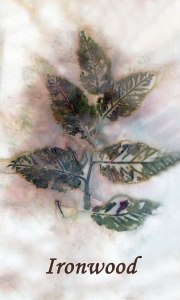
Ironwood tree ecoprint from my upcoming Tree Alchemy Oracle!

There are actually two tree species that are known as both “hornbeam” and “Ironwood” along the US East Coast and into the midwest: The American Hop Hornbeam (Ostrya virginiana) and the American Hornbeam (Carpinus caroliniana).  After doing a lot of research and interaction with both of these trees, I see them as interchangeable.  First, they are both in the Beech family (Order: Fagales, Family: Betulaceae). They actually have a very similar growth habit and look to their bark (like muscles), their wood is quite similar, and the hop-looking fruits are similar on both trees.  Thus, if you can find either of these trees, you can apply the information I’m sharing.  I have primarily focused on Ostrya Virginiana (Ironwood/Hop Hornbeam) in my comments here as it is the more dominant tree in my specific ecosystem.

This post is part of my Sacred…

View original post 1,348 more words

Astrorisa Moon Forecaster – Leo Full Moon -January 28, 2021

Video Forecast
Happy Full Moon!
Thursday, January 28 2021, 02:16 PM ET
Moon 9°06′ Leo, in House 2
Sun 9°06′ Aquarius, in House 8
Sun opposite Moon
Moon opposite Saturn
Moon opposite Jupiter
Moon square Uranus
Moon square Mars

The Trick To Finding Edible Winter Mushrooms

Cloudy skies.  Frigid temperatures.  Frozen soils. 

Winter in my neck of the woods is a faithful provider of all those conditions and more.

Most wild creatures left the scene months agobut a handful of them — fungi included — remain active and reveal themselves to anyone with a desire to look.

Take Flammulina velutipes, for instance. 

Also known as Enoki, this wild edible fungus actually thrives in cold weather.  While many wild fungi retreat as temperatures fall, Enoki fruits prolifically with the help of antifreeze compounds produced within its tissues.

Enoki is also a fairly predictable fungus.  It associates with a particular tree that commonly grows in eastern North America.  If you know the name of this tree, you’ll have no trouble locating wild Enoki mushrooms.

In a brand new video, I discuss a few tips to help you identify and find this tree in the wild.  If you’re interested in learning more, check it out!

Another wild creature that hasn’t fled the scene completely is the Cedar Waxwing.  I recently observed a flock of these beautiful birds feasting in a local apple orchard.  To read about this encounter, check out the latest Instagram post.Click to view post

Thanks for reading and watching, and thanks for your continued support!

-Adam Haritan

Herbal Hacks, Part 3: Garden Care and Herb Drying Tips

The Herb Society of America's avatarThe Herb Society of America Blog

The good ideas just keep coming! Read on for the third installment of reader-submitted herbal hacks: garden care and herb drying tips.

flowers-5792157_1920_Image by Prawny via Pixabay In summer, I dry herbs in paper bags in the rear window of my car. It only takes 2-4 days, depending on the amount of sun. – Gail Seeley

Fill a lidded, plastic trash can with water, then measure out and and add your favorite water soluble plant food. Store your watering can inside. This tip will make caring for plants in containers much easier. –Holly Cusumano

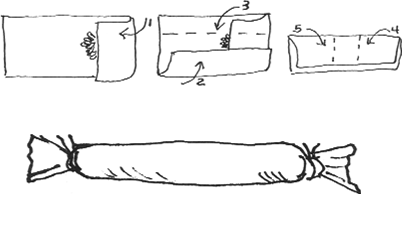
Folded and rolled towel cropped_Carol KaganExcerpt from Herbal Sampler, 2nd ed. You can dry herbs in your frost-free refrigerator. This method results in good quality and keeps the bright color of the herbs. Make sure the herbs are clean and dry. Remove the leaves from stems and place on a section of paper towel. Roll or fold the towel to cover the herbs…

View original post 420 more words

The Butzemann (Magical Scarecrow) Tradition at Imbolc and through the Light Half of the Year

Dana's avatarThe Druid's Garden

Last year’s butzemann, dressed in her finery (Technically, she was a Butzefrau!)

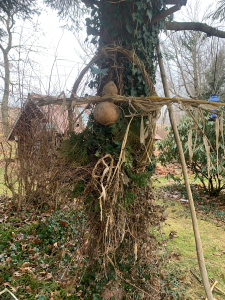
For the last three years, I’ve spent part of my Imbolc celebration making a Butzemann for our land.  The Butzemann is a really interesting tradition from PA Dutch (German) culture called the Butzemann (literally, Boogieman).  In a nutshell, the Butzemann is a magical scarecrow that protects the land for a season.  He is created at Imbolc from natural materials and given clothes and a heart. At the Spring Equinox, the Butzemann is shown the property and the breath of life is breathed into the Butzemann, naming him/her for the season.  Then the Butzemann is displayed prominently throughout the season to protect the and.  Before or on Samhain, the Butzemann is burned and the protective spirit is released and then at Imbolc, a new tradition begins. Today I thought I’d share this tradition with my readers, in case they…

View original post 1,420 more words