Years ago, I started reading books on Taoism. One Taoist concept I learned early on was the inevitability of change. Nothing stays the same, Taoists tell us. Things move, shift, grow, and fade, whether we’re paying attention or not.
Years later, I became interested in ecology, and I began to wonder: how do forests change? Specifically, I began to wonder how forests in the northeastern United States have changed over the past 400 years.
Turns out, I wasn’t the only one wondering about this. Ecologists have been trying to figure this out for a long time. What they’ve found is somewhat surprising and even a bit paradoxical:
After 400 years of intense land use, the northeastern forest is both largely unchanged and completely transformed.
Mace is a wonderfully unique spice. It derives from the Myristica fragrans tree and is native to Indonesia’s Banda Islands—the legendary “Spice Islands”—though it is now also cultivated in Grenada and other tropical regions. You can’t talk about mace without mentioning its twin, nutmeg, because, even though they are different spices, they grow together hidden inside the fruit of the Myristica tree. When the fruit is ripe, it splits open to reveal the seed (nutmeg), which is covered in a delicate, lacy, red membrane, called the aril, otherwise known as mace.
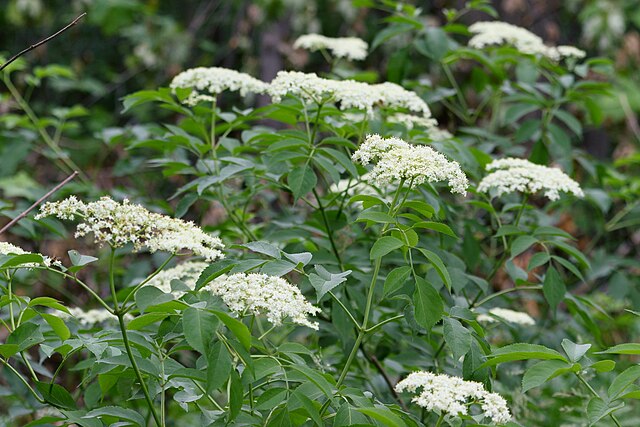
Elderberry (Sambucus canadensis) is an herb of many faces. In spring, its white, lacy blossoms brighten woodlands and hedgerows, attracting bees and butterflies with their sweet fragrance. By autumn, those delicate blooms transform into heavy clusters of deep purple berries — a feast for birds, wildlife, and humans alike. Every part of the elder — flowers, berries, leaves, and even wood — has long been treasured for food, craft, and healing.
A Storied Past
The story of elderberry stretches back to the Ice Age, between 12,000 and 9,000 BCE, when glaciers carried its seeds across North America, Europe, and Asia. By 2000 BCE, early peoples were already cultivating the plant for its medicinal and culinary gifts.
“The scent of rosemary, the smoke of sage, the whisper of bay — the old language of the earth still speaks if we pause long enough to listen.”
— Beth Schreibman Gehring, from Forage & Gather
Before Halloween, there was Samhain, the ancient Celtic turning of the year when the harvest ended and winter began to breathe at the edges of the fields. It was the time when fires were lit high on the hills to call the sun back, when families gathered to share what they’d grown, and to honor what they’d lost. They believed that on this night, the veil between worlds grew thin so that those who came before might wander close for just a moment, drawn by the scent of wood smoke and the warmth of the hearth.
The herbs of this season are the same ones that have long carried us through the threshold times, the in-between spaces when the light fades and the earth exhales. I think of them as old friends who know how to steady us when the days grow short.
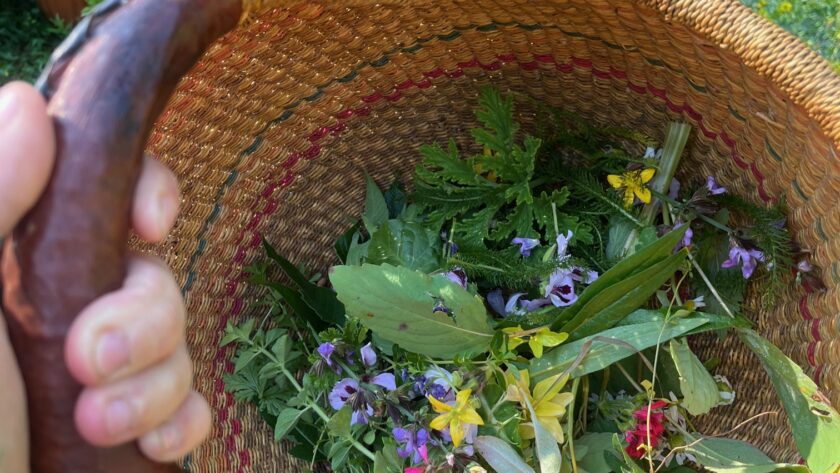
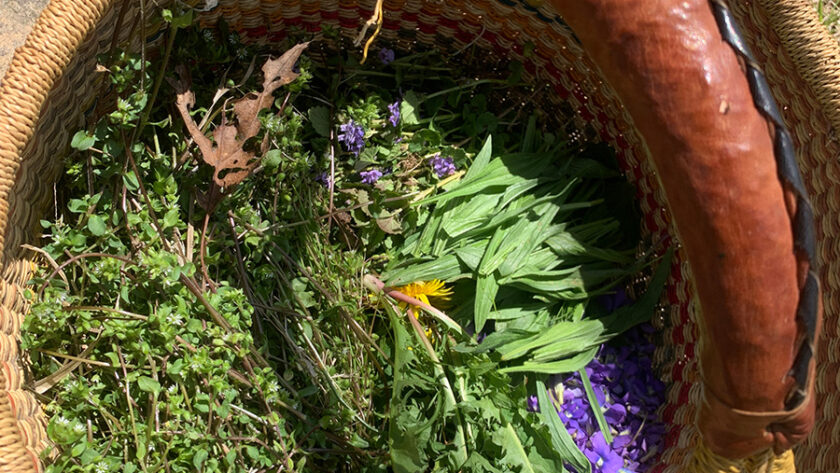
Throughout the year, including on warmer days in the deepest winter months, you will find me out on the land: scattering seeds; planting and harvesting; communing with the plants, trees, and mushrooms; and working nature magic. With baskets overflowing with abundant herbs, nuts, seeds, and mushrooms, I take only what I need, leaning into the abundant plants, and harvest with permission and gratitude. I leave offerings, scatter seeds, and weave magic and flute songs. I often have other people with me–friends, herbal apprentices, visitors, cats, geese. We honor the land while we harvest the plants that heal, soothe, and help us connect with the sacred.
The autumnal equinox, which falls on September the 22nd, is a spoke in the wheel of the year — the brief pause when day and night are perfectly balanced, before the tipping into the darker half of the seasons. In the old calendars, it was a time of harvest and gratitude, a season of preparing pantries and hearts for the coming winter.
Across cultures, this threshold was marked with festivals. The Celts observed Mabon, a harvest rite of thanksgiving where fruits, nuts, squashes, and grains were gathered in and shared with kin and community. Herbs such as sage and thyme flavored the loaves and stews, while rosemary was woven into wreaths to bless the home. It was a season of pausing, giving thanks, and carrying the abundance of the fields inward. Continue Reading …
A growing number of people are taking an interest in herbal medicine. Why learn herbalism now? For many, it is a way to deeply learn and lean into the nature right outside their door. Further, learning how to identify, prepare, preserve, and use medicinal plants helps you take health into your own hands. A lot of people who live in the US (especially in rural areas) recognize that healthcare is more costly and more difficult to access: it is harder than ever to keep a family doctor or get specialist care, and it is so costly that a lot of people can’t afford visits, tests, or medicines.
If you’d like to join us on August 30 or August 31 for an exciting day of ecology and geology, you can register here. These outings are great opportunities to explore beautiful ecosystems while learning tree identification, mushroom identification, forest history, geologic influences on plant communities, and much more.
I’d love to see you there!
And now on to the new video…
Are pawpaws neurotoxic?
It sounds like an absurd question to ask. After all, many people eat these wild fruits every year without experiencing any apparent negative effects.
But let’s consider the following pieces of information:
Studies have linked the consumption of fruits in the Annonaceae family to neurodegeneration in humans. Pawpaw, it turns out, is in the Annonaceae family.
A compound isolated from pawpaws is neurotoxic in laboratory studies.
And a case report from 2020 describes a man who developed a possible variant of a neurodegenerative disorder called progressive supranuclear palsy. The man was known to eat lots of pawpaws.
Of course, none of this information is conclusive, but it does make some people wonder. Are pawpaws neurotoxic? Should we avoid eating them? Or is this issue overhyped?
I’m excited to announce that I’ll be leading a series of forest ecology outings, and I’d love for you to join me!
On August 30 and 31, 2025, I will be leading two Summer Forest Ecology Outings at McConnells Mill State Park in Pennsylvania.
Designated a National Natural Landmark for its outstanding features, McConnells Mill is a treasure trove for learning. Central to the park’s landscape is the Slippery Rock Gorge — a deep ravine carved by powerful forces, exposing millions of years of ancient bedrock and currently supporting mature forest ecosystems.
Located in northwestern Pennsylvania, Cook Forest is home to one of the last remaining old-growth forests in the entire region, with 11 old-growth areas spanning over 2,300 acres. One of the areas within the park, the Forest Cathedral, contains arguably the finest concentration of old-growth trees in the northeastern United States.
During these outings, we will walk through deciduous and coniferous woodlands while discussing forest ecology. We’ll investigate big trees and big rocks. We’ll see historic landmarks, and we’ll discuss important geological influences that have drastically shaped the landscape.
In addition to learning key characteristics of mature and old-growth forests, participants will learn tree identification, mushroom ecology and identification, the role of fire as an ecological agent, ways to interpret forest history, and much more.
These outings are great opportunities to learn, explore, and connect with nature in spectacular settings. They’re also great opportunities to meet wonderful people.
Please note: Each outing is a single-day event. To maximize your learning experience, space is limited and registration with payment in advance is required to secure your spot.
Nature is a perfect system. A tree falls during a thunderstorm. Within several weeks, the wood is colonized by fungi, bugs, and others who begin the years-long process of breaking down the wood and returning all of the nutrients into the web of life. Soon, oyster mushrooms are erupting from the log, bugs burrow in deep, and mice make their home under the old roots. In 10 or 15 years, moss grows thick, and an acorn takes root and begins to grow in the soil that was a stump. The tree’s trunk becomes a nursery tree for many other plants to get a foothold, off of the forest floor. Suddenly where there was death, there is life. This circle continues and continues, connecting us all in a great web of life. There is no waste in this system–every single part of nature can be recycled and reused infinitely.
Serviceberry is part of this beautiful ecosystem!
One of the challenges humans have in this age is that they have built systems that have disregarded the cycle of life, which includes both creating things that do not easily return to nature and removing ourselves entirely from this system. Rather than think in a circle or cycle, we think in a line. This embedded linear thinking currently pervades modern Western human society. The Story of Stuff short film series does a great job of visually describing these problems: many human systems are based on the foundation of greed, quick profit, and short-term linear thinking. What often happens when someone takes up nature spirituality is that their patterns of shifting slowly change from lines to circles. This happens with people connecting to many different nature-connected communities: including nature spirituality, gardening, rewilding, bushcraft, natural building, or permaculture practice. As soon as you start being part of nature, living with nature, and connecting to nature, you are aware of the cycle. The longer you take up these practices, the more profound this cyclical thinking becomes.
You must be logged in to post a comment.