
The Story Behind The Movie Hidden Figures …

melbaroy-jpg__800x600_q85_crop_subject_location-1310768
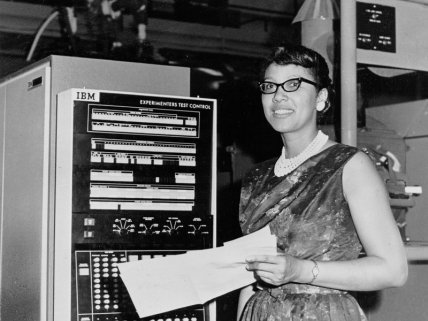
Melba Roy

As America stood on the brink of a Second World War, the push for aeronautical advancement grew ever greater, spurring an insatiable demand for mathematicians. Women were the solution. Ushered into the Langley Memorial Aeronautical Laboratory in 1935 to shoulder the burden of number crunching, they acted as human computers, freeing the engineers of hand calculations in the decades before the digital age. Sharp and successful, the female population at Langley skyrocketed.

Many of these “computers” are finally getting their due, but conspicuously missing from this story of female achievement are the efforts contributed by courageous, African-American women. Called the West Computers, after the area to which they were relegated, they helped blaze a trail for mathematicians and engineers of all races and genders to follow.

“These women were both ordinary and they were extraordinary,” says Margot Lee Shetterly. Her new book Hidden Figures shines light on the inner details of these women’s lives and accomplishments. The book is being adapted into a movie that will receive a wide release release in January.

“We’ve had astronauts, we’ve had engineers—John Glenn, Gene Kranz, Chris Kraft,” she says. “Those guys have all told their stories.” Now it’s the women’s turn.

 Growing up in Hampton, Virginia, in the 1970s, Shetterly lived just miles away from Langley. Built in 1917, this research complex was the headquarters for the National Advisory Committee for Aeronautics (NACA) which was intended to turn the floundering flying gadgets of the day into war machines. The agency was dissolved in 1958, to be replaced by the National Aeronautics and Space Agency (NASA) as the space race gained speed.

The West Computers were at the heart of the center’s advancements. They worked through equations that described every function of the plane, running the numbers often with no sense of the greater mission of the project. They contributed to the ever-changing design of a menagerie of wartime flying machines, making them faster, safer, more aerodynamic. Eventually their stellar work allowed some to leave the computing pool for specific projects—Christine Darden worked to advance supersonic flight, Katherine Johnson calculated the trajectories for the Mercury and Apollo missions. NASA dissolved the remaining few human computers in the 1970s as the technological advances made their roles obsolete.

The first black computers didn’t set foot at Langley until the 1940s. Though the pressing needs of war were great, racial discrimination remained strong and few jobs existed for African-Americans, regardless of gender. That was until 1941 when A. Philip Randolph, pioneering civil rights activist, proposed a march on Washington, D.C., to draw attention to the continued injustices of racial discrimination. With the threat of 100,000 people swarming to the Capitol, President Franklin D. Roosevelt issued Executive Order 8802, preventing racial discrimination in hiring for federal and war-related work. This order also cleared the way for the black computers, slide rule in hand, to make their way into NACA history.

Katherine Johnson at her desk at Langley with a
Katherine Johnson at her desk at Langley with a “celestial training device.” (NASA)

Exactly how many women computers worked at NACA (and later NASA) over the years is still unknown. One 1992 study estimated the total topped several hundred but other estimates, including Shetterly’s own intuition, says that number is in the thousands.

As a child, Shetterly knew these brilliant mathematicians as her girl scout troop leaders, Sunday school teachers, next-door neighbors and as parents of schoolmates. Her father worked at Langley as well, starting in 1964 as an engineering intern and becoming a well-respected climate scientist. “They were just part of a vibrant community of people, and everybody had their jobs,” she says. “And those were their jobs. Working at NASA Langley.”

Surrounded by the West Computers and other academics, it took decades for Shetterly to realize the magnitude of the women’s work. “It wasn’t until my husband, who was not from Hampton, was listening to my dad talk about some of these women and the things that they have done that I realized,” she says. “That way is not necessarily the norm”

The spark of curiosity ignited, Shetterly began researching these women. Unlike the male engineers, few of these women were acknowledged in academic publications or for their work on various projects. Even more problematic was that the careers of the West Computers were often more fleeting than those of the white men. Social customs of the era dictated that as soon as marriage or children arrived, these women would retire to become full-time homemakers, Shetterly explains. Many only remained at Langley for a few years.

But the more Shetterly dug, the more computers she discovered. “My investigation became more like an obsession,” she writes in the book. “I would walk any trail if it meant finding a trace of one of the computers at its end.”

She scoured telephone directories, local newspapers, employee newsletters and the NASA archives to add to her growing list of names. She also chased down stray memos, obituaries, wedding announcements and more for any hint at the richness of these women’s lives. “It was a lot of connecting the dots,” she says.

“I get emails all the time from people whose grandmothers or mothers worked there,” she says. “Just today I got an email from a woman asking if I was still searching for computers. [She] had worked at Langley from July 1951 through August 1957.”

Langley was not just a laboratory of science and engineering; “in many ways, it was a racial relations laboratory, a gender relations laboratory,” Shetterly says. The researchers came from across America. Many came from parts of the country sympathetic to the nascent Civil Rights Movement, says Shetterly, and backed the progressive ideals of expanded freedoms for black citizens and women.

Read more: The True Story of “Hidden Figures,” the Forgotten Women Who Helped Win the Space Race

The Secret of the Voice in Your Head

Excellent advice …

voices

All day long, we go around with a monologue inside our head – the chatter of our thinking. Much of it includes thoughts such as: what do I have to do next, why is this or that person making things difficult, what am I going to have to eat or drink in the next? Will I be late? Am I good enough to do what’s expected from me? What happens if I lose my income? How am I going to stop this pain?

Often – if not almost always – it’s a mixture of fear and stress.

We sometimes mix the negative voice with fantasies of escape or revenge. These fantasies are not tangible nor rational enough to produce satisfying action.

The voice in your head sounds like your own, but it’s not. It tends to be a compiled rumble of childhood messages mixed with adult conflicts and disappointments. The fears and stress are enunciated in your own words and in your own voice.

On the bright side, we can replace the negative thoughts with positive affirmations or steps toward solutions. Even then, a negative voice will pop up out of nowhere. Chasing those negative thoughts is like hitting the plastic moles in What-A-Mole. So, how do you untangle this mess of unhappy inner quarrels?

Here’s a secret for the ages: you don’t have to believe in your own thoughts.

Your thoughts are just thoughts, words streaming through your head like the crawl at the bottom of a news channel. Let those thoughts be. They are not you. You don’t have to own them. They actually get quieter if you pay them no mind.

It’s a tiny thing to learn, but it’s helped me a great deal.

Source:  The Secret of the Voice in Your Head

Rob Spiegel's avatarSpiritual Awakening

voices

All day long, we go around with a monologue inside our head – the chatter of our thinking. Much of it includes thoughts such as: what do I have to do next, why is this or that person making things difficult, what am I going to have to eat or drink in the next? Will I be late? Am I good enough to do what’s expected from me? What happens if I lose my income? How am I going to stop this pain?

Often – if not almost always – it’s a mixture of fear and stress.

We sometimes mix the negative voice with fantasies of escape or revenge. These fantasies are not tangible nor rational enough to produce satisfying action.

The voice in your head sounds like your own, but it’s not. It tends to be a compiled rumble of childhood messages mixed with adult conflicts and disappointments. The…

View original post 137 more words

Donate to the “My People Fund”

Help Dolly Parton provide a hand up to those families who have lost everything in the fires in Sevier County, TN through Dolly’s “My People Fund.” #SomePlaceSpecial #MyPeopleFund

_92782331_dollyparton

Source: Donate to the “My People Fund”

If You Want To Help Louisiana …

As always … Do your own due diligence when donating.

American Red Cross

The Louisiana branch of the American Red Cross is providing meals and dozens of shelters for residents needing a safe place to sleep.

A detailed listing of the organization’s efforts, facilities and needs can be found here and you can contribute financially by either visiting here or by texting the word LAFLOODS to 90999 to make a $10 donation.

Salvation Army

The Salvation Army is working from its Baton Rouge facility to help those evacuated during the flood.

The organization has sent extra personnel to the area to provide mobile feeding units, hygiene kits and to help in cleanup efforts. You can volunteer or donate money to the Salvation Army’s Gulf Coast fund.

The United Way

Donations for flood relief can be made through the United Way of Southeast Louisiana website. They are also seeking volunteers.

Dee Vazquez, from left, helps Georgette Centelo and her grandfather Lawrence Roberts after they tried to recover their belongings from a family mobile home in Central, north of Baton Rouge, Lousiana, Monday, Aug. 15, 2016. (David Grunfeld/NOLA.com The Times-Picayune via AP)

Second Harvest Food Bank of Greater New Orleans & Acadiana

This organization is seeking financial support as they distribute thousands of pounds of food, water and supplies to flood victims.

Convoy of Hope

This faith-based, nonprofit organization is providing food, water, equipment and relief supplies to southern Louisiana. You can donate here and specify that you would like your donation to go to the Louisiana August 2016 flood relief efforts.

Operation Blessing International

Operation Blessing International is another faith-based, nonprofit that has already deployed volunteers to help in cleanup efforts and reconstruction. For more on their relief efforts in Louisiana, you can find information here. If you’re interested in volunteering, email volunteer@OB.org and to offer financial support, you can donate here.

LSU Fund

Louisiana State University’s Zeta Phi Beta sorority has a GoFundMe site, which is aiming to raise $10,000 and disburse it to students impacted by the flooding.

Save the Children

This organization that serves children and their families around the world is providing support to help with emergency assistance in flooding areas. To support their efforts, you can donate to the Gulf Coast Floods Children’s Relief Fund.

Animal Shelters

There are several animal shelters in the area that are seeking donations, volunteers and foster parents for hundreds of rescued pets, including Companion Animal Alliance, as well as a GoFundMe site for Denham Springs Animal Shelter.

Drop Off Items

 If you live in the area, there are a number of places where you can drop off items like diapers, pillows, bedding, toiletries, clothing, car seats, mattresses, food, gift cards, stuffed animals, pet food and water bottles. See a full list of locations accepting donations here.

Goodreads Giveaway is Go! — Natalie J Case

Click here! to enter my Goodreads giveaway. I have two signed books up for grabs. If I get 350 entrants, I’ll run another giveaway next month. You have until Monday, July 18th to enter Good luck!

via Goodreads Giveaway is Go! — Natalie J Case

In The Shadows To Protect Us From The Dark

logo

Like many who travel the thin line between the light and dark … You usually see headlines about the dark, but these men prove there is light in the dark.

The Benghazi Story

Thrown to the curb once their work is done … Find them here.

Shadow Warriors Project


Hammond Ranch – The Rest Of The Story

Before It’s News – It’s About The Gas & Uranium

It’s finally coming to light why the Federal Government is using BLM – The Bureau of Land Management to arrest, imprison and confiscate lands that have been in families since the western expansion.

It’s always about the money. When you follow the money in the Bundy Ranch situation, we found Harry Reid and his son in bed with a Chinese solar company.

If you look at the REAL reason Bureau of Land Management tried to illegally take over Sugar Pine Mine, in southwestern Oregon, you’ll find that BLM has been the enforcers for the Federal Government since the turn of the century.

Kerby Jackson, author and historian, has documented many cases.

Now we find Obama ordering the destruction of a family ranch for the natural gas and uranium. Assets they will sell to the Chinese … The country that really owns the United States along with UNESCO.

Seems the 11 western states have become the testing ground for how far the Federal corporation can push before the citizens of the Republic push back.


West Virginia kids in Rose Bowl Parade – WOWK 13 Charleston, Huntington WV News, Weather, Sports

9541785_g

Source: West Virginia kids in Rose Bowl Parade – WOWK 13 Charleston, Huntington WV News, Weather, Sports

CHARLESTON, WV – 20 West Virginia kids are getting ready for the opportunity of a lifetime- a chance to ride in the Rose Bowl Parade. The float starts a new tradition of partnerships and an opportunity to show-off all West Virginia has to offer.

This Friday among the colorful floats made of roses you’ll see a little piece of West Virginia. A miniature Greenbrier, New River Gorge Bridge and other landmarks will be featured in the “Find Your Adventure” float.

“It’s a fantastic opportunity because the eyes of the world are on the Rose Bowl Parade. Even if you don’t like football, you watch the Rose Bowl Parade,” explained Amy Goodwin Commissioner of Wild Wonderful West Virginia.

The Division of Tourism worked with the WVU Medicine Children’s and Children’s Miracle Network to create the first West Virginia float in the Rose Bowl Parade since 1963. Six WVU Medicine Children’s patients will ride the float now being nicknamed “The WVU Children’s Miracle Float”.

“We might go to Disney land. I’m going to be in the canoe I’m going to like have a helmet too,” Brody Wilmoth told WBOY-TV earlier this year before leaving for the trip. Brody was previously a Miracle Child, acting as an ambassador for other kids in the Children’s Miracle Network. He’s just one child with an amazing story of recovery and now of adventure.

“it’s been a dream of mine to go to California, it’s so exciting. I’ve met and went and met the president, I spent the weekend with Mark Wills, the singer, Miss America, and now I’m getting to do this,” said Samantha Stalnaker. She was also a Miracle Child and will be riding in the float Friday as well.

The former patients voted on names for the two black bears that will be on float. The black bears of course being West Virginia’s state animal. The final decision for names- courage and pride.

“Because that really embodies the patients of that hospital, and the people of west Virginia. Courage and pride – that’s who we are,” Goodwin explained.

The WVU Medicine Children’s group organizing the float is still accepting donations to go towards the cost of building the float. You can check out pictures and updates on the float on their Facebook page. Be sure to watch for the float Friday morning.

An Interesting Concept

Patreon

Recurring funding for artists and creators

Creators receive millions of dollars each month in support from their patrons

Public Lands For The People Press Release


MEDIA RELEASE

Public Lands for the People

FOR IMMEDIATE RELEASE

Monday, Nov. 23, 2015

The following is a media release issued by Public Lands for the People, a national non-profit organization based in California:

CEQA court case settlement to cost taxpayers $350,000

Public Lands for the People has recently learned that the state of California has offered to pay $350,000 to a coalition of environmental groups, including the Karuk Tribe and Center for Biological Diveristy, to drop a lawsuit over the California Department of Fish & Wildlife’s 2012 suction dredge mining regulations.

The case centers around a flawed study under the California Environmental Quality Act, which requires state and local agencies to identify significant environmental impacts and to avoid or mitigate those impacts, if feasible. The court battle, known in mining circles as the CEQA case, involves two separate lawsuits:

  • The Karuk Tribe, Center for Biological Diversity, Environmental Law Foundation, Pacific Federation of Fisherman’s Associations and Friends of the River allege that the regulations adopted in March 2012 were not developed in accordance with the California Environmental Quality Act, fail to mitigate identified impacts and are inconsistent with existing state law. The case was filed April 3, 2012 in Alameda County Superior Court.
  • Meanwhile, Public Lands for the People also sued the state, alleging that the Subsequent Environmental Impact Report, which was based on reports from Horizon Water and Environment, a consulting firm based in Oakland, Calif., was improperly and unlawfully conducted and therefore rendered skewed, unscientific findings.

“The 2012 dredging regulations were based on bad science from a deeply flawed environmental report,” said PLP President Walt Wegner. “The SEIR results were used to prop up the case for far more restrictive suction dredge mining regulations because of pressure from these environmental groups.”

The SEIR study claims that suction dredge mining has several “potentially significant impacts” on the environment, even though all previous studies had concluded that dredging causes a “less than significant impact,” Wegner said.

“How does this drastic change in study results happen overnight? The study is bogus and heavily influenced by politics—not science,” said Wegner. “And, now after years of battling the CEQA case, these environmental groups have decided to take the money and run, leaving California taxpayers on the hook for $350,000.”

PLP Attorney James Buchal said it’s a shame that state taxpayers will be stuck with the tab, again.

“It is regrettable that once again the state of California has decided to shovel hundreds of thousands of dollars in fees to entities working to cripple the state’s natural resource economy. To make matters worse, the state agreed to pay that money and allow the tribe and its allies to dismiss their claims without prejudice, meaning they could bring them all over again for a second payoff,” Buchal said. “The Karuks are done; they’ve settled. The state and the tribe have agreed to it, and at this point I think it’s just a pro forma approval by the judge, and the money will be paid.”

PLP’s CEQA case is expected to proceed Jan. 20 in San Bernardino County Superior Court.

“With the tribe dismissing its claims, that leaves only the miners claiming that the environmental analysis of the 2012 regulations was defective. But, what gives this a sort of surreal and Kafkaesque quality is that back in January the judge ruled that the regulations are unconstitutional anyway,” Buchal said, referring to another dredging case heard by California Superior Court Judge Gilbert Ochoa.

Ochoa ruled in January 2015 that the federal Mining Law of 1872 pre-empts the state ban on dredging under the Supremacy Clause of the U.S. Constitution, which states that federal law supersedes state law. The ruling was deemed a win for miners, however the state continues to cite dredgers and has refused to issue dredging permits to miners.

Clark Pearson, northern director for PLP, said the CEQA case settlement wreaks of cronyism and corruption between the state and environmental groups.

“It doesn’t pass the smell test,” Pearson said. “This was a sweetheart lawsuit … so basically they were paid off to drop the case. Do you think the same offer will be made to miners? I highly doubt it. No offer has been made to us, and we are the prevailing party. We should be entitled to attorney fees.”

Suction dredge mining has been banned since 2009 in what began as a two-year moratorium imposed under Senate Bill 670, and extended under various legislation.

“That so-called moratorium has become a de facto ban, which is unconstitutional—and small-scale suction dredge miners are paying the price,” Wegner said. “The state has crippled the local economies of many mining towns in California, and is actually making the mercury problem worse. Contrary to the propaganda from some environmental groups that it may harm fish, dredging not only removes mercury and lead from California streams and rivers but it cleans hard-packed, silt-covered gravels that salmon and other fish need to spawn, and it also improves fish habitat by creating refugia.”

Sue-and-settle cases

Friendly lawsuits, or sue-and-settle cases, have been the subject of investigations in Washington, D.C. In fact, the Center for Biological Diversity is listed as fourth on the list of most frequent environmental group plaintiffs in sue-and-settle cases in a 54-page report, “Sue and Settle, Regulating Behind Closed Doors,” published by the U.S. Chamber of Commerce in 2013.

U.S. Chamber of Commerce “Sue and Settle, Regulating Behind Closed Doors” report: https://www.uschamber.com/sites/default/files/documents/files/SUEANDSETTLEREPORT-Final.pdf

The Karuk Tribe is based in the northwestern corner of the state in Humboldt and Siskiyou Counties and has opposed suction dredging mining along with environmental groups, such as the Center for Biological Diversity and the Sierra Fund, which is listed as the worst offender in the Sue and Settle report.

Public Lands for the People is a 501[C](3) nonprofit corporation whose mission statement is “to represent and assist outdoor user groups and individuals interested in keeping public and private lands open to prospecting, mining and outdoor recreation through public education, scientific data and legal means.”

-30-

NOTE: (Kafkaesque refers to Franz Kafka and his novels about arbitrary bureaucracy.)

For more information, contact:

PLP President Walt Wegner

Phone: (818) 887-5970

Website: www.PublicLandsForThePeople.org

Email: info@publiclandsforthepeople.org

Public Lands for the People

2029 Ventura Blvd., Ste. 47-466

Woodland Hills, CA 91364


Public Lands for the People is a 501[C](3) nonprofit corporation: #95-4521318 & 1880483