FOUR ISPMB ‘HALLELUJAH HORSES*’ HEADING FOR FULL CELEB STATUS | Straight from the Horse’s Heart

by Elaine Nash as published on FaceBook

Animal Planet Here We Come

As I posted earlier, we saw 10 mares off on their several-month long journey to Alaska yesterday. Six of them will be going to the Chena Hot Springs Resort near Fairbanks. The other four have an even more exciting life ahead of them because they have been adopted by Dr. Dee Thornell, who’s featured as ‘Dr. Dee’ on the Animal Planet show, Alaska Vet. In addition to being a celebrity vet who flies to remote Alaskan villages to help animals of just about every sort, she is a horse driving enthusiast and well known national competitor. Dr. Dee asked me to select four big, beautiful bay mares from our herds for her, so they can be trained to become a competitive four-in-hand team. She hopes to show people all over the world that mustangs are very versatile, athletic, fast, and fun to show off!

Before heading north, the four big bay mares (real beauties!) will join the Chena Hot Springs Resort horses in WY for needed care, gentling, and training (and probably foaling) before heading up the AlCan highway this spring or summer to their new home with Dr. Dee!

CONGRATULATIONS, LADIES!
We’ll look forward to seeing you four on TV and cheering for Dr. Dee’s Hallelujah Horses!

Previous episodes of Alaska Vet can be seen at http://www.animalplanet.com/tv-shows/dr-dee-alaska-vet/.

https://www.facebook.com/groups/ISPMB.Adoptable.Horses/

WE STILL NEED LOTS OF HELP to get the rest of these horses cared for, placed, and transported by March 26th, our deadline. Still many horses to get out of there! Here’s how you can help:

DONATE: www.ISPMBHorseRescueMission.org

ADOPT:
Lots of nice, healthy horses still available. We also need adopters for dozens of BLIND HORSES, SENIOR HORSES, and STALLIONS (If adopting stallions, ask about the gelding subsity of $100. provided by the National Equine Rescue Network.)
https://docs.google.com/…/1FAIpQLSdXEVFZhWzY6qKuPr…/viewform

TRANSPORT:
We need as many adopters as possible to arrange for and transport your own horses. Time is of the essence at this point, and there’s not time nor manpower to arrange for a lot of individual Fleet of Angels transports for you at this point.

We also need teams of drivers who have large trailers (40′-ish) that are capable of hauling 15-20 horses at once, and who can take load after load until the end of the month.

*Hallelujah Horses is the nickname given by Fleet of Angels to the 810 horses impounded and seized from ISPMB (Int’l Society for the Protection of Mustangs and Burros) in South Dakota. Fleet of Angels was given custody of all the horses, so each horse could be properly evaluated, treated and cared for, adopted, and transported to a safe new home. www.FleetOfAngels.org

Source: FOUR ISPMB ‘HALLELUJAH HORSES*’ HEADING FOR FULL CELEB STATUS | Straight from the Horse’s Heart
Kentucky legislature setting the stage for the slaughter of horses with SB 139

FRANKFORT, KY — Kentucky is marketed as the Horse Capital of the World, the State with “unbridled spirit”, as seen in its logo.

Tragically, this unbridled spirit does not extend to the safety, well-being and benevolent treatment of the horses it so proudly hails as an integral part of its history, economy and culture.

Kentucky is renowned for its lack of animal protection laws and that extends to its horses. According to some, Kentucky ranks in the bottom five in animal welfare but most recently there have been claims it is at the very bottom.

Here are two examples involving racehorses. There are many more.

1. There is nothing on the books that governs how many times a racehorse can be whipped or for how long before it becomes cruelty or abuse, a Churchill Downs veterinarian smirked several years ago.

2. When PeTA exposed horrific acts of cruelty exposed in a shocking undercover video Kentucky horseracing officials were asked to review it, and claimed they saw nothing wrong.

Now the Kentucky State legislature is laying the groundwork to bring horse slaughter to Kentucky.

Entire article posted at its Source: Kentucky legislature setting the stage for the slaughter of horses with SB 139

Feel Good Sunday: Short & Sweet, in more ways than one | Straight from the Horse’s Heart

“We have a brief but funny one for you on this day of rest, folks.  Nothing will give you the chuckles over your morning coffee or Bloody Mary like a herd of wild minis’ stampeding through a barn with a dog in the lead, ya just gotta luv it!

Have a great  day with family and friends, be they two legged or four, and we will jump back into the fray in the morning.  Keep the faith.” ~ R.T.

Source: Feel Good Sunday: Short & Sweet, in more ways than one | Straight from the Horse’s Heart

BLM Violates Own Wild Horse Welfare Standards | Straight from the Horse’s Heart

Source: The Cloud Foundation

Roundup Incident Sparks Outcry

photo by Terry Fitch of Wild Horse Freedom Federation

photo by Terry Fitch of Wild Horse Freedom Federation

COLORADO SPRINGS, CO – On February 12, the Bureau of Land Management (BLM) conducted a helicopter roundup of wild horses at Cedar Mountain Herd Management Area (HMA) in Utah.  The Cloud Foundation (TCF) and advocates across the country contend that BLM’s actions at the roundup violate standards in their own Comprehensive Animal Welfare Program (CAWP).

Eyewitness, Mosie Trewhitt, a professional horse trainer, photographed the incident of a lone pinto mare being driven by a helicopter. The mare could not keep up with her band but the helicopter kept pushing her. Then a wrangler joined the pursuit and both helicopter and wrangler chased the mare on a dead run along a barbed wire fence line. The wrangler tried to rope her numerous times and was finally successful. The mare lurched and flipped over or tried to jump the fence. She became entangled in the barbed wire, and ended up on the other side of the fence.

The mare escaped, dragging the rope behind her and has not been seen since the incident according to BLM who also contend she was uninjured. Trewhitt’s blog, Voices of the Herd, documents the incident with vivid photographs. Fears persist that this mare who appears to be pregnant may be strangled by the rope or suffer from infection due to an obvious gash on her right rear leg.

Read the entire article at the Source: BLM Violates Own Wild Horse Welfare Standards | Straight from the Horse’s Heart

‘Skin Trade’ Donkeys ‘Waiting to Die’ at ‘Horrific’ Markets | Straight from the Horse’s Heart

by as published on Horse and Hound

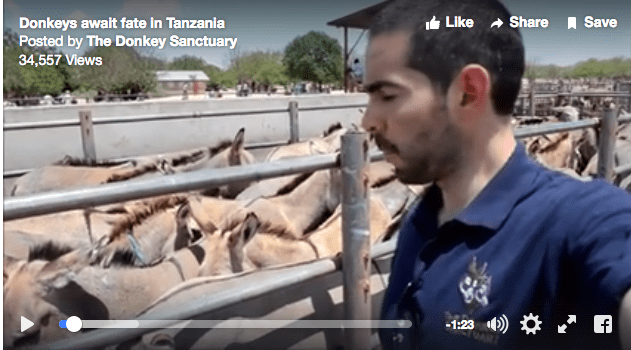
“There’s about 700 donkeys coming here to wait to die. There’s no food, there’s no water…”

The ‘horrific’ conditions facing donkeys in markets in Tanzania have been highlighted by welfare groups.

The Donkey Sanctuary’s Alex Mayers and Thomas Kahema, founder of The Tanzanian Animal Welfare Society, recently visited a donkey market in Tanzania believed to be serving the skin trade.

Read the entire article at the Source: ‘Skin Trade’ Donkeys ‘Waiting to Die’ at ‘Horrific’ Markets | Straight from the Horse’s Heart

I-Team: Federal agency spends more than $100M to kill predatory animals | Straight from the Horse’s Heart

Wildlife Services is a welfare program for ranchers, and on top of all the other ones where the government comes in, they do aerial gunning, they use traps and snares…They use all kinds of horrible poisons to kill animals.”

Click Image to View Video

Click Image to View Video

LAS VEGAS – DISCLAIMER: Some of the images in this story may be disturbing.

Nevada Lawmakers are debating a plan that would remove hundreds of thousands of dollars from a program that targets predators such as coyotes, mountain lions, and bears.  The money is raised from hunters when they obtain their licenses, and it goes into programs that kill predators which prey on trophy animals such as deer or big horn sheep.

But the state program is a drop in the bucket compared to a little known federal agency that spends more than $100 million in public funding per year to kill animals.

The I-Team discovered that Nevada is a bloody battleground for coyotes and other predators. An obscure federal agency called Wildlife Services, which was created in the late 1800’s, spends huge sums each year to shoot, trap, and poison predators, such as coyotes, foxes, lions, bears, and birds. […]

Read the entire article at the Source: I-Team: Federal agency spends more than $100M to kill predatory animals | Straight from the Horse’s Heart

‘Stop the Yellowstone Massacre’: Group Puts Up Billboards Urging End to Bison Slaughter | Straight from the Horse’s Heart

“The most recent update from Yellowstone National Park said that 179 bison had been sent to slaughter….”

photo by Rachel Leathe

photo by Rachel Leathe

Drivers heading south from Four Corners on Highway 191 will now zip past a billboard with a gory scene and a simple message: dead bison, lying in a pool of blood underneath block letters asking people to call Montana’s governor and tell him to “Stop the Yellowstone Massacre.”

The billboard is one of two that the Alliance for the Wild Rockies bought, the other being in Helena. Steve Kelly, a board member for Alliance for the Wild Rockies and the artist who painted the picture, said they hope people will see the signs and pressure Montana Gov. Steve Bullock into blocking the annual shipping of Yellowstone bison to slaughter for the year.

“It’s a horrendous thing,” Kelly said. “He’s the one who has the power to stop it.”

Read the article in its entirety at the Source: ‘Stop the Yellowstone Massacre’: Group Puts Up Billboards Urging End to Bison Slaughter | Straight from the Horse’s Heart

Idaho Helicopter Ruling a Victory for Wilderness, Wildlife | Straight from the Horse’s Heart

“It is intolerable that agencies entrusted with enforcing our laws are themselves wantonly violating them…”

collared-wolfConservation groups cheered when a federal judge ruled last month that the Forest Service and Idaho Department of Fish and Game violated federal law by landing helicopters in an Idaho wilderness area to attach tracking collars to elk and wolves. The court also ordered the data gathered through these illegal activities destroyed. The now-halted project gives every appearance of an unscientific witch hunt, tailor-made to scapegoat wolf predation as the cause of elk population declines and to justify a wolf-killing program in wilderness.

Source: Idaho Helicopter Ruling a Victory for Wilderness, Wildlife | Straight from the Horse’s Heart

The BLM Continues Lack of Transparency in Adobe Town Wild Mare Radio Collar Study | Wild Hoofbeats

Only 3 mares in the trailer?

On Sunday morning I waited at the parking lot next to the corrals at the Rock Springs BLM facility. It was 1 degree above zero, and I was bundled up accordingly. I am the only member of the public there, unaffiliated with the BLM or University of Wyoming. One trailer and two trucks drive in front of me, and I am waiting for the other trailer. There are only 3 mares in this trailer, I am assuming three of the four mares that had radio collars put on on Friday. But there were 5 other mares that I had been told by Kate Schoenecker of USGS had not been collared because they were too young. In the Environmental Assessment, it states clearly that they were only going to collar mares 5 years old and older. Young mares who are still growing can be strangled by the collars. But where were the 5 other mares? They flagged me to follow, and I pulled out of the facility. When we took a break I asked where the other mares were. I was told they were still at the Rock Springs facility and they were being “re-evaluated.” What does that mean? They are either too young for the study, under 5, or they are not. Are they being kept for some other purpose? Both the EA and the BLM’s own press release state that none of the horses from Adobe Town are to be removed – they are all supposed to go back to the Herd Management Area. So what is the BLM not telling us?

These mares need to be released back to the area where they were trapped IMMEDIATELY.

Robin comes out of the trailer

We drove to Bitter Creek Road, which is about 30 minutes from Rock Springs, and we started down the road. After we got off of the paved portion of the road, conditions got worse, from occasional mud to water and ice flooded areas. It was a challenging drive. After we passed Eversole Ranch, about 10 miles later the trailer stopped and the first mare was released, a little bay I named Robin. She ran as fast as she could once she hit the ground, only turning back to look at us when she had gone what she thought was a safe distance. There were no other wild horses in sight, and I learned that all three of the mares had been trapped about 30 miles south of this area.


Robin looks back at us

We got back in our cars and continued driving for about 8 miles before stopping again to let another mare out of the trailer, this time a little sorrel I named Felicity. She turned around immediately after jumping out, looking for her friend, the grey mare in the back of the trailer. I noticed a cut over her eye that looked swollen. Any time you transport wild horses there can be injuries. It did not look deep and it did not prevent her from running off when one of the contractors shooed her away. There were no other horses around her either.

Felicity comes out of the trailer

Felicity looks back at her friend in the trailer

Felicity finally runs away

We continued driving as the road got worse for another 10 miles, almost to the state border with Colorado before letting the last mare go, a grey mare who was pure white who I named Ghost. She ran down the road past the cars and disappeared. We turned around carefully and went back out the way we came.

Ghost jumps out

Ghost looks out, getting her bearings

Gone!

On the way back, right in the area Felicity had been released I caught sight of a wild family at a run. They ran across the road in front of us, and the grey stallion in front was magnificent with his flowing mane. I hope that Felicity can meet up with them and join their family.

The wild family

Crossing the road

We were going to meet up with the other contractors, who had been bait trapping in the northeast portion of Adobe Town who had loaded the grey mare with a collar at Rock Springs, then loaded up her family with her. They had held onto the family and were going to release them all together. After driving on the highway, we got onto muddy roads, and drove until we met up with a horse trailer full of horses. This was the grey mare and her family. they were moving quite a bit in the trailer, clearly eager to get out. We followed the trailer until they stopped and we positioned ourselves to watch them emerge, which they did at first tentatively and then faster. As they leaped out I saw a filly at the side of the grey collared mare who I named Dove, and was told she was her yearling filly. No doubt this is why they kept the family back so they could be released together.

The grey family in the trailer

Tentatively they get out

Running from the trailer

The collared mare Ghost and her young filly

Going....gone!


They ran off over the hill, and I breathed a sigh of relief that all four were back home.

One thing that really puzzled me was that I saw piles of panels used for traps, all stacked on a semi. Neither team of contractors had a new trap set up. When I asked they told me some decision was being made at 7pm this evening, they did not tell me what. According to the BLM’s own web page on the bait trapping, they had trapped for only 5 days, starting Sunday February 5. They gathered by their own report 27 horses over the four days, and shipped 9 mares to the Rock Springs corrals. The information on the study in the EA said they would be trapping in 3-5 locations. Why then were they only trapping in two locations, and had not set up any traps after Thursday? In the EA, the BLM had written that if bait trapping “fails” they would go to a helicopter roundup. I hardly think that 5 days only is enough time to “fail.” it takes time to accustom wild horses to a trap and to let them get used to it and come in. That is what they are currently doing in Sand Wash Basin, where they have given far longer than 5 days to trap the horses.  This seems to me to be a setup to fail. If they are not continuing to bait trap then they are getting ready to bring the helicopters in. Wild horses are injured and killed when driven with helicopters. There is no justification for subjecting the wild horses of Adobe Town to a helicopter roundup when they are not even over the Appropriate Management Level for their area.

The BLM should continue to use bait trapping if they have to finish getting 16 more mares for this ill-conceived research study, or better yet, they need to go back to the drawing board and redesign the study so that the researchers use non-invasive, safe direct observation, not dangerous radio collars.

Link to Daily Gather Reports:

https://www.blm.gov/programs/wild-horse-and-burro/herd-management/gathers-and-removals/2017-Adobe-Town-Wild-Horse-Gather

People Are Killing Millions Of Donkeys Just For Their Skins

Warning: Graphic Content – What they’re used for is such a waste

Marjorie Farabee, Director of Wild Burro affairs at WHFF, and her good friend Miss Abby ~ photo by Terry Fitch

For centuries, in rural cultures across the globe, one animal has been an important part of the family, helping to keep farms and villages running.

Not only do millions of people depend on donkeys for practical purposes — many donkeys are seen more and more as smart and loyal pets.

But this friendship between people and donkeys is increasingly threatened by a growing trade in something you’ve probably never even heard of: “ejiao,” (also known as “colla corii asini” or “donkey hide glue”) a kind of gelatin made from donkey skin — and demand for ejiao is killing literally millions of donkeys per year.

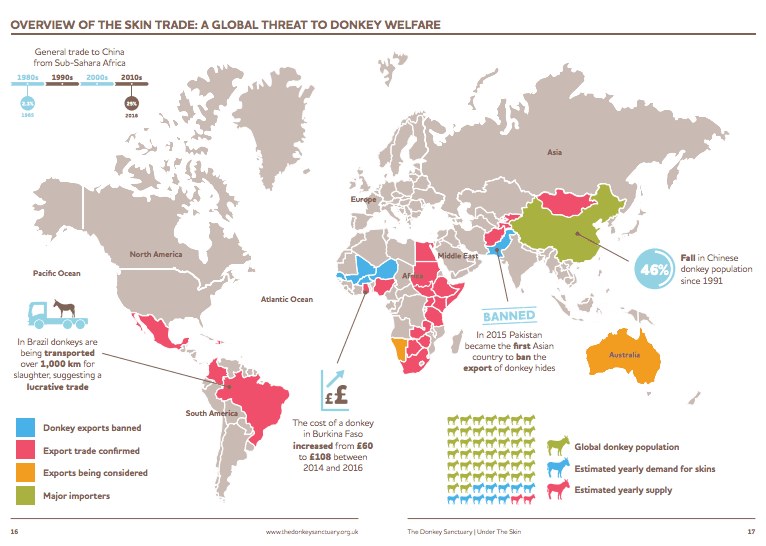
A new report from The Donkey Sanctuary in the U.K. shows just how massive this emerging global trade really is. At least 1.8 million donkey skins are being traded each year — but it could be between 4 million and 10 million. The trade is difficult to track and until now hasn’t been studied at such a large scale.

“Our report reveals the shocking scale of this global trade and how it’s causing a chain of welfare issues for the donkeys at every step, from sourcing to transport and finally to slaughter,” Mike Baker, chief executive of The Donkey Sanctuary, told The Dodo in a statement.

“Ejiao is a medicine with ancient roots and has been promoted as a product worthy of emperors,” the report says, explaining that traditional herbalists in China claim that ejiao can increase libido, slow aging and prevent disease. But ejiao has not been recognized as having medicinal properties by western medicine.

dead-donkeysThis belief means that donkeys are becoming more valuable for their skins, and therefore harder for rural families to afford. Even the loyal donkeys families already have are at risk. It is becoming more common for donkeys to be stolen right out of a family’s yard and slaughtered for their skins.

While exports of donkey skins come from South America and Asia, the largest source is in Africa, where donkeys (many of them stolen) are rounded up in “donkey markets,” where they are often packed together and left without shelter from the hot sun and without food or water, while they await slaughter.

Often, after the skins are removed, the bodies of the donkeys are burned.

“The market is far worse than I expected,” said Alex Mayers, program manager at The Donkey Sanctuary, from a donkey market in Tanzania last week. “There are about 700 donkeys basically coming here to wait to die. There’s no food or water. The donkeys are very stressed. There are lots of signs of dehydration and hunger.”

But there is hope.

Some countries have already taken action and banned exports of donkey skins, making their donkeys much safer. This includes the African countries of Niger and Burkina Faso, and Pakistan, in Asia.

The Donkey Sanctuary is calling for a stop to the trade of donkey skins worldwide, so that the damage already done to donkey populations and the people who depend on them can be assessed.

overview-mapIn particular, we urge other countries affected by this trade to follow the lead taken by Burkina Faso and Niger and ban the slaughter and export of donkeys for their skins,” Suzi Cretney, public relations manager for The Donkey Sanctuary, told The Dodo.

Cretney said that raising public awareness about where ejiao really comes from could help consumers make better choices.

“We are asking countries to follow the lead by Burkina Faso and Niger to end the slaughter and export of donkeys for their skins because it could help thousands, if not millions of donkeys — their welfare, and their real value supporting people’s livelihoods is at risk,” Baker said.

“This has to stop,” Mayers said, standing by a pen packed with donkeys awaiting their fate. “This absolutely just has to stop.”

To get action alerts about how you can help save these donkeys, join the campaign.

Click (HERE) for video and graphic photos!

https://www.thedodo.com/donkey-skin-trade-2230693220.html

Source: People Are Killing Millions Of Donkeys Just For Their Skins | Straight from the Horse’s Heart