The Bureau of Land Management is scrubbing their trail on the internet | Straight from the Horse’s Heart

After NBC News wrote about the Bureau of Land Management featuring a photo of a coal bed at the top of their website, the BLM changed it… to now feature this photo of an oil & gas pipeline.

by Debbie Coffey, V.P. & Dir. of Wild Horse Affairs, Wild Horse Freedom Federation                                                                    All Rights Reserved.          Copyright 2017

The Bureau of Land Management is scrubbing most of its links off of the internet, and in doing so, erasing much of its history from public view.

Many of the blm.gov links that are still remaining on the internet at this point say “page not found,” or the links are no longer cached.

The BLM also suddenly removed state and district websites.  Instead, you will now find “landing pages” that direct you to only one main Bureau of Land Management website.  (You can look at the new BLM website HERE.)

I called a BLM Public Affairs Specialist to ask some questions about the defunct websites and links.  This person said in the past there were about 90,000 pages (and then a bit later stated that it could possibly be only about 60,000 pages) of BLM content on the internet, but that all of these pages couldn’t be maintained or updated, and weren’t centralized.  This person said the BLM’s prior content management system was outdated.

Most importantly, this person also said there were now standards to reduce the amount (of pages/content).

Who made the decision to even have a standard to reduce content available to the public on the internet?  During this website transition, who is making the decisions, and on what basis, of what data to migrate, or not to migrate, to the new BLM website?  These decisions cherry pick what information will be available to the public in the future.

Make no mistake, this “reducing the amount” of content on the internet is erasing many of this agency’s past actions, activities, and government documentation.  Many of these links had historical value.  For example, the BLM activities of BLM employees Sally Spencer and Lili Thomas over the years are now gone.  These types of links on the internet didn’t need to be “maintained” or “updated.”  They were historical in nature.

In the past, in doing a google search for Sally Spencer (a longtime BLM employee, and the Marketing Specialist famous for selling so many wild horses and burros to kill buyer Tom Davis), she was included on many, many BLM government links.  I went to the BLM’s new website and searched “Sally Spencer,” and only 3 items appeared.  When I searched “Lili Thomas” (another longtime BLM Wild Horse & Burro Program employee who oversaw the BLM’s Long Term Holding facilities for wild horses for many years), only 4 items appeared.  And when I searched “John Neill” (a longtime Palomino Valley Center manager), all that came up was “No results found.”

These individuals are BLM personnel who have been central in management issues in the BLM’s Wild Horse & Burro Program, as evidenced by FOIA documentation garnered by the late Dr. Patricia Haight of The Conquistador Program.

Even when I searched the new BLM website for “Dean Bolstad” (the Division Chief of the Wild Horse & Burro Program) only 2 items appeared.

(Although, luckily, thanks to In Defense of Animals, you can still go online and see this youtube video of Lili Thomas saying “working with wild horses is not a pretty sight” at a public meeting.)

What I can’t understand is, if the new content management system is bigger and better, why couldn’t the new content management system have contained all of the old data along with new data?  If this agency were truly transparent, they would add data, not reduce data, available to the public on the internet.

At first the Bureau of Land Management only removed the Directories for District offices and Field Offices, making it difficult, for example, to find out who was the Wild Horse & Burro Specialist, Hydrologist, Range Management Specialist or other personnel in any particular district or field office or to find an email address or telephone number for them.  BLM personnel frequently transfer to other offices and states, so it was already hard enough to try to keep up with who was where.  But now the public really doesn’t have a clue who is doing what or where.

You used to be able to go to the home pages of BLM state and district websites, and get a quick overview of not only roundup plans for wild horses & burros, but mining expansion plans, oil & gas lease sale plans, and other uses of our public lands in that area, all in one place.

Now, the BLM has divided these by topics or by “regions,” on their new website.   Under the “region” of Nevada (we call them states here in the U.S.A.), there isn’t a box for wild horses & burros (only oil and gas leasing, greater sage grouse, Great Basin Landscape Conservation Cooperative, Information Access Center, Nevada Resource Advisory Councils & Federal Register Notices).

By scattering information all over this one “centralized” website, the BLM has made it much harder for the public to put together the pieces of information for a clear picture about the multiple uses of our public lands in any one area.

The Program Data page for the Wild Horse & Burro Program is HERE.  When I clicked on the box for Historical Program Data and Public Lands Statistics, I noticed something was missing that used to be available to the public.  It was the column on Adoptions by Locations & Date.  Information from the years 2009-2015 were previously available.

The biggest reason this data was important is because it let the public know the dates of adoption events (including internet adoptions), the locations of the events, the number of the wild horses and burros offered for adoption (until Fiscal Year 2014) and the number of wild horses and burros that were actually adopted at each event.

The BLM likely stopped reporting the number of horses & burros offered at adoption events in Fiscal Year 2014 because it didn’t want the public to know how many horses & burros were racking up “strikes” by not being adopted.  When a wild horse or burro isn’t adopted after 3 events and gets 3 “strikes” it can be sold without restriction (to slaughter), no matter how young it is.  Even this seemingly small reduction of data indicated a lack of transparency by this agency.

Another reason this data is important to the public is because it let the public see what areas of the country adopt the most (and the least) wild horses & burros.

While the new BLM website contains a lot of information, it seems we have lost much more information that was once available on the internet, but was not migrated to the new BLM website.  For example, the BLM News Release on its promised investigation into the deaths of wild horses at the Scott City feedlot is on the internet, but as of today, is not one of the 63 News Releases available to the public on the BLM’s new website.

We will never know how much, or what, the BLM has removed from the internet.  The BLM’s scrubbing of their trail on the internet has not only erased part of the history of this government agency, it is censorship, and it is the equivalent of a modern day book burning.

SEE EXAMPLES REFERENCED ABOVE HERE.

Source: The Bureau of Land Management is scrubbing their trail on the internet | Straight from the Horse’s Heart

WWP Wins Ban of M-44 Wildlife ‘Cyanide Bombs’ in Idaho | Straight from the Horse’s Heart

News Bulletin from Western Watersheds Project

“Our delight with the statewide ban on M-44s across Idaho is tempered by several factors…”

When Canyon Mansfield and his dog were sprayed with cyanide by a Wildlife Services M-44 “coyote getter” near Pocatello three weeks ago, Western Watersheds Project convened a group of conservationists and animal welfare groups to to draw up a strategy. As part of our strategy, WWP filed an Administrative Procedures Act petition on behalf of ourselves and 19 other groups demanding that the agency to cease the use of M-44s statewide in Idaho, and remove those that were already deployed. Much to our surprise, yesterday we received a letter from Wildlife Services committing to exactly these requests.

Our delight with the statewide ban on M-44s across Idaho is tempered by several factors. The new ban doesn’t bring Canyon Mansfield’s dog back to life, nor can it take away the trauma this 14-year-old boy has experienced as a result of this wildlife-killing device. And it isn’t necessarily a permanent ban – Wildlife Services committed to informing WWP at least 30 days in advance if they ever deploy M-44s in Idaho again, but we don’t know if the reprieve for wildlife and public safety will last a month, a year, or a decade.

In writing the petition and generating the media around it, WWP was able to draw upon a wealth of knowledge assembled over decades by Predator Defense, the organization that leads efforts to ban these devices at the nationwide level. Bannock County Sheriff Lorin Nielsen and Pocatello Mayor Brian Blad spoke out strongly against M-44s in the media. The Idaho State Journal issued a blistering editorial condemning M-44s, and journalists across Idaho and throughout the country elevated the tragedy and the need to get rid of M-44s to a nationwide issue.  And the Mansfield family themselves had the strength an endurance to bring their personal tragedy into the national spotlight in hopes that what happened to their son would never happen to anyone else’s children ever again.

This is an important, if temporary, victory. But there is a long road ahead. We hope to make the Idaho ban on M-44s permanent, and to see the manufacturing facility and storage depot in Pocatello permanently closed. We are advocating to eliminate the use of the deadly toxin Compound 1080 and its poison baits that likewise kill family pets on an all-too-frequent basis. We are pursuing legal challenges to shut down killing programs of all kinds pursued by Wildlife Services, from aerial gunning to traps and snares, that target our native wildlife for eradication. And we are pressing for federal legislation to end these taxpayer-funded killing programs.

We want to be sure we recognize each one of our conservation partners who joined us in the petition that brought this victory: Predator Defense, WildEarth Guardians, the Center for Biological Diversity, Friends of the Clearwater, Alliance for the Wild Rockies, Western Wildlife Conservancy, Nevada Wildlife Alliance, Gallatin Wildlife Association, Environmental Protection Information Center, the Wolf Conservation Center, Wilderness Watch, Klamath Forest Alliance, Northeast Oregon Ecosystems, Yellowstone to Uintas Connection, Footloose Montana, Animal Legal Defense Fund, Project Coyote, Voices of Wildlife, and the Mountain Lion Foundation.

But we also want to thank, you, our members and supporters. Without your generous contributions, there would be no Western Watersheds Project to fight these battles. So give yourself a pat on the back, because today you have made a wonderful difference in the world we share with our native wildlife.

http://mailchi.mp/fad0343a19b8/wwp-wins-ban-of-cyanide-bombs-in-idaho

Source: WWP Wins Ban of M-44 Wildlife ‘Cyanide Bombs’ in Idaho | Straight from the Horse’s Heart

Get real, John Ruhs | Straight from the Horse’s Heart

Source: Get real, John Ruhs | Straight from the Horse’s Heart

  John Ruhs, BLM Nevada State Director

Yosemite Sam, Ruhs’ doppelganger

Dadgummit!  After John Ruhs, Nevada’s BLM State Director, said that he wanted to round up 4,000 wild horses in Elko County last summer (supposedly in response to the continued lies blaming wild horses and burros for the “deterioration of drought-stricken rangeland”), we’re noting that many mines that will use billions of gallons of water are now on the verge of expanding in Nevada.

Ruhs recently spoke at the Elko Convention Center, and stated that “We are pretty proud of the fact that this last year we have worked with the Nevada Cattlemen’s Association, the Nevada Department of Agriculture, the Forest Service, Fish and Wildlife Service and NDOW to provide some public opportunities to talk about sage grouse land use amendments and what they mean to the grazing program. A lot of work still needs to be done.”

The BLM ALWAYS works with the Nevada Cattlemen’s Association.  And the National Cattlemen’s Association.  Actually, the BLM works FOR them.  Notice that the focus of talking about sage grouse land use amendments is all about what they mean to the grazing program?

Ruhs also lamented that wild horse and burro issues dominate a large part of the Nevada BLM and Ruhs went on to talk about the difficulties in wild horse management.

Wild horse and burro issues dominate?  Like, bigger than all of the mines and outnumbering all of the livestock?

And talk about difficulties?  How about all those abandoned mines in Nevada, John?

And management?  There is only wild horse and burro “MISmanagement.”

Ruhs then said “We are somewhere in excess of 37,000 horses on the rangeland that is a big priority for us and it’s one of the things that I hope in the new administration that we will see some changes that will finally allow us to get some work done on the ground.”

We hope that the work that Ruhs is referring to getting done “on the ground” will include getting an accurate count of the wild horses and burros, rescinding some livestock overgrazing permits and making sure the extractive industries don’t use every last drop of water.

Why even bother to imply that the BLM “manages” anything, except impending environmental damage from the “multiple uses” that make a buck?  Don’t stash the truth, John.

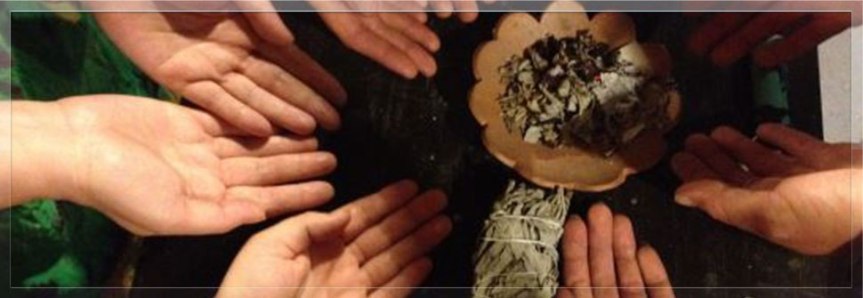
Home – Southwestern Medicine Women Gathering- Southwestern Medicine Women Gathering ~ Good Witches Homestead

Source: Home – Southwestern Medicine Women Gathering- Southwestern Medicine Women Gathering

Celebrating Plants and Women

Welcome to the Southwestern Medicine Women Gathering

Celebrating Plants and Women

You are cordially invited May 4 – 7, 2017 to join the Medicine Women of the Southwest


The Southwest Region of the United States, carries many medicinal secrets in it’s desert. We are gathering local herbalists, desert enthusiasts, plant lovers and healers to share their Medicine Women wisdom for natural healing and wellness.

This Southwestern Gathering will bring together Medicine Women to share their teachings knowledge of the medicinal plants available to us. We will focus on women’s health and well-being, how to use what is in our backyards. Experiencing the celebration of life, Mother Earth and honoring her beauty and abundance that she shares with us.

Herbal workshops, goddess awakening, desert walk, plant identification, bee therapy, tea blends, salves more.

Is Donkey Skin the New Ivory? | Straight from the Horse’s Heart

by Alixandra Caole Vila as published at Nature World News

African Donkeys are Being Slaughtered to Extinction

While China’s taste for elephant ivories have died down, it seems like their fondness has shifted to Donkey skin this time.

According to the National Council of Societies for the Prevention of Cruelty Against Animals (NSPCA), South African donkeys are being slaughtered to extinction for the gelatin found in their skin and their meat.

While the donkey-hide gelatin has no commercial value in Africa, it is a popular ingredient used to create Chinese medicine to treat anemia and menopause-linked ailments. The gelatin, called Ejiao in Chinese, reportedly stops bleeding and strengthens the blood.

“[Ejiao] is quite a popular ingredient in China that people may self-prescribe,” Chinese medicine expert Mazin Al-Khafaji told The Independent. “It’s a hard gel, made from donkey hide, which is then dissolved in hot water or alcohol. It’s also used topically in a cream, for leg ulcers for instance.”

CNN noted that because donkey skin is highly sought-after in China, the donkey population went down from 11 million to six million in the past 20 years. Approximately 80,000 animals had been sold in the first nine months of 2016. While the demand had delivered a valuable stream of foreign currency, it has placed small-scale farmers in a difficult situation.

China File said that because the price of donkeys increased, rural communities who depend on the animals for livelihood are suffering.

Speaking with Science Times, a donkey owner in Mogosani village named Ikgopeleng Tsietsoane shared that currently, the price of a donkey is 2,000 rand. It used to be only 400 rands ($30 or 29 euros).

At present, a number of African countries, including Niger and Burkina Faso, have banned China from buying their donkeys to save the docile beast’s population and the livelihood of locals. However, smuggling still persists in areas where it is considered illegal to do so…(CONTINUED)

http://www.natureworldnews.com/articles/37104/20170406/is-donkey-skin-the-new-ivory-african-donkeys-are-being-slaughtered-to-extinction.htm

Source: Is Donkey Skin the New Ivory? | Straight from the Horse’s Heart

Public comment needed on Nevada mine that will use over 2 billion gallons of water in 10 years | Straight from the Horse’s Heart

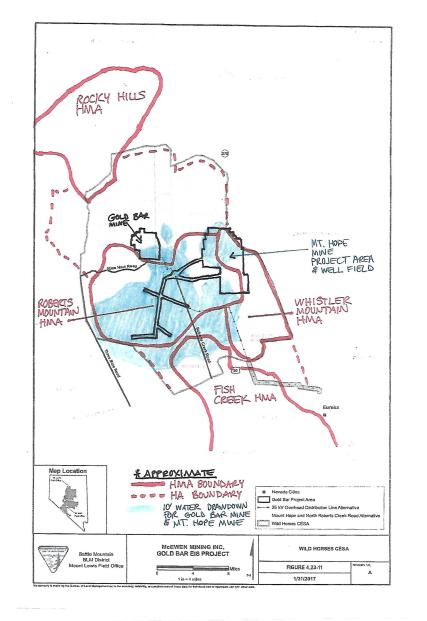
This map shows the Gold Bar Mine area, the approximate HMA (in solid red) and HA boundaries(in broken red lines), the approximate Mt. Hope Mine Project area and well field, and the approximate combined Gold Bar Mine and Mt. Hope Mine 10′ water drawdown area (in blue).  The 10′ water drawdown (in blue) effects almost the entire Roberts Mountain HMA.  The 1″ water drawdown will effect a much larger area.  (Streams can dry up with as little as a 1′ water drawdown.)

BE SURE TO LOOK AT ALL 8 MAPS AT THE BOTTOM OF THIS ARTICLE.

It’s best to write comments in your own words so that the BLM counts each comment as one, instead of counting a thousand similar comments/form letter as only one.  You can read the joint comments submitted by Wild Horse Freedom Federation and The Cloud Foundation below, and a quick summary on pages 5-41 of the DEIS HERE.  Comments are due by April 17, 2017.

Some suggested talking points are:

  1. Be sure to ask for the NO ACTION ALTERNATIVE.
  2. The Gold Bar mine project will use over 2 billion gallons of water in 10 years.  The BLM needs to take into consideration past (historic), current and likely future droughts and climate change when deciding if they will approve this DEIS.
  3. The Project will negatively impact the water, forage, safety, and “free-roaming” abilities of the Roberts Mountain wild horse herd on the Roberts Mountain HMA, as well as the nearby wild horse herds on Whistler Mountain and Fish Creek Herd Management Areas.
  4. The BLM is minimizing the area of impact by only indicating the 10′ water drawdown, and not the 5′ or 1′ water drawdown.  The 5′ and 1′ water drawdown will cover a much larger area of land.  A stream can dry up with as little as 1′ of water drawdown.
  5. When the nearby Mt. Hope mine becomes operational, it is proposed that it will use an additional 7,000 gallons per minute for the life of the mine (40-50 years).  Mt. Hope mine will use over 3 1/2 billion gallons of water per year and over 36 billion gallons of water in 10 years.
  6. The BLM refers to the Cyanide Management Plan (1992), (noted in Vol. 1A, 1.4.3) and the Solid Minerals Reclamation Handbook (1992), (noted in Vol. 1A, 1.4.4).  These are 25 years old and outdated.  Ask for updates of this Plan and Handbook for this DEIS.
  7. The area of Gold Bar Mine will be expanded by 40,000 acres or 62.5 square miles, creating more environmental degradation.

The DEIS is available online at HERE.   Interested individuals should address all written comments to Christine Gabriel, Project Manager, using any of the following ways:

Fax: (775) 635-4034

Email:  blm_nv_bmdo_mlfo_gold_bar_project_eis@blm.gov

Mail:  Bureau of Land Management

Mount Lewis Field Office

50 Bastian Road

Battle Mountain, NV 89820

Wild Horse Freedom Federation and The Cloud Foundation submitted these joint comments regarding the BLM’s Gold Bar Mine Project:


Bureau of Land Management

Mount Lewis Field Office

50 Bastian Road

Battle Mountain, NV 89820

Email: blm_NV_bmdo_mlfo_gold_bar_project_eis@ blm.gov

DATE:  April 5, 2017

Subject: DEIS MMI Gold Bar Mine Project

Dear Ms. Gabriel:

On behalf of The Cloud Foundation (TCF) and Wild Horse Freedom Federation (WHFF), 501(c)3 non-profit corporations, and our hundreds of thousands of supporters throughout the United States, we would like to thank you for the opportunity to submit scoping comments on the Draft Environmental Impact Statement (DEIS) for McEwen Mining Inc.’s (MMI) Gold Bar Mine Project (Project).

TCF, a wild horse and burro advocacy group and an advocacy group for all wildlife on our public lands in the West, and Wild Horse Freedom Federation, a voice for the protection of wild horses and burros and public lands, strongly oppose the expansion of the Gold Bar mining project and we urge the NO ACTION ALTERNATIVE in this DEIS for the following reasons:

Wild Horse Herds To Be Affected:

The Project will negatively impact the Roberts Mountain Wild Horse Herd as well as the nearby herds of Whistler Mountain and Fish Creek Herd Management Areas.

Sage Grouse Habitat Affected:

Not only wild horses will be affected in this area. All wildlife will suffer.

Open pit mining is the most environmentally destructive type of mining anywhere. Extreme weather events can overwhelm all mandated precautions, threatening migratory birds and small mammals. In the case of a flood, even large mammals like wild horses risk exposure to potentially lethal mining waste.

Direct habitat damage due to mining plus further fragmentation by roads and large equipment traveling on these roads will eliminate hopes for the recovery of the Greater Sage Grouse in this area. The transport process in itself is dangerous—accidents, dust, spread of contaminants, noise, etc.

Greater Sage Grouse were once so numerous that the “sky was black” with these large birds, according to Ginger Kathrens’ late Uncle, Allan Ralston, who spoke of this area after his return from WWII. Now the birds are threatened and a species of critical environmental concern. BLM should prioritize these risks.

Impacts on Water Sources:

Per the Gold Bar DEIS, page 4-147, under 2 different scenarios, the mine will either pump 380 gpm (gallons per minute) or 500 gpm (gallons per minute).

If the mine pumps 380 gpm, this equals 22,800 gallons per hour, 547,200 gallons per day, and 199,728,000 gallons per year.  Over 10 years, it will pump over 2 billion gallons of water.

If the mine pumps 500 gpm, this equals 30,000 gallons per hour, 720,000 gallons per day, and 262,800,000 gallons per year.  Over 10 years, it will pump over 2 1/2 billion gallons of water.

This does not include the water which the Mt. Hope mine will use once mining begins.  Mt. Hope is projected to use 7,000 gallons per minute for the life of the mine (40-50 years).

The project will deplete surface and ground water resulting in the drying up of ephemeral streams. Reducing water tables to dangerously low levels will negatively impact perennial streams. This DEIS minimizes the impact on water resources by not providing 5’ or 1’ water drawdown maps and thus minimizing the additional area of land that will be effected.  A stream can dry up with as little as 1’ of water drawdown.

Maps created by Wild Horse Freedom Federation are included in the Appendix.

Map 1 – (Figure 4.23-11 of DEIS) Gold Bar Mine Wild Horse CESA (Cumulative Effects Study Area).  On page 4-265 of the DEIS, it states “The CESA for the wild horses and burros includes Roberts Mountain, Whistler Mountain, and portions of the Fish Creek HMAs, as well as Kobeh Valley and Roberts Mountain HAs where wild horses existed based on past inventories, and where they could be potentially affected by the Project…”

Map 2 – shows the addition of the approximate 10′ water drawdown area – (Figure 4.19-3 of Gold Bar Mine Project), 500 gpm (gallons per minute) for 10 years.

Map 3 – shows the addition of the approximate HMA and HA boundaries.

Map 4 – shows the addition of the approximate Mt. Hope Mine Project area and well field – (Figure 3.13.1 Mt. Hope Project EIS).

Map 5 – shows the addition of the approximate Mt. Hope Mine 10″ water drawdown area – (Figure 3.2.18 Mt Hope Project EIS).

Map 6 – shows approximate sketch of Gold Bar Mine and Mt Hope Mine with HMA and HA boundaries

Map 7 – shows approximate HMA boundaries over grazing allotments map – (Figure 3.7 – 1, Gold Bar Mine EIS)

Map 8 – shows approximate mining, water drawdown, and grazing with the HMA and HA boundaries.

BLM writes in their description of the Roberts Mountain HMA: Water availability is a key influence to wild horse use during summer months. Wild horses will generally travel much farther to water than will livestock. In many HMAs water sources are plentiful and supplied by perennial streams, springs, and human constructed water developments such as livestock water tanks and ponds. In other cases, water sources are limiting, and in drought years, wild horses may have difficulty accessing sufficient water, (emphasis added) especially if the population exceeds the Appropriate Management Level (AML). In these cases, wild horse distribution is closely tied to the location of the available waters, which becomes very important to the health of the herd.

Drought Ridden Region

Drought is common in this driest state in the Union. Emergency removals of wild horses because of the lack of water are common. Removals of 14 wild horse herds occurred in 2009 south of Ely by BLM. The Agency cited the lack of reliable water sources as the reason for the removal of wild horses on 1.4 million acres of public land.

The proposed expansion and creation of more water dependent, extractive uses of the land is irresponsible.

Outdated Plan and Manual

This DEIS is based, in part, on a plan and a manual that are each about 25 years old and outdated.  We are referring to the BLM Cyanide Management Plan (1992), (noted in Vol. 1A, 1.4.3) and the Solid Minerals Reclamation Handbook (1992), (noted in Vol. 1A, 1.4.4).  We ask that you review these outdated materials and update them if you are going to base any part of this DEIS on these outdated plans.

Economic Uncertainty

The potential for failure of this project is so high that the Securities and Exchange Commission (SEC) states: . . .in addition to greater uncertainty as to the economic feasibility of Mineralized Material compared to proven and probable reserves, there is also greater uncertainty as to the existence of Mineralized Material. U.S. investors are cautioned not to assume that measured or indicated resources will be converted into economically mineable reserves. The estimation of inferred resources involves far greater uncertainty as to their existence and economic viability than the estimation of other categories of resources.

Couple the above with the failure of the previous mine developers, Atlas Corporation, who filed for bankruptcy and abandoned the land in an unreclaimed condition in 1999.

Wide Scale Damage

McEwen Mining, a Canadian Mining company, is poised to take over and create even more environmental degradation. The area would be expanded by 40,000 acres or 62.5 square miles, or about 1/3 the size of the Colorado Springs metropolitan area where TCF is headquartered. In other words, this is destruction on a grand scale.

Damage from gold mining is permanent. No amount of mitigation can return the landscape to anything approaching a natural state. Over flights of the area reveal large-scale destruction. Increasing this permanent destruction for the hope of short-term gain is not a reasonable, and certainly not an environmentally friendly decision.

For the above reasons, we urge you to select the NO ACTION ALTERNATIVE for the Gold Bar Mine Project.

Thanks very much for your consideration of our position on this important issue.

Sincerely,


Ginger Kathrens                             Debbie Coffey

Executive Director,                         Vice-President,

The Cloud Foundation, Inc.          Wild Horse Freedom Federation

107 S. 7th Street                                P.O. Box 390

Colorado Springs, CO 80905        Pinehurst, TX  77362

MAPS:

Map 1

http://wildhorsefreedomfederation.org/wp-content/uploads/2017/03/Gold-Bar-Mine-Map-1.pdf

Map 2

http://wildhorsefreedomfederation.org/wp-content/uploads/2017/03/Gold-Bar-Mine-Map-2.pdf

Map 3

http://wildhorsefreedomfederation.org/wp-content/uploads/2017/03/Gold-Bar-Mine-Map-3.pdf

Map 4

http://wildhorsefreedomfederation.org/wp-content/uploads/2017/03/Gold-Bar-Mine-Map-4.pdf

Map 5

http://wildhorsefreedomfederation.org/wp-content/uploads/2017/03/Gold-Bar-Mine-Map-5.pdf

Map 6

http://wildhorsefreedomfederation.org/wp-content/uploads/2017/03/Gold-Bar-Mine-Map-6.pdf

Map 7

http://wildhorsefreedomfederation.org/wp-content/uploads/2017/03/Gold-Bar-Mine-Map-7.pdf

Map 8

http://wildhorsefreedomfederation.org/wp-content/uploads/2017/03/Gold-Bar-Mine-Map-8-with-mining-water-drawdown-and-grazing.pdf

Source: Public comment needed on Nevada mine that will use over 2 billion gallons of water in 10 years | Straight from the Horse’s Heart

Democrats Ask Teachers To Destroy Books Written By ‘Climate Deniers’ | The Daily Caller


Andrew Follett
Energy and Science Reporter

Three senior House Democrats asked U.S. teachers Monday to destroy a book written by climate scientists challenging the environmentalist view of global warming.

The Democrats were responding to a campaign by the conservative Heartland Institute copies of the 2015 book, “Why Climate Scientists Disagree About Global Warming” to about 200,000 science teachers. Democratic Reps. Bobby Scott of the Committee on Education, Raúl M. Grijalva of the Committee on Natural Resources, and Eddie Bernice Johnson of the Committee on Science, Space and Technology all issued a statement telling teachers to trash the book.

“Public school classrooms are no place for anti-science propaganda, and I encourage every teacher to toss these materials in the recycling bin,” Scott said. “If the Heartland Institute and other climate deniers want to push a false agenda on global warming, our nation’s schools are an inappropriate place to drive that agenda.”

The book’s three authors all hold doctorates and taught climate or related science at the university level. The book was written by former Arizona State University climatologist Dr. Craig D. Idso, James Cook University marine geology and paleontology professor Robert M. Carter, and University of Virginia environmental scientist Dr. Fred Singer.

Grijalv accused the scientists of “lying to children about the world we live in to further corporate polluter profits” and said that doing so was “cruel.” Johnson stated that the scientists had sent “scientifically inaccurate materials on climate change to public school teachers across the country” at the behest of ominous right wing donors and the Charles and David Koch brothers.

The best way to get adults to act like environmentalists is by brainwashing their children, according to research published by Oregon State University. Talking to kids about global warming caused their parents to use less energy and act more like environmentalists. The research was run on was run on 30 Girl Scout troops in northern California and had a “lasting impact on family energy consumption” for at least eight months after the end of the program.

Based on the study’s success, the researchers are now disseminating the curriculum to Girl Scout leaders around the country and attempting to adapt it to other groups of kids, including schools and youth-focused organizations such as 4-H with the help of other universities, such as Stanford. The research was financially supported by government grants.

Follow Andrew on Twitter

Send tips to andrew@dailycallernewsfoundation.org.

Source: Dems Tell Teachers To Trash Global Warming ‘Denier’ Books | The Daily Caller

20 Environmental Groups Jointly Demand Wildlife Services Ban M-44 Cyanide Bombs in Idaho | Straight from the Horse’s Heart

Since 2000, Wildlife Services has killed more than 50,000 members of more than 150 non-target species, including federally and/or state-protected animals such as Mexican gray wolves, grizzly bears, kangaroo rats, eagles, falcons, California condors, red-tailed hawks, great horned owls, armadillos, pronghorns, porcupines, long-tailed weasels, javelinas, marmots, snapping turtles, turkey vultures, great blue herons, ruddy ducks, sandhill cranes and ringtail cats.

On March 28, 2017, a coalition of wildlife and conservation groups petitioned the U.S. Department of Agriculture’s (USDA) Wildlife Services (WS) and Animal and Plant Health Inspection Service (APHIS) to immediately ban M-44 devices in Idaho. M-44s are cyanide bombs used by WS to kill local predators such as coyotes, as part of a larger taxpayer-funded wildlife eradication campaign wherein WS, on behalf of the federal government, slaughters millions of wild animals every single year.

The recent hospitalization of a youth and killing of a family dog in Idaho who encountered one of these ground weapons near their home was one motivator for the creation of this petition. The document lists many other incidents of indiscriminate pet injuries and killings by M-44s in Appendix A.

The petition specifically calls on the agencies to:

1. Cease all use of M-44 explosive cyanide devices on all land ownerships in the State of Idaho, and
2. Immediately remove any and all M-44s currently deployed on all land ownerships in Idaho.

Signage on BLM contractor’s property housing former wild horses. ~ photo by R.T. Fitch of Wild Horse Freedom Federation

In November 2016, WS committed to cease the use of M-44s on Idaho’s public lands. Also, in 2016, a workplan between WS and the Bureau of Land Management (BLM) Idaho Falls District forbade the placement of these devices within a quarter mile of residences.

The recent incident with the teen and his pet occurred within a quarter mile of his home. The petition concludes this incident shows the “commitment to cease using M-44s on public lands in Idaho is inadequate to protect public safety and wildlife,” because either WS personnel are not carrying out the commitment or older bombs are still present on public land.

“Cyanide bombs are indiscriminate killers that must be banned,” Andrea Santarsiere, a senior attorney with the Center for Biological Diversity, said in a press release. “Any animal that might pull on the baited trigger is at risk, including endangered wildlife like Canada lynx and grizzlies, as well as people and pets. And in just the past few weeks these cruel devices have injured a child and killed an endangered wolf and several family dogs. Enough is enough.”

The petition explains:

Since 2000, Wildlife Services has killed more than 50,000 members of more than 150 non-target species, including federally and/or state-protected animals such as Mexican gray wolves, grizzly bears, kangaroo rats, eagles, falcons, California condors, red-tailed hawks, great horned owls, armadillos, pronghorns, porcupines, long-tailed weasels, javelinas, marmots, snapping turtles, turkey vultures, great blue herons, ruddy ducks, sandhill cranes and ringtail cats.

The petition also discusses how the cyanide bombs and other non-selective killing methods are actually unproductive because they disrupt ecosystem balances, can actually increase livestock losses and have not been shown to be economically effective.

Bethany Cotton, Wildlife Program Director for WildEarth Guardians, previously asserted to EnviroNews that “many ranchers peacefully coexist with coyotes and report no conflicts,” and that nonlethal predator response options include solar powered electric fencing and livestock dogs, amongst others.

“Ranchers can use less vulnerable types of livestock, hang flagging called ‘fladry,’ or actually put cowboys out there with their animals to discourage predator losses without resorting to demands for poisons and poisonous land mines that kill pets and non-target wildlife,” Erik Molvar, Executive Director of the Western Watersheds Project, told EnviroNews. He signed the petition on behalf of the coalition of environmental groups. “It is senseless and irresponsible for federal agencies to use taxpayer dollars to sow land mines and poisons in open country to kill native wildlife to prop up failing ranching operations,” he stated.

Federal law requires the petitioned agencies to provide a final decision in writing to the petitioners: Western Watersheds Project, Predator Defense, WildEarth Guardians, the Center for Biological Diversity, Friends of the Clearwater, Alliance for the Wild Rockies, Western Wildlife Conservancy, Nevada Wildlife Alliance, Gallatin Wildlife Association, Environmental Protection Information Center, the Wolf Conservation Center, Wilderness Watch, Klamath Forest Alliance, Northeast Oregon Ecosystems, Yellowstone to Uintas Connection, Footloose Montana, Animal Legal Defense Fund, Project Coyote, Voices of Wildlife and the Mountain Lion Foundation…(CONTINUED)

http://www.environews.tv/033017-20-environmental-groups-jointly-demand-wildlife-services-ban-m-44-cyanide-bombs-idaho/

Source: 20 Environmental Groups Jointly Demand Wildlife Services Ban M-44 Cyanide Bombs in Idaho | Straight from the Horse’s Heart

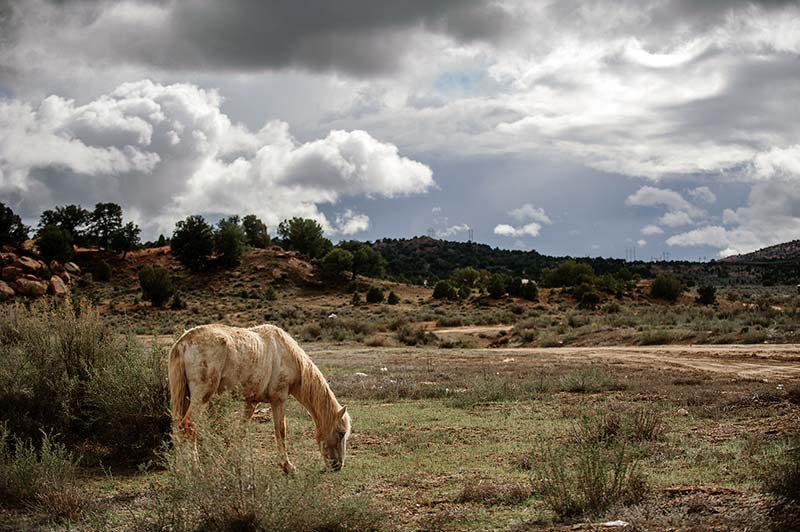
Fish and Wildlife may propose a horse hunt on the Navajo Nation – Navajo Times

Navajo Times | Adron Gardner
A gaunt horse grazes along State Route 264 near Tse Bonito, N.M. on March 27.

WINDOW ROCK

With multiple efforts to reduce the number of wild horses on the Navajo Nation, officials are considering a hunt.

The Navajo Nation Department of Fish and Wildlife asked hunters and sportsmen for their support for a hunt as a potential means to reduce the number of wild horses on the Navajo Nation at the 2017 Navajo Nation Sportsman’s Expo on March 25. NNDFW staff confirmed after the conference that a proposal has not yet been completely drafted, so the department hadn’t yet anticipated details of how the possible hunt would work such as weapons to be used, number of tags to take horses, and hunt unit maps.

Department manager Gloria Tom said the department hoped to address the problem and would propose a solution to Navajo Nation governance once drafted, but also called on the hunters present to add their voices to the conversation around the feral herds and what to do about them.

“Our leaders, they really need to hear from people like you,” Tom said. “People who live out there, people who hunt.”

She said government officials sometimes take information from NNDFW as something that employees are paid to say as part of their jobs and concerns from experts who work for the government might have less impact on elected officials than the voices of their constituents and voters.

“To me, you have a greater chance of success,” she said.

She said previous attempts to trap, round up, or allow horses to be adopted had not made a large enough impact. NNDFW officials said the department is drafting a proposal to get support from Navajo Nation leaders.

“I compare this problem to our cat and dog problem,” she said.

Source: Fish and Wildlife may propose a horse hunt on the Navajo Nation – Navajo Times

Federal Bill to Ban Lethal Wildlife Poisons Introduced after Three Dogs Killed by M-44 “Cyanide Bombs,” Kids Exposed ~ Predator Defense


March 30, 2017 – This month three dogs were killed by M-44 “cyanide bombs” in Wyoming and Idaho. In both cases children were present and put at grave risk of poisoning. This is beyond unacceptable.

M-44s are indiscriminate sodium cyanide ejectors set by USDA Wildlife Services agents and local wildlife agencies for “predator control.” Details | Diagram There is no justifiable excuse for the use of M-44s. It is insane to set poison traps in the great outdoors.

We’ve been pressuring for an M-44 ban since 1990, collaborating with Rep. Peter DeFazio (D-Oreg.). We are thrilled to announce that on March 30 Rep. DeFazio introduced the legislation we’ve been working on in Congress. The bill is called H.R. 1817, “The Chemical Poisons Reduction Act of 2017.” It would ban both lethal M-44 sodium cyanide devices and Compound 1080, which are used unnecessarily by government wildlife agents for predator control.

What we need now is your help to get this legislation passed into law. This is a nonpartisan, public safety issue, and there honestly are no valid arguments against banning wildlife poisons. Learn how to help

Background on March M-44 events

Early in March 2017 we began working with a family in Wyoming who went out for a beautiful pre-spring walk on the prairie–one they’d taken many times before–and lost two dogs in horrifying circumstances.

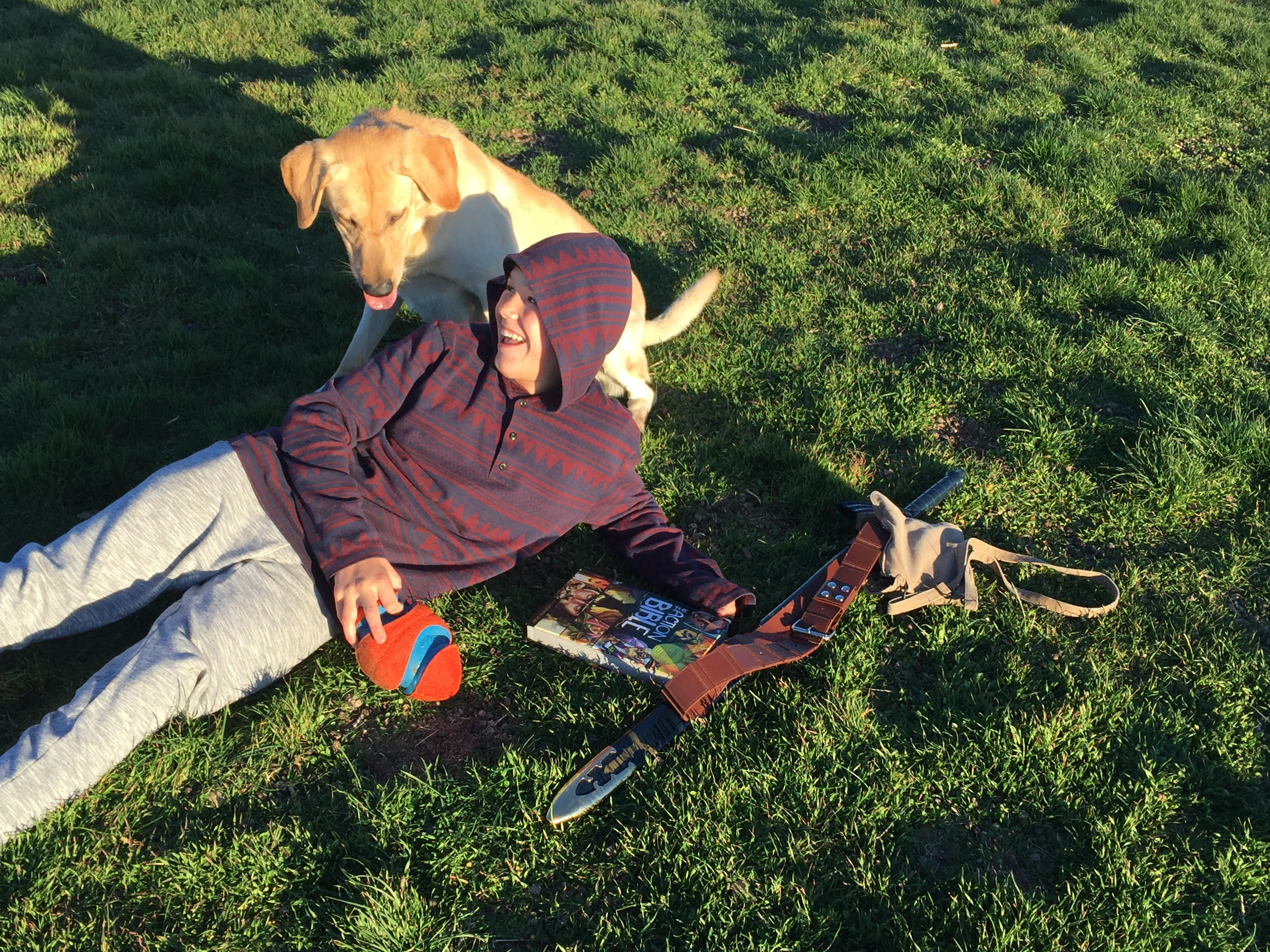
We’re also spreading the word about the other devastating event in Idaho, where a 14-year-old boy in Pocatello, Idaho accidentally set off an M-44 behind his back yard and watched helplessly as his dog died an excruciating death. The boy had to be hospitalized and is being closely monitored. He and his family are devastated and outraged. Here’s what our executive director, Brooks Fahy, had to say about this case in The Oregonian:

“[The] Idaho poisoning of a dog and the near poisoning of a child is yet another example of what we’ve been saying for decades: M-44s are really nothing more than land mines waiting to go off, no matter if it’s a child, a dog, or a wolf. It’s time to ban these notoriously dangerous devices on all lands across the United States.”

On March 28, 2017, we joined a coalition of environmental and wildlife groups asking for an immediate ban on M-44s in Idaho and removal of all existing devices in the state.

How You Can Help

Media Coverage

Learn More

Oregon Wolf Killed by M-44, a Poison-Filled Device that Also Endangers People, Pets


March 2017 – Just how many animals need to die a horrible death before people realize it is insane to set poison traps in the great outdoors?

A wolf died a cruel death in Oregon on Feb. 26, 2017 because of a device set on private land by federal agents from the egregiously misnamed program within the USDA called “Wildlife Services.”

We’ve been working with U.S. Rep. Peter DeFazio (D-Oreg.) for decades to ban wildlife poisons like the M-44 sodium cyanide ejector. These indiscriminate devices also endanger pets and people.

M-44s are an outrage, and taxpayers fund their use. This travesty must be put to an end. And it will be if enough of us speak out and demand it. We are currently working on new legislation to ban M-44s and will keep you posted. Learn how you can help

Media Coverage

How You Can Help

Learn More

Source: Predator Defense – a national nonprofit helping people & wildlife coexist since 1990