Old-Growth Forest Myths Vs Reality

I really enjoy spending time in old-growth forests.

I admire the sights, I love the sounds, and I like that old-growth forests can make a human feel small, yet still important. 

Old-growth forests once covered large areas of land in North America, but these forests are far less common today.  

As a result, we might find ourselves imagining things that aren’t entirely true.

We might believe, for instance, that North America was an endless expanse of old-growth forest at the time of European settlement.  We might also believe that North America’s old-growth forests were — and still are — untouched and free from disturbance.

But how much of what we believe is true?

In a brand new video, I explore a few old-growth forest myths and discuss why our modern perceptions often miss the full story.

You can watch the video here.

Thanks for reading and watching, and thanks for your continued support!

— Adam Haritan

Exploring Wild Ecosystems Is Now Open For Enrollment

Greetings,

I am excited to announce that my newest online course, Exploring Wild Ecosystems, is now open for enrollment!

You can register here.

This course is designed to improve your ecological knowledge by introducing you to fascinating ecosystems — including alvars, barrens, bogs, dunes, fens, glades, savannas, vernal pools, and others!

Learning to recognize ecosystems is an essential step toward understanding how nature works.  When we pay attention to the bigger picture, we see beyond individual components.  We see connections, we see relationships, and we see where humans fit into the story. 

If you want to develop ecological literacy; if you want to be able to read landscapes more effectively; if you want to see how all the components within nature are connected, consider enrolling in Exploring Wild Ecosystems today.

Please note that Exploring Wild Ecosystems is open for one week only — from today until Monday, September 30.  After that, registration will be closed.  Upon registration, you can immediately access all course content and view the lessons at your own pace.

To learn more about the course, check out this video which gives you an overview of what you can expect.

Thanks for supporting nature education!  I hope to see you in there!

—Adam Haritan

Physical Land Healing: How do I know what to do?

Dana's avatarThe Druid's Garden

Some years ago, I remember one influential druid speaking at a major event and saying, “The best thing you can do in nature is pick up the garbage and get out.” From a certain standpoint, this perspective makes a lot of sense. It is the same perspective held by many conservationists trying to preserve pristine lands or lands that have been replanted and are healing; the best thing that can be done is figure out how to keep people from mucking them up, pick up garbage, and leave them undisturbed. This is a perspective ultimately rooted in the desire to care for nature, to preserve nature, and to do good. Unfortunately, this perspective doesn’t really seem to provide a meaningful way to respond to today’s problems ecologically because it’s largely based on assumptions that mitigate damage rather than actively regenerate ecosystems. This perspective as a whole teaches us how to…

View original post 3,336 more words

In Praise Of Wood Frogs

Greetings,

In my neck of the woods, signs of spring abound — from the blooming of Snow Trillium and Sharp-Lobed Hepatica, to the reappearance of the Eastern Phoebe and warmer days.

Among the indications that winter has predictably expired and tipped its hat to another growing season is the emergence of the wood frog.

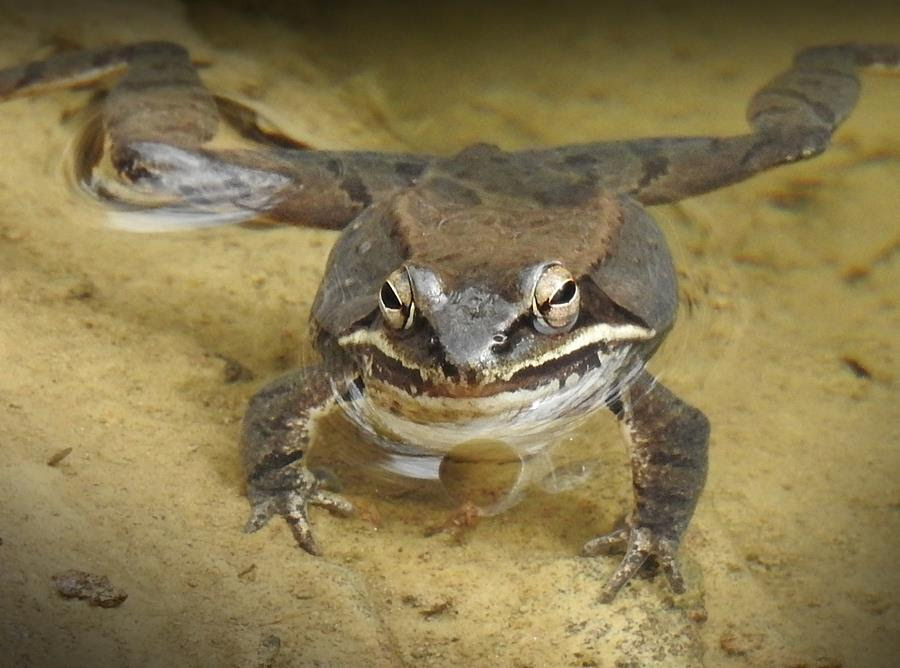
The wood frog is one of nature’s most resilient and adaptable creatures, occupying a range that — at the species level — spans thousands of miles of varied habitats.  Perhaps most interesting of all is that this hardy frog has the amazing ability to freeze solid when temperatures plummet… and survive the experience!

The wood frog has been patronizing the local pools lately, allowing itself to be observed and filmed by anyone with any interest in these sorts of things.

As it turns out, I do have a deep interest in these sorts of things, and I recently visited a nearby floodplain to document and film the seasonal manners of this libidinous amphibian.

If you are interested in learning more about the wood frog — and also about vernal pools, cryoprotectants, and holistic approaches to conservation — check out the brand new video!


Have you ever seen something that looks like this?  Though it resembles a pinecone, this structure is not produced by any conifer tree.  Instead, this pyramidal growth is produced in response to an insect that feeds on a particular flowering shrub.  Check out this recent Instagram post to learn more!


Thanks for reading and watching… and as always, thank you for your support!

-Adam Haritan

A Druid’s Guide to Connecting with Nature, Part I: A Framework

A Druid’s guide to connecting with Nature – Part I:  A Framework

Dana's avatarThe Druid's Garden

A lot of people find druidry because they want to “connect” with nature.  They want to attune to nature, feel part of it, gain knowledge and wisdom about it. But what does “connecting” to nature look like in practice?  Going out in the woods and feeling good?  Knowing the name of trees?  Walking with sacred intent in a natural place?  Spending time in nature?  All above the above? And so, over the next few posts, I want to spend more time with the concept of “connecting to nature” and share some strategies for what people can do to connect with nature in a multitude of ways.

As I’ve written about earlier, part of what I see as the core of druidry as a spiritual tradition is the work of “connection.” In that post, I talked about connecting to nature, connecting to the spirit, and connecting to the creative practices as…

View original post 1,761 more words