Ozark Encyclopedia – C – Chestnut – Mountain Man Traditional Healing

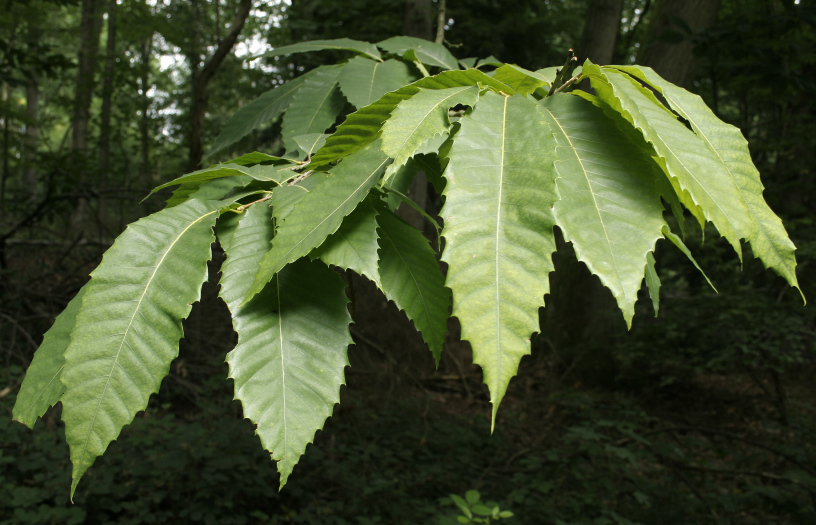
Chestnut – Castanea dentata, C. pumila

Parts used: bark, leaf, nut

Traditional uses: Compound decoction of leaves used as cough syrup. Leaves from young sprouts dipped in hot water and put on sores. Cold, compound infusion of bark used to stop bleeding after childbirth. Infusion of year old leaves taken for heart trouble.

“In some places Chestnut leaves are used as a popular remedy in fever and ague, for their tonic and astringent properties. Their reputation rests, however, upon their efficacy in paroxysmal and convulsive coughs, such as whooping-cough, and in other irritable and excitable conditions of the respiratory organs. The infusion of 1 OZ. of the dried leaves in a pint of boiling water is administered in tablespoonful to wine glassful doses, three or four times daily.” ~Grieve MH 

Leaves used for coughs – “Chestnut leaves syrup is good for cough when seeped as tea.” ~Parler FBA II 1951

Bark tea for hives – “Chinquepin bark tea sweetened with honey will cure hives.” ~Parler FBA II 2466

Bad luck to burn – “If you burn chinquapin wood, it will cause bad luck or a death in the family.” ~Parler FBA XIV 11262


Grieve, Margaret A Modern Herbal (MH)

Moerman, Daniel E. Native American Ethnobotany (NAE)

Parler, Mary Celestia Folk Beliefs from Arkansas (FBA)

Source: Ozark Encyclopedia – C – Chestnut – Mountain Man Traditional Healing

Wild Horses Misinformation and Bad Science: Corrupt Government Agency and Non-Profits ~ Photojournalist ~ Journalist

By John Cox

john-cliffs-blog-post

“The fact that we live at the bottom of a deep gravity well, on the surface of a gas covered planet going around a nuclear fireball 90 million miles away and think this to be normal is obviously some indication of how skewed our perspective tends to be.” ― Douglas Adams, The Salmon of Doubt: Hitchhiking the Galaxy One Last Time

Why do we take issue at the lack of good science data with what is called today, Pesticide PZP? Because subjectivity and science remain two separate situations. The dynamics of each very different. Many of us find Pesticide PZP nothing more than subjective rhetoric – the results on our Public Lands of this endeavor remains quite negative, with no good potential results foreseen in the future. Wild Horses are going extinct! False science, misinformation, ignoring of Ecological demands, and corruption the reasons why . . .

The wild horses on America’s Public Lands is falling victim to what many of us simply refer to as bad, and incompetent white-paper gibberish. As history shows us time and again, government agencies seem to attract this type of research, calls it science, and as history shows us, time after time, until we see the outstanding negative results, in this case a species going extinct, do we finally realize the mistake.

But only over time is the burden of responsibility taken to task, the fingers point to those who cannot defend themselves, and these elements of destruction, these non-profits and BLM who promote this Pesticide PZP scam, simply move-on to other schemes and scams to obtain taxpayer money differently, is all . . .

Well, as taxpayers and American’s it is time for all of us to Stand Up and say no to any further Pesticide PZP use —

Spotted Owls in the Cascades

For explanation reasons, I am using the Spotted Owl within the Nooksack River watershed, as well as the Skagit River Valley, both in the Cascade Mountains. It shows us, overtime, the dynamic also involved within the wild horses, even though separate ecological zones, separate species for sure, yet similar in population encounter and census.

The biology, when all the variables considered, show situations that remain overlooked, or even ignored, by Pesticide PZP research. Many define, categorically, Pesticide PZP as questionable subjective reasoning of combined-information only, merely passed-off as science –

“If we knew what it was we were doing, it would not be called research, would it?” ― Albert Einstein

Many of us accept this fact of facts, as there simply exists too many variables left unexplored from the Pesticide PZP data gathering, to be any type of acceptable science what so ever. Way too many significant data situations ignored or even not thought about what so ever, which would show beyond a doubt Pesticide PZP, a questionable situation at best, and non-useful. The reasoning why significant variables left unexplored? Well, let’s take a look at some of the more obvious, and viability of our wildlife in general.

A census of the Spotted Owl may show twenty-five owls exist, but perhaps only seven are of a reproductive age, and only five sexually active. The outcome of this, within a good biology context, would likely be five-owls, not twenty-five. To assimilate across the board a 20% to 38% increase, as they do with wild horses, is simply bad management, untruthful, and no good-science or biology would back up such claims what so ever – as variables do exist on this planet, always.

When we refuse to consider significant variables, that do exist and apparent should not be ignored, then we have to question the supposed science involved. On the same scale of research, if we ignore the habitats, or Ecological Zones that exist, deduction through subjectivity only, and as if Pesticide PZP unharmful within any circumstance – but never explored, through due diligence and good data gathering, we never find out if harmful or not in Ecological Zones of any type. . . Used on something like Wild Horses, we become very concerned at this monumental error in judgement, that certainly lacks scientific responsibility, and one can also attest, irresponsible within an ethical or humane context as well . . . – John Cox, The Cascades

Source: Wild Horses Misinformation and Bad Science: Corrupt Government Agency and Non-Profits

Tower of Babel – secretsoftheserpent

Source: Tower of Babel – secretsoftheserpent

By gserpent

tower-of-babel-19-jun-091

To most researchers the Tower of Babel is used to explain how we as humans have so many languages. The demon like god of the patriarch religions did not like the human race trying to reach the heavens, so he got mad, threw a temper tantrum and made everyone speak in different languages. This way we could not understand each other and work together accomplish amazing feats.  No this god wanted us not to understand each other and fight for the rest of eternity. How does anyone believe this stuff? Now that we have the childish version out-of-the-way, let’s get on with the truth.

Most researchers think that babel comes from the hebrew ‘balal’ meaning to confuse or scatter. It is where we get english word babble. Theologians say babel comes from Babylon because that is where they think the tower was, in Babylon. Ralph Ellis has shown that babel comes from the Egyptian ‘berber’ and means pyramid. As a matter of fact he as actually shown that the real name of this Tower of Babel was Mount Shenar. Mount Shenar means snow mountain. The Great Pyramid had a limestone covering. It was pure white. They built it to look like a snow-covered mountain. The Tower of Babel was also called the watchtower. That is exactly what the Great Pyramid was, a watchtower to watch the heavens.

The Tower of Babel myth is the building of the Pyramids, but the scribes that wrote this were using ancient texts that were in their possession. They had to spin this story in their favor. If you have read my Lemurian Magic post, you know that the Pyramids were built after the cataclysm. Ancient Egypt had an Upper(matriarch) Egypt and Lower(patriarch) Egypt. Egypt was all about unifying Upper and Lower Egypt. The union of the two land was called Semai Taui or ‘tying the knot’. This is why getting married is referred to as tying the knot. If you wanted to help unite Egypt, you could stay. If not, get out. Every civilization around Egypt is Egyptian rejects. Sumer, Babylon, Judea, Greece, Rome, Arabia, and all the Mediterranean countries. None of these civilizations wanted to work together, so they left or were kicked out of Egypt. They started their own patriarch countries and languages. These countries hated Egypt for not giving them their way, but their ancestors had still helped build the Pyramids.

About the time the propaganda of the Torah or Old Testament was being written, high priests of Lower Egypt and surrounding countries that hated Upper Egypt decided the common man was not to be included in the secrets. The common man was stupid and vulgar to them. The common man had to be controlled. Several times they tried to regain Lower Egypt and instill monotheism for control of the common man, but were eventually kicked out. This just added to the hatred of Egypt and the common man. The ancient texts had to be written in a way that only certain people would understand them. The rest would take them literally and be controlled. Other scribes, like Manetho, caught on to what was happening and wrote their version of history to try to preserve the true history. But how many people have even heard of Manetho? Then you have the Nag Hammadi scrolls. The catholic church got their filthy hands on them, but good thing for us the church didn’t understand what the scribes were trying to tell.

The story of the Tower of Babel myth is the building of the Pyramids, but they had to spin the texts in their favor then destroy any evidence that said otherwise. Instead of the Pharaoh(god) kicking out all the people who didn’t want to unify and work together, they made him kick out the people who wanted to unify to make it look like he didn’t want them working together. They completely reversed history in their favor. Can’t make money off a god that wants to unite people. They used this same type method with the biblical family of Jesus. This was a matriarchal family, but they used them to create a patriarchal religion(see His Royal Jesus). The people who scattered to the outlining countries started their own languages, but this myth is code for the language of the ancient texts being used. It is code for when these scribes started confuse people with their writings. This showing that the truth had to be hidden, so that the common man could be controlled with whatever religion or government they invented. The language of these texts are impenetrable and they seem like nonsense to the common man. As truth starts to leak out I believe the bi-polar, demonic, patriarch gods will be on their way out. The so-called elites thought that their ancestors had destroyed all the evidence of the truth. They thought their texts were all that was left. If someone tried to translate them in a language the common man could read, they burnt them at the stake. What they didn’t bank on was the vulgar, common man being smart enough to dig the truth out of these stories. It is the common man that has begun to show the truth to the world.

The Great Pyramid had a walk way that ascended to the top. It was in the white limestone castings that the Lower Egyptians tore down. It was known as the Latter to Heaven or the Latter of Osiris. The Lower Egyptians decided that if they couldn’t have it, no one could have it. Then they made this Tower of Babel myth, so that anyone who knew the truth about the Great Pyramid would be punished by their demonic god. The Tower of Babel, Mount Shenar, Mount Sinai, and Mount Ararat are all the Great Pyramid.

Homemade Medicine – Crooked Bear Creek Organic Herbs

Source: Homemade Medicine – Crooked Bear Creek Organic Herbs

Guide to make your own simple, effective herbal remedies

Making our own herbal medicines and body care products can save money and improve our health, and it’s much easier than you may think. If you already make herbal teas, then making infusions, decoctions, tinctures, salves and poultices can quickly become part of your repertoire, too. Don’t worry if they sound confusing; you’ll soon discover how to prepare a variety of plants to make a range of simple but effective herbal medicines.

One very important note before you begin making herbal medicines: Always make sure you are using the correct plant (check the Latin name) and the correct part of the plant (flower, leaf, roots), as some parts may be toxic if used internally.

Internal Medicines

Tea Time

Making herbal tea may seem fairly straightforward, but to reap the greatest medicinal value from herbs, we need to do more than dunk a tea bag in hot water. There are two main forms of herbal tea: infusions and decoctions.

Infusions: Infusions are the commonly known form of herbal tea, in which herbs are literally infused in hot water, usually one heaping teaspoon of dried herb (or one teabag) per cup of hot water for 10 to 20 minutes. This is the ideal method for extracting the medicinal compounds in most berries, flowers, and leaves. You can also use fresh herbs, but because of their higher water content, you usually need to double the amount of herbal matter per cup of water (two teaspoons per cup of water instead of one).

Decoctions: To extract the medicinal compounds from seeds, roots or stems, you’ll want to make a decoction, which involves boiling the herbs and allowing them to simmer for about an hour, usually allowing one heaping teaspoon of dried herb per cup of water. Note that this method is less suitable for berries, flowers, and leaves because it tends to destroy many of the delicate medicinal compounds they contain. As with infusions, you can use fresh herbs, but you typically need to double the amount of herb matter per cup of water.

What if you want to make a tea from some combination of roots, berries, seeds, stems, flowers and leaves? Start by making a decoction with the roots, seeds or stems. Bring it to a boil, then reduce to a simmer to continue brewing for an hour. Turn off the heat and add any berries, flowers, and leaves. Allow the mixture to steep for an additional 10 to 20 minutes. Now you’ve extracted the best medicinal compounds from all of the herbal components you’re using.

Tinctures

Tinctures are alcohol extracts of fresh or dried herbs. They’re highly effective at preserving a plant’s active constituents. You can make a tincture from roots, leaves, seeds, stems or flowers.

To make an herbal tincture, finely chop the fresh, clean herb you are using. You can also use dried herbs. Either way, the idea is to chop the herb as much as possible, to give the alcohol as much surface area to act upon as you can. Some herbalists recommend grinding dried herbs in a coffee/spice grinder before making a tincture.

Place the chopped or ground herb in a half-quart or quart-sized glass jar. Fill the jar with as much plant matter as possible to ensure the medicinal value of your tincture, keeping in mind that you’ll need enough alcohol to completely submerge the herbal matter. Top with vodka or pure grain alcohol, making sure all of the plant matter is submerged in the alcohol to prevent mold growth. Note that different kinds of alcohol will produce different kinds of tinctures. Visit Mountain Rose Herbs for more information. Date and label the jar, and allow the mixture to sit for two weeks, shaking daily to encourage extraction. After two weeks, strain the contents through a cheesecloth-lined sieve. After most of the liquid has gone through the sieve, pull up the corners of the cheesecloth and, using clean hands, carefully wring out any remaining liquid. Store the herbal tincture in a dark glass jar or dropper bottle away from heat or sunlight to preserve its healing properties. Tinctures will usually keep for a few years. You can make an herbal tincture out of any medicinal or culinary herb that can be used internally. A typical tincture dose is 30 drops (about one dropper full) three times daily, but we recommend looking up specific dosage recommendations for the herbs you use. Avoid tinctures if you are pregnant or nursing, or if you have liver disease, diabetes or alcoholism.

Skin-Healing Medicines

Infused Oils

Infused oils are made by infusing herbs in oil, rather than alcohol as in tinctures. The infusion technique works to transfer the healing properties of herbs to oils. Infused oils are excellent for massage; as skin or bath oils; or as a basis for balms and salves, which I’ll explain in the next section. Never ingest these oils.

Infused oils are easy to make. Choose any type of vegetable or carrier oil, other than petrochemical-based oils such as baby oil or mineral oil. It is also best to avoid oils that break down quickly when exposed to heat, such as flaxseed oil. I prefer olive oil or sweet almond oil, which can be warmed to encourage the transfer of healing compounds from the herb matter to the oil.

You can make many types of infused oils, but two of the most common are St. John’s wort and calendula oils. St. John’s wort oil, made from the flowers of the plant, can be used for treating bruises, swellings, hemorrhoids, scars and sprains. It is also recommended as a topical treatment for eczema. Avoid sun exposure for a few hours after using this oil on your skin as it can cause photosensitivity. Calendula oil, also made from the flowers of the plant, aids wound healing and alleviate various skin conditions.

Making herbal infused oils is particularly suited for the delicate flowers and leaves of plants. Simply add fresh flowers or leaves to a jar and fill it with oil, such as sweet almond oil, apricot kernel oil, almond oil or olive oil. You’ll want enough plant matter to ensure the medicinal value of the infused oil, but not packed so tightly that the oil cannot penetrate the plant material. The plant material must be completely submerged in the oil to prevent mold from forming. Label and date the jar, including the herb and the oil used. Allow the infusion to rest for two weeks, shaking the bottle periodically to encourage the infusion process. After two weeks, strain the herbs from the oil, squeezing out any remaining oil with clean hands. Cap and label the jar, and store away from light and heat.

Salves

Salves are basically herbal balms or ointments made by thickening herbal oil infusions with melted beeswax. Most health-food stores sell plain beeswax, which can be shaved with a potato peeler or grated with a cheese grater and then melted over low heat. You can also buy beeswax pastilles, which are ready to melt. Be sure to avoid other types of wax, as they are made of petroleum byproducts.

Allow two tablespoons of shaved, melted beeswax to one cup of infused oil after the herbal material has been strained off. Melt the oil and beeswax over low heat, preferably in a double-boiler, to prevent overheating. Stir regularly. Remove from the heat as soon as the beeswax is melted and well-incorporated into the oil. Immediately pour into small, shallow jars, tins or lip balm containers. Let cool undisturbed to allow the ointment to set. Use for skin irritations and other skin conditions, and for dry or chapped lips. Similar to herbal infusions, calendula, and St. John’s wort is excellent choices to use in salves.

Poultices

A poultice is a paste made with herbs that are applied to the skin. It is typically applied while hot or warm, except when made with herbs that are naturally chemically hot, such as chilies or ginger. To make a poultice, fill a natural-fiber cloth bag with powdered or chopped fresh herb matter. Tie it closed, and then place it in a bowl of hot water just long enough to soak and heat the herb. Remove it from the water, and apply to the affected area until the poultice has cooled and until you experience some relief. Reheat and reapply the poultice. It is best to use a fresh poultice each day.

Poultices are particularly effective in soothing aching or painful joints or muscles, as is the case with ginger. Calendula helps bruises and damaged skin, while echinacea boosts the immune system to help heal long-lasting wounds.

Some of My Favorite Healing Herbs

All of the herbs listed here are safe and effective. However, before making specific remedies of your own, make sure to research the herb you plan to use to ensure you’re using the right parts and amounts, as well as contraindications that may apply specifically to you and your circumstances.

• Calendula (Flowers): Skin healer extraordinaire
• Chamomile (Flowers): Relaxant and dental antimicrobial (use tea as a mouthwash)
• Dandelion (Roots or Leaves): Osteoporosis preventer and anticancer powerhouse
• Echinacea (Roots): Immune booster
• Feverfew (Flowers and Leaves): A headache and migraine alleviator
• Garlic (Cloves) Amazing germ buster
• Ginger: (Root): Muscle and joint pain healer
• Horsetail (Leaves): Nail, teeth and bone builder
• Juniper (Berries): Urinary tract antimicrobial
• Lavender (Flowers): Anxiety and depression alleviator
• Licorice (Root): Chronic fatigue syndrome solution
• Nettles (Leaves): Allergy remedy
• Oregano (Leaves): Antimicrobial antidote
• Peppermint (Leaves): Headache remedy and sinusitis aid
• Red Clover (Flowers): Relieves menopausal symptoms such as hot flashes
• Rosemary (Leaves): Memory booster
• St. John’s Wort (Flowers): Anxiety antidote and anticancer therapy; skin healer
• Thyme (Leaves): Cough and antibacterial medicine
Ozark Encyclopedia – B – Buttons – Mountain Man Traditional Healing

Source: Ozark Encyclopedia – B – Buttons – Mountain Man Traditional Healing

Used in wart buying ceremony – “Some specialists go through a kind of wart-buying ceremony, but no money actually changes hands. You show the man your wart, and he says: ‘Want to sell it?’ You answer ‘Yes, sir.’ Whereupon the wart taker produces a big safety pin with many buttons strung on it. He selects one of these and hands it to you saying: ‘Carry that there button in your pocket till the wart’s gone. Hit’s mine now, ‘cause I done bought an’ paid for it.’” ~Randolph OMF 127

Buttons kept for good luck – “A button received as a gift is always lucky, no matter what the color. Years ago, many an Ozark girl collected buttons from her friends and strung them together into a sort of necklace called a charm string. A charm string not only brought good fortune to the owner but also served as a sort of memory book for women who could not read one button recalled a beloved aunt, another a friend’s wedding, still another a dance or a quilting party or an apple-peelin’ or some other pleasant occasion.” ~Randolph OMF 61

White button for eye troubles – “When a foreign body gets into the eye, just press a big white button against the eyelid and wink repeatedly; the object which is causing the trouble will pass out through one of the holes in the button. Near Day, Missouri, a small boy got some sawdust in his eye. A friend cut a small pearl button off his shirt, washed it carefully, and somehow placed it under the boy’s eyelid. I was told that the poor chap walked about for several minutes, with the big bulge in his eyelid plainly visible. It must have been terribly painful, but he stuck with it until the tears washed the sawdust away.” ~Randolph OMF 139-140

“If you hold a big white button over your eye when something is in it, it will leave through one of the holes.” ~Parler FBA II 2167

In mouth for head pains – “A white bone button, held in the mouth, is recommended for any pain above the tongue, especially headaches and earaches.” ~Randolph OMF 145

Brass button in mouth for earache – “Some mountain folk cure the earache, it is said, by putting a brass button in the patient’s mouth and then unexpectedly discharging a gun behind his back.” ~Randolph OMF 145

“Some people believe you can cure an earache by putting a brass button in your mouth and shoot a gun unexpectedly behind your head.” ~Parler FBA II 2123


Parler, Mary Celestia Folk Beliefs from Arkansas (FBA)

Randolph, Vance Ozark Magic and Folklore (OMF)

Pied Piper – secretsoftheserpent

Source: Pied Piper – secretsoftheserpent

By gserpent

MUS-FAPC2020_500


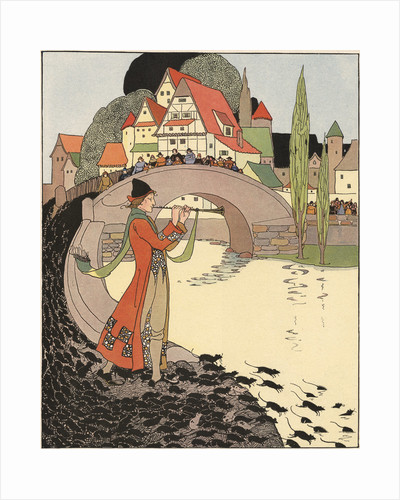
The Pied Piper of Hamelin is an example of just how brilliant the scribes were in preserving history. With Goethe and the Brothers Grimm involved, this myth holds some very astounding secrets. This myth is true, but it didn’t happen in the way that researchers think. It’s time to reveal the secrets of this myth that have been hiding for over 700 years.

The Pied Piper legends came out about the same time as the King Arthur legends. These legends came out  when the Crusaders brought back ancient texts from Syria and Jerusalem. The stories of these ancient texts spread through Gaul, Germany, Italy, Spain, Portugal, Greece, Scandinavia and Holland. Witty scribes got a hold of these ancient texts and preserved the history in stories of their local. The entire story of King Arthur is the story of the biblical Jesus, but they made him a King in Britain(See King Arthur). The story of the Pied Piper took place in Egypt, but the Germanic scribes placed it in Germany.

The first clue to this story is the Pied Piper shows up in a ‘coat of many colors’. This is the same thing Joseph, son of Jacob, wore in the Old Testament. In Patriarch Pharaohs, I showed that Jacob was the Lower Egyptian Pharaoh Yacobaam. He was kicked out of Egypt, but his son Joseph became a high priest to the Upper Egyptian Pharaoh. This ‘coat of many colors’ is what high priests wore in Egypt. This is telling the people ‘with eyes to see’ and ‘ears to hear’ that this is an Egyptian story. It was this Upper Egyptian bloodline of Joseph’s that was kicked out of Egypt twice. The first was his father Yacobaam(Jacob) and the second was a few generations later. We know this story as the story of Moses and the Israelites.

Using rats and cats is reinforcing that this was a dispute between Upper and Lower Egypt. The Rat Goddess was Tat-Taiut, she was always portrayed wearing a disk with horns and the Uraeus. The disk is the moon and the horns are for Taurus. These were symbols of Upper Egypt. The Uraeus is the cobra symbol of Lower Egypt. She was known as the “Goddess of the two lands”(Upper and Lower Egypt). The cats are symbolizing Bast or Bastet. She was the Cat Goddess of Lower Egypt. The Lower Egyptians were the ones forcing monotheism on everyone in Egypt. They wanted to get rid of all the gods except Aton, the sun. That is why all the cats are dead in this story.

The Piper tells the Mayor he will rid the town of rats for 1,000 florins. The mayor tells him if you get rid of the rats we will happily pay 50,000 florins. In just about every version of this story the Piper is playing a flute or some just say pipe. A piper is a person who plays the bagpipes. In Egypt they had the bagpipes, they just called it a skin bag. The Piper plays his pipes and all the rats follow him. He takes them to the river and the rats are all drowned or swept away by the current. This is confirming that this story is talking about the Moses story in the bible. In the bible the Pharaoh’s army is swept away or drowned. The Piper goes to get his payment and the mayor refuses to pay him the 50,000 florins. The Piper ask for at least the 1,000 florins he wanted. The mayor gives him 50 florins and says be happy you have that. The Piper tells the mayor “you will regret breaking your promise” and he vanishes. The people are not happy with the mayor for breaking his promise, but he exclaims “We saved 50,000 florins”!

The Piper returns that night and plays his pipes. This time only the children follow him out into the streets. The children followed him  through forest and to the foot of a mountain. When the Piper came to a dark rock he played his pipes louder and a great door creaked open. The children followed the Piper into the cave. When the last child had entered the cave, the door creaked shut. A great landslide came down the mountain blocking the entrance to the cave forever. Only a little lame boy escaped this fate and he is the one that told the citizens what happened. Remember that word ‘lame’, there is a reason the Brothers Grimm used it in their version of the story.

This is exactly what the ancient texts say happened in Egypt. This is the true story the patriarch religions have been hiding. Upper and Lower Egypt were fighting about religion. The Lower Egyptians wanted one god. The Upper Egyptians said “No, we like all our gods and goddesses thank you”. The Upper Egyptians paid the Lower Egyptians to leave. They agreed on a price, but when it was time for the Lower Egyptians to go, the Upper Egyptians didn’t give them all the money. So the Lower Egyptians went through out Egypt and killed all the Upper Egyptian children. They tore up the Great Pyramid. All the white limestone came down like a land slide. They took the white limestone and used it to build things where they settled. In Judea!!!!!!! This is the story of Moses in the bible!(see Patriarch Pharaohs) Even the Koran says that because they were not paid their full amount of the money, they caused all this death and destruction. This is what the base of religion is built on. If I don’t get my way I will just kill people and destroy things!!! And we wonder why this world is so screwed up!

The name of the Pied Piper is also giving away that it is an Egyptian story. Pied means having various colors, but the scribes like using words that have more than one meaning. If you take the word pied in the mathematical sense, it refers to Pi or 3.14. The Great Pyramid was built using Pi, so this is showing yet again it is a story about Egypt and the Great Pyramid. The word lame can mean ‘crippled or physically disabled’, but it also means ‘a person who is out of touch with modern fads or trends’. The Brothers Grimm used this word for the latter meaning. Modern fad and trends has always been religion. I am the lame boy who is telling you what really happened.

One last thing that was bugging me that I finally found. Why would the scribes put this story in Hamelin? I know it was named after a Royal Saxon family, but a lot of towns were named after royalty. In a book about ancient Egyptian magic, I found that Hame means ‘great carpenters’. Lin is just what it says ‘line of or descendant of’. So Hamelin would be ‘line of the great carpenters’. Carpenters being Masons. It is why they call Jesus a carpenter in the bible.(See His Royal Jesus) Modern Masonry is from Egypt, so this is pointing once again to Egypt.

Lemongrass Benefits to Support Your Health – Crooked Bear Creek Organic Herbs

Source: Lemongrass Benefits to Support Your Health – Crooked Bear Creek Organic Herbs

Lemongrass (Cymbopogon citratus) is a perennial herb with a distinct, lemony aroma and flavor. It’s a staple of both Vietnamese and Thai cuisine. Though the plant is native to India, it’s grown all over the world today. Lemongrass is a rich source of nutrients that offer many therapeutic benefits.

Lemongrass Quick Facts
Scientific Names There are over fifty different species of lemongrass including Cymbopogon citratus (ornamental lemongrass), Cymbopogon nardus (Citronella), Cymbopogon flexuosus (Cochin or Malabar grass), and others.
Family Poaceae
Origin India and other Asian countries.
Health Benefits Provides antioxidants, supports the immune system, deters insects and other harmful organisms.
Common Uses Cooking, tea, perfume, cosmetics, medicine, and aromatherapy.
Benefits of Lemongrass

Lemongrass is a source of beneficial phytochemicals and specialized nutrients that support the body’s response to harmful organisms, boost the immune system and promote overall wellness. Although the balance of nutrients may vary slightly from one variety to the next, in general, lemongrass provides antioxidants like isoorientin, orientin, caffeic acid, and chlorogenic acid; all of which help halt the damaging action of free radicals. Caffeic acid, in particular, may neutralize free radical action up to 85%.
1. Supports the Body’s Response to Harmful Organisms

Some of the phytochemicals found in lemongrass are resistant to harmful organisms. Two of which, geraniol and nerol, are effective against a broad spectrum of harmful organisms. Another citral targets candida, specifically.

Lemongrass may also be effective against entire colonies of organisms known as biofilms. A biofilm is a thin, slimy, continuous collection of organisms that adheres to a surface with the help of proteins and sugar. Dental plaque on teeth is a common example of a biofilm.
2. Promotes Normal Immune System Response

Lemongrass encourages a normal, balanced immune system response—not one that’s over reactive and ends up doing more harm than good. In that way, lemongrass may protect healthy cells and help soothe irritated tissue. Lemongrass contains two antioxidants, geraniol, and nerol, that belong to a class of phytochemicals called monoterpenes. These phytochemicals influence the immune response. Citral also affects immune response by discouraging the body from producing cytokines—proteins that cause inflammation. Geraniol and citral also work in tandem to discourage the proliferation of malfunctioning cells and encourage the body to detoxify itself of them.
3. Stomach Protection

Your stomach features a protective lining called the mucosal layer that prevents acidic, gastric juices from damaging the interior of the stomach. It’s not uncommon, however, for alcohol or over-the-counter pain relievers like aspirin to upset this protective layer. According to Brazilian folk medicine, lemongrass essential oil may help protect the mucosal layer of the stomach.
4. Encourages Normal Cardiovascular Health

Lemongrass offers a multi-tier approach for supporting cardiovascular health. First, as a source of antioxidants, lemongrass may disrupt the oxidation of fat in the arteries. Second, the citral in lemongrass helps to relax overstressed blood vessels. And, lastly, although more research is necessary to quantify the effects in humans, the results of some animal studies suggest that lemongrass promotes normal cholesterol levels.
5. Deters Insects

Topical or environmental application of lemongrass essential oil has long been used as a mosquito deterrent. You’re probably familiar with the outdoor citronella candles designed to keep mosquitoes at bay. The citronella in those candles is usually sourced from the Cymbopogon winterianus or Cymbopogon nardus varieties of lemongrass. In fact, the mosquito-deterring effects of lemongrass oil are comparable to many chemical repellants such as DEET.
6. Encourages Restful Sleep

Night owls rejoice! If you struggle falling or staying asleep, lemongrass can help. Studies have found that lemongrass may increase sleep duration, encourage dream remembrance, and promote restful sleep.
Tips for Growing Lemongrass

Lemongrass does best in regions 8-11, but you can still grow it indoors if you live in a colder region. Take a stalk of lemongrass and peel off the dry outer layers and discard. Place the skinned stalks upright in a tall glass or jar. Add about 1-2 inches of water to the jar to cover the base of the stalks. Place in a window or another sunny area to encourage root growth. Change the water frequently—about once a day—over the next month. Delicate roots should sprout from the end of the stalks. Once they reach 2 inches, they’re ready to plant.

To plant, dig a hole either in a container or the ground. Gently fill the space around the lemongrass stalk with soil, being careful not to break the roots. Make sure to keep the soil around the plant well hydrated, but not soaked. In 3-4 months, when the plant is well established, you can start harvesting. Cut fresh stalks as needed for tea or recipes. Keep your lemongrass well pruned to encourage consistent harvests. To store, peel off the tough, dry sheath around the harvested stalks, cut to size, and store in a plastic bag in the freezer until needed.
Using Lemongrass

Lemongrass is available fresh, dried, powdered, or as an essential oil. Your intentions will dictate the best form to select. Fresh lemongrass is best for cooking, extracts are commonly found in supplements, and the essential oil has many aromatherapy applications.
Lemongrass Tea Recipe

Lemongrass tea is an easy and excellent way to add lemongrass to your diet. To make a tea with fresh lemongrass stalk, roughly chop three whole stalks, pour 6 cups of almost-boiling water over the fresh lemongrass, and steep for at least 5 minutes. Add raw honey to taste if you prefer a sweet flavor. You can also use dry stalks if you smash them with a tenderizer first and steep for longer—about 10 minutes.


Ozark Encyclopedia – B – Butternut Tree – Mountain Man Traditional Healing

Butternut tree – Juglans cinerea

Parts used: bark

Traditional uses: Infusion of bark taken to check bowels. Pills from inner bark used as a cathartic and compound infusion used for toothache. Pills prepared from inner bark and used as a cathartic.

“Butternut is a mild cathartic like rhubarb; it does not constipate and is often used as a habitual laxative, also for dysentery and hypatic congestions. It has been employed as a vermifuge and is recommended for syphilis and old ulcers. The expressed oil of the fruit removes tapeworm. The fruit when halfgrown is made into pickles and when matured is a valuable article of diet. The bark is used for dyeing wool a dark brown colour but is inferior to that of the black walnut for this purpose. It is said to be rubefacient when applied to the skin.” ~Grieve MH

Leaves used to repel insects – “Some Ozark women scatter fresh walnut or butternut leaves about their houses to repel insects…” ~Randolph OMF 68

As a laxative – “The inner bark of the white walnut or butternut is also a popular laxative; most people boil this down to a thick syrupy mess, then thicken it with flour and roll it into pills, which are allowed to dry with a little sugar on the outside.” ~Randolph OMF 97

“…take the juice from the inner bark of a butternut tree and make a laxative.” ~Carter and Krause HRIO

“Take the inner bark of a butternut tree root and boil it in water until about three-fourths of the water has boiled away. Give a teaspoonful for a purgative.” ~Parler FBA II 1906


Carter, Kay & Bonnie Krause Home Remedies of the Illinois Ozarks (HRIO)

Grieve, Margaret A Modern Herbal (MH)

Moerman, Daniel E. Native American Ethnobotany (NAE)

Parler, Mary Celestia Folk Beliefs from Arkansas (FBA)

Randolph, Vance Ozark Magic and Folklore (OMF)

Source: Ozark Encyclopedia – B – Butternut Tree – Mountain Man Traditional Healing

Ozark Encyclopedia – B – Butterfly Weed – Mountain Man Traditional Healing

Butterfly Weed, Pleurisy Root – Asclepias tuberosa

Parts used: root

Traditional uses: As an antispasmodic and expectorant the root is great for helping to clear chest congestion, hence the name “pleurisy root”. Also good for stomach issues and in remedying diarrhea. It’s sometimes combined with other diaphoretics like sassafras or dittany to reduce fevers. Caution should be taken with this plant as high doses can act as an emetic and purgative. Also, the plant should be harvested responsibly. Since you’re taking the root, only what is needed should be gathered and the rest left to go to seed.

“Antispasmodic, diaphoretic, expectorant, tonic, carminative and mildly cathartic… It possesses a specific action on the lungs, assisting expectoration, subduing inflammation and exerting a general mild tonic effect on the system, making it valuable in all chest complaints. It is of great use in pleurisy, mitigating the pain and relieving the difficulty of breathing, and is also recommended in pulmonary catarrh. It is extensively used in the Southern States in these cases, also in consumption, in doses of from 20 grains to a drachm in a powder, or in the form of a decoction. It has also been used with great advantage in diarrhoea, dysentery and acute and chronic rheumatism, in low typhoid states and in eczema. It is claimed that the drug may be employed with benefit in flatulent colic and indigestion, but in these conditions it is rarely used. In large doses it acts as an emetic and purgative.” ~Grieve MH

*** Cautions: All plant parts toxic in large quantities ***

Used for lung trouble – “A tea made from the roots of butterfly weed (Asclepias), also known as pleurisy root, is used for ‘lung trouble,’ which usually means the late stages of tuberculosis.” ~Randolph OMF 94

“Butterfly roots…is good for pneumonia. Butterfly roots are also known as pleurisy root.” ~Parler FBA III 2868

For nervousness – “A tea made from the roots of the butterfly weed (Asclepias) is supposed to be good for nervousness and restlessness.” ~Randolph OMF 113-114

Butterfly root, Virigina snakeroot, and senega snakeroot for colds – “The juice from butterfly root (Asclepius tuberosa), black snake root (Serpentaria), and Senca root (Polygala senega), mixed together and made into a tea.” ~Parler FBA II 1831

Root used for coughs – “Dig Butterfly root…Boil it in a little water. Drain water off and sweeten a little. This made a good cough syrup for children.” ~Parler FBA II 1965

Used for fevers – “To cure the fever Mrs. Landy’s cure differed from her son’s. She said the best way to cure it was to boil down pleurisy roots…and make a tea out of it and give and adult a dose of 2 tablespoons.” ~Parler FBA II 2206

Root used for measles – “Butterfly root…was used for measles.” ~Parler FBA III 2693

Tea for typhoid – “Butterfly weed…tea will break typhoid fever.” ~Parler FBA III 3483


Grieve, Margaret A Modern Herbal (MH)

Moerman, Daniel E. Native American Ethnobotany (NAE)

Parler, Mary Celestia Folk Beliefs from Arkansas (FBA)

Randolph, Vance Ozark Magic and Folklore (OMF)

Source: Ozark Encyclopedia – B – Butterfly Weed – Mountain Man Traditional Healing

Ozark Encyclopedia – B – Burdock – Mountain Man Traditional Healing

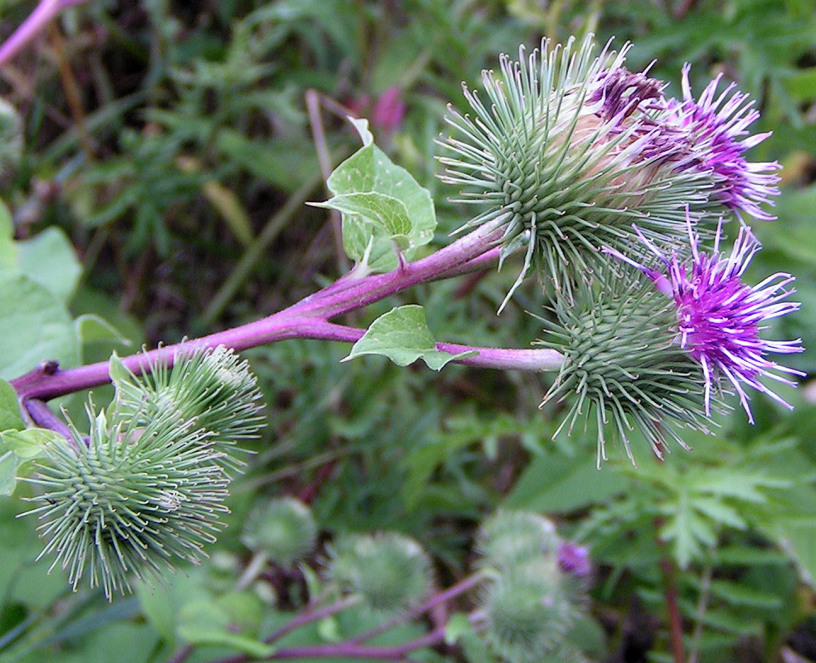
Burdock – Arctium lappa, A. minus, A. tomentosum

Parts used: root, leaf

Traditional uses: Root used in washes for boils and skin complaints. Leaf infusion used to tone stomach. Leaf poultice used for tumors and swellings and to reduce inflammation. Blood purifier, alterative, diuretic, and diaphoretic.

“Alterative, diuretic and diaphoretic. One of the best blood purifiers. In all skin diseases, it is a certain remedy and has effected a cure in many cases of eczema, either taken alone or combined with other remedies, such as Yellow Dock and Sarsaparilla.” ~Grieve MH

Used in formula for chills – “A gentleman in Cyclone, Missouri, tells me that his family made a ‘chill remedy’ that was in great demand; the exact formula was kept secret, he says, but the main ingredient was crushed burdock seeds.” ~Randolph OMF 107

“Burdock roots…boiled were given for chills.” ~Parler FBA II 1747

Beads worn as protection from witchcraft – “A basket maker at Eureka Springs, Arkansas, told me that children are best protected against witches by wearing a neck-lace of dried burdock roots, cut into small pieces and strung like beads.” ~Randolph OMF 291

 Boiled in compound drank for colds – “There used to be a plant called burdock. They’d dig that up and get the root and soak it in whiskey. Then they’d take that and put other ingredients such as nutmeg and butter and ginger in it. You’d drink that hot and go to bed of a night it’d suck that cold out.” ~Carter and Krause HRIO

Medicine for the blood of young folks – “From the weed Burdock (Arctium minus) you make a medicine for the blood of young folks. You boil the weed down and give the youngin’ a dose of 1 tablespoon before meals.” ~Parler FBA II 1357

Burdock, Witch Hazel, and Dogwood as a spring tonic – “Mix burdock roots, witch hazel bark, dogwood bark and take 1 teaspoonful before breakfast in the spring. This is called a spring tonic.” ~Parler FBA II 1369

Root chewed to purify blood – “To purify the blood chew the roots of the burdock plant.” ~Parler FBA II 1516

Root water used for boils – “To cure boils and sores that children have use Burdock roots…that have been soaked in water and drink the water.” ~Parler FBA II 1564

Roots worn against nosebleed – “A necklace of burdock roots…used to be worn to prevent nosebleeding.” ~Parler FBA III 2786

Wild cherry and burdock used for rheumatism – “Wild Cherry bark and Burdock root…boiled and mixed with whiskey is good for rheumatism.” ~Parler FBA III 2974


Carter, Kay & Bonnie Krause Home Remedies of the Illinois Ozarks (HRIO)

Grieve, Margaret A Modern Herbal (MH)

Moerman, Daniel E. Native American Ethnobotany (NAE)

Parler, Mary Celestia Folk Beliefs from Arkansas (FBA)

Randolph, Vance Ozark Magic and Folklore (OMF)

Source: Ozark Encyclopedia – B – Burdock – Mountain Man Traditional Healing

Storytime with Rachel F Hundred

Creating stories for pleasure

Sibyl Moon

Shh I'm Writing

Sylum Clan

Nothing is True. Everything is Connected.

Laura Bruno's Blog

Medical Intuition, Astrology, Soul Readings, Intuitive Coaching, Tarot, Reiki: Inspiring and Empowering Visionaries, Artists and Healers

Fire Family Conflagration

Weekly Challenge from the 118, 126, & 113

Kiayea's Corner

all things fanfic...

Crystal Dawn Books & Gifts

Crystals, and all things Magical

Starkindler's Realm

welcome to the inner workings of my mind...

The Herb Society of America Blog

Learn • Explore • Grow

Dr. Gary Samuelson

A Journey of Discovery

Kylia's World

Where Canon has No Meaning and Universes Collide

originaltempus

Just another WordPress.com site

Profilers For Christmas

The Crime Drama Advent Calendar

Entangled Wood

Just another WordPress.com site

brokenamethystwrites

Here there be Dragons

Toasterpop's Fiction

Fanfiction and original stories from Toasterpop

Breakaway Consciousness

Seeking Ideas Beyond Conventional Thought

gypsysue

Writting, Drafts, Ideas

Ellywinkle

All Things Wicked and Wonderful

Natalie J. Case

Author, Editor, Photographer, Artist

Your Stories. Your Wall.

Honoring their service and building their legacy. The official blog of the Vietnam Veterans Memorial Fund.

00Q Reverse Big Bang!

Art and Stories for all things 00Q, since 2014

The Wild Hare Project

Where the Writer Comes First.

Anthea Davis

FanFiction Author

Every Fandom Bangs

The home of the Every Fandom Bang and Reverse Bang!

Penumbria

n. pl. pe·num·brae (-br) or pe·num·bras 1. A partial shadow, as in an eclipse, between regions of complete shadow and complete illumination.

This Crooked Crown

Witchcraft for the Everyday and the Extraordinary

This is who I am...

... and this is what I like

Fanfiction Recommendations by Isabelle Disraeli

Fanfiction Recommendations ~ Slash, Femslash, & Het Fanfic Recs

Ellywinkle

EVIL AUTHOR DAY

Convivial Supper

Recipes from the Past

Kaethe Vaako's Fiction

what my demented mind comes up with

Sylum Archive

Nothing is True. Everything is Connected

Quantum Bang

The Multi-Fandom Fix-it Big Bang

by Geep 10

a place for me to share what I've written

Good Witches Homestead

Enchanted World of Magical Gardening ~ Crystals & Gemstones ~ Locally Grown Organic Herbs

tkbenjamin

m/m original fiction and fanfic for adults only

Chestnut NOLA

It's All About The Romance

Loam Ananda

Spiritual Journeys in Druidry