Harvesting Memories: Weaving Threads of Magic Between Generations

Exploring Wild Ecosystems Is Now Open For Enrollment

Greetings,

I am excited to announce that my newest online course, Exploring Wild Ecosystems, is now open for enrollment!

You can register here.

This course is designed to improve your ecological knowledge by introducing you to fascinating ecosystems — including alvars, barrens, bogs, dunes, fens, glades, savannas, vernal pools, and others!

Learning to recognize ecosystems is an essential step toward understanding how nature works.  When we pay attention to the bigger picture, we see beyond individual components.  We see connections, we see relationships, and we see where humans fit into the story. 

If you want to develop ecological literacy; if you want to be able to read landscapes more effectively; if you want to see how all the components within nature are connected, consider enrolling in Exploring Wild Ecosystems today.

Please note that Exploring Wild Ecosystems is open for one week only — from today until Monday, September 30.  After that, registration will be closed.  Upon registration, you can immediately access all course content and view the lessons at your own pace.

To learn more about the course, check out this video which gives you an overview of what you can expect.

Thanks for supporting nature education!  I hope to see you in there!

—Adam Haritan

An Embarrassing Foraging Story

Many years ago, I became obsessed with finding wild cranberries.  At the time, I had only read about wild cranberries in foraging books.  I had never seen a single cranberry in the wild.

On my quest to find wild cranberries, I somehow ended up in northern Pennsylvania.  A friend told me that a bog existed several miles north of I-80.  “You can’t miss it,” my friend said.  When I arrived at the location and stepped out of my car, all I could see was a deciduous forest.

“A bog must be in there somewhere,” I thought.  Rather than consult a map, I immediately hopped on a trail leading into the woods.

A closed-canopy forest surrounded me for many miles.  Large trees prevented sunlight from reaching the understory.  The forest exuded dark beauty, but it lacked wild cranberries.

I continued walking deeper into the forest, constantly scanning the ground for wild cranberries.  No luck.

Hours passed before a realization dawned on me.  Earlier in the day, I saw an extensive opening in the forest.  It was way off in the distance near the beginning of the trail.  Unfamiliar with bogs, I thought the opening might’ve been a field or a meadow, so I ignored it.  Several hours later, I realized my amateur mistake.  Could the opening have been a bog?

With daylight fading fast, I headed back toward the opening and eventually walked into a sphagnum-rich ecosystem bursting with wild cranberries.  “So this is a bog,” I thought to myself.  “How could I have overlooked this?”

In hindsight, it’s easy to see how I missed the bog.  I had no idea that a bog was an open habitat.  I had no idea that finding a bog in a forest could be as simple as looking for light.

Today, I see things a bit differently.  I certainly don’t consider myself to be an expert forager, but I understand the importance of developing ecological literacy — something that specialists often disregard.

To improve any outdoor skill — foraging, botanizing, birding, hunting —  it’s essential that we learn the ecosystems in which our desired organisms live.  I’m not sure why ecological thinking is undervalued today, but I decided to do something about it.

Exploring Wild Ecosystems is my newest online course designed to help you gain ecological literacy.  If you want to be able to read landscapes more effectively, consider enrolling today.  Enrollment is currently open until Monday, September 30.

To learn more, and to register, click here.

I hope to see you in there!

—Adam Haritan

Foraging The Delicious Edible Cauliflower Mushroom

Before I share a brand-new video with you, I’d like to mention that my newest online course, Exploring Wild Ecosystems, will reopen for registration on Monday, September 23.

This online course is designed to strengthen your relationship to wild places by introducing you to fascinating terrestrial and wetland ecosystems.  With a focus on the connections and communities that bind nature together, Exploring Wild Ecosystems will help you gain important ecological skills.

You can register here on Monday. 

Speaking of connections, forests are teeming with connections of all kinds.  Nothing in a forest exists in isolation.

Take the cauliflower mushroom, for instance. 

This edible mushroom grows in association with certain trees.  To find the cauliflower mushroom, it only makes sense to explore ecosystems where these trees grow.

During a recent hike, I discovered a cauliflower mushroom growing near a mature red oak.  Sensing the connection, I started checking every oak in the forest.  Within 30 minutes, I found two more cauliflower mushrooms — one of which I harvested and turned into a delicious meal.

Fortunately, I brought my camera along to document the experience.  To learn more about this lovely edible mushroom, check out the brand-new video.

Thanks for reading and watching!  If you want to develop ecological literacy and see how all the components within nature are connected, consider enrolling in Exploring Wild Ecosystems on Monday.

— Adam Haritan

A Weed Lover’s Manifesto

Why I’ll Probably Never Eat This Mushroom

“Is it edible?”

This question constantly runs through the forager’s mind.

As it turns out, the answer isn’t always a simple yes or no, particularly regarding wild mushrooms.

Some mushrooms are choice edibles.  Some mushrooms are toxic raw.  Some mushrooms are toxic no matter how thoroughly you cook them.

But there’s another category of mushrooms:  those that are no longer recommended for consumption even though field guides once listed them as edible.

Included in that latter category is a mushroom that grows in hemlock forests.  This lilac-colored mushroom causes unpleasant symptoms in many people who consume it.

But not everyone experiences unpleasant symptoms, and in some cultures, this mushroom is considered undeniably edible.

Why is this the case?  How can a mushroom poison some people and nourish others?

In this brand-new video, I share my thoughts.

Thanks for reading and watching!  Have you seen any neat mushrooms lately?

— Adam Haritan

Finding Dozens of American Chestnut Trees

I like finding all kinds of trees, but there’s one tree in particular whose presence excites me more than most.

American chestnut.

I’ll drive out of my way to find a decent-sized American chestnut.  I might even interrupt a conversation to point out American chestnut.

This behavior may seem strange to some people.  I consider it proper etiquette for anyone with a burning passion for North American trees.

I recently explored a remote forest in search of American chestnut trees.  By the end of the day, I had found dozens of American chestnuts — one of which was the largest I had ever seen.

Fortunately, I brought my camera along to document the experience.  If you’re interested in seeing several beautiful American chestnuts, check out the brand-new video!

Thanks for reading and watching.  Have you seen any American chestnuts lately?

— Adam Haritan

The Great Hemlock Decline

I can’t say I’m the biggest fan of Shakespeare, but a particular line from Hamlet has always stuck with me.

“There is nothing either good or bad, but thinking makes it so.”

These words come to mind particularly when I think about the current state of our forests. 

Understandably, people are worried about the “unprecedented changes” occurring in woodland ecosystems.  Invasive species are taking over, diseases are killing trees, and desirable organisms are failing to regenerate.

At any given moment, the state of our forests can seem rather bleak.

But when we recall the words of William Shakespeare, our perception of this matter shifts — especially when we consider something fascinating about eastern hemlock.

Many people know that an insect is currently threatening the health of eastern hemlock.  Nothing about this situation seems good until we understand a critical piece of information:  eastern hemlock is no stranger to threats. 

In a brand new video, I discuss an important event of the past that may help us better understand modern-day forests.

You can watch the video here.

Thanks for reading and watching, and thanks for your continued support!

— Adam Haritan

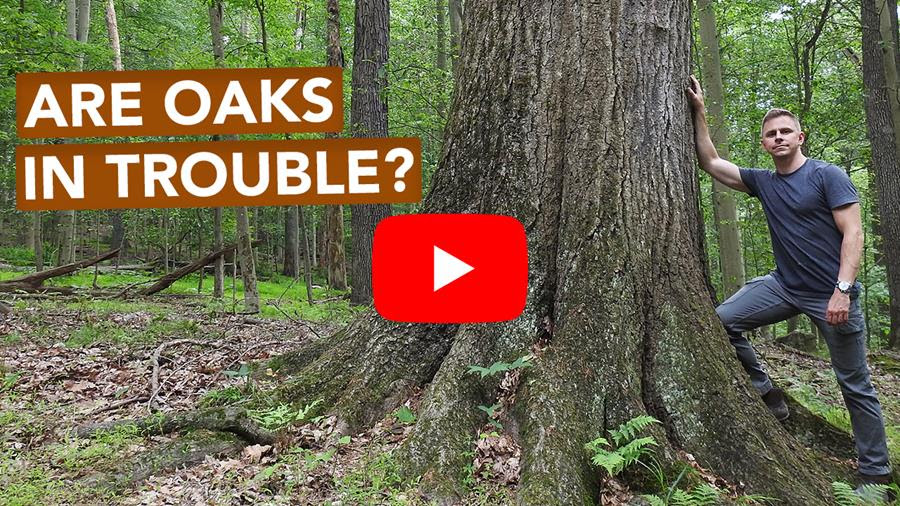
Are Oaks in Trouble?

Before I share a brand-new video with you, I’d like to remind you that enrollment for Exploring Wild Ecosystems closes on Monday, June 3.

This online course improves your knowledge of ecology by introducing you to fascinating terrestrial and wetland ecosystems.

If you want to develop ecological literacy and be able to read landscapes more effectively, consider enrolling in Exploring Wild Ecosystems today.

Speaking of reading landscapes more effectively, we can predict future ecosystems based on current observations.

Consider a mature oak forest, for example.

Looking at an oak forest today, we might hope that conditions will remain stable for many years.  Any native plant enthusiast will tell you that oak forests are repositories of biodiversity.  Without oaks, other organisms that depend on oaks suffer.

But a quick glance at mature oak forests today tells us that significant changes are occurring.  These changes, it turns out, aren’t particularly favorable to oaks.

Ecologists are worried about something that’s occurring underneath the towering oaks.  This phenomenon has been happening to oak forests for the past 100 years.  According to ecologists, it will persist without active management.

In a brand-new video, I address this important ecological issue.

You can watch the video here.

Thanks for reading and watching, and thanks for your continued support!

— Adam Haritan

I never met the man who wrote these words

“Each place is itself only, and nowhere repeated.” —Barry Lopez

I never met the man who wrote these words, but I imagine his definition of place wasn’t limited to cities, towns, and suburbs. 

As a writer of various nature-themed topics, Barry Lopez undoubtedly included tundras, rivers, canyons, forests, meadows, and deserts in his definition of place.  No two of them are alike, he wrote.  Each place has a story we can learn.

When we visit a bog and decipher its origins; when we visit a savanna and study the role of fire; when we visit a swamp and see how different it is from a marsh, we learn how remarkable each place is.

For the past 18 months, I’ve been working on a new online course designed to highlight these fascinating ecosystems.  I’m excited to announce that Exploring Wild Ecosystems will be open for registration on Monday, May 20. 

If you want to strengthen your ecological skills and improve your understanding of nature, consider enrolling in this brand-new online course.

Please note:  Exploring Wild Ecosystems will be open for a limited time.  Upon registration, you can immediately access all course content and view the lessons at your own pace.  To register, mark your calendar for Monday, May 20, and visit this link.  All additional details will be posted on Monday.

I hope to see you in there!
—Adam Haritan

P.S.  If you haven’t read any books by Barry Lopez, I encourage you to do so!