Public tour of Bruneau off-range corrals offered in June | KBOI

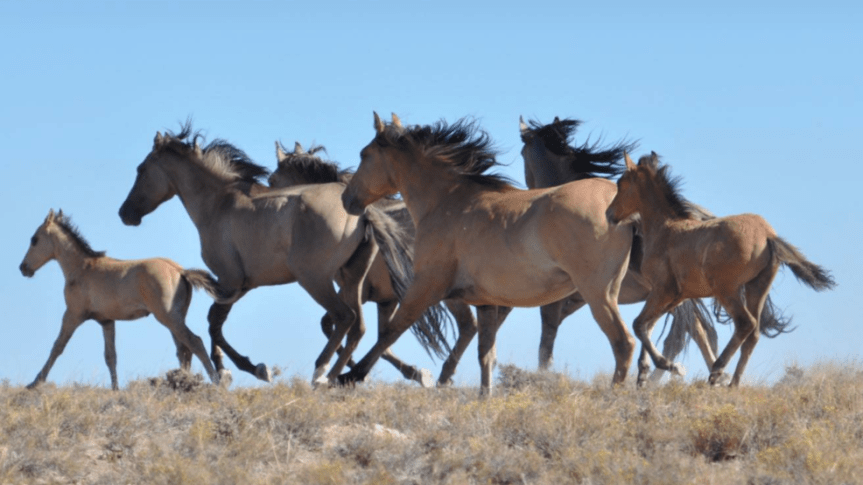
The horses receive an abundance of feed tailored to their needs each day, along with a constant supply of fresh water through automatic watering troughs.

BOISE, Idaho (KBOI) – The BLM in Idaho will offer a public tour of the Bruneau off-range corrals on Thursday, June 8.

Two public tours will be offered — the first will begin at 10 am and the second will begin at 1 pm.

Each tour will last about two hours and can accommodate up to 20 people.

Spaces will be filled on a first-come, first-served basis.

The public can sign up to attend and receive driving directions to the facility by calling BLM at (208) 329-4534.

Please RSVP for one of the two tours by June 5.

Details about the tour:

• Tours start promptly at the scheduled time, so be at the facility a few minutes early or the wagon may leave and we cannot come back to pick you up

• Bring comfortable shoes and clothes. Hats and sunscreen recommended

• Bring your own water

• Cameras and video cameras welcome

• Visitors will not be able to walk around the facility unaccompanied. They must travel with the group in the wagon at all times

The Bruneau off-range corrals are located at 28536 Jacks Creek Road, and are privately owned and operated.

About a 75-minute drive southeast of Boise, the facility provides care for over 1600 wild horses.

The facility encompasses 80 acres containing 39 large holding pens, each pen measuring 70,000 square feet that will safely hold approximately 100 horses.

The horses receive an abundance of feed tailored to their needs each day, along with a constant supply of fresh water through automatic watering troughs.

Free choice mineral block supplements are also provided to the animals in each pen.

A veterinarian routinely inspects the horses and provides necessary medical care as needed.

The BLM strives to place horses removed from the range into good, private homes.

Source: Public tour of Bruneau off-range corrals offered in June | KBOI

The vision of technocracy ~ Jon Rappoport

by Jon Rappoport

“Well, boys, we’ve got this strange thing called THE INDIVIDUAL. Could somebody tell me what he is? He’s not conforming to our algorithms. He’s all over the place. And while we’re at it, what the hell is this IMAGINATION? It keeps slipping out of our grasp, it doesn’t fit the plan…”

PART ONE

—Technocrats say they want to wipe out poverty, war, and inequality. But in order to achieve these lofty goals (or pretend to), they need to re-program humans—

Technocracy is the basic agenda and plan for ruling global society from above, so we need to understand it from several angles.

Consider a group of enthusiastic forward-looking engineers in the early 20th century. They work for a company that has a contract to manufacture a locomotive.

This is a highly complex piece of equipment.

On one level, workers are required to make the components to spec. Then they must put them all together. These tasks are formidable.

On another level, various departments of the company must coordinate their efforts. This is also viewed as a technological job. Organizing is considered a technology.

When the locomotive is finished and delivered, and when it runs on its tracks and pulls a train, a great and inspiring victory is won.

And then…the engineers begin to think about the implications. Suppose the locomotive was society itself? Suppose society was the finished product? Couldn’t society be put together in a coordinated fashion? And couldn’t the “technology of organizing things” be utilized for the job?

Why bother with endlessly arguing and lying politicians? Why should they be in charge? Isn’t that an obvious losing proposition? Of course it is.

Engineers could lay out and build a future society that would benefit all people. Disease and poverty could be wiped out. Eliminating them would be part of the blueprint.

This “insight” hit engineers and technicians like a ton of bricks. Of course! All societies had been failures for the same reason: the wrong people were in charge.

Armed with this new understanding, engineers of every stripe began to see what was needed. A revolution in thinking about societal organization. Science was the new king. And science would rule.

Of course, for an engineered world to work, certain decisions would have to be made about the role of the individual. Every individual. You couldn’t have an air-tight plan if every human were free to pursue his own objectives. Too many variables. Too much confusion. Too much conflict. Well, that problem could be solved. The individual’s actions would be tailored to fit the coordinated operations of the planned society.

The individual would be “one of the components of the locomotive.” His life would be connected to other lives to produce an exemplary shape.

Yes, this could imply a few problems, but those problems could be worked out. They would have to be worked out, because the overriding goal was the forming of a world organization. What would you do if one bolt (an individual human) in one wheel of a locomotive was the wrong size? You would go back and correct the error. You would re-make the bolt.

Among technocrats, the overall vision superseded the glaring need to “remake” individuals who would fit in. It was perfectly all right to re-program the individual.

Other people entered the game. High-echelon Globalists saw technocracy as a system they could use to control the population.

Essentially, an already-misguided vision of a future technocratic utopia was hijacked. Something bad was made much worse.

In a nutshell, this is the history of technocracy.

A locomotive is a society? No. That was the first fatally flawed idea. Everything that followed was increasingly bizarre.

Unfortunately, many people in our world believe in Globalism, if you could call a partial vague view a legitimate belief. They dreamily float on all the propaganda cover stories—greatest good for the greatest number of people; no more poverty; equality of sharing; reducing the carbon footprint; a green economy; “sustainable development”; international cooperation; engineering production and consumption of goods and services for the betterment of everyone; and all of this delivered from a central platform of altruistic guidance.

If you track down the specifics that sit under these cover stories, you discover a warped system of planning that expresses control over the global population.

The collective utopia turns out to be a sham.

Waking up is hard to do? Breaking up is hard to do? They must be done.

A workable technological fix is a very nice achievement when the project is a machine. But transferring that glow of victory to the whole of society is an illusion. Anything that calls itself education would tackle the illusion as the first order of business.

Engineering society requires engineering humans.

That is the fatal flaw.

It’s called mind control.

PART TWO

Continue reading “The vision of technocracy ~ Jon Rappoport”

The Devil is in the Details as BLM again removes thirsty wild horses due to “emergency” in the Antelope Valley HMA in Nevada | Straight from the Horse’s Heart

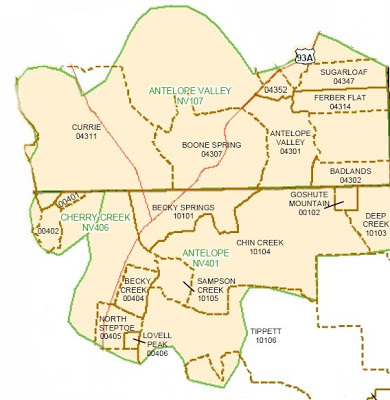
Antelope Valley grazing allotments (2008)

Before you read BLM’s version of this “emergency” below, be sure to read Cindy MacDonald’s 2008 article “The Devil’s in the Details” on American Herds Blogspot.  We have to wonder how many acres of public lands that the “private land owner” (mentioned by the BLM below) uses to graze their own private livestock, since it seems the entire HMA is used for livestock grazing.  The BLM seems to be giving the public the same ongoing bullshit (literally). –  Debbie

“traditionally the wild horses spend the summers in Antelope then migrate to Antelope Valley for the winter ~ except the Nevada Department of Transportation (NDOT) strung up a new fence up on Hwy 93 effectively trapping the horses and in one area, completely cut them off from any water at all.

Speaking to BLMs Kyle Hansen in the Ely Field Office, Mr. Hansen explained range conditions were so bad due to drought that it “looked like an atom bomb went off” and provided photos as evidence of the dust bowl conditions the wild horses would be forced to try and survive in over the winter in if they were not immediately removed.

He also stated compounding the problem was a local rancher who had allowed wild horses to drink water from his property for years but finally “had enough”,  fenced the area and now the horses that remained would probably die of thirst.” – Cindy MacDonald

Source:  BLM

2017 Antelope Valley Emergency Wild Horse Gather

Progress as of Monday, May 22, 2017

Purpose of Gather:

The Bureau of Land Management (BLM) Elko District, Wells Field Office, in coordination with the BLM Ely District will begin a wild horse water bait trap gather to remove wild horses on private lands near the Boone Spring Area. The gather is taking place due to a request from a private land owner to remove the excess wild horses.

Details of Gather:

BLM plans to humanely gather approximately 60 wild horses through the use of a water bait trap.

Public Observation: 

Because of the nature of the water gather method, wild horses are reluctant to approach the trap site when there is too much activity. In addition, the gather operations are being conducted on private land. Therefore, only essential gather operation personnel will be allowed at the gather site during operations.

Adoption Information: 

The wild horses removed from the range will be transported to the Indian Lakes Off-Range Corral in Fallon, NV to be prepared for the BLM’s Adoption Program. Learn more about how to adopt a wild horse or burro from the BLM.

Background:

This gather will attempt to remove excess wild horses from private land near the Boone Spring area of the Antelope Valley Herd Management Area. The private land owner has requested removal of the horses. The Antelope Valley HMA has an Appropriate Management Level (AML) of 155-259 adult wild horses. As of March 1, 2016, the BLM estimated the population at 1,013 wild horses (not including foals born this year). The BLM Wells Field Office has determined that even though there has been above average amounts of precipitation this winter and spring, there are still no known water sources in the area for wild horses to obtain water later this spring and summer. Learn more about the Antelope Valley HMA.

er later this spring and summer. Learn more about the Antelope Valley HMA.

Source: The Devil is in the Details as BLM again removes thirsty wild horses due to “emergency” in the Antelope Valley HMA in Nevada | Straight from the Horse’s Heart

Wild horse trained as therapy horse in running for international award | Straight from the Horse’s Heart

SOURCE:  postregister.com

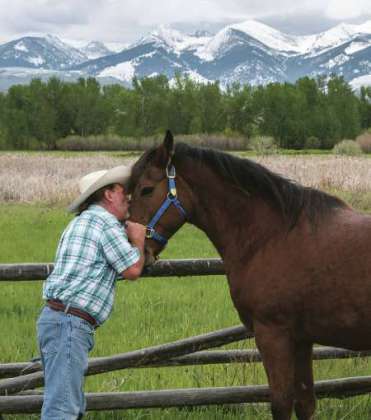
Steve Drippon displays affection to Rooster; loving a special horse. Jerry Slagle / for the Post Register

SALMON — A horse named Rooster is an equine without equal if you ask the volunteers and staff at Whitewater Therapeutic and Recreational Riding Association.

The Salmon-based association offers horseback experiences to riders of all ages whose challenges can include everything from a physical disability to a psychological trauma.

In the decades since the accredited nonprofit was founded, dozens of horses have been either selected or donated for the purpose of providing equine therapy but few have gained the profile and elicited the adoration of Rooster.

Whitewater workers say Rooster has all the mannerisms of a courtly gentleman even though he once was a wild horse from the Challis area before adoption through a U.S. Bureau of Land Management program.

“I’ve dealt with a lot of good horses but Rooster has a special place in my heart,” said Joyce Scott, Whitewater’s executive director. “He’s an elegant and powerful horse who personifies peace and calmness. Everyone who rides him falls a little bit in love with him.”

In a first for Whitewater, Rooster has been nominated in the regional round of a contest for therapy horse of the year with the Professional Association of Therapeutic Horsemanship International.

Read the rest of this article HERE.

Source: Wild horse trained as therapy horse in running for international award | Straight from the Horse’s Heart

Kentucky lawyer leases land to protect horses, plans sanctuary in coal country – Tuesday’s Horse

JACKSON, Ky. (Source Article) —  Curtis Bostic is an attorney, a politician and — for a few weeks in 2016 — an accused horse thief.

On a cold December day in the rugged hilltops of Breathitt County, Bostic was trying to rescue some horses he said had been abandoned and were malnourished. But he was arrested by a sheriff’s deputy, who said the horses belonged to two men who follow the local custom of setting them free in the winter to wander the wilderness of the county’s abandoned coal fields.

The charges were later dismissed after the sheriff’s department said it didn’t have probable cause to make the arrest. But during the night Bostic spent in jail, he came up with an idea: A few weeks later, he leased the land where he had been arrested. He sent a letter to the two men who had pressed charges against him. Now, they were the trespassers, and Bostic ordered them to come get their horses before he put them up for adoption.

“I can’t change the full county. But I can say you are not going to come to my property and drop your horse off in the cold winter,” Bostic said.

Bostic wants to turn 4,000 acres of former coal mines into a horse sanctuary. It’s the latest idea on how to tackle the growing horse population in the mountains of Kentucky, a state known more for pampered thoroughbreds on pristine farms than bony horses roaming free.

Bostic’s descriptions of thousands of horses suffering at the hands of cruel owners have offended the locals who say he doesn’t understand their culture.

Clifton Hudson, 30, owns five horses that he sets free to wander land he doesn’t own near his home in Breathitt County. He said he provides 600 pounds of salt each month for the horses. He stopped hauling hay bales to the land because the horses were not eating them, a sign he says means they have plenty of grass to graze. The locals often bring their children to the mountains on the weekends to pet and feed the horses.

“It’s just really it’s more of a pastime than anything else with the people of the county,” Hudson said. “So far the only person really had an issue with it has been Mr. Bostic.”

Wild horses have been a familiar sight in the Kentucky mountains for decades. But following the Great Recession and the thousands of jobs lost because of the disappearing coal industry, more horses have been set loose. Read the full story »

Source: WCPO Cincinnati. Report originally filed by the Associated Press. Written by Adam Beam . Featured image by Jervis Pics.

Source: Kentucky lawyer leases land to protect horses, plans sanctuary in coal country – Tuesday’s Horse

Would the government let Jesus cure cancer? « Jon Rappoport’s Blog

By Jon Rappoport

As I’ve been telling you for years, it’s easy to keep the public on your side if you regularly tout medical “breakthroughs” in the press. The latest innovation. The promise of a cure around the corner. The maybe-could-be discovery that will change the course of disease treatment forever.

In this case, a start-up called Tilos has one of those, for cancer. They say it’s an antibody their researchers came across while looking for a cure for MS. They stumbled on to it by accident. Aha.

Somehow, this antibody helps the immune system to recognize and wipe out cancer cells. It produces “a memory” in immune-system cells, and they are ready to go to war when cancer arrives. Or something. It’s hard to say.

The people at Tilos are, naturally, very enthusiastic.

So forthwith, I give you an assignment. Keep track of stories about this amazing antibody as time passes, and see whether it ever a) becomes a real cancer treatment, and b) does any good. Or c) disappears down the memory hole, never to be heard from again. I’m betting on c. Why? Because I’ve watched a number of these flashes dim out quickly and recede into nowhere land. And because, in this case, the company is very far from being able to fashion the antibody into a ground-level treatment. Of course, it’s possible that, on the basis of the recent gaudy announcement, Tilos could pick up some investor funding, but funding isn’t a disease treatment the last time I looked.

On the other hand, if a non-pharmaceutical company or researcher actually makes a promising discovery in cancer treatment (read about the troubles of Dr. Stan Burzynski, Dr. Willam Koch, Royal Rife, etc.), all hell breaks loose. The press immediately pounces on the researcher as if he’s working on an H-bomb in his basement. He must be an outright quack and charlatan, “because they all are.”

Corporate drug outfit=potential breakthrough.

Independent non-pharmaceutical researcher=Dr. Nazi.

Good press vs. bad press comes down to: how much can you pay; who do you know; how much advertising can you afford to buy; what official expert can you bring on board to vouch for you; is your product a drug rather than a detested natural non-patentable substance; can you do officially recognized clinical trials; are you connected with a favored group (university, research foundation, federal facility, pharma lab) who can obtain publication in a well-known medical journal.

Or are you a dreaded INDEPENDENT?

In the 1990s, I watched a federal trial in a Los Angeles courtroom. The defendant was charged with selling medical drugs without a license to practice medicine.

The defendant was prepared to argue that a) the substance he was selling was naturally produced in the body and b) it was effective.

The prosecution moved to exclude such testimony, on the grounds that it was irrelevant.

The judge agreed. Therefore, the trial was nasty, brutish, and short. The defendant was found guilty and sentenced to prison for several years.

This is how the federal bureaucracy operates. “Do you have a government-issued license to heal? No? You’re a criminal.”

I believe that if Jesus of Nazareth were walking the Earth today, in the United States, he would be arrested on the same grounds.

This would be particularly so if he were curing cancer.

Imagine this extreme case: in a stadium packed with 50,000 people who have been diagnosed with cancer, Jesus of Nazareth waves his hand and cures all of them in a few seconds.

Now he is threatening the profits of many companies, to say nothing of the power of the government, which backs the chemo-radiation-surgery monopoly to the hilt.

So he is arrested. He is put on trial. He opts to defend himself without an attorney. He tells the court that curing cancer is no crime.

The prosecuting attorney objects. “Your Honor,” he says, “whether or not this man has cured cancer is beside the point. He has no license to practice medicine. That is why we are here today. We are simply establishing that a) he was practicing medicine and b) he has no government-issued license. That is the scope of this proceeding.”

The judge agrees. The verdict is issued. Guilty.

Of course, on another front, the major media, who depend for their existence on pharmaceutical advertising, take the ball and run with it. The networks and major newspapers seek out “experts,” who emphatically state that what Jesus of Nazareth “performed” in the stadium was mere hypnotism. It was all a placebo effect. Whatever sudden “remissions” may have occurred are just temporary. Tragically, the cancers will return.

Not only that, these 50,000 people have effectively been sidetracked and diverted from seeking “real care from real doctors.” With chemo, with radiation, with surgery, they would have stood a chance of surviving and living long normal lives.

Other media pundits send up this flag: “Many of those present in the stadium were bitter clingers to their religion. They refuse to accept science. They are living in the past. They favor superstition over real medical care. In fact, they are threatening the whole basis of healthcare, since other confused and deluded Americans may now turn away from doctors and seek snake-oil salesmen and preachers for healing.”

From the highest perches of political power in this country, the word quietly goes out to the media: don’t follow up on those people who were in the stadium; don’t try to track them; don’t compile statistics on their survival rates; move on to other stories (distractions); let this whole madness die down.

But among the citizenry, an awareness spreads: the government is controlling healing through its issuance of licenses. That’s how the government is essentially protecting one form of “healing” and enabling it to become an all-encompassing cartel.

What would be the alternative or the adjunct to licenses?

Contracts.

Contracts are agreements entered into by consenting adults, who assume responsibility for the outcomes. In the case of healing, a contract would specify that people have a right to be wrong.

Let’s say two consenting adults, Jim and Frank, agree to allow Frank to treat Jim for his arthritis with water from a well on Frank’s land.

The two men acknowledge that no liability will be attached to the outcome. In other words, whether Jim get better or gets worse, no one is going file a suit. No one is going to go to the government for redress of wrongs.

The well water may be wonderful or it may be completely useless. Both men understand and acknowledge that. But they assert a right to try the treatment, because they are free.

Immediately people say, “This is ridiculous. Water can’t cure arthritis. Frank is cheating Jim. Jim is a victim. He needs to see a doctor. He needs to go on arthritis drugs.”

No, Jim doesn’t have to do anything. He is free.

To put it another way, Jim has the right to be right or wrong. It’s his decision, which is beyond the scope of any authority.

If government tries to remove that right from all of us, it is essentially saying it knows what is correct, it knows what is true, it knows what we need and require, and it’s going to give it to us even if it has to shove it down our throats. Does that sound like freedom to you?

If Jesus of Nazareth lived in the United States today, and if he went around curing cancer, he would be arrested. He wouldn’t be charged with blasphemy or treason. He would be charged with something much simpler and more mundane: practicing medicine without a license.

And he would be convicted and sentenced.

Because then and now, the government, in its throne of corruption, wants to protect its proprietary and illegal interests.

Source: Would the government let Jesus cure cancer? « Jon Rappoport’s Blog
Something Old, something New | Straight from the Horse’s Heart

From Rewilding Europe

“At the rate that the BLM is decimating our last remaining free roaming herds of wild horses and burros we may find ourselves taking notes on how the Europeans are bring wild equines back to their rightful ranges.” ~ R.T.


Looking to boost the benefical impact of free-roaming wild horses in the Coa Valley, Associação Transumância e Natureza (ATN) starts the Zebro Project.

Raising the grazing

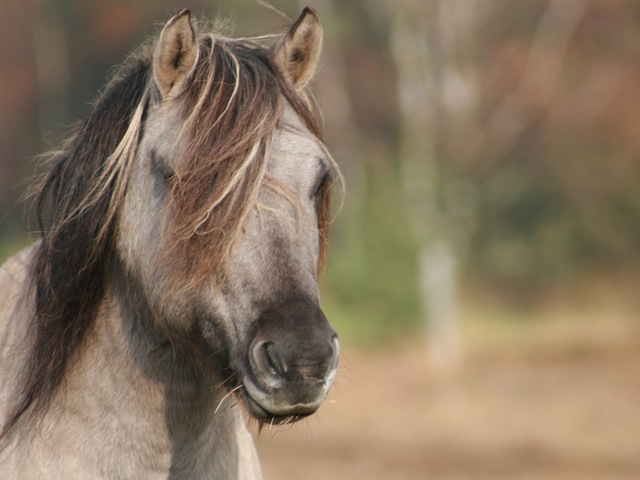
Free living Sorraia horses in Faia Brava nature reserve, Western Iberia rewilding area, Portugal. Juan Carlos Múñoz / Rewilding Europe

Rewilding Europe wants Europe’s native herbivores to return in significant, naturally balanced numbers to the lands where they once belonged. With domesticated livestock numbers on the decline in many European countries due to land abandonment, such herbivores can play a vital grazing role, opening up landscapes and enhancing biodiversity.

To this effect, Rewilding Europe now supports natural grazing in 16 different pilot areas across nine countries. In Faia Brava, one of our largest natural grazing pilots located in northern Portugal’s Middle Côa Valley, wild Garrano horses are the herbivores now reshaping the landscape in a way that benefits a wide range of local flora and fauna.

Thanks to the efforts of Associação Transumância e Natureza (ATN), our partner in the Western Iberia rewilding area, another site in the Middle Côa Valley will soon benefit from wild equine grazing too. The Portuguese NGO has this year started the so-called Zebro Project, carefully selecting and cross-breeding Sorraia horses to maximise their wild characteristics. These animals will eventually be released as a herd at a site close to (but separate from) Faia Brava.

“Our eventual aim is to recreate wild, free-roaming horses that will replace those that have been lost from the Iberian ecosystem,” explains Pedro Prata, the Western Iberia rewilding area team leader and ATN’s executive coordinator.

“We want rustic equine and cattle breeds to take back their ancestral grazing role in the Middle Côa Valley in a natural and sustained way,” continues the Portuguese. “These herbivores can reduce weed density, create clearings, promote seed dispersal and favour populations of wild scavengers and predators.”

An equine experiment

The rewilding of horses began back in 2005, when ATN introduced five Garrano horses into Faia Brava. Further introductions since then have seen the number of free-roaming horses in the reserve rise to an estimated 60 to 70 animals. These are now part of Rewilding Europe’s European Wildlife Bank.

Like the Garrano, the Sorraia is an ancient horse breed that was once found wild across the Iberian Peninsula, but whose populations decreased dramatically under pressure from hunting and the rise of domestic livestock and mechanised agriculture. The Sorraia has a particularly interesting history, having once been called the “zebro” or “zebra” in Portuguese, due to its striped markings.

Hardy native animals that lived off uncultivated lands and salt marshes in Iberian river valleys, zebros were occasionally captured by farmers for agricultural work. A small population of Sorraia horses, thought to be direct descendants of the zebro, was discovered in the 1920s. It is from this stock that the lineage has been preserved, although the breed remains rare.

In its attempt to recreate the zebro, or a genetic approximation of this ancient wild equine, the challenge is to identify the right horses for breeding.

“It is difficult to find modern-day horses with the genotype, phenotype and behaviour of ancient breeds,” explains Pedro Prata. “We are looking  for animals with more rusticity, which are strong enough to survive in adverse conditions, resist pathogens and diseases, and generally adapt to wild conditions. These are now quite scarce.”

Since the beginning of 2017, ATN has acquired several stallions and mares displaying the Sorraia phenotype. The plan is to acquire further animals this year, using part of the ATN membership fee for acquisition, transport and habitat management, and to launch a new line of merchandising to celebrate the project.

While the European wild horse is officially extinct, its genome is not lost and still exists across several types of old horse – from Exmoor ponies in the United Kingdom to the Hucul ponies of Eastern Europe’s Carpathian Mountains. These primitive animals still boast many of the characteristics and genetics of their ancestors, making them particularly suitable for rewilding and the grazing of wild habitats.

Rewilding Europe’s brochure on rewilding horses can be viewed here.

https://www.rewildingeurope.com/news/something-old-something-new/

Source: Something Old, something New | Straight from the Horse’s Heart

Girl Who Couldn’t Speak Uttered First Words to Donkey: ‘I Love You’ | Straight from the Horse’s Heart

by Leigh Scheps of Inside Edition

Feel Good Sunday

The first thing Amber Austwick ever said out loud was “I love you” to a donkey. The 6-year-old is a twin who was born prematurely at 26 weeks. She suffered from complications at birth that forced doctors to perform a tracheotomy. Amber never said a word until she met her four-legged friend at this donkey sanctuary. Her time there is therapeutic, and since her introduction to the donkey, Amber’s become a lot more confident.

Source: Girl Who Couldn’t Speak Uttered First Words to Donkey: ‘I Love You’ | Straight from the Horse’s Heart

A Mustang murder mystery in northern Nevada – Tuesday’s Horse

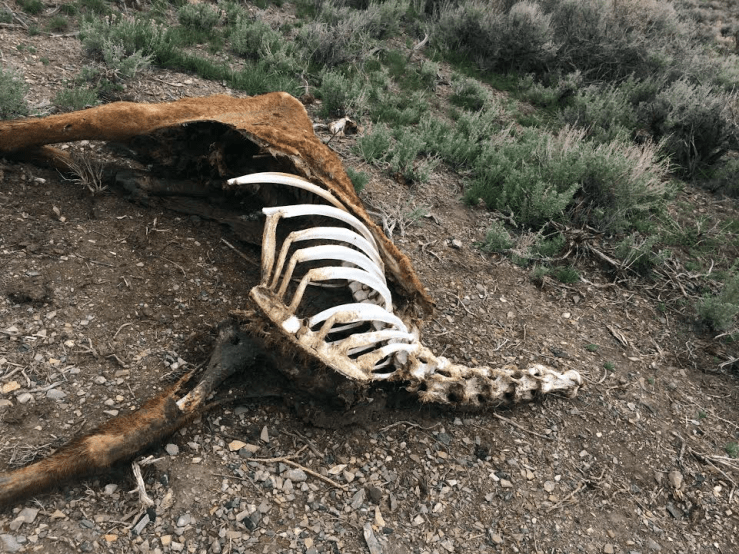
WILD HORSES NEVADA (Warning: Graphic Image) — On May 10, 2017, Tuesday’s Horse received an email from the Professor and Chair of the Geological and Environmental Sciences Department of a California University stating he was leading a student field trip in Northumberland Canyon south of Austin, Nevada the previous weekend and they discovered the following:

We came across six horse carcasses, all missing their heads. This was very disturbing to the students and I am trying to figure out what happened. Was there planned culling of wild horses? Why would the heads be removed?

The headless remains of a Mustang found in northern Nevada taken by a student while on a geological field trip in the Austin area. May 2017.

The Professor had not been able to reach the Bureau of Land Management (BLM) so reached out to us for assistance.

At long last I tracked down the right BLM office thanks to the coordinates the Professor provided.

After several email exchanges and a few phone calls with a BLM agent in that office, we made little progress figuring out what had happened to these Mustangs or why.

Here is a summary of those exchanges:

• It is highly likely these Mustangs were shot and killed. Although rare in the area, other wild horses have been shot and killed and left on the side of the road in much the same manner.

• The heads were either removed by trophy hunters or for use in local rituals. It is also possible someone discovered the carcasses and removed the skulls much later and cleaned them to use as relics. The heads are not missing because of scavengers.

• Due to the vastness and remoteness of the area it is close to impossible to find any witnesses. Investigators often have to rely on hearsay such as “someone bragging” about the kill.

My BLM contact agreed to talk with other field agents plus get in touch with the U.S. Forestry Service for their input.

A few days later my BLM contact reconnected to tell me that wild horses killed in suspicious circumstances do fall under the jurisdiction of the U.S. Forestry Service and they would determine whether or not to investigate.

An agent of the U.S. Forestry Service contacted me with the following:

• They had discovered carcasses like these the previous year, perhaps even as early as Spring 2016, and they were “probably the same ones”.

• Due to the condition of the carcasses and the amount of time elapsed they have little to nothing to go on and did not feel it warranted the time and expense of an investigation. No one offered an explanation why they took no action at the time they first found the dead horses other than “it’s too hard”.

• They have come across dead Mustangs before where they suspected foul play and occasionally seen heads removed like this.

• The missing heads were not the result of scavenging.

It was never quite clear to me when coming across something like this, how they determine when it is worth investigating and when it is not.

The BLM and USFS were not the only ones. I also contacted a noted investigative reporter who also declined.

So Now What?

The agents I dealt with were responsive. Perhaps it ended the way it did with me at the direction of higher ups.

Yet wait a minute. Any way you look at it, murdering a Mustang is a federal crime. Murdering six. Leaving the six dead horses at the side of the same road. Removing their heads. Surely that warrants at least some looking into.

Something must be done or these murders, even if only committed sporadically, will continue.

I offered a reward for the arrest and conviction of these Mustang Murderers. The response?

I appreciate knowing about the reward and I will see how that might be promoted.

End of story? I thought so until a few minutes ago. We’ll let you know. Stay tuned.

Source: A Mustang murder mystery in northern Nevada – Tuesday’s Horse

Special Report: KPVI Investigates Cyanide traps and the USDA | Straight from the Horse’s Heart

story by as broadcast/published on KPVI.com

“This is not the first time the USDA had a run in with the Gate City…”

It’s almost been two months since a Pocatello family lost their dog and almost their son to a cyanide trap set 300 yards behind their house. Since then the USDA says they’ve taken all the traps out of the Gem state. But that hasn’t changed anything to investigators who say they were never notified of the deadly chemical, meant to kill predators, planted around Bannock County.

The incident began in the Buckskin area back in March. Canyon Mansfield says, “I panicked and sprinted down to get my mom.” The 14-year-old and his dog Kasey were 300 yards away from their house. He describes, “Suddenly there’s like a pop and then orange gas spews out.” The Mansfield family dog died and they almost lost their son as well. Theresa Mansfield, Canyon’s mother says, “We didn’t want to believe it was from Cyanide poisoning, but deep down it scared the crap out of us.”

The Cyanide trap was placed on BLM land with no warnings in sight. Investigators found a second trap not far from the first. Bannock County Sheriff Lorin Nielsen says, “We’re not Alaska. There are wilderness places where people go. I don’t care what the purpose is. If it’s endangering public it shouldn’t be there.”

Since the death of Kasey there’s been a worldwide outcry. The Bannock County’s Sheriff’s office has launched their investigation. The city has also stepped in. In March Pocatello’s Mayor Brian Blad wrote a letter to the USDA asking them to stop manufacturing Cyanide Traps, or M-44’s, in the city. Since then the agency reached out to the mayor. He says he toured the facility, learned about their safety precautions and products “They’re going to continue to do their practice until congress acts,” said Blad.

This is not the first time the USDA had a run in with the Gate City. Seven years ago the agency was responsible for illegally setting “Quick Kill” traps, meant for Rock chucks within city limits. Obtained by KPVI in an incident report by Pocatello’s animal control, an elderly woman called them after finding a cat trapped alive in a “quick kill” trap or Conibear trap in her backyard. She admitted to the city she requested the traps from the USDA. She says at least three cats had been killed before and they were removed by the local USDA representative Todd Sullivan. Sullivan is the same man involved in the Mansfield investigation. In 2010 the charges against Sullivan were dismissed by a federal judge.

The city and USDA came to an agreement that they would not place Conibear traps in Pocatello without notifying the city first. The USDA declined to speak to KPVI on camera, but gave us a written statement answering our questions. They told us, the incident involving the Mansfield Dog is still under investigation and can’t comment. But claimed they had “107 M-44’s set on 16 properties in the state and all have been removed.” Our request to tour the Pocatello manufacturing facility was denied, they say because of security concerns.

The agency tells us the Pocatello location has been manufacturing M-44 deceives since 1969. And also handles, “Gas cartridges for fumigating rodent burrows, rodent grain baits…, predator lures, and repackages other products such as order control products and animal immobilization drugs.”

The sheriff’s investigation is now left in the hands of county prosecutors to find if any state laws were violated. In the meantime, the sheriff says this to residents, “We now have to be aware of our surroundings. If there is something that is out there that is not part of… leave it alone, leave it alone,” Nielsen said.

Source: Special Report: KPVI Investigates Cyanide traps and the USDA | Straight from the Horse’s Heart