GRAPE HYACINTH – Good Witches Homestead

Source: GRAPE HYACINTH – Good Witches Homestead

COMMON NAME:  grape hyacinth
GENUS:  Muscari
SPECIES, HYBRIDS, CULTIVARS,
M. armeniacum ‘Early Giant’-blue
M.a. ‘Blue Spike’-up to 12-inch blossoms.
M. a. ‘White Beauty’-white.
M. botryoides-pure white.
FAMILY:  Liliaceae
BLOOMS:  early spring
TYPE:  perennial
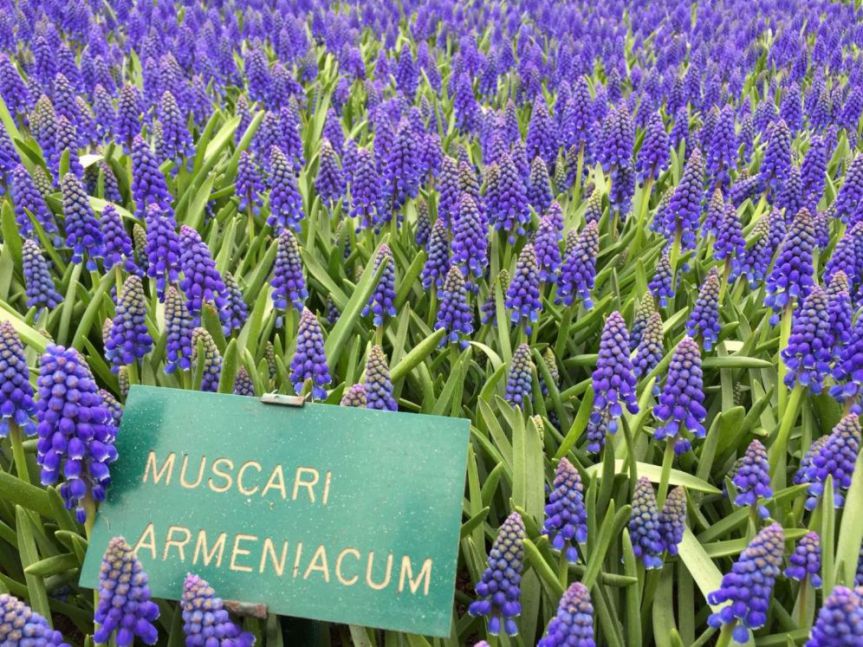
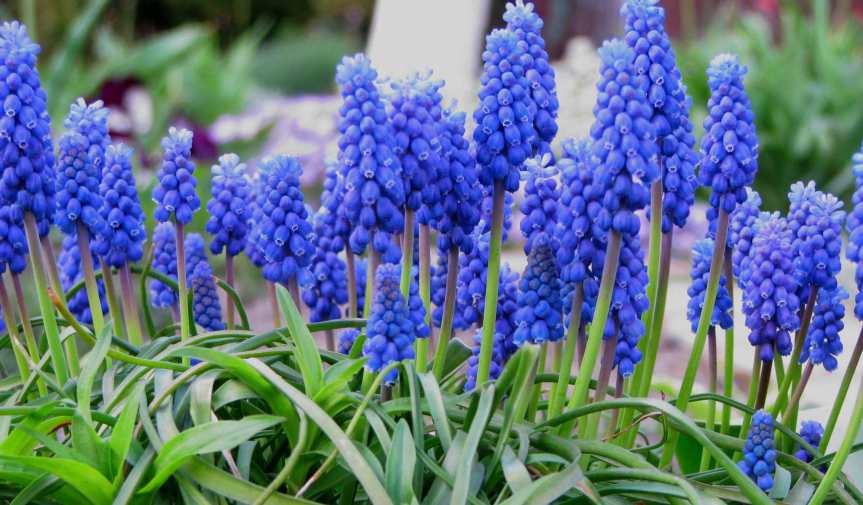
DESCRIPTION:  Most grape hyacinths grow 6 to 8 inches tall and produce spikes full of round, almost closed blossoms. They spread about 3 inches and have foliage that is long, narrow and grasslike.
CULTIVATION:  Grape hyacinths come from small bulbs, which should be planted 3 inches deep and 3 inches apart. For best effect, the bulbs should be planted in quantities. They are particularly effective under trees or shrubs. Grape hyacinth does equally well in full sun or partial shade. The leaves should be left to die back naturally after the flowers bloom.

Some species of the genus Muscari have a sweet, musky scent, and this is the reason for the name, for Muscari is from the Greek word moschos, or “musk.” Many gardeners originally grew the plant for its scent and not its beauty. The species name botryoides is also from Greek and means “a bunch of grapes.” This, along with the plant’s physical resemblance to the hyacinth, gives us the common name, grape hyacinth.
M. botryoides is also called the starch hyacinth, for it smells like starch.

Muscari_armeniacum2

Grape hyacinths are native to southern Europe, Northern Africa, and western Asia. The small bulbs have been used extensively in cooking. It has been suggested that boiled in vinegar {to reduce the bitterness}, the bulbs of M. comosa and M. atlanticum can be made into very tasty pickles. Other species are so bitter that they have earned the name Bulbus vomitorium. The first-century Greek physician Discorides wrote, “of this wort it is said that it was produced out of dragon’s blood, on top of mountains, in thick forests.”


HYACINTH – Good Witches Homestead

Source: HYACINTH – Good Witches Homestead

COMMON NAME:  hyacinth
GENUS:  Hyacinthus
SPECIES, HYBRIDS, CULTIVARS,
H. Orientalis ‘Amsterdam’-bright red to pink.
H. o. ‘Anne Marie’-light pink.
H. o. ‘Carnegie’-creamy white.
H. o. ‘Delft Blue’-blue
FAMILY:  Liliaceae
BLOOMS:  early spring
TYPE:  perennial
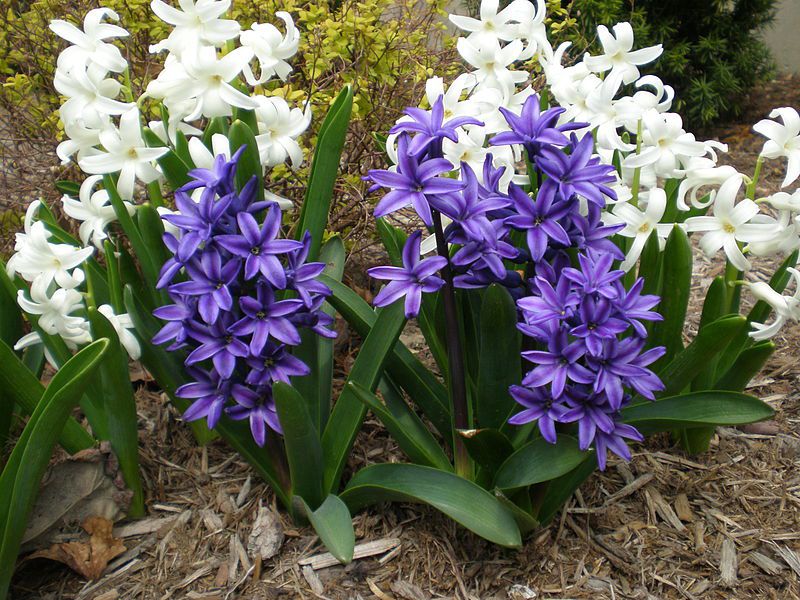
DESCRIPTION:  Hyacinths are widely used as a spring bulb. The top flower size is 7 to 7 1/2 inches in circumference. The flower spike is composed of neatly rounded mounds of small blossoms. Flowers are available in pink, white, cream, reddish pink, blue, yellow, and violet blue.
CULTIVATION:  Good drainage is a must for this plant because the bulbs rot easily if water stands on them. Bulbs should be planted in the fall, 6 inches deep, 6 to 8 inches apart. Mulch them in the fall to protect the tender spring growth from frost damage. Bulbs should be planted in an area that bets full sun or partial shade.

According to mythology, hyacinths originated because of the wrath of Zephyr, a god of the wind. Apollo, king of all the gods, fell in love with Hyacinthus, son of the king of Sparta. One day as Apollo and Hyacinthus were playing quoits {a game similar to today’s horseshoes}, Apollo threw the metal ring and Zephyr, jealous and enraged, caused the wind to make the metal ring hit Hyacinthus and kill him. Broken hearted, Apollo created the hyacinth flower out of the blood of his friend. Some even say that the petals look like the Greek syllables ai ai, meaning “woe.”
The Victorian language of flowers hyacinth means sport or play, and the blue hyacinth is a symbol of sincerity.
The Greeks dedicated this plant to Ceres, the goddess of agriculture. In ancient Sparta, annual Hyacinthian feasts were held. A Greek girl wore a crown made from hyacinth blossoms when she assisted at her brother’s wedding.
Greeks used concoctions made from the plants to treat dysentery and the bite of poisonous spiders. Such a concoction was also reputed to have the power to prevent a young boy’s voice from changing during puberty, making it very popular with singing masters of the time.
Hyacinths were first found growing in Asia Minor, as is suggested by the species name orientalis. Cultivated in Turkey and Persia, hyacinths were brought to England from Persia in 1561.

hycinths

The following story is told of how hyacinths got to Holland: Trading ships carrying crates of these exotic and expensive bulbs wrecked off the coast of Holland. The crates broke open, and the waves washed the bulbs ashore, where they rooted and produces beautiful flowers. However hyacinths got to them, the Dutch lent their magical hands to the plant, and by 1724 more than 2,000 varieties of hyacinth were found in Europe. Though interest in the bulbs never quite reached the level that tulips created, the price of hyacinth bulbs was quite high and competition for new varieties fierce.


Scilla – Good Witches Homestead

Source: Scilla – Good Witches Homestead

COMMON NAME:  scilla
GENUS:  Scilla
SPECIES:  S. sibirica
FAMILY:  Liliaceae
BLOOMS:  early spring
TYPE:  perennial
DESCRIPTION: Scilla has short {4 to 6 inches} spikes of bright blue or white flowers. The foliage is attractive and the growing habit neat, making it an excellent plant to use as a border or edging plant. It also lends itself well to an informal setting and looks very good naturalized under trees or shrubs.
CULTIVATION:  The small bulbs should be planted 4 inches deep in the early fall. Give them an open, sunny spot, and they will multiply rapidly.

Ten species of Scilla are native to Europe, and several of these have been cultivated for many centuries. Some records indicate that at least five species of Scilla were being cultivated as early as 1597.
The genus name means “I injure” and refers to the poisonous properties of the plant. Red scilla was even used as rat poison.
Scilla is often called squill. The bulbs of both the red and white squills were made into a concoction called a “syrup of squills.” This supposedly had medicinal properties, and a drug found in the bulbs was used as a component in heart tonics. The physiological effects of eating this bulb were thought to be similar to those of inhaling tobacco, for both acts on the nervous system. Roman statesmen suggested Scilla was a diuretic. It was also used to treat asthma and dropsy.
The Welsh name for this plant is cuckoo’s boot. S. bifolia was described by John Gerard, author of a sixteenth-century herbal, as “small blew flowers consisting of sixe little leaves spread abrode like a star. The seed is contained in small round bullets.”

During Elizabethian times, the starch used for stiffening collars was made from the bulbs of this plant.


The Victorian Language of Flowers – Good Witches Homestead

The language of flowers was quite suited to Victorian England, for it allowed for communication between lovers without the knowledge of ever-present chaperones and parents. Messages that would be a social impossibility if spoken could be conveyed by sending certain types of flowers. How these flowers were sent was of great importance as well, for this was also part of the message. If the blossom was presented upright, it carried a positive thought. If the flower came upside down, it might mean quite the opposite. If the giver intended the message to refer to himself, he would incline the flower to the left. If the message referred to the recipient, it would be inclined toward the right. If flowers were used to answer a question and were handed over with the right hand it meant “yes’;  with the left hand, the answer was “no.” Other conditions of the plant were important as well. For example, if a boy sent a girl a rosebud with the leaves and thorns still on it, it meant ” I fear, but I hope.” If the rosebud was returned upside down, it meant, “you must neither fear nor hope.” If the rosebud was returned with the thorns removed, the message was “you have everything to hope for.” If the thorns were left but the leaves removed, the message was “you have everything to fear.” If the young lady kept the rosebud and placed it in her hair, it meant “caution.” If she placed it over her heart, the message was clearly “love.” The Victorians took the language of flowers a bit further and actually began attributing personalities to various flowers, as Thomas Hood exemplified:
The cowslip is a country wench,
The violet is a nun;-
But I will woo the dainty rose
The queen of everyone.

During the last part of the nineteenth century, several floral dictionaries were published. Among these was The Poetical Language of Flowers {1847}, The Language and Sentiments of Flowers {1857}, The Floral Telegraph {1874}, and Kate Greenway’s The Language of Flowers, first published in 1884 and republished in 1978. Because more than one dictionary existed, the possibility of error was great. One of these floral misinterpretations was famous by Louisa Anne Twamley in her poem “Carnations and Cavaliers.” The poem describes how a knight gave his lady a pink rose, meaning our love is perfect happiness. His lady either did not know about the language of flowers or did not care, for she sent back to him a carnation, which means refusal. The result was the tragedy: the lovers died for each other’s love.

It was during the Victorian period that tussie-mussies became popular. A  tussie-mussie is a small bouquet of fresh or dried flowers, usually surrounded by lacy doilies and satin ribbons. Tussie-mussies were popular, in part, for the very practical purpose of warding off bad smells and disease. Some of the most useful flowers for this purpose included lavender, rosemary, and thyme. Tussie-mussies made marvelous gifts then, and they still do. They are easy to make, and, accompanied by a card explaining the meanings of the flowers used, make a uniquely personal present. Tussie-mussies can be made from either fresh or dried flower. Choose a relatively large, perfect blossom for the center flower. A perfectly formed rose blossom is wonderful for this. Surround this with smaller blossoms and ferns and put the stems through a doily or starched lace. If using fresh flowers, wrap the stems with damp paper towels and then cover them with plastic wrap or foil held in place with florist tape. If using dried flowers, simply wrap the stems with florist tape. Fresh flowers that are good to use in tussie-mussies include rose, baby’s breath, cornflower, phlox, aster, and carnation. Suitable dried flowers include strawflower, statice, honesty, ageratum, and sedum.

Flowers and Their Meaning … […]


Read the entire article at its Source: The Victorian Language of Flowers – Good Witches Homestead

What Was The Floral Calendar? – Good Witches Homestead

Calendars have existed for thousands of years in various forms. The Chinese, Japanese, Romans, Egyptians, and Hopi and Navajo Indians, among countless others, developed calendars.
Each of these calendars was different, but each was an accurate means of keeping track of the seasons and the passage of time. Because calendars were so closely tied with nature, it followed logically that different months should be associated with particular plants and flowers.
The Chinese, especially, used plants to keep track of time. According to Chinese folklore, two trees grew at the Court of Yao. One tree put forth one leaf every day for fifteen days as the moon waxed, and then it shed one leaf every day for fifteen days, as the moon waned. In this way, they measured the months. On the other side of the garden was a tree that put forth leaves every month for six months, then shed leaves every month for six months. In this way, they kept up with the passage of the years. A Chinese legend dating back to the seventh century A.D. says that Ho Hsien-Ku, daughter of a humble shopkeeper, ate the peach of immortality given to her by Canopus, god of longevity. She then became one of the eight Taoist immortals and decreed that honor should be paid to a particular flower each month of the year. This formed the basis of the Chinese floral calendar. Through the centuries, other civilizations adopted the custom of using a floral calendar.
floral clockPrimary among these were the Japanese and English. The English took the art of keeping time with plants to an extreme with their experiments with a floral clock. A pet project of Carl Linnaeus, the floral clock, or watch of Flora, never worked quite as well as he has wished. […]


Rest of the post at its Source: What Was The Floral Calendar? – Good Witches Homestead

   NorthWest Herb Symposium        “Botanicals at the Beach” – NorthWest Herb Symposium: “Botanicals at the Beach”

Source:    NorthWest Herb Symposium “Botanicals at the Beach” – NorthWest Herb Symposium: “Botanicals at the Beach”

Source:    NorthWest Herb Symposium        “Botanicals at the Beach” – NorthWest Herb Symposium: “Botanicals at the Beach” – Crooked Bear Creek Organic Herbs

Medicinal and Herbal Wildflowers – Good Witches Homestead

From the beginning of human history, man has considered plants “useful.” Of course, the most obvious use is as a food source, but in all cultures, plants have also figured prominently as medicines. From prehistoric rites to modern medicine, plants have been shown to possess curative properties. Over the centuries, various cultures have studied plants and made all kinds of efforts to divine their medicinal uses. Some experiments have proved disastrous, even fatal. Others seemed miraculous. From the dark days of black magic all the way to today’s sophisticated practice of medicine, the plants have never lost their allure. In fact, today we live in a time of renewed interest in herbal remedies. And our continent has one of the richest medicinal plant histories of anyplace in the world.

Below, you’ll find just a few of the wildflowers that man has used from ancient times forward to aid in his health and provide cures for his illnesses and diseases. It is provided as a source of information and not intended for prescriptive purposes. In fact, many of the same plants used as medicinals are also poisonous if not used properly. (Wildflowers mentioned that pose a serious danger are noted.)

Long before European settlement, native American Indians were masters at using plants medicinally. And today’s modern medicine proves many of their ancient cures. Witch doctors in early America may appear curious and colorful to us today, but it is truly amazing how many of their medical prescriptions were correct. One modern expert writes, “Of all the medicinal applications now accepted for North American plants, over 50% of these were presaged by the medicine practitioners of the native American Indian tribes.”

Meanwhile in Europe, during the Middle Ages, the Herbalists worked to advance the plant studies that had been going on there since the time of the ancient Greeks. During the Middle Ages, with more superstition than science, the herbalists offered their cures, sometimes with disastrous consequences.

The famous Doctrine of Signatures. One of the more bizarre pseudo-sciences that flowered during the early medieval period was medical treatment based on plant structure and appearance. Certain herbalists decided that one could prescribe an herbal cure or treatment based on a relationship between plant parts and body parts. This wild course of the study noted, for example, that parts of the plant Hepatica could be made into a curative concoction for liver ailments. Why? Because the plant has three-lobed leaves that reminded the herbalists of the human liver. Today, Hepatica , the beautiful early spring wildflower we enjoy still carries the name based on its connection to the human liver, yet it’s been shown to have no medicinal value. (Hepatica is the Latin word for “liver”, as is hepatitis.) Most prescriptions based on the Doctrine of Signatures probably only made people sick, since ingesting various non-food plants is usually upsetting. However, others, when poisonous plants were unknowingly used, were fatal.

As medical science progressed and Europeans settled North America, the advancing European medical knowledge of plants was combined with the traditions of Native American medicine. This led to an active exportation of plants from North America, as the settlers learned the new plants’ “secrets” from the Indians.

But this was only the beginning. As modern medicine evolved, plant values were studied and tested, and the results have been amazing.

Today, flowering plants provide almost 25% of the basic ingredients for our modern drugs. This little-known fact makes the study of medicinal plants even more interesting today than ever before. North America has tens of thousands of native plants that have yet to be studied. As Lady Bird Johnson has said, “Surely there are others like digitalis waiting out there.” She was referring to the famous English medicinal wildflower commonly known as Wild Foxglove, but botanically, “Digitalis purpurea.” This is the now-famous plant that is widely used today to treat heart disease. The medicine derived from this plant is usually called, simply “Digitalis”, and has saved untold lives worldwide through its modern applications.

How at least one medicinal plant was “discovered.” The story of the Foxglove is a classic. In 1775, an English physician and botanist named William Withering were asked to treat a patient suffering from dropsy, a broad term that at the time meant “fluid retention.” He had heard of an “old woman in Shropshire” who knew a secret cure which included the foxglove plant. Dr. Withering, after using the secret remedy, which was a concoction of over twenty herbs, found it amazingly successful, but also quickly perceived that only one plant in the mix was working the cure. The whole stew was said to be a diuretic, but Dr. Withering knew that the major cause of dropsy was congestive heart failure. He also knew that foxglove, with its powerful toxic properties in the proper quantity, could strengthen cardiac contraction and enable the heart to pump more efficiently, delivering blood to the rest of the body. Ten years later, Dr. Withering published “10 years of clinical data on patients treated with foxglove.” The rest, as they say, literally, is history–medical history.

From an old woman’s secret cure, through the careful work of an early physician, we have a “wonder drug” direct from a plant that is used today to treat almost every kind of heart disease.

The cure for spider bite becomes environmental monitor. Other stories in herbal and medicinal plants take various paths, as the scientific use of a species is accidentally discovered. Spiderwort, Tradescantia virginiana, a common North American native wildflower with three-petaled purple flowers, was once considered a cure for the bites of spiders, but during modern times has offered scientists other advantages. Botanically, the plant is unusual, being a historic link between the sedges (grass-like wetland plants) and lilies. Moreover, the plant has relatively large chromosomes, making it useful for lab studies in cytology (the structure of cells).

Modern scientific studies of Spiderwort recently rendered an unexpected discovery. Attentive botanists noticed that the plant is extremely sensitive to pollution and radiation which cause its blossoms to change color from blue to pink in a very short period of time! What happens is that the number of cells mutating when in contact with severe pollutants, correlates directly to the level of pollution. So this plant is now used as an inexpensive, but a very accurate device for testing pollution. Where dangerous pollution is expected, spiderworts are planted, and their flower color is closely monitored for changes.

Of course, man cannot exist without plants (since they provide the very oxygen we breathe), so it is no wonder that this interdependence has produced a very long and fascinating history which continues today.

Here are a few examples of various wildflowers and how they’ve been used over the centuries for herbal and medicinal purposes. Plus a few that are stars of the very active boom today in herbal remedies and supplements.  […]

Rest of the article at its Source: Medicinal and Herbal Wildflowers – Good Witches Homestead

The Natural Health Benefits of Gentian Root – Good Witches Homestead

Gentian, one of the “bitter” herbs, has been used by herbalists for over 2,000 years to help stimulate liver function. It was named as a tribute to Gentius, an Illyrian king who was believed to have discovered that the herb had tonic properties. He used the herb for treating wounds and as a natural antidote for various types of poisons. Traditional folk healers believed that gentian root could improve the digestive process by stimulating the flow of saliva, bile, and stomach acids if you took the herb before your meal. During the Middle Ages, it was used as an antidote to certain poisons.

Today, it is used specifically to protect the liver, stimulate its function, help regenerate its cells, and increase the flow of bile. It is also known to inhibit the development of viruses that affect the liver. This should come as no surprise for herbalists, as gentian has been used for centuries to stimulate appetite, improve overall digestion, and treat a host of gastrointestinal issues such as diarrhea, heartburn, stomach aches, and vomiting.

Gentian is also helpful in improving the overall health of the kidneys. It helps with the detoxification process by aiding in the elimination of harmful substances from the body. The root itself also has antiseptic properties which help with the removal of harmful microorganisms that can be found in the digestive system. In fact, the herb has even been used to help eliminate parasitic worms in the intestines. […]

Read the entire article at the Source: The Natural Health Benefits of Gentian Root – Good Witches Homestead

~ March Magick ~ – Ye Olde Dark Arts

Activities and Rituals: consecration of tools, earth blessings, grounding work, planting/sowing, rejuvenation spells, spring cleaning

Animals:  chicks, hares, lambs, rabbits

Birds: swallows

Colors: dark green, light pastel colors

Deities: Artemis, Astarte, Hecate, Isis, The Morrigan

Flowers: crocus, daffodil, honeysuckle, iris, lilly […]

Read the entire post at the Source: ~ March Magick ~ – Ye Olde Dark Arts

Milk Thistle Uses to Improve Your Health – Crooked Bear Creek Organic Herbs

Milk thistle (Silybum marianum), a member of the Asteraceae family, is a therapeutic herb with a 2000-year history of use in traditional Chinese, European, and Ayurvedic medicine. Originally native to Southern Europe, Asia Minor, and the Mediterranean region, the plant now grows wild throughout the world. In addition to being one of the most commonly used supplements for supporting liver health, milk thistle also offers specialized nutrition for the cardiovascular system, prostate, and gallbladder. High-quality, organic milk thistle is inexpensive, readily available, and should be on your list. Let’s take a look at seven exciting ways milk thistle supports good health.

Source: Milk Thistle Uses to Improve Your Health – Crooked Bear Creek Organic Herbs